
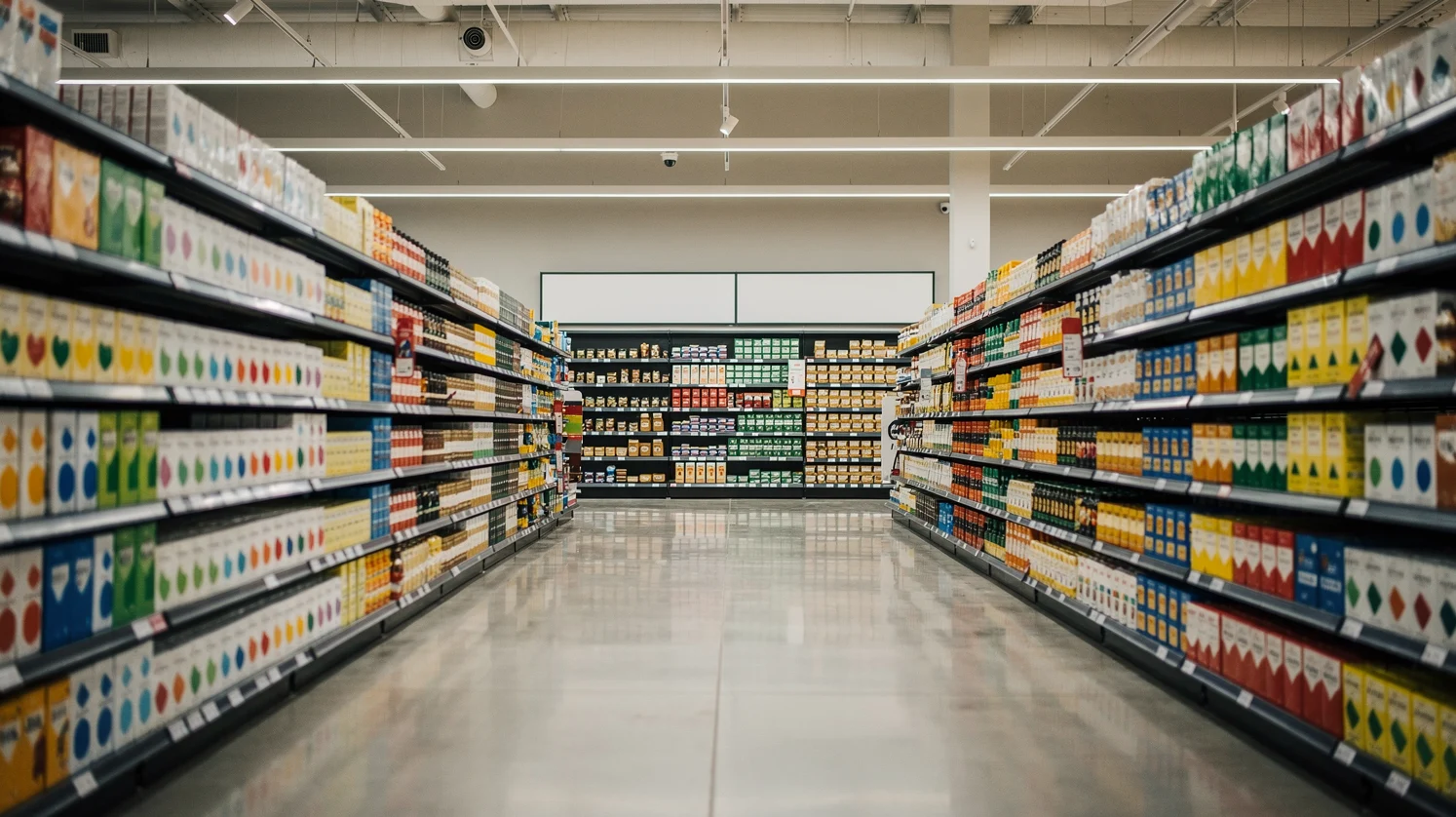
The discount grocery model that Aldi and Lidl perfected in Europe is reshaping the US supermarket aisle. In a market long dominated by Walmart, Kroger and regional chains, the two German banners have grown by stripping out everything that does not lower the price on the shelf. The result is a playbook that traditional grocers, private label brands and even e-commerce operators are studying closely as food inflation, tariff pressure and channel shifts squeeze margins across the industry.
In short
- Hard discount, not deep discount. Aldi and Lidl run on roughly 1,500 to 2,000 SKUs, against 30,000+ at a typical US supermarket, which collapses cost of goods, labor and shrink.
- Private label is the engine. About 90 percent of sales at both chains come from exclusive brands, which fund lower prices without sacrificing margin.
- Small boxes, dense networks. Stores average 15,000 to 22,000 square feet, far smaller than a Kroger or Publix, which lowers rent, payroll and energy per dollar of sales.
- Operations are the moat. Quarter-bound carts, multi-barcoded packaging, conveyor checkouts and a four-person store team are unglamorous but compound into a 20 to 30 percent price gap.
- The US fight is on. Aldi is racing toward 2,400 stores, Lidl is past 180 and expanding the East Coast, and incumbents are responding with their own private label and small-format pushes.
This is the supporting deep dive on Aldi and Lidl for our retail cluster. For the full landscape of department stores, grocers and experiential retail, see our pillar guide on the state of retail, which sets the wider context for everything below.
Why the aldi lidl playbook matters in 2026
For most of the past decade, US grocery share gains came from two directions: Walmart at the value end and Whole Foods style premium at the top. The middle, where regional chains and conventional supermarkets sit, kept losing ground. The shift accelerated after 2022 as food at home inflation outpaced wage growth in many markets, and shoppers started reorganizing their weekly trip around a hard discounter for staples and a conventional store for fill in.
Aldi and Lidl are the chief beneficiaries. Circana and NielsenIQ data have shown hard discount as one of the fastest growing US grocery channels, with Aldi alone adding more than 100 stores per year and Lidl pushing into Pennsylvania, the Carolinas and the New York metro. The pressure is no longer hypothetical. Kroger has expanded its Smart Way opening price line, Walmart has rebuilt Great Value packaging, and Target leans on Good and Gather and Favorite Day to defend share.
Understanding the aldi lidl playbook is therefore not optional for anyone working in food retail, consumer packaged goods, payments, last mile or shopper marketing. It is the operating system that increasingly sets the price ceiling for the category.
Key terms and definitions
Before unpacking the model, it helps to lock down the vocabulary. The discount channel uses several terms that look interchangeable but mean different things in practice.
| Term | What it means | Why it matters |
|---|---|---|
| Hard discounter | Limited assortment, mostly private label, no frills format with low operating costs | Defines the Aldi and Lidl class, distinct from “value” or “deep discount” promo retailers |
| SKU rationalization | Carrying one or two options per need rather than 10 or 20 | Cuts purchasing cost, shelf labor and out of stocks |
| Private label | Products sold under the retailer’s own brand | Higher gross margin and full control of cost, recipe and packaging |
| Treasure hunt aisle | Rotating, non food assortment refreshed weekly | Drives trip frequency and basket size on top of grocery staples |
| Quarter cart | Shopping cart unlocked by a coin deposit | Eliminates cart wrangler labor without losing carts to the parking lot |
| Conveyor checkout | Long belt, two scan positions, customer bags after paying | Doubles items per minute per cashier compared with a standard US lane |
The aldi lidl playbook is the combination of all of these moves, not any single one. Competitors that copy the small box without copying the SKU discipline tend to fail. Competitors that copy the private label push without copying the labor model see margin but not price leadership.
How the playbook actually works in practice
The model is best understood as a chain of decisions, each one designed to remove cost without removing what shoppers actually want. To see how that interacts with the rest of the food system, our companion piece on grocery private label winning shelf space explains how the same logic is now bleeding into Kroger, Walmart and Target.
1. Curate the assortment hard
A typical Kroger carries roughly 30,000 to 40,000 SKUs. Aldi runs about 1,400, Lidl about 2,000 to 3,500 depending on store size. The cuts are deliberate. One brand of ketchup, two pasta shapes, a handful of cereals. Each remaining SKU sells dramatically more units, which earns deeper buying terms, denser pallet flow and lower handling cost per unit.
2. Lean on private label
About 90 percent of Aldi and Lidl sales come from their own brands. Aldi’s Simply Nature, Specially Selected and Never Any program, plus Lidl’s Preferred Selection and Deluxe, give the chains a controlled portfolio they can reformulate, repackage and reprice without negotiating with a national brand. National brand placements exist mainly for traffic anchors like Coca Cola and a few category landmarks.
3. Engineer the box for labor
Stores are small (15,000 to 22,000 square feet), shelves are stocked from shipper cases that double as display units, and most stores run with a team of four to seven people on shift. Cashiers scan from a seated position, push items down a conveyor, and customers bag at a counter behind the lane. The combined effect is roughly half the labor hours per dollar of sales versus a conventional supermarket.
4. Standardize the network
Almost every Aldi and Lidl looks the same. That sameness is a cost lever. Construction, refrigeration spec, planogram and POS are repeatable, so new store opening cost is predictable and operating training is short. Standardization also feeds back into the supply chain because every store takes the same pallet of the same SKU, which keeps the distribution centers running on rhythm rather than custom orders.
5. Refresh the non food aisle
Aldi Finds and Lidl Surprises are the treasure hunt aisles. Each week a fresh assortment of seasonal goods (garden tools in spring, air fryers in fall, ski gear in winter) lands in the middle of the store. Margins on non food are higher than on grocery, and the rotation gives shoppers a reason to come back even when the grocery basket would otherwise pause.
Common mistakes when copying the playbook
Plenty of US grocers have tried to import elements of the discount model. The failures tend to follow a pattern.
- Cutting SKUs without rebuilding the supply chain. A smaller assortment only pays off if buying terms, DC slotting and merchandising are rebuilt around it. Cutting in half but keeping the same vendor list typically leaves cost untouched.
- Adding private label without the formula control. Slapping a store brand on an existing supplier’s product without controlling spec leaves the retailer with weaker margins than Aldi or Lidl, even at lower retail prices.
- Keeping the conventional labor model. A small box that still needs a baker, a deli clerk, a floral team and three cashiers does not lower payroll per square foot enough to fund a price gap.
- Promotion dependence. Conventional grocers run weekly circulars and digital coupons. Aldi and Lidl run on everyday low price with very little promotion. Trying to bolt EDLP onto a promo culture tends to confuse shoppers and store teams.
- Ignoring perishables quality. Discount shoppers will tolerate fewer options but not worse food. Both chains invest heavily in fresh produce, meat and bakery quality, which is what stops the trade off from feeling like a downgrade.
The flip side is also true. Retailers that get the playbook right (Trader Joe’s is the cleanest US example, though it sits in a slightly different positioning) see the same flywheel: high private label share, tight assortment, distinctive own brand storytelling and a labor model designed around a small box.
Examples from US retail and e-commerce
The aldi lidl playbook is no longer a European curiosity. Several US retailers and channels are now applying parts of it. To get the full picture of how these moves connect to broader industry trends, our overview of the retail industry explained traces the underlying structural shifts.
Kroger Smart Way and the opening price line
Kroger relaunched Smart Way as its opening price tier, replacing the older Heritage Farm and P$ST lines. The strategy explicitly references the discount channel: a curated value range across the most price sensitive categories, designed to keep trips inside Kroger rather than splitting them with Aldi.
Walmart Great Value reboot
Great Value has been rebuilt with cleaner packaging, broader fresh coverage and a sharper price gap to national brands. Walmart is also expanding bettergoods, its premium private label, to give shoppers a private label ladder rather than a single value tier.
Target’s grocery push
Target leans on Good and Gather (the everyday line) and Favorite Day (snacks and desserts) to defend its grocery basket against Aldi in the same trade areas. The chain is also using small format urban stores to compete on convenience where Aldi cannot easily place a full box.
Costco and the warehouse channel
Costco is not a hard discounter, but it shares two of the playbook’s load bearing ideas: a tight SKU count, around 4,000, and a dominant private label, Kirkland Signature. The membership model funds the rest of the structure and shows that limited assortment is not unique to Aldi and Lidl.
E-commerce and direct to consumer
Online, Brandless attempted a private label first, flat price model and failed, mostly because it lacked the physical density and freight efficiency that anchor the discount model. Amazon‘s own brands, including 365 by Whole Foods, Amazon Basics and Solimo, are a closer fit and have grown into a meaningful share of the consumables basket on Amazon.com.
Tools, partners and vendors worth knowing
For retailers, consultants and brand teams working on a discount style program, a handful of vendors and data sources keep coming up in the playbook. They are worth bookmarking even if you do not currently sell to or compete with Aldi and Lidl.
| Category | Examples | Why it shows up |
|---|---|---|
| Market data | Circana, NielsenIQ, Numerator | Track share, basket cross shop and private label penetration by chain |
| Private label co-manufacturers | TreeHouse Foods, Hearthside, Utz, Post | Supply many of the own brand SKUs on US discount shelves |
| Retail technology | Relex, Blue Yonder, RetailNext | Forecasting, replenishment and store traffic analytics tuned for small box, high velocity |
| Payments | Adyen, Fiserv, Toast for non grocery | Lower cost rails, contactless, tap to pay rollout that fits a fast checkout model |
| Last mile | Instacart, DoorDash, Shipt | Aldi and Lidl both lean on third party marketplaces rather than building bespoke delivery |
| Public data | US Census Bureau retail trade | Authoritative channel level grocery and food at home sales |
On the delivery side specifically, our analysis of grocery delivery economics looks at why neither Aldi nor Lidl have rushed to build first party last mile, and why marketplace partnerships have so far been the rational choice for hard discount.
How Aldi and Lidl source product differently
One of the least visible parts of the aldi lidl playbook is sourcing. Conventional US grocers work with national brand suppliers on a deal cycle: weekly trade promotions, slotting fees, off invoice allowances and category captain arrangements. The discount model breaks that cycle by making the retailer the brand. Sourcing teams talk directly with manufacturers about a finished product spec (ingredients, pack size, label, price), and the supplier wins the business with the lowest landed cost at that spec.
For US co-manufacturers, this is a double edged opportunity. The volumes are huge, and the contracts can fill a plant for the year. The catch is that the retailer owns the brand equity, so a supplier who builds a Simply Nature line for Aldi cannot pivot that capacity easily if the contract is lost. That dynamic forces co-manufacturers to be unusually efficient and unusually flexible, which is part of what props up the price gap.
It also explains why some categories never make it into the discount channel in a serious way. Fresh seafood, premium spirits, regional craft beer and high turnover impulse confectionery all need either local sourcing, complex licensing or relationship driven distribution that does not map cleanly onto a centralized own brand sourcing engine. Both Aldi and Lidl quietly carry national brands or limited regional SKUs in those pockets, and that is fine; the rest of the store carries the model.
The shopper data the playbook does not need
A third quiet feature of the aldi lidl playbook is what it ignores. Conventional US grocers have spent the past 20 years building loyalty programs, app installs, personalized offers and clean room data partnerships with CPG brands. Aldi and Lidl have done relatively little of that. Aldi launched a US digital coupon feature only recently, and Lidl’s app focuses on the weekly ad and store locator rather than 1:1 targeting.
The reason is structural. Personalized offers only matter when there is a wide assortment, promotional pricing on national brands and a margin pool to fund discounts. A discount chain with everyday low price on private label has none of those ingredients. The shopper data the playbook does need (store level forecasts, fresh waste, traffic flow) sits inside the operations stack, and both chains invest heavily there.
This is a useful reframe for retailers who feel pressure to copy the discount price gap while also running a sophisticated loyalty program. The two strategies are not incompatible, but the data stack that serves a hard discount model is very different from the data stack that serves a personalized supermarket.
What the next five years look like
The aldi lidl playbook is mature in Europe but still relatively young in the United States. A few directions are worth watching closely between now and 2030.
- Store count. Aldi has signaled a path toward 2,400+ US stores, including conversions of Winn-Dixie and Harveys boxes acquired from Southeastern Grocers. Lidl is expanding more slowly but pushing along the East Coast and into new urban markets.
- Private label premiumization. Both chains are stretching their own brands upward with Specially Selected and Deluxe ranges, organic Simply Nature lines and clean label commitments. The opening price tier is no longer the only story.
- Tech inside the small box. Self checkout, electronic shelf labels and computer vision for shrink are arriving in Aldi and Lidl stores. The labor model is the moat, but the moat is being widened with technology rather than narrowed.
- E-commerce integration. Marketplace listings on Instacart, DoorDash and Shipt are now standard, and both chains have built out their own digital coupon and weekly ad apps. Pure direct to consumer remains unlikely; the economics of a $30 average basket do not support owned last mile.
- Regulatory and tariff exposure. Both retailers rely on imported private label sourcing for many categories. Tariff regimes and supply chain shifts will test how much of the price gap is structural versus sourcing dependent.
For incumbents, the strategic question is not whether to compete with hard discount but where. Defending the full basket on price is rarely viable. Defending fresh, prepared meals, pharmacy, fuel rewards and digital convenience is. The retailers that will keep their share are the ones that read the aldi lidl playbook honestly, copy what fits and double down on what only a full service grocer can do.
Zooming back out, the discount story is one chapter of a wider restructuring covered end to end in our pillar on the state of retail, alongside department stores, mall anchors and experiential formats. The common thread is that operating discipline beats merchandising flair when consumer wallets get tight, and right now Aldi and Lidl are the cleanest expression of that idea on US soil.
How brand and CPG teams should respond
If you sell branded packaged goods into US grocery, the rise of Aldi and Lidl forces a real choice. The first option is to chase listings inside the discount channel, which usually means accepting tighter buying terms, simpler packaging and significantly higher volume commitments. The second option is to lean harder into the categories and channels where national brand equity still pays off: premium tier, innovation led launches, regional or DTC plays and partnerships with retailers that need national brand traffic anchors.
The wrong move is the middle path: a mid tier national brand sold at slight premium to private label, in cluttered packaging, with weak ad support. That is exactly the position the discount channel was built to attack, and the evidence from the past decade is that those brands lose share year after year. Categories like canned soup, paper goods and pasta sauce have already gone through this compression, and others (frozen meals, condiments, snacks) are in the middle of it now.
For CPG strategy teams, three diagnostic questions are worth running on each brand in the portfolio.
- Can the brand defend a price premium of 15 to 25 percent over private label? If not, the premium has to come down or the brand needs a real innovation refresh.
- Is the packaging working harder than the private label equivalent? Many private label launches from Aldi, Lidl and Trader Joe’s now win design awards. National brands sitting next to them with 2015 era packaging look outdated.
- Where is the brand’s media doing work that private label cannot? National TV, household name endorsements, sports sponsorship and creator partnerships are leverage points private label rarely matches.
The brands that come out of this period strongest will be the ones that pick their fights carefully. Trying to be everywhere, at every price point, in every channel is exactly the strategy the discount playbook is designed to dismantle.
FAQ
Are Aldi and Lidl owned by the same company?
No. They are separate companies headquartered in Germany. Aldi itself is split into Aldi Nord and Aldi Sud, which operate independently. In the United States, the Aldi banner is run by Aldi Sud, while Trader Joe’s is owned by Aldi Nord. Lidl is part of the Schwarz Group, which also owns the Kaufland hypermarket chain in Europe.
Why are Aldi and Lidl prices so much lower than other US grocers?
The price gap comes from a stack of operational choices: a small SKU count, around 90 percent private label, small store boxes, low headcount per store, conveyor checkouts and standardized formats. Each move shaves a few percentage points of cost, and combined they fund a price gap of roughly 20 to 30 percent on a comparable basket.
Is the quality really comparable to name brands?
For most center store categories, blind taste tests and Consumer Reports style reviews put Aldi and Lidl private label at or near parity with national brands. Fresh produce, meat and bakery are areas both chains have invested heavily in, partly to neutralize the perception that discount means lower quality.
How big a threat are they to Walmart and Kroger?
Significant in food, less so on the full basket. Walmart and Kroger carry general merchandise, pharmacy, fuel and a much wider grocery assortment that Aldi and Lidl do not match. The threat is on trip frequency and price perception: shoppers who add an Aldi or Lidl trip to their week tend to shrink their basket at the conventional store rather than abandon it.
Do Aldi and Lidl deliver groceries?
Yes, through third party marketplaces. Aldi works with Instacart, DoorDash and Shipt across most of its US footprint. Lidl partners with similar providers in the markets it serves. Neither chain has built a first party delivery operation, because the cost of running last mile would undercut the price gap that defines the brand.
What can other retailers realistically copy?
The easiest moves are private label expansion, opening price tier overhauls and SKU rationalization in specific categories. The hardest moves to copy are the labor model and the small box format, because they require rebuilding store operations from scratch rather than tweaking the existing template.
Where can I find authoritative data on the US grocery channel?
The Aldi entry on Wikipedia is a reasonable starting point for company history. For channel level retail trade data, the US Census Bureau publishes the monthly Advance Monthly Retail Trade Survey and the annual Retail Trade report. Industry trackers like Circana, NielsenIQ and Numerator provide deeper share and basket data, usually on a paid basis.