
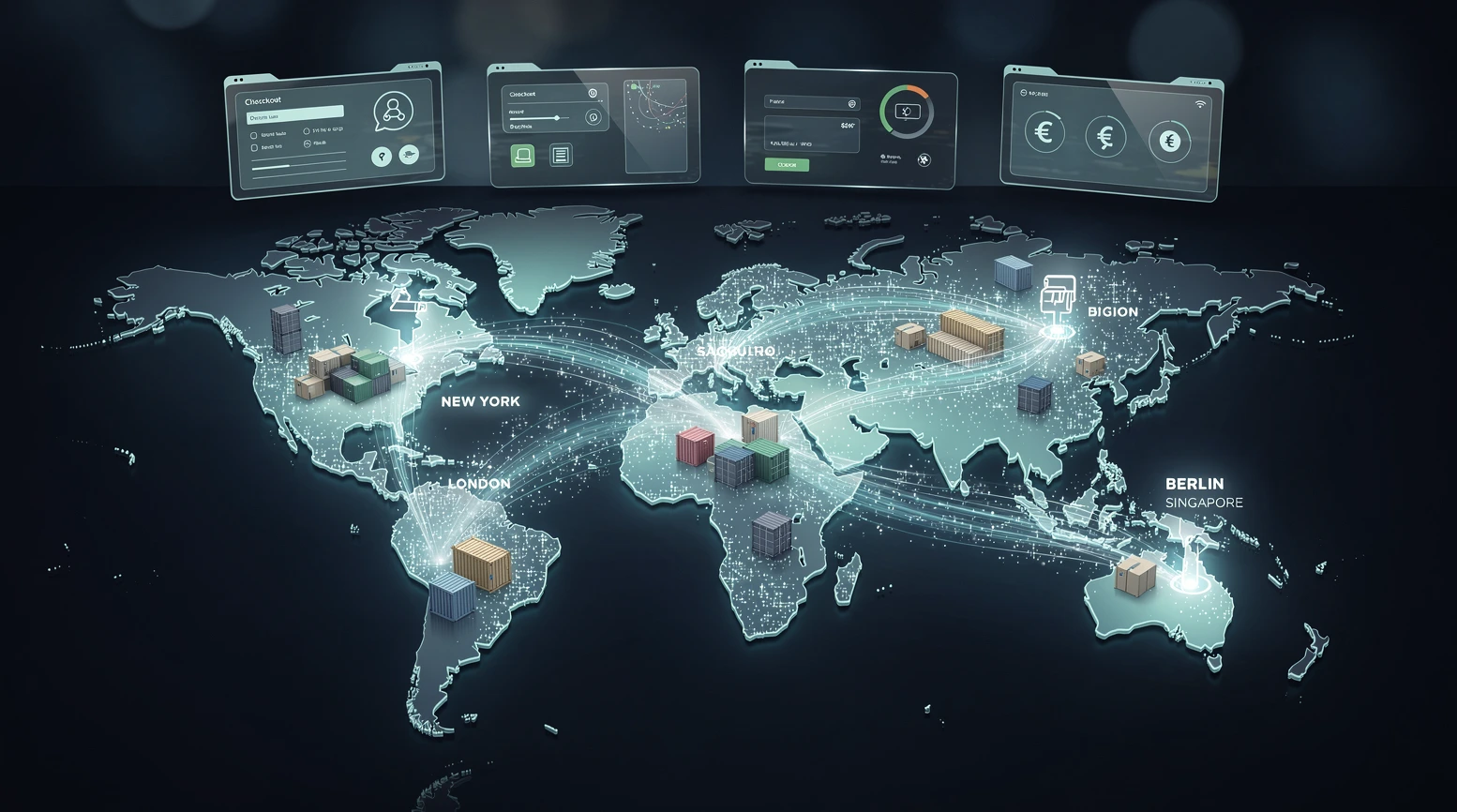
Cross-border commerce tools 2026 sit at the center of a messy, fast-changing stack: payments, duties, logistics, tax, localization, fraud. The right shortlist can compress months of integration work into weeks. The wrong one can lock a US brand into a vendor that breaks the moment volumes scale or a new market is added.
In short
- Stack first, vendors second: map the seven cross-border capabilities you actually need before you read a single demo deck.
- Duties and tax are the silent killers: landed-cost engines like Avalara, Zonos, and Global-e cut returns and chargebacks more than any marketing tool.
- Logistics is the slowest layer: expect 60 to 90 days to onboard a serious 3PL or DDP partner, plan accordingly.
- Payments and FX are now table stakes: Adyen, Stripe, and Airwallex cover most of the 2026 buyer journey for US retailers selling abroad.
- Marketplaces shorten the learning curve: using Shopee, Amazon Global Selling, or eBay International before opening a direct store is usually the cheapest education available.
Why cross-border commerce tools matter more in 2026
US retailers are no longer asking whether to sell abroad. They are asking how to do it without lighting margin on fire. Customs reform in the EU, the end of the de minimis loophole for low-value parcels in several markets, and the rise of marketplace platforms in Southeast Asia and Latin America have all moved the goalposts since 2024. Tooling that was “nice to have” in 2022 is now the difference between a profitable shipment and a write-off.
The other shift is buyer expectation. Shoppers in Mexico, Germany, the UK, and Japan now expect prices in local currency, taxes shown at checkout, delivery in five to ten days, and easy returns. None of that is possible with a single Shopify store and a shipping plugin. The serious cross-border stacks in 2026 layer a landed-cost engine, a local-payments router, a 3PL with bonded warehousing, and a localization platform. For a deeper map of how these layers fit together with trade policy, our guide to understanding global trade for retail and cross-border commerce walks the full picture.
One number tells the story. According to Statista, the global cross-border e-commerce market is projected to pass $2.1 trillion in 2026, growing roughly twice as fast as domestic e-commerce. The vendors covered below are the ones that show up consistently in real US retailer stacks at that scale.
The seven capabilities every cross-border stack needs
Before evaluating any specific vendor, write down the capabilities. Most teams skip this step and end up paying twice for overlap or buying a “platform” that solves three problems and ignores four. A working cross-border stack in 2026 covers seven distinct jobs:
- Storefront and localization: language, currency, price psychology, regional content blocks.
- Tax and duty calculation: landed cost shown at checkout, VAT or GST registration, HS code classification.
- Payments and FX: local payment methods, multi-currency settlement, FX conversion, payouts.
- Fraud and risk: chargeback management, 3D Secure routing, velocity rules tuned per region.
- Logistics and fulfillment: 3PL warehousing, DDP shipping, customs brokerage, returns.
- Marketplaces and listings: Amazon Global, eBay International, Shopee, Mercado Libre, MyDeal.
- Analytics and unit economics: margin per market, return rate by SKU, cohort retention.
Many vendors claim to cover more than one of these. Treat those claims with skepticism. The depth needed to do duty calculation well is different from the depth needed to run a returns operation in Germany, and one team rarely builds both equally.
Tax, duty, and landed-cost vendors that actually work
This is the single highest-leverage category in any cross-border stack. Customers abandon carts at twice the normal rate when surprise duties show up on delivery. Returns from “buyer refused parcel” events can wipe out the unit economics of an entire campaign. The vendors below all solve the same core problem: show the buyer the real landed cost at checkout, then collect and remit duties correctly.
Avalara is the heavyweight choice for US retailers already running multi-state sales tax through Avalara AvaTax. Adding Avalara Cross-Border for HS code classification and duty calculation reuses the same compliance backbone. Zonos competes hard on the Shopify and BigCommerce ecosystem with a more developer-friendly API and clearer pricing for sub-$50M brands. Global-e and Borderfree sit at the enterprise tier, bundling duty calculation with localization and merchant-of-record services, which can be useful for brands that do not want to register for VAT in 27 jurisdictions themselves.
| Vendor | Best for | Pricing model | Sweet-spot revenue |
|---|---|---|---|
| Avalara Cross-Border | Brands already on Avalara AvaTax | Subscription plus per-transaction | $10M to $500M+ |
| Zonos | Shopify and BigCommerce stores | Tiered subscription | $1M to $50M |
| Global-e | Brands that want full merchant-of-record | Revenue share, 3 to 8 percent | $20M to $1B+ |
| Borderfree (Pitney Bowes) | Mid-market apparel and beauty | Hybrid subscription plus rev share | $10M to $200M |
| Easyship | Small sellers and Shopify side projects | Per-shipment | Under $5M |
Picking between them comes down to two questions. First, do you want to be the merchant of record in every destination, with the compliance overhead that brings, or do you want a partner to take that on for a revenue share? Second, what is your HS code complexity? A single-category beauty brand can survive with a simpler engine. A general retailer carrying electronics, apparel, food supplements, and homewares needs the deeper classification library that Avalara or Global-e provide. Before picking, run the same SKU through three vendors and compare the calculated duty. The spread is often 20 to 40 percent, which tells you everything about classification quality.
Logistics, fulfillment, and 3PL platforms that scale across borders
Logistics is the slowest, most expensive layer in any cross-border stack. Onboarding a serious 3PL takes 60 to 90 days. Switching one in production is a six-month project. This is the area where US retailers most often regret moving fast. Before picking a partner, read our companion piece on how to choose your first cross-border market without guessing, because the right 3PL depends entirely on where you actually sell, not where you think you might sell.
The 2026 cross-border 3PL landscape has three tiers. At the top sit DHL Supply Chain, Maersk (after the LF Logistics acquisition), and FedEx Logistics, with bonded warehousing in every major hub and integrated customs brokerage. In the middle are platforms like ShipBob, Flexport, and Bringg that combine software with a fulfillment network, useful for brands doing $5M to $50M cross-border. At the bottom, regional specialists like Sendcloud (EU), ParcelHero (UK), and Easyship (global) handle the last-mile carrier mix for smaller sellers.
The hidden cost in this category is returns. Returns from Germany to a US warehouse can cost 18 to 25 dollars per parcel, eating most of a typical apparel margin. Brands that scale past $10M in cross-border revenue almost always set up local returns hubs (often Poland or the Netherlands for EU, Hong Kong for APAC) by year two. ReBound, Loop Returns, and Returnly all support multi-region flows. Building a clean returns process early is cheaper than retrofitting one after a customer-service crisis.
Payments, FX, and fraud prevention vendors worth knowing
Payment localization is the second-highest converter after duties. Shoppers in the Netherlands expect iDEAL, in Germany SOFORT or Klarna, in Brazil PIX and Boleto, in Mexico OXXO. A US-only Stripe account that only accepts Visa, Mastercard, and Amex will see conversion drop by 30 to 50 percent in those markets. The serious payment platforms for cross-border in 2026 are Adyen, Stripe (with the local-payment-method library), Airwallex, and Worldpay. Adyen leads on coverage and chargeback tooling for mid-market brands. Stripe wins on developer experience. Airwallex has carved out a strong position in APAC and on FX cost.
FX is the silent margin killer. A 2 percent FX markup on every euro sale, compounded over a year, is the cost of a full marketing hire. Multi-currency accounts at Airwallex, Wise Business, or Revolut Business reduce the spread to roughly 0.3 to 0.6 percent for major pairs. Combined with local settlement (collecting in EUR, holding EUR, spending EUR on EU 3PL costs) the savings compound. For brands above $5M cross-border revenue, this is one of the easier wins available.
Fraud is the third leg. Cross-border orders carry a higher fraud rate than domestic, often 2 to 4x. Signifyd, Riskified, and Forter all offer chargeback guarantees, taking the fraud risk off the merchant for a fee of roughly 0.5 to 1.2 percent of GMV. For first-time cross-border sellers, a guarantee-based fraud vendor is often worth more than a self-managed rules engine, because the learning curve on regional fraud patterns is steep. Building fraud rules from scratch for Brazil, India, and Indonesia simultaneously rarely ends well.
Marketplaces and localization tools: where to sell and how
For most US retailers, the cheapest way to learn a new market is to list on a local marketplace before opening a direct store. The marketplace handles localization, payments, fraud, and often logistics, and gives you twelve months of conversion data to decide whether the market is worth a direct push. Tax compliance is also commonly handled by the marketplace operator, which collapses the stack significantly.
The 2026 short list for US sellers includes Amazon Global Selling (works almost everywhere), eBay International (strong in EU and UK), Mercado Libre (Latin America), Rakuten (Japan), Allegro (Poland), Shopee (Southeast Asia), and MyDeal or Catch (Australia). Each has its own onboarding, fee, and listing-quality model, and the right approach to Shopee ads is very different from the right approach to Amazon PPC. Our breakdown of Shopee ads for sellers entering Southeast Asia covers the campaign mechanics; the same logic does not transfer to Mercado Libre or Allegro without adjustment.
Localization tools sit between the storefront and the marketplace. Weglot, Smartling, and Lokalise handle string-level translation and right-to-left rendering. CommerceTools and Shopify Markets handle the catalog and currency side. For brands that want a single localized direct store across five to ten markets, the combination of Shopify Markets, Weglot, and a duty engine is the lightest viable stack. Larger retailers move to CommerceTools or BigCommerce Multi-Storefront when the catalog complexity outgrows Shopify’s per-market model.
Analytics and unit economics: the tooling most retailers skip
The seventh capability in the stack is the one most US retailers under-invest in: analytics that show real per-market unit economics. The default dashboards from Shopify, Adyen, and most 3PLs report revenue and order count. They do not report margin per market after duty, FX, payment fees, fraud cost, returns, and customer service. Without that view, expansion decisions are guesses dressed up as data, and the team often keeps pushing into markets that are quietly losing money.
The lightweight version of this is a custom Looker or Metabase dashboard on top of a small warehouse (BigQuery, Snowflake, or Postgres) that ingests orders, payments, fulfillment costs, and returns. Tools like Hightouch and Fivetran handle the ETL piece. The serious version, used by retailers past $50M cross-border, layers Polar, Daasity, or Glew on top to provide pre-built retail metrics by market. Either way, the number that matters is contribution margin per market per quarter, not gross revenue, and tracking it for at least four quarters is what separates retailers that expand successfully from retailers that retreat after a year.
One related piece of tooling worth flagging is HS code automation. Manual HS classification at scale is a hidden cost center: a 1,000-SKU brand can spend 80 to 120 hours per year just keeping classifications current as catalog and regulation change. Vendors like 3CE, Avalara Item Classification, and Zonos Classify automate most of that work, with accuracy that meets or exceeds in-house junior analysts. For brands above 500 active SKUs, this pays back inside a quarter and is one of the few “small wins” in the cross-border stack with a clean ROI line.
How to put a cross-border tool shortlist together without burning a quarter
The trap most teams fall into is starting with a vendor and working backward to a stack. Reverse the order. Start with the market, work to the buyer journey, and only then pick tools. The cleanest sequence for a US brand expanding to its first or second cross-border market is:
- Pick a single beachhead market. One country, not a region.
- Map the buyer journey. Local payment methods, expected delivery, typical return reason, language and currency norms.
- List the seven capabilities. Mark which you will buy, which you will defer, and which the marketplace will absorb if you list there first.
- Shortlist two vendors per capability. Run a one-week pilot, not a six-week procurement cycle.
- Negotiate a 12-month contract maximum. Cross-border vendor pricing changes fast, do not lock in.
- Measure unit economics by market. Margin per order, not gross revenue, is the only number that matters.
The mistake most often seen in 2024 and 2025 was buying a full enterprise stack (often Global-e plus DHL plus Adyen) before validating that the market was worth it. A serious chunk of those investments were churned within 18 months. The right move for a brand at $20M domestic revenue starting cross-border is usually: Shopify Markets, Zonos, a Stripe local-payment-methods setup, and a marketplace listing as a hedge. Total monthly cost is well under $5,000. Once a market is validated past $500K in annualized revenue, upgrade.
Common mistakes when picking cross-border tools, and how to avoid them
Three patterns show up repeatedly when US retailers review their cross-border stack after the first year. The first is over-engineering. Picking an enterprise duty engine before there is enough volume to amortize the monthly minimum is a common $80,000 mistake. The second is under-engineering payments. Skipping local payment methods to “see if the market converts” is a self-fulfilling failure, because the market never converts without local payment options. The third is ignoring tax registration. Many brands assume the duty engine handles VAT registration. It does not, in most cases, and the registration timeline in the EU can be eight to twelve weeks per country.
A related trap is choosing a vendor based on a flashy dashboard rather than core mechanics. The data on duty calculation accuracy, fraud chargeback ratio, payment authorization rate, and 3PL on-time delivery is what matters. Demos are designed to show the dashboard, not the failure modes. Always ask for the same three numbers from each vendor: median calculation accuracy on your top 20 SKUs, p95 delivery time on your top three lanes, and authorization rate by destination. Vendors who cannot produce these numbers within a week have not done the work to know them.
Finally, tax basics are often misunderstood. The interaction between a duty engine and a tax registration is not always intuitive, and the cost of getting it wrong shows up as buyer chargebacks. Our overview of cross-border tax basics every small retailer should know covers the registration logic in more detail. Even brands using a merchant-of-record like Global-e should read it, because the moment the contract changes (or the brand outgrows the model), the registration question becomes urgent.
What a working 2026 stack looks like, end to end
Three example stacks illustrate the range. A $5M Shopify apparel brand expanding into the UK and EU runs Shopify Markets, Zonos, Stripe with local-payment-methods, ShipBob’s UK warehouse, and Signifyd for fraud guarantee. Total monthly software cost roughly $3,500, plus per-shipment fees. A $50M multi-category retailer running direct in eight countries plus marketplaces runs CommerceTools, Avalara Cross-Border, Adyen, DHL Supply Chain in the EU, Maersk for North Asia, Signifyd, and Lokalise for localization. A $500M brand at full enterprise scale runs SAP Commerce or CommerceTools, Avalara plus a regional tax co-pilot in each major market, Adyen, multiple 3PLs by region, Forter for fraud, and a custom data layer for unit economics by SKU by market.
Each of these stacks took 12 to 24 months to build. None of them were bought in a single procurement cycle. The pattern that works is small, iterative bets per market, with strict willingness to switch vendors as volume scales. Cross-border in 2026 rewards teams that move incrementally and measure honestly. For a wider map of how trade policy, marketplaces, and tools interact in 2026, see our global trade and cross-border commerce guide.
FAQ
What is the most important cross-border commerce tool to buy first?
A landed-cost engine. Showing the buyer the full duty and tax at checkout, before they pay, cuts cart abandonment and refused-parcel returns more than any other single tool. Zonos or Easyship are reasonable starting points under $10M revenue. Avalara Cross-Border is the upgrade path past that.
Do I need a separate 3PL in every country I sell to?
No. Most US retailers run two to three 3PL nodes total: a US warehouse, an EU warehouse (often in Poland or the Netherlands), and an APAC warehouse (often in Hong Kong or Singapore). The exception is high-velocity markets like the UK and Australia, where local warehousing materially improves delivery time and conversion, so a fourth node may pay back.
How much should I budget for cross-border tools at $10M annual revenue?
Software costs are typically 0.5 to 1.5 percent of cross-border GMV. At $10M revenue with $2M cross-border, that is roughly $1,000 to $2,500 per month in software, plus per-transaction fees on payments and shipping. Logistics and customs are separate and usually 8 to 15 percent of cross-border GMV.
Should I be the merchant of record or use a partner?
Use a partner (Global-e, Borderfree) when entering more than three markets at once and you do not have in-house tax counsel. Be the merchant of record yourself when you have a single major market (often the EU after a single VAT OSS registration) and you want full margin and full data ownership. Most brands switch from partner to self-managed somewhere between $20M and $50M cross-border revenue.
Can a marketplace replace a direct cross-border stack?
For the first 12 to 18 months in a new market, often yes. Amazon Global Selling, Shopee, eBay International, and Mercado Libre all let US sellers test demand without building their own tax, payments, or fraud stack. The downside is data ownership and margin compression. Most serious brands run marketplaces and direct in parallel by year two.
What is the fastest way to fail at cross-border in 2026?
Three patterns: skipping local payment methods, ignoring duty calculation at checkout, and using domestic-only fraud rules on international orders. Any one of them collapses conversion or unit economics. All three together is the worst quarter most retailers will have.
How long does it take to set up a serious cross-border stack?
Six to nine months end to end. The bottlenecks are tax registration (eight to twelve weeks in some EU countries), 3PL onboarding (60 to 90 days), and payment-gateway certification for local methods (two to six weeks per method). The software portion can be running in a week, but the operations underneath take longer.
Which vendors should I avoid in 2026?
Avoid generic “global e-commerce platforms” that bundle everything but specialize in nothing. The serious wins come from picking best-in-class for each capability and integrating them. Also avoid any vendor that will not show you median calculation accuracy, authorization rate, or p95 delivery time on a real customer in your category.