
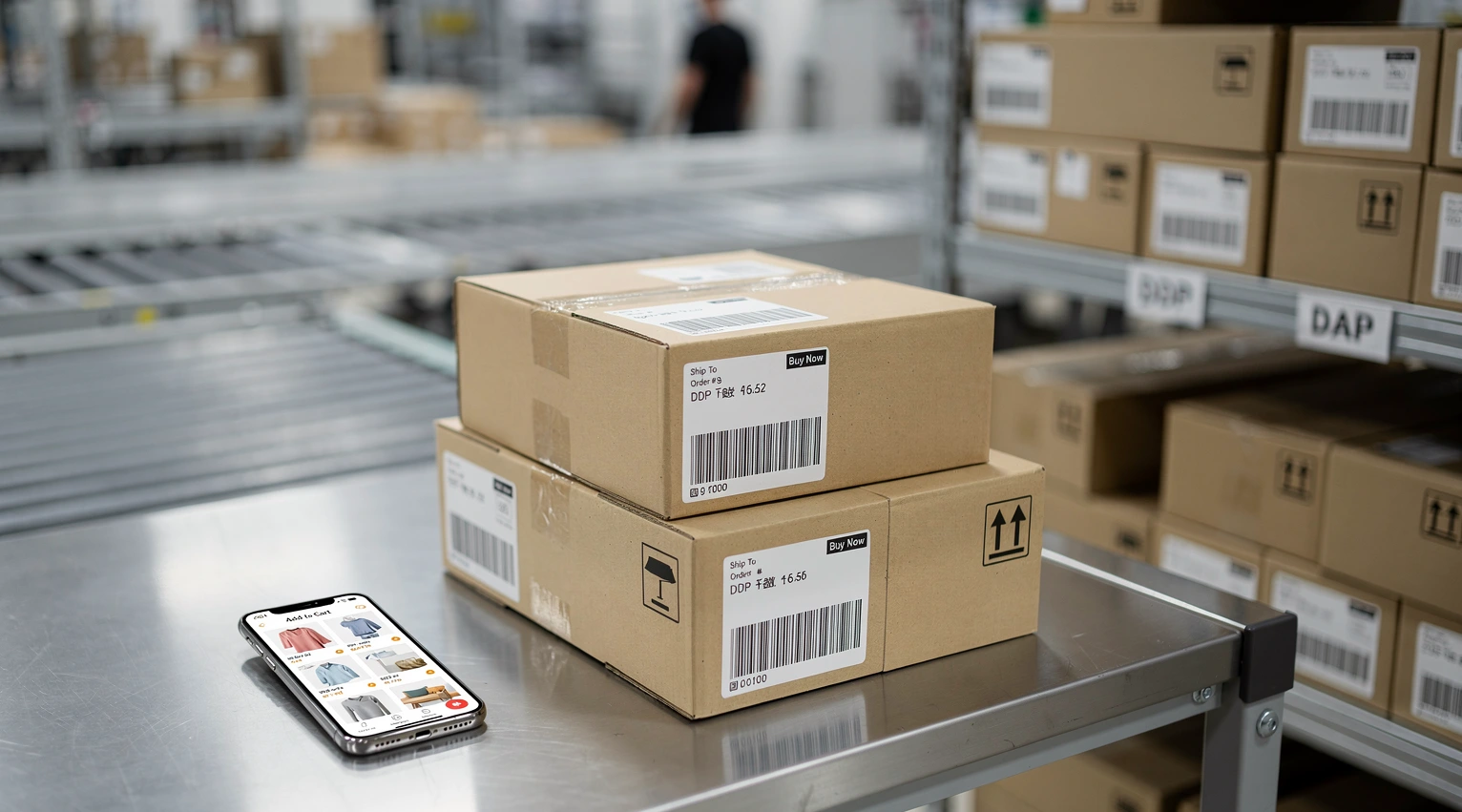
If your purchase orders still say DDP by default, you are probably overpaying your supplier to act as your customs broker, and you cannot see how much. The two terms that dominate retail import contracts in 2026, Delivered Duty Paid (DDP) and Delivered At Place (DAP), look almost identical on a quote sheet: goods arrive at your dock, price quoted door to door. The difference sits in one line of the Incoterms 2026 rules, and that one line decides who fronts the duty, who is on the hook for a misclassified HS code, and who absorbs a tariff hike that lands while your container is mid-ocean.
For a retailer importing a few hundred SKUs a season, the choice is not academic. It changes your landed cost by 4 to 11 percent on a typical apparel or housewares order, and it determines whether a customs audit lands on your desk or your vendor’s. This guide gives you the math, the liability split, and the contract language to choose deliberately rather than by habit.
In short:
- DDP means the seller clears customs in your country and pays import duty and import VAT/sales tax; DAP means the seller delivers to your premises but you, as importer of record, clear customs and pay those charges.
- DDP simplifies your accounting but hides a markup: suppliers pad the duty estimate and pocket the spread, so a “cheap” DDP price often beats a DAP price only on paper.
- Under DAP you become importer of record, which gives you control of HS classification, duty-drawback claims, and broker choice, but also full liability for underpaid duty.
- With the EU and several markets removing low-value de minimis thresholds in 2026, DDP exposure on small parcels rose sharply, making the term more attractive for low-value direct-to-consumer flows than for bulk wholesale.
- The right answer is per lane and per supplier, not per company: pick DAP where you have customs competence and volume, DDP where you lack a local broker or ship low-value parcels.
What is the actual difference between DDP and DAP in 2026?
The short answer: both terms put the goods in front of your door, but only one of them puts the customs paperwork and the duty bill in front of your door too. Under DAP, the seller’s responsibility ends when the truck arrives at the named place, typically your warehouse or store backroom. You are then responsible for import clearance, duty, and import tax as the importer of record. Under DDP, the seller carries that clearance and pays the duty and import tax before the goods reach you, which folds straight into your wider cross-border tax basics and your VAT recovery position.
Everything else (carriage, main freight, insurance arrangement, risk transfer at delivery) is identical between the two terms. That is precisely why retailers confuse them. The single variable is the customs clearance step in the destination country, and in 2026 that single variable carries more cost and more audit risk than it did five years ago. The term you choose therefore ripples into your VAT recovery and your books, not just your freight invoice.
A useful mental model: DAP transfers the goods, DDP transfers the goods and the bureaucracy. Whether you want that bureaucracy depends on whether you can do it cheaper and more accurately than your supplier can. Many retailers cannot, which is the honest case for DDP. Many others can and simply never measured the gap.
Who is the importer of record, and why it matters
The importer of record is the legal entity responsible to customs authorities for the accuracy of the declaration and the payment of duty. Under DAP that is you. Under DDP it is the seller, or an agent the seller appoints in your country. This is not a clerical distinction. The importer of record owns the HS classification decision, owns any post-clearance audit, and is the party customs pursues for underpaid duty plus penalties, sometimes years later.
When you accept DDP, you hand that exposure to your supplier, which sounds attractive until you realize a foreign supplier has little incentive to classify your goods conservatively and may not even be reachable when an audit notice arrives 18 months after the order shipped. Control and liability travel together. You cannot offload the liability under DDP while keeping control of how your products are classified.
How do the numbers actually compare? A landed-cost breakdown
Answer first: on identical goods, DAP almost always produces a lower true landed cost when you have a competent broker, because DDP prices bundle a hidden duty markup and a service margin. The catch is that DAP shifts working-capital timing and audit risk onto you, and those have a cost too, just not one that shows on the supplier’s quote.
Consider a representative order: 2,000 units of branded homeware, FOB value of 40,000 USD, shipped to a single destination warehouse, dutiable at a 6.5 percent rate, with destination import VAT of 20 percent (recoverable for a registered business). The table below compares a typical DDP quote against a DAP arrangement where you clear the goods yourself.
| Cost component | DDP (supplier clears) | DAP (you clear) |
|---|---|---|
| Goods value (FOB) | 40,000 | 40,000 |
| Freight and insurance | 3,200 | 3,200 |
| Import duty (6.5%) | 2,810 (built into price) | 2,810 (you pay customs) |
| Supplier duty markup / handling | 1,950 (hidden) | 0 |
| Customs broker fee | 0 (in supplier price) | 320 |
| Import VAT (20%, recoverable) | 0 to you (supplier reclaims) | 9,242 (you reclaim) |
| Net landed cost (ex-VAT) | 47,960 | 46,330 |
The DAP route runs roughly 1,630 USD cheaper on this order, about 3.4 percent of net landed cost, and the entire gap is the supplier’s bundled markup and handling margin. Scale that across a season of 30 such orders and you are looking at five figures of margin you handed away for the convenience of not filing a customs entry. The import VAT line looks alarming under DAP, but for a registered retailer it is recoverable, so it is a cash-flow timing item, not a true cost. That timing difference, however, is real money if you are tight on working capital.
The hidden costs that flip the calculation
The breakdown above favors DAP, but four factors can reverse it, and you should price all of them before signing:
- Broker competence and fixed fees. If your per-entry broker cost is high relative to order size, small DAP shipments lose their advantage. A 320 USD entry fee is trivial on a 40,000 USD order and punishing on a 1,500 USD one.
- VAT cash-flow drag. Under DAP you front the import VAT and wait weeks or a quarter to reclaim it. On thin margins that financing cost is real, and postponed-VAT-accounting schemes (where available) are the fix.
- Classification risk. If your products sit in an ambiguous HS bracket, the audit exposure you take on under DAP may justify paying a DDP premium to push that risk onto a supplier with local clearance expertise.
- Tariff volatility. When duty rates are moving, DDP locks your cost at the quoted price and the supplier eats any mid-shipment increase, which during a tariff spike can be worth more than the markup you pay.
The point is not that DAP wins or DDP wins. The point is that the winner depends on order size, your broker setup, and how stable duty rates are on your lane this quarter. Retailers who run the same term across every supplier are leaving the per-lane optimization on the table.
How does the 2026 de minimis shake-up change the choice?
Answer first: the removal of low-value duty exemptions makes DDP far more attractive for small-parcel and direct-to-consumer flows, and slightly more relevant even for wholesale, because the volume of dutiable small shipments exploded. For years, parcels under a threshold (800 USD in the United States, 150 EUR in the EU) cleared duty-free, so the DDP-versus-DAP question barely applied to e-commerce parcels. That world is closing.
The change matters most for retailers running drop-ship or marketplace fulfillment, where thousands of low-value parcels now each carry a duty liability and a clearance event. Handling that yourself, parcel by parcel, is operationally brutal, so DDP through a carrier or platform that batches clearance becomes the pragmatic default. The mechanics and the affected sellers are detailed in our breakdown of how the EU formally ends the duty-free threshold for low-value imports, and the same direction of travel applies in several other markets.
For bulk wholesale containers the de minimis change is neutral (those were always dutiable), so the classic DAP cost advantage stands. The practical 2026 posture is a split strategy: DDP for the long tail of small parcels, DAP for palletized and containerized bulk where your broker economics work. Treating both flows under one term is where retailers either bleed margin on bulk or drown in clearance admin on parcels.
Tooling and broker selection for a split strategy
Running two terms in parallel demands visibility you probably do not have in a spreadsheet. You need duty estimation at PO time, landed-cost simulation, and a broker or platform that can batch small-parcel clearance under DDP while handling your bulk DAP entries cleanly. The market for this matured fast in 2026, and we maintain a current rundown of tools and vendors for tariffs and customs that covers classification engines, landed-cost calculators, and clearance platforms. Pick tooling before you renegotiate terms, because the term you can run profitably depends on the clearance infrastructure you actually have.
How do you negotiate the term with a supplier?
Answer first: never accept a bundled DDP price without asking for the DAP equivalent and the line-item duty estimate, because the gap between them is the supplier’s hidden margin and it is negotiable. The single most effective request is: “Quote this order both DDP and DAP, and on the DDP quote, itemize the duty, the clearance fee, and your handling charge separately.”
Most suppliers resist itemizing because the spread is profit. A supplier who refuses to break out the duty component is telling you the markup is large. A supplier who provides it gives you a baseline to negotiate the handling charge down or to switch to DAP and capture the difference yourself. Either way you win information you did not have. The same disciplined, data-first approach that wins margin in supplier negotiations carries over into how you market the savings downstream, a theme we explore in our look at retail marketing in the age of AI search and social commerce, where transparent pricing is increasingly a positioning advantage.
Build your negotiation around three concrete asks: the dual quote, the itemized DDP breakdown, and a duty-rate-change clause specifying who absorbs a mid-shipment tariff increase. That third clause is where DDP earns its premium during volatile periods, so make the supplier price the risk rather than assuming it for free.
The exact language that gets you a clean quote
Vague requests get vague answers, so be specific. A request that works in practice reads: “Please quote PO #1182 under both DDP and DAP Incoterms 2026. On the DDP quote, show import duty, customs clearance fee, and your handling margin as separate line items. Confirm in writing which party absorbs a duty-rate increase that takes effect after the goods ship.” That phrasing forces three disclosures at once and signals you understand the term, which alone shifts the negotiation in your favor.
If the supplier counters that they cannot itemize because clearance is handled by a third party, ask for that third party’s invoice to be passed through at cost with your handling margin shown separately. A supplier unwilling to pass through clearance at cost is monetizing the clearance step, and you now know the size of the prize for moving to DAP. Keep the exchange in email so the duty-rate clause is documented, because verbal assurances on tariff risk are worthless when a customs bill actually changes.
When does risk and title actually transfer under each term?
Answer first: under both DDP and DAP, risk of loss transfers to you when the goods are placed at your disposal at the named destination, ready for unloading, so the risk-transfer point is identical and is not a basis for choosing between them. This surprises retailers who assume DDP, being the more comprehensive term, also keeps risk with the seller longer. It does not. The two terms diverge only on the customs-and-duty obligation, not on where risk passes.
The practical consequence is that your cargo insurance arrangement should look the same under either term, covering the goods through the main carriage and up to the delivery point. Do not assume DDP bundles better insurance. Neither term obligates the seller to insure the goods to a particular level, which means a retailer who reads “duty paid” as “fully protected” is exposed. Confirm the insurance scope as a separate clause regardless of the Incoterm, and verify the policy covers the goods during unloading and any inland leg to a second location if you transship.
Title to the goods, which is a contractual and ownership question separate from Incoterms, is not governed by DDP or DAP at all. Incoterms allocate cost, risk, and obligation; they say nothing about when you legally own the merchandise. Your sale contract or letter of credit handles title transfer, and conflating it with the Incoterm is a common source of disputes when a shipment is lost or a supplier becomes insolvent mid-transit. Keep the two concepts separate in your paperwork.
How do you operationalize the term inside your business?
Answer first: choosing the term is the easy part; the hard part is wiring it into your purchasing, finance, and receiving workflow so the choice actually holds. A DAP decision that your buyer makes but your finance team never sets up a broker for will collapse into a chaotic clearance at the port, eating the savings in demurrage and rush fees. Treat the term as an operational commitment, not a line on a PO.
For a DAP lane you need four things in place before the first container ships: a customs broker engaged with a power of attorney on file, a deferred-duty or postponed-VAT account where available, a confirmed HS classification for every SKU, and a receiving process that flags clearance status before the truck shows up. Miss any one and the goods stall. For a DDP lane the operational lift is lighter, but you still need to verify the supplier’s appointed agent is registered to act in your country and that the duty they pay matches the classification you would have used, because a supplier who under-declares to lower their own quote creates a liability that can surface as your problem.
Build a simple decision rule your buyers can apply without escalating every order. A workable default: orders above a value threshold and on stable-tariff lanes go DAP through your broker; low-value parcels and ambiguous-classification goods go DDP; anything during an active tariff dispute goes DDP with a documented duty-rate clause. Review the thresholds quarterly, because broker fees, duty rates, and de minimis rules all moved in 2026 and will keep moving.
Common mistakes retail importers make
The errors below recur across importers of every size, and each one quietly costs margin or invites a customs problem.
- Defaulting to DDP for the convenience. Convenience is real, but it is rarely worth the 3 to 11 percent bundled markup on bulk orders where you could clear the goods competently yourself.
- Assuming DDP removes all your risk. If your supplier misclassifies goods and customs later challenges it, the audit and reputational fallout can still reach you, especially where local rules name the consignee as a responsible party.
- Ignoring import VAT cash-flow under DAP. The duty saving can be eaten by the financing cost of fronting VAT for a quarter, so check whether postponed VAT accounting is available before you switch.
- Running one term across every lane. Order size, broker fees, and duty volatility differ by lane; a blanket policy guarantees you are wrong on some of them.
- Forgetting the 2026 de minimis change on small parcels. Flows that were duty-free are now dutiable, and importers still using old assumptions are accruing unbilled liability.
- Not specifying who absorbs a tariff increase mid-shipment. Without a clause, a DDP supplier may renegotiate or a DAP arrangement may surprise you with a higher bill at clearance.
FAQ
Is DDP or DAP cheaper for a small retailer?
For bulk orders with a competent broker, DAP is usually cheaper because DDP prices bundle a hidden duty markup and handling margin, often adding 3 to 11 percent to landed cost. However, for small or low-value parcels where a fixed broker entry fee outweighs the order value, DDP can win on net cost. The honest answer is per-order: run a dual quote and compare net landed cost, including the cash-flow drag of fronting import VAT under DAP. Most retailers who never compare are overpaying on bulk.
Who pays import duty under DAP?
Under DAP you, the buyer, pay import duty and import VAT or sales tax, because you act as the importer of record once the goods reach the named delivery place. The seller covers carriage and delivery up to that point but stops short of clearing customs. This gives you control over HS classification and broker choice, but it also makes you the party customs pursues for any underpaid duty or penalties, potentially long after the goods arrive. Budget for both the duty and the broker fee.
Does DDP protect me from a customs audit?
Mostly, but not absolutely. Under DDP the seller is importer of record and bears primary responsibility for the declaration and duty, so an audit normally lands on them. Yet in several jurisdictions the consignee can still be named as a responsible party, and a misclassification by an unreachable foreign supplier can create headaches and reputational exposure for you. DDP transfers most of the liability, not all of it. If your goods sit in an ambiguous classification, treat DDP as risk reduction rather than immunity.
How did the 2026 de minimis changes affect Incoterms choices?
The removal of low-value duty exemptions in the EU and other markets means small parcels that once cleared duty-free are now dutiable, each carrying a clearance event. That made DDP through a carrier or platform that batches clearance the pragmatic default for direct-to-consumer and drop-ship flows, where handling thousands of individual DAP entries would be operationally unworkable. For bulk wholesale containers, which were always dutiable, the change is neutral and the traditional DAP cost advantage still holds. The result is a split strategy across parcel and bulk flows.
Can I switch a supplier from DDP to DAP mid-relationship?
Yes, and it is one of the highest-return negotiation moves available. Ask the supplier to quote the same order under both terms and to itemize the duty, clearance fee, and handling charge on the DDP quote. The gap between the two quotes is the margin you recapture by clearing the goods yourself under DAP. You will need a reliable customs broker and a way to handle import VAT cash flow before switching, but for bulk orders the savings usually justify the operational lift within a season.
What is a duty-rate-change clause and do I need one?
It is a contract clause specifying who absorbs a tariff increase that takes effect while goods are in transit. Under DDP the supplier has quoted a fixed delivered price, so without a clause they may try to renegotiate when duties rise; under DAP you pay whatever rate applies at clearance. In volatile tariff periods this clause is where DDP earns its premium, because a supplier who contractually eats the increase is providing real value. Always make the supplier price that risk rather than leaving it ambiguous in the order.
What’s next: Start by pulling a dual DDP and DAP quote on your three largest import lanes this quarter and itemizing the duty on each, because that single exercise usually reveals where you are overpaying. Then align your customs tooling and broker setup to support a split strategy before you renegotiate terms, using our cross-border tax fundamentals as the baseline and confirming the rules with the World Customs Organization classification guidance for any ambiguous SKUs. Done well, the term you choose stops being a default and becomes a per-lane margin lever.