
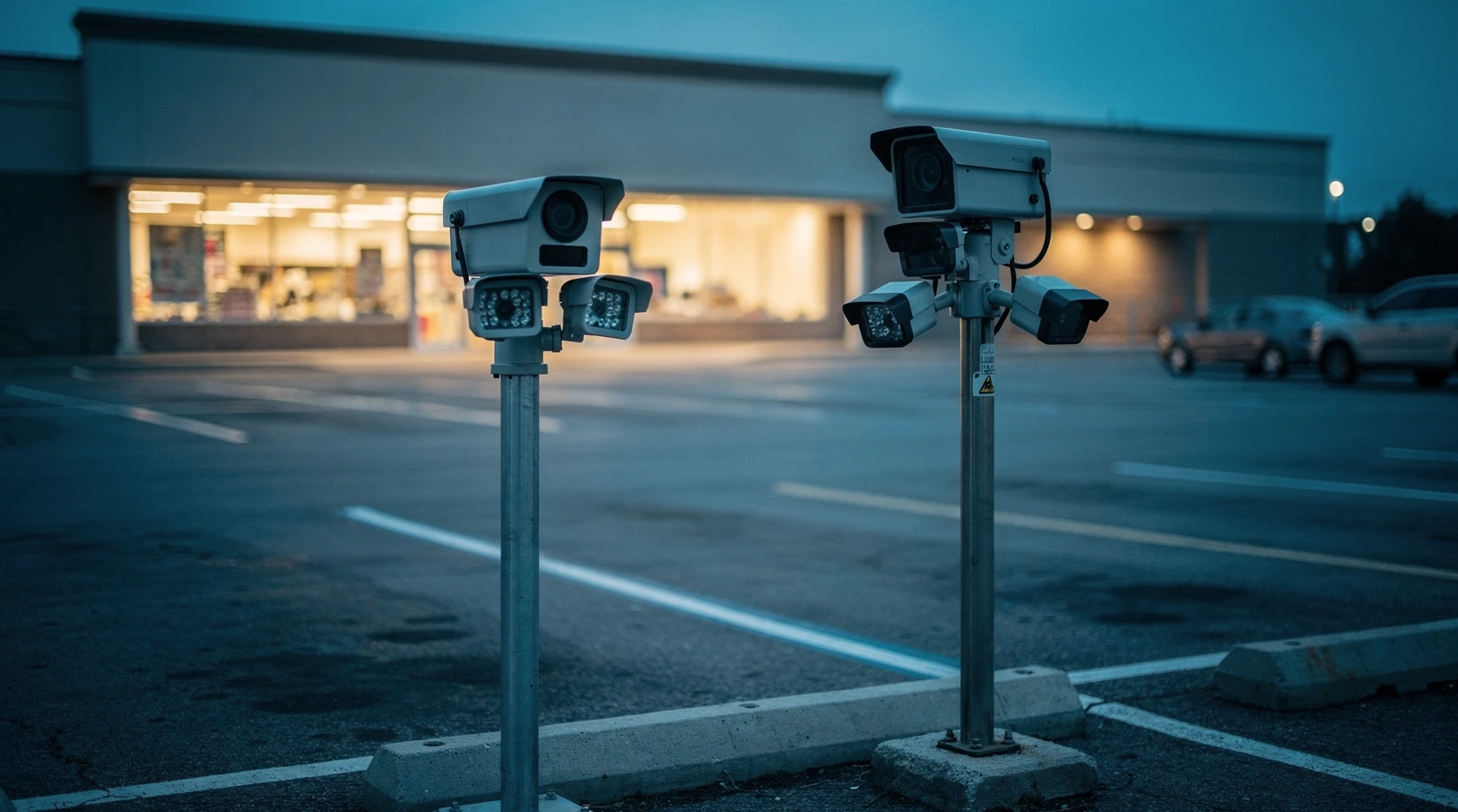
Ulta Beauty is facing an organized boycott campaign over automated license plate reader cameras installed in the parking lots of some of its stores. The cameras are supplied by Flock Safety, a surveillance technology vendor whose municipal contracts have been cancelled in a growing list of American cities.
The dispute went viral this week after the advocacy group UltraViolet launched a campaign titled “Hey Ulta: Mass surveillance isn’t pretty,” according to Retail Dive. Social media users then filled the retailer’s Instagram comments with objections to the partnership.
The commercial question is narrower than the outrage suggests. Ulta says the technology addresses organized retail crime, the deployment covers a very small share of its roughly 1,500 stores, and the cameras do not perform facial recognition.
What makes the story consequential for retail is precedent rather than scale. Amazon walked away from a planned Flock integration in February after a similar backlash, which gives Ulta a visible template and raises the cost of holding the line.
In short
- Ulta Beauty uses Flock Safety automated license plate readers in the parking lots of a small number of stores, reported as fewer than 1% of roughly 1,500 locations.
- The advocacy group UltraViolet is running a boycott campaign demanding Ulta cut ties with Flock and deactivate the cameras.
- The cameras read plates plus vehicle make, model, and color. Reporting is consistent that they do not use facial recognition.
- Amazon cancelled a planned Ring integration with Flock in February 2026 after a separate privacy backlash, establishing the retreat precedent now being cited.
- The pressure is not only reputational. Flock has lost municipal contracts across many jurisdictions, and Florida has barred license plate readers from state highways.
What is Ulta actually doing with Flock cameras?
Ulta has installed Flock Safety automated license plate reader (ALPR) cameras in the parking lots of selected stores. The systems photograph vehicles entering and leaving, and log identifying details in a searchable database.
Ulta’s stated purpose is loss prevention. The retailer’s director of organized retail crime described the goal as bridging a gap with law enforcement, telling an industry audience that the company “was looking for technology that would help us bridge the gap and collaborate” with police.
Neither Ulta nor Flock responded to Retail Dive’s requests for comment on the current campaign. That silence is itself a data point, because it suggests the company has not settled on a public position.
What the cameras capture, and what they do not
The distinction between plate reading and face reading is doing significant work in this dispute. Flock’s ALPR units record the license plate along with vehicle attributes such as make, model, and color.
Reporting across outlets is consistent that these are not facial recognition systems. That matters legally, because several U.S. states regulate biometric identifiers far more strictly than vehicle data.
| Data element | Captured by Flock ALPR | Why it matters |
|---|---|---|
| License plate number | Yes | Links a vehicle to a registered owner through state records |
| Vehicle make, model, color | Yes | Allows matching even where a plate is obscured or misread |
| Time and location stamp | Yes | Builds a movement history when combined across camera sites |
| Facial image or faceprint | Not per available reporting | Keeps the deployment outside most state biometric privacy statutes |
| In-store shopper behavior | Not per available reporting | The cameras are described as parking lot installations |
| Payment or loyalty identity | Not per available reporting | No reported linkage to Ulta customer accounts |
How many stores are involved
Scale is the strongest fact in Ulta’s favor. The deployment has been reported at fewer than 1% of the retailer’s locations, which against roughly 1,500 stores implies a figure in the low tens.
Flock has said the Ulta relationship dates to July 2025, which means the cameras operated for more than a year before drawing broad public attention. The controversy is therefore about disclosure and consent as much as about the technology itself.
Why did the backlash start now?
Nothing in the deployment appears to have changed this week. What changed is visibility, after a shopper documented cameras in an Ulta parking lot and the clip circulated widely.
UltraViolet, a gender justice advocacy organization, converted that moment into a structured campaign. The framing, “Hey Ulta: Mass surveillance isn’t pretty,” deliberately targets the gap between a beauty retailer’s brand promise and the imagery of police surveillance infrastructure.
Why the brand mismatch amplifies the story
Ulta’s customer base skews female, and the objections raised have been specifically gendered. A social media creator central to the campaign highlighted risks to women with abusive partners in law enforcement, to people navigating immigration enforcement, and to those seeking reproductive healthcare.
Those arguments are difficult to answer with shrink statistics. A retailer defending a security investment on loss numbers is arguing a different question from the one its critics are asking.
What is Flock Safety, and why is it contested?
Flock Safety sells automated license plate reader systems primarily to law enforcement, and secondarily to private customers such as retailers and homeowner associations. Reporting places the company’s law enforcement footprint at more than 5,000 agencies nationwide.
The core objection is not to any single camera but to the network. Individually, a parking lot camera records vehicles on private property; collectively, a national mesh of readers produces a searchable record of where vehicles have been.
The warrantless tracking objection
Civil liberties groups argue that pooled ALPR data lets police reconstruct movement histories without a warrant. The American Civil Liberties Union runs a campaign against the technology under the name “Get The Flock Out.”
Because the data originates from cameras on private commercial property, the retailer becomes an upstream contributor to that pool. That is the specific link the Ulta campaign is attacking.
The immigration enforcement concern
A significant share of the municipal cancellations has been driven by concern over data sharing with federal immigration authorities. NPR reported in February that this concern was a principal reason cities were ending Flock contracts.
For a national retailer the exposure is reputational rather than legal. A company does not control how a law enforcement partner queries data once it enters a shared system.
Why did Ulta deploy the cameras at all?
The retail crime rationale is concrete. Flock has reported that its cameras helped identify suspects in organized retail crime targeting Ulta stores, in cases involving losses exceeding $190,000.
Beauty retail is a well-documented target for organized theft. High-value, small-format, easily resold inventory is close to the ideal profile for resale-driven crews, and parking lot vehicle data is one of the few evidentiary threads such cases produce.
That is the genuine tension in this story. The tool that most directly addresses the crime pattern is also the tool that generates the privacy objection, and there is no obvious substitute that does one without the other. The wider trade-off between security investment and customer experience is a long-running problem in shrink and loss prevention that does not alienate shoppers.
Why $190,000 is a small number in this argument
The disclosed loss figure is modest relative to Ulta’s revenue base. Read literally, it is a rounding error against a company of Ulta’s size.
Loss prevention teams would argue the figure understates deterrence value and represents only documented cases. Critics would argue the same figure cannot justify participation in a national surveillance network, and on a pure cost basis that argument is difficult to rebut.
How does this fit the wider retail surveillance shift?
Parking lot cameras are one visible edge of a much larger build-out. Retailers have spent the past several years adding sensing infrastructure across the store estate, driven by shrink pressure, thinner staffing, and cheaper computer vision.
Most of that build-out has attracted little attention because it is framed as operations rather than surveillance. Shelf cameras counting inventory, exit sensors, and queue analytics all collect data about people in stores, and almost none of it is disclosed at the level a privacy campaign would demand.
Why the parking lot is the flashpoint
The lot is where the framing breaks. A camera inside a store is legible to shoppers as loss prevention, a category the public broadly accepts, whereas a pole-mounted unit reading plates in a lot resembles municipal policing infrastructure.
The vehicle is also a stronger identifier than most in-store signals. A plate resolves to a registered owner through state records, which converts an anonymous visit into an identified one without the shopper doing anything.
That single property explains why this deployment generated a campaign while comparable in-store systems did not. The objection is not that a camera exists but that the output is durably identifying.
The consent gap
Retail data practice has generally relied on implied consent through entry to a space. That model holds reasonably well for security cameras and much less well for systems that generate a persistent record shared with third parties.
The Ulta case exposes the gap precisely. Shoppers who would not object to being filmed at a till objected strongly to their vehicle movements entering a law enforcement queryable database.
Retailers that treat the two as equivalent are likely to be surprised in the same way. The distinction the public is drawing is about downstream sharing, not about cameras.
Why is beauty retail unusually exposed?
Category economics put beauty chains near the center of the organized retail crime problem. Cosmetics and fragrance combine high unit value, small physical size, broad brand recognition, and an active resale market.
That profile makes the merchandise close to ideal for resale-driven theft crews. It also means losses concentrate in a way that is highly visible to a loss prevention function, which increases pressure to adopt aggressive countermeasures.
The countermeasures create their own friction
The sector’s existing responses already sit uneasily with the shopping experience. Locked cabinets, tethered testers, and staffed fragrance counters all slow purchase and shift the store atmosphere toward suspicion.
Parking lot ALPR is an attempt to move enforcement away from the sales floor. The logic is sound on its face, because catching crews through vehicle evidence is less intrusive to ordinary shoppers than locking product behind glass.
The campaign response suggests that logic does not survive contact with the customer. Moving surveillance off the floor and into the lot changed its character rather than reducing it, and the lot version proved more objectionable rather than less.
A customer base that reacts
Ulta’s demographics compound the exposure. A predominantly female customer base with high social media engagement is well positioned to organize, and the specific harms raised by the campaign speak directly to that group.
A hardware retailer running identical cameras would likely face a smaller reaction. That is not a defense of the practice, but it does explain why this particular partnership became the test case.
What happened when Amazon faced the same question?
Amazon provides the closest available precedent, and it resolved against Flock. In October 2025 Ring announced a planned integration with Flock’s Community Requests program, which would have let Ring users share doorbell video with police through Flock’s system.
The integration never launched. In February 2026, days after a Super Bowl advertisement promoting an unrelated Ring feature drew privacy criticism, Amazon cancelled it.
Amazon framed the decision in operational terms, saying that following a comprehensive review it determined the integration “would require significantly more time” than anticipated, leading to a joint decision to cancel. Flock said the cancellation allowed both companies to best serve their respective customers and communities.
Political pressure was explicit. Senator Ed Markey described the technology as “creepy” in an open letter to Amazon, per NBC News reporting.
What the Amazon case actually established
The useful lesson is about timing rather than principle. Amazon exited a partnership that had not yet shipped, which is a far cheaper decision than removing hardware already installed and relied upon by store teams.
Ulta is in the harder position. Its cameras are operating, its loss prevention function has integrated them, and reversal means accepting a capability gap that the company has publicly said it needed. Amazon’s broader pattern of contesting rather than conceding regulatory fights, visible in its successful defense against California’s injunction bid, suggests large retailers weigh these calls case by case rather than by policy.
How far has the pullback from Flock spread?
The municipal picture matters because it shapes how a retail partnership is perceived. A vendor that cities are actively dropping carries different reputational weight from an uncontroversial one.
The figures below come from advocacy trackers and news reporting rather than from Flock, so they should be treated as directional. Flock disputes characterizations of its scale and impact.
| Development | Reported timing | Significance |
|---|---|---|
| Santa Cruz city council ends Flock contract | January 2026 | Early municipal exit in a large state |
| Mountain View police discontinue Flock ALPR use | February 2026 | Discontinuation by the department itself |
| Amazon cancels planned Ring integration | February 2026 | First major consumer brand retreat |
| Chandler council declines contract renewal | August 2026 | Shows the trend continuing into late 2026 |
| Florida bars license plate readers from state highways | Reported 2026 | State-level restriction, not just local |
| Roughly 23 city councils vote to cancel, reject, or deactivate | During 2026 | Advocacy tracker figure, not company-confirmed |
| More than 100 local governments cancel or decline renewal | Since early 2025 | Cumulative figure from news reporting |
The direction is consistent even if individual counts are contested. A retailer signing or renewing an ALPR contract in late 2026 is doing so against a visible municipal trend in the other direction.
What is the actual cost calculation for a retailer?
Framed as a business decision, this is a comparison between a measurable operational benefit and a hard-to-measure brand cost. The asymmetry is what makes it difficult.
Loss prevention benefits are quantifiable, attributable, and defended by a function whose performance is measured on them. Brand damage from a boycott campaign is diffuse, lagging, and rarely attributed to a single decision.
| Factor | Argues for keeping the cameras | Argues for removing them |
|---|---|---|
| Documented recoveries | Cases tied to more than $190,000 in reported losses | Small relative to company revenue |
| Deterrence | Claimed but not directly measurable | Unproven, so it cannot carry the argument alone |
| Customer sentiment | Most shoppers were unaware for over a year | Awareness is now the point, and it is rising |
| Staff safety | Organized crews create genuine store-level risk | Other security measures address presence directly |
| Vendor risk | Contract already in place and operating | Vendor is losing contracts and facing state restrictions |
| Precedent | Reversing invites pressure on other decisions | Amazon reversed without lasting damage |
Note the last row carefully. The Amazon comparison cuts in favor of retreat precisely because the retreat was quickly forgotten, which is the outcome a pressured company most wants.
What are the regulatory tripwires?
There is no federal statute squarely governing private ALPR deployment in retail parking lots. The constraints are a patchwork of state law, and they are moving.
Florida’s restriction on license plate readers along state highways illustrates the direction. It targets road infrastructure rather than private lots, but it establishes that legislatures are willing to regulate the category directly.
Why biometric statutes do not currently apply
The strictest U.S. privacy statutes attach to biometric identifiers, and the Illinois Biometric Information Privacy Act is the model. Because the reporting indicates these cameras do not perform facial recognition, that body of law does not obviously reach the deployment.
This is the single most important technical fact in Ulta’s legal position. Adding face matching to the same hardware would move the deployment into a materially more dangerous statutory category.
Where retail data practice is already tightening
The broader trend is toward disclosure obligations on how retailers collect and use customer data. State rules requiring retailers to label algorithmic pricing practices, for example, take effect as surveillance pricing bans go live on October 1.
Regulators have shown interest in the same underlying question of consumer data collected without meaningful notice. The Federal Trade Commission’s work on personalized pricing, covered when the FTC opened a 30-day comment clock, rests on a similar theory of undisclosed data use.
None of these reach parking lot cameras today. The relevant point is that the disclosure standard retailers are being held to is rising across adjacent areas at the same time.
What would adequate disclosure look like?
If the disclosure gap is the operative failure, the remedy is reasonably well defined. It is also cheap relative to the cost of a campaign, which is why the omission is notable.
The elements below are not drawn from a legal standard, because no controlling standard exists for private ALPR use in most states. They reflect what would have neutralized the specific objections raised against Ulta.
| Disclosure element | What it answers | Objection it addresses |
|---|---|---|
| Signage at lot entry | That cameras are operating and what they capture | Discovery framing, the “quietly installed” charge |
| Published data policy page | What is recorded and for what stated purpose | Uncertainty about scope, including facial recognition |
| Retention period | How long records are held before deletion | Indefinite movement history concern |
| Third-party sharing terms | Who can query the data and under what process | Warrantless access and immigration enforcement concerns |
| Named accountable owner | Who inside the company approved and reviews it | Perception that security acted without oversight |
| Store list or count | Where the systems actually operate | Assumption of estate-wide deployment |
The retention and sharing rows carry most of the weight. Nearly every objection raised against Ulta reduces to a question about how long data persists and who can search it, and neither has been answered publicly.
Why silence is the expensive option
An unanswered campaign lets critics define the deployment’s scope. In the absence of a published policy, the public reasonably assumes the broadest plausible reading, including estate-wide coverage and open law enforcement access.
Both assumptions appear to be wrong on the available reporting. A company that has a genuinely narrow deployment and declines to say so is absorbing reputational cost it does not owe.
That calculation shifts as coverage compounds. Early disclosure reads as transparency, while the same disclosure issued after a week of pressure reads as concession, and the second version does less work.
What should other retailers take from this?
The operational lesson is about disclosure rather than technology choice. Ulta’s cameras ran for more than a year without controversy and became a crisis within days of becoming visible.
That pattern rewards proactive disclosure. A posted notice at the lot entrance and a published policy page convert a discovery narrative into a documented practice, which is a far weaker basis for a campaign.
The second lesson concerns vendor selection. Vendor reputational risk is now a real procurement criterion, and a supplier losing public contracts is a liability that a security specification will not capture.
The third lesson is about internal ownership. Decisions made inside a loss prevention function can carry brand consequences that the function is not staffed to evaluate, which argues for review outside the security organization. That coordination problem across store operations is a familiar one in the retail store operations playbook.
What happens next?
The immediate question is whether Ulta responds publicly. As of publication the company had not commented to Retail Dive, and silence becomes harder to hold as a campaign accumulates coverage.
Three outcomes are plausible. Ulta could remove the cameras and follow the Amazon precedent, keep them while publishing a disclosure and data policy, or continue without comment and let attention decay.
The middle path is the most likely on the available evidence. It preserves the loss prevention capability, addresses the disclosure objection that made the story spread, and avoids conceding that the original decision was wrong.
What remains unclear?
Several material facts are not established. The exact number of Ulta stores with cameras has not been confirmed by the company, and the “fewer than 1%” figure comes from reporting rather than disclosure.
The data retention and sharing terms of the Ulta agreement are also unknown. How long footage is held and under what conditions law enforcement can query it are the questions that would most clarify the privacy exposure, and neither party has published them.
Petition signature counts for the UltraViolet campaign have not been reported in the coverage reviewed. Campaign scale is therefore difficult to assess, which matters for judging commercial impact.
Finally, there is no evidence yet of measurable sales effect. Boycott campaigns frequently generate more coverage than transaction change, and nothing in the current reporting establishes that Ulta has lost revenue.
Frequently asked questions
What is Ulta Beauty doing with Flock cameras?
Ulta has installed Flock Safety automated license plate reader cameras in the parking lots of a small number of its stores. The retailer has described the deployment as a response to organized retail crime, and Flock has said the relationship dates to July 2025.
Do the cameras use facial recognition?
Reporting across multiple outlets is consistent that they do not. Flock’s automated license plate readers capture license plates along with vehicle make, model, and color, rather than faces.
How many Ulta stores have the cameras?
The deployment has been reported at fewer than 1% of Ulta’s roughly 1,500 locations, which implies a figure in the low tens. Ulta has not confirmed an exact number publicly.
Who is behind the boycott campaign?
UltraViolet, a gender justice advocacy organization, launched the campaign under the title “Hey Ulta: Mass surveillance isn’t pretty.” It is demanding that Ulta cut ties with Flock Safety and deactivate the parking lot cameras.
Why is Flock Safety controversial?
Critics argue that pooling license plate data across thousands of camera sites lets police reconstruct vehicle movement histories without a warrant. Concern about data sharing with federal immigration authorities has driven many municipal contract cancellations.
Did Amazon really cut ties with Flock?
Amazon cancelled a planned integration between Ring and Flock’s Community Requests program in February 2026, before it launched. Amazon attributed the decision to a review concluding the work would require significantly more time, following privacy criticism of an unrelated Ring advertisement.
Is it legal for a retailer to run license plate readers in its parking lot?
There is no federal statute squarely prohibiting it, and the practice is generally governed by a patchwork of state law. Because these cameras are not reported to use facial recognition, biometric privacy statutes such as Illinois BIPA do not obviously apply.
Has any government restricted this technology?
Yes. Florida has barred license plate readers from state highways, and reporting indicates roughly 23 city councils voted during 2026 to cancel, reject, or deactivate Flock systems, with more than 100 local governments cancelling or declining renewal since early 2025.
Has Ulta responded to the campaign?
Not publicly as of publication. Retail Dive reported that neither Ulta nor Flock responded to its requests for comment.