
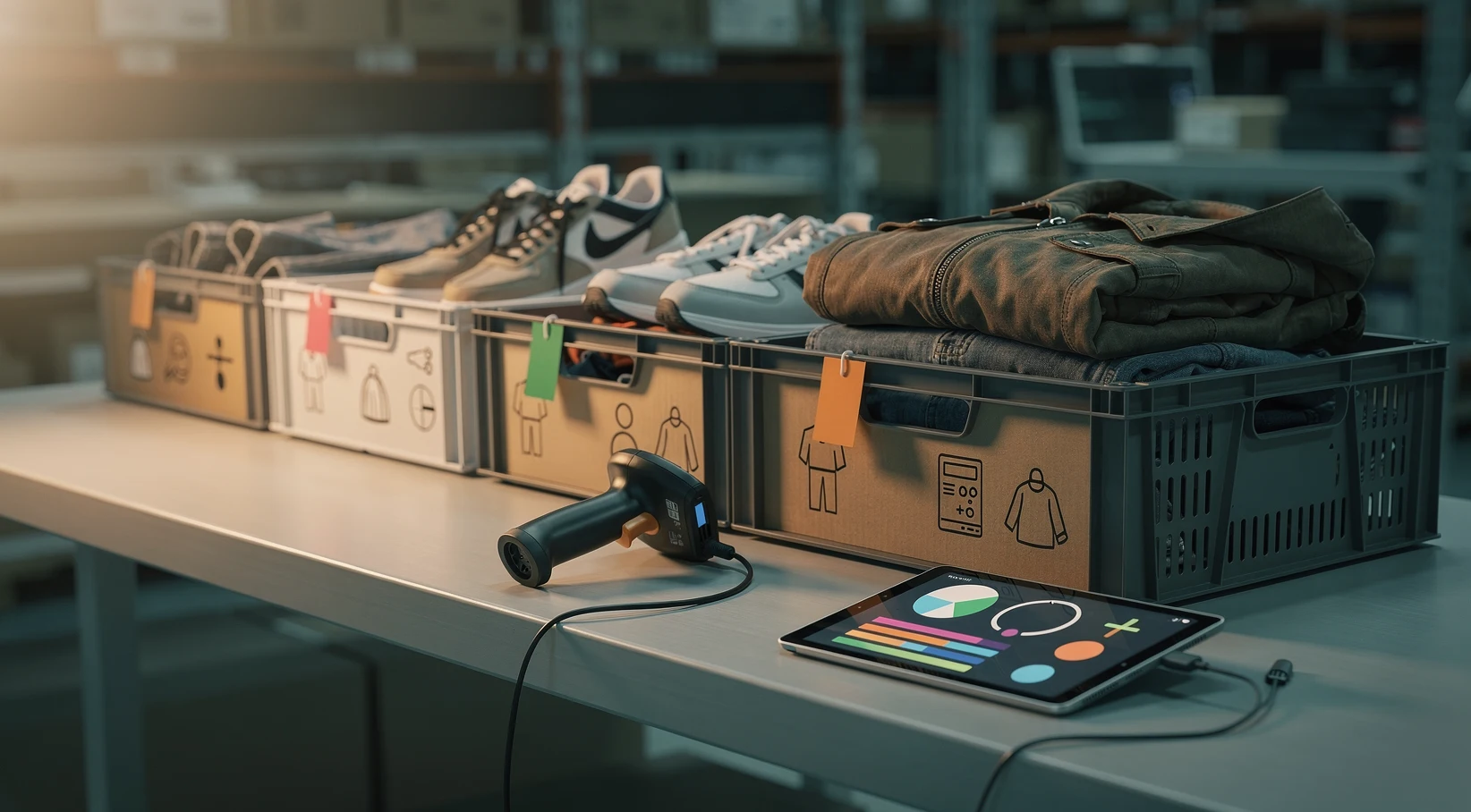
Resale stopped being a sustainability slide and became a line in the P&L. Retailers that once treated used goods as someone else’s business now run intake desks, grading rubrics and dedicated resale inventory. The shift happened quietly, because the operational work looks nothing like buying new stock. This guide covers what recommerce actually is, how the three operating models differ, where the margin hides and what it costs to run the channel properly.
In short
- Recommerce is a channel, not a campaign. It needs its own inventory logic, staffing, pricing rules and returns policy, because every unit is unique and supply arrives from customers rather than from suppliers.
- Three operating models dominate: brand-owned resale, powered resale (a vendor runs the machinery under your brand) and pure marketplace listing. They differ most in capex, control and speed to launch.
- Margin comes from acquisition cost, not price. Trade-in credit is the single biggest lever, and store credit costs less than cash because it returns as a full-price basket.
- Labor is the line nobody forecasts. Intake, authentication, photography and grading run per unit, so cost scales linearly while software costs do not.
- Cannibalization is usually smaller than feared but it is real in some categories, and the honest way to measure it is a holdout test rather than an attribution model.
What recommerce covers and what it does not
Recommerce, short for reverse commerce, is the sale of previously owned goods through a structured commercial channel. The defining feature is that inventory flows backward from the consumer into the retailer, then forward again to a second buyer. That reversal is what breaks conventional retail systems, because nearly every process in a merchandising stack assumes supply arrives as identical units from a vendor.
The category covers several distinct activities that get lumped together. Trade-in programs take goods from a customer in exchange for credit or cash. Branded resale stores sell those goods back under the retailer’s own name. Peer-to-peer marketplaces let customers sell to each other while the platform takes a fee.
Rental, repair and refurbishment sit adjacent to recommerce and share much of the same operating machinery, but they are not the same business. Rental keeps title with the retailer and monetizes time. Repair extends the life of a good the customer already owns. Refurbishment restores function and typically carries a warranty, which changes the legal picture considerably.
What recommerce is not
It is not clearance. Selling last season’s unsold new stock at a discount is markdown management, and it uses the ordinary merchandising stack. Recommerce inventory has been owned and used by a consumer, which introduces condition variance, authentication risk and a different consumer protection regime.
It is not automatically a sustainability program either. Extending the life of a garment or a device does displace some new production, but the environmental case depends on displacement rates that are difficult to prove per transaction. The US Environmental Protection Agency publishes material-specific data on textile waste that is useful for framing the problem, though it does not measure any individual retailer’s displacement effect. Treat sustainability as a genuine co-benefit and a marketing asset, not as the financial justification.
Why the definition matters operationally
Each activity implies a different inventory model. Trade-in creates owned inventory with a cost basis you set. Marketplace listing creates no inventory at all and generates fee revenue instead of gross margin. Consignment sits in between, with goods on your floor that you do not own.
Finance teams routinely get this wrong in the first year. A consignment model booked as owned inventory inflates the balance sheet and distorts turn calculations. Decide the accounting treatment before the first unit arrives, not after the auditors ask.
The three operating models: owned, powered and marketplace
Almost every recommerce program in the market is a variation on three structures. Choosing between them is the single most consequential decision, because it sets your capex, your control over the customer relationship and your realistic launch date. The wave of consolidation among resale technology vendors has narrowed the field further, a dynamic covered in our analysis of recommerce consolidation through H2 2026.
Brand-owned resale
The retailer takes possession, grades, prices, lists and fulfills. Everything runs on internal systems and internal staff, usually in a dedicated intake facility or a back-of-store bench. Control is total, and so is the cost.
This model makes sense when the category carries high average selling prices, when authentication is a competitive moat, or when customer data from the trade-in is strategically valuable. Luxury, premium footwear, sporting equipment and consumer electronics tend to fit. Low-ticket apparel usually does not, because the per-unit handling cost swamps the resale price.
Powered resale
A specialist vendor runs intake, grading, photography, listing and fulfillment, while the storefront carries the retailer’s brand. The retailer supplies traffic, trust and the trade-in offer. The vendor supplies the machinery and takes a share of revenue or a per-unit fee.
Powered resale is how most brands launch, and for good reason. Time to market drops from roughly 12–18 months to something closer to 8–16 weeks, and capex is near zero. The trade is margin share and a dependency on a third party for a customer-facing experience.
Marketplace listing
The retailer facilitates customer-to-customer sales, handles payments and takes a commission. No inventory is owned, no grading is performed and liability for condition largely sits with the seller, subject to platform policy and applicable law. Revenue is fee income at very high incremental margin.
The catch is trust. Without authentication or grading, dispute rates rise, and a bad transaction reflects on the retailer’s brand even when the retailer never touched the goods. Platforms that succeed here invest heavily in seller verification, dispute resolution and buyer protection funds.
| Dimension | Brand-owned | Powered | Marketplace |
|---|---|---|---|
| Who holds inventory | Retailer | Vendor (usually) | Nobody, the seller ships |
| Typical time to launch | 12–18 months | 8–16 weeks | 6–12 months for the platform build |
| Upfront capex | High: facility, systems, staff | Low: integration and creative | Medium: platform and trust tooling |
| Revenue recognition | Gross sales, cost of goods applies | Gross or net depending on contract | Net commission and fees |
| Gross margin profile | 50% to 70% before handling | Shared with the vendor | Fee take rate, often 8% to 20% |
| Control of customer data | Full | Contractual, often partial | Full on platform, thin on product |
| Authentication burden | Retailer owns the risk | Vendor owns the risk | Distributed, policy dependent |
| Best fit | High ASP, moat categories | Fast entry, testing demand | Large existing traffic base |
Hybrid structures
Plenty of operators mix models by category. A premium outerwear line runs brand-owned because authentication matters and prices support the labor. The route-by-route comparison of brand-owned resale versus ThredUp and Poshmark sets out how the fees and the workload differ. Basics go to a marketplace tier where the retailer never touches the goods.
Hybrids are operationally harder but commercially sensible. The rule of thumb is simple: own the units where handling cost is a small fraction of resale price, and refuse to own the rest.
Where the margin comes from in used goods
New retail margin is a spread between a negotiated wholesale cost and a list price. Recommerce margin is a spread between an acquisition cost you set yourself and a market-clearing price you mostly do not control. That inversion is the whole game.
Because you set the acquisition cost, the trade-in offer is the primary margin lever. Offer too little and supply dries up. Offer too much and you buy inventory you cannot sell profitably, which is a mistake that only becomes visible two quarters later when aged units start to pile up.
Store credit versus cash
Paying trade-in value in store credit rather than cash improves the economics twice. The nominal credit costs the retailer its gross margin rate rather than face value, so a $50 credit at a 55% gross margin costs roughly $22.50 in real terms. It also drives a return visit, and redemption baskets are frequently larger than the credit itself.
The standard structure is a credit premium: offer 20% to 40% more value in store credit than in cash. Customers self-select, supply grows and the blended acquisition cost falls. Track breakage separately, because unredeemed credit is a liability with its own accounting treatment and, in many US states, unclaimed property rules may apply.
Sell-through rate is the hidden variable
A used unit either sells or becomes dead stock, and there is no vendor to take it back. Sell-through within 90 days is the metric that decides whether the channel works. Programs that hit 70% or better at 90 days generally make money, while programs below 50% usually do not, regardless of headline gross margin.
Aged inventory in recommerce depreciates faster than new stock, especially in electronics where a new model release resets the whole price curve. Build a markdown ladder from day one and enforce it automatically. Discretionary markdowns applied by humans always run late.
The margin stack in practice
| Line item | New unit (illustrative) | Resold unit (illustrative) |
|---|---|---|
| Selling price | $120.00 | $58.00 |
| Acquisition or COGS | $54.00 wholesale | $17.00 credit at cost |
| Inbound freight | $2.50 | $4.00 prepaid label |
| Intake, grading, photography | $0.40 pooled | $8.50 per unit |
| Cleaning or refurbishment | $0.00 | $3.00 |
| Outbound fulfillment | $6.00 | $6.00 |
| Returns provision | $8.40 at 7% | $5.80 at 10% |
| Payment and platform fees | $3.40 | $1.70 |
| Contribution | $45.30 | $12.00 |
| Contribution margin | 37.8% | 20.7% |
These figures are illustrative rather than benchmark data, and they will move sharply by category. The structural point survives the specifics: a resold unit carries a much better gross margin and a much worse cost-to-serve. Everything hinges on whether per-unit handling can be pushed below the point where contribution turns negative. If you have not built a channel-level view of this, our guide to contribution margin by channel sets out the reporting structure.
Intake, grading and the labor cost nobody forecasts
The financial model usually survives contact with reality. The labor model usually does not. Every used unit needs a human decision at least once, and that decision cannot be pooled across a pallet the way receiving a new purchase order can.
What actually happens at intake
A unit arrives, gets identified against a catalog, gets inspected for defects, gets assigned a condition grade, gets cleaned or repaired if warranted, gets photographed, gets priced and gets listed. In a mature operation that chain runs 6–12 minutes per unit for apparel and considerably longer for electronics or anything requiring authentication. At a fully loaded labor rate of $22 to $28 per hour, that is roughly $3 to $6 of pure touch time before overhead.
The trap is that this cost is fixed per unit while resale prices vary enormously. A $200 jacket absorbs eight minutes of handling comfortably. A $14 t-shirt never will, no matter how efficient the bench becomes.
Grading is a pricing system, not a quality check
A grading rubric exists to make prices predictable and disputes rare. Most operators run four or five tiers, and the discipline that matters is consistency between graders rather than granularity. Two people looking at the same jacket must land on the same grade at least 90% of the time, or returns and complaints climb.
| Grade | Definition | Typical price index | Expected return rate |
|---|---|---|---|
| Like new | No visible wear, tags may be present | 60% to 75% of new retail | Low |
| Excellent | Minor wear, no defects, fully functional | 45% to 60% | Low |
| Good | Visible wear, all defects disclosed and photographed | 30% to 45% | Moderate |
| Fair | Significant wear, functional, priced to move | 15% to 30% | High |
| Reject | Fails standard, routed to recycling or bulk | Salvage value only | Not listed |
Photograph every disclosed defect and attach the image to the listing. Disclosure is the cheapest returns-reduction tool available, and it is also the safest posture under consumer protection rules that penalize misleading descriptions. Under-describing condition converts a sale into a return plus a refund plus a re-listing cost.
Reverse logistics and the returns problem
Recommerce return rates typically run above new-goods rates because expectations are harder to set. When a used unit comes back, it needs re-grading and re-listing, which means paying the intake cost twice on the same item. That double cost is why disclosure quality matters so much more here than in new retail.
For low-value units, the arithmetic sometimes favors not taking the item back at all. The logic is the same one that applies in new retail, set out in our piece on returnless refunds and when writing off a return is cheaper. Apply it carefully in resale, because a returnless refund permanently destroys a unit that had residual value.
Where automation genuinely helps
Catalog matching, price recommendation and image background processing automate well. Condition assessment, authentication and defect detection remain stubbornly human for most categories, despite steady progress in computer vision. Budget for automation to cut roughly 20% to 35% of touch time, not to eliminate the bench.
Cannibalization: does resale eat new product sales
This is the question that stalls recommerce programs in the approval stage, usually raised by whoever owns the new-goods margin. The honest answer is that cannibalization exists, is category dependent and is almost always smaller than the internal fear. It is also measurable, which means the argument does not have to be settled by opinion.
Why the effect is usually modest
Used buyers and new buyers frequently are not the same person at the same moment. A shopper choosing a $58 used jacket over nothing at all is incremental revenue. A shopper who buys used because a new unit was unavailable in their size is a recovered sale, not a lost one.
Trade-in changes the picture further, because the credit is spent on new product. In several published brand programs, trade-in participants have gone on to spend more in total over the following year than non-participants, though selection effects make those figures hard to read as pure causation. Loyal customers trade in, and loyal customers spend more anyway.
Where cannibalization is real
Three conditions raise the risk materially. First, when the used unit is functionally identical to the new one, which is common in electronics and rare in fashion. Second, when the price gap is narrow, roughly under 30%, so the used unit is a direct substitute rather than a different value proposition. Third, when the same customer sees both options in the same session with equal prominence.
Merchandising fixes most of this. Separate the resale surface from the new-product surface, avoid placing used units in new-product search results by default, and keep the price gap wide enough that the choice is genuinely different.
How to measure it properly
Attribution models will not answer this question, because they cannot observe the counterfactual. A geographic or store-level holdout is the practical alternative: launch resale in a matched set of markets, hold back a control set and compare new-product sales growth across both over a full season. It is slower and far more credible.
Set the success criterion before the test starts. If new-product sales in resale markets grow within one point of control markets while total revenue rises, the channel is accretive and the argument is over.
Customer behavior: who buys used and who trades in
Buyers and sellers in recommerce are different populations with different motivations, and programs that assume they are the same tend to underinvest in one side. Supply acquisition is usually the harder problem, because sellers must be persuaded to do physical work.
The buy side
Used buyers split roughly into three motivations: price access to a brand they could not otherwise afford, treasure hunting for scarce or discontinued items, and values-driven purchasing where reuse itself is the point. The first group is the largest and the least loyal. The second group is the most valuable, because scarcity supports price and repeat visits.
Younger cohorts over-index on secondhand purchasing, but the behavior has spread well beyond them, particularly in electronics and home goods. The broader demand picture and what it means for assortment is covered in our overview of the state of consumer behavior in retail and e-commerce. Treat generational framing as a starting hypothesis and validate it against your own transaction data.
The sell side
People trade in for three reasons: they want the money, they want the closet space, or they want the disposal to feel responsible. Friction kills all three. Every extra step in a trade-in flow reduces completion sharply, and printing a label at home is a meaningful barrier for a large share of customers.
The highest-converting programs share four traits. An instant quote before any commitment, a prepaid label or in-store drop-off, a credit premium over cash, and a clear promise of when the credit lands. Anything that requires the customer to guess at value before committing suppresses volume.
What supply seasonality does to the model
Trade-in volume spikes in January and after major product launches, then falls away. Demand for used goods does not follow the same curve, so inventory builds and clears unevenly. Plan intake labor as a flexed resource rather than a fixed headcount, and be prepared for the storage cost of holding January supply until it clears.
Regulation, warranties and consumer protection on used goods
Used goods do not sit outside consumer law, and the assumption that “sold as seen” removes obligations is one of the more expensive misunderstandings in the category. Rules vary substantially by jurisdiction and they change, so the specifics below are orientation rather than a compliance checklist.
Warranties and disclosure in the United States
In the US, the Federal Trade Commission enforces the Magnuson-Moss Warranty Act, which governs how written warranties on consumer products must be presented, including on used goods where a warranty is offered. The FTC publishes business guidance on federal warranty law that sets out the disclosure obligations. Separately, implied warranties under state law may apply unless validly disclaimed, and the rules for disclaiming them differ by state.
Condition claims are advertising claims. Describing a unit as “excellent” or “refurbished” creates an expectation, and the FTC treats deceptive or unsubstantiated product claims as an enforcement matter. This is the practical reason to define grades publicly and photograph disclosed defects.
The European picture
In the European Union, the Sale of Goods Directive (Directive (EU) 2019/771) sets a general conformity guarantee period, and it permits member states to allow a reduced period for second-hand goods where the parties agree, subject to a floor set in the Directive. Implementation differs by member state, so the applicable period depends on where the sale takes place. The European Commission publishes the consolidated text and national implementation details, and those sources should be checked before any policy is written.
Adjacent EU rules matter too. Repairability and spare-parts obligations are expanding, a direction we cover in our explainer on right to repair laws and what they change for retailers. Those obligations interact with refurbishment programs, because a retailer that repairs and resells may take on duties it did not have as a pure reseller.
Category-specific obligations
Some categories carry rules that apply regardless of whether the good is new or used. Electrical safety, battery handling and shipping restrictions apply to used electronics. Children’s products, car seats and safety equipment attract particular scrutiny in many jurisdictions, and some are effectively unsalable secondhand. Counterfeit exposure is a genuine legal risk in branded goods, which is one reason authentication is treated as a control function rather than a nice-to-have.
Data handling is its own obligation. Traded-in phones, laptops and connected devices arrive carrying personal data, and a documented, verifiable wipe procedure is a baseline requirement rather than a best practice.
A necessary disclaimer
This article is general information and commentary for retail operators. It is not legal, tax or customs advice, and it does not account for your jurisdiction, your contracts or your specific facts. Rules, thresholds and effective dates change frequently, and every figure or rule referenced here should be verified against the relevant official source, such as the FTC, the European Commission or your national regulator. Before launching a resale, trade-in or refurbishment program, consult a licensed attorney, tax advisor or the relevant regulator about your particular situation.
Building the business case with realistic numbers
Most recommerce business cases fail review for the same reason: they model gross margin and ignore cost-to-serve. A model that survives scrutiny starts from units and touch time, then works up to revenue.
The five inputs that decide the outcome
- Trade-in participation rate. What share of your active customers will actually send something in during a year. Early programs frequently land between 1% and 4%, not the double digits assumed in optimistic decks.
- Units per participant. Whether a trade-in event yields one item or a bag of eight changes the fixed-cost absorption per shipment dramatically.
- Acceptance rate at intake. The share of received units that clear your condition standard. Rejects still cost freight and handling, and they still have to be disposed of.
- Sell-through at 90 days. The single strongest predictor of whether the channel makes money.
- Fully loaded touch time per unit. Not the best case on a good day, the average including training, rework and supervision.
Sizing the operation honestly
Work the arithmetic in both directions. If the plan calls for 50,000 units in year one at nine minutes of touch time, that is 7,500 hours, or roughly four full-time equivalents before absence, training and supervision. Add facility space at about 0.4 to 0.8 square feet of active storage per apparel unit in flow, and the “we will just use the back room” plan usually collapses at that point.
Storage duration is the variable that surprises people. Units that sit for 120 days occupy space that was budgeted for 45, and the resulting congestion slows intake, which slows listing, which further slows sell-through. That feedback loop is the most common failure mode in year two.
What good looks like at maturity
A functioning brand-owned program typically shows contribution margin somewhere in the mid-teens to mid-twenties as a percentage, sell-through above 70% at 90 days, grading consistency above 90% and a return rate within a few points of the new-goods channel. Powered programs show thinner net margin but far better return on invested capital, because the capex never happened. Marketplace models show high percentage margins on a much smaller revenue base.
Judge the channel on contribution dollars and on its effect on total customer value, not on gross margin percentage. A channel that returns 20% contribution while lifting new-product spend among participants is a good channel, even though its margin percentage looks worse than the core business.
How to run a 90-day recommerce pilot without rebuilding the stack
The fastest way to resolve an internal argument about resale is to run a bounded test that produces real numbers. A pilot is not a small version of the full program, it is an instrument for measuring the five inputs above.
Scope it deliberately narrow
Pick one category with high average selling price and low authentication complexity. Pick a limited set of stores or a single region so you retain a control group. Cap total units at a number your bench can absorb without hiring, typically a few thousand.
Use a powered vendor or a manual bench rather than building systems. The pilot exists to test demand and unit economics, not integration architecture. Building software before you know the acceptance rate is the most common way to waste a year.
Instrument it before launch
Decide in advance what you will measure and where the numbers come from. Log touch time per unit by hand if necessary, and record rejects with reasons, because reject analysis is what improves the trade-in quote. Track credit redemption rate and the basket size on redemption, since that is where most of the financial case actually lives.
Set a stop rule too. If sell-through at 60 days is under 40% and the trend is flat, the category is wrong and the honest move is to change category rather than to add marketing spend.
What to do with the results
A successful pilot gives you a defensible unit economic model and an internal answer on cannibalization. That combination is what unlocks capital for a permanent operation. A failed pilot is also useful, provided the failure is diagnosed at the input level rather than written off as “resale does not work for us.”
FAQ on recommerce
What does recommerce mean?
Recommerce, short for reverse commerce, is the structured resale of previously owned goods, usually through trade-in programs, branded resale storefronts or peer-to-peer marketplaces. The defining feature is that inventory flows backward from consumers into a retail channel before being sold again.
Is recommerce profitable for retailers?
It can be, but profitability depends far more on per-unit handling cost and sell-through than on gross margin percentage. Programs that keep touch time low, maintain sell-through above roughly 70% at 90 days and pay trade-in value in store credit are the ones that generate positive contribution.
Does resale cannibalize new product sales?
Some cannibalization occurs, particularly in electronics and wherever the used unit is a near-identical substitute at a narrow price gap. In most apparel and lifestyle categories the effect is modest, and trade-in credit tends to return as new-product spend. The only reliable way to measure it is a market-level holdout test rather than an attribution model.
Should a brand build resale in-house or use a vendor?
Most brands should start with a powered vendor, because it cuts launch time to weeks instead of a year and requires almost no capex. Building in-house makes sense once volume is proven and the category has high average selling prices or authentication requirements that justify owning the process.
How should used goods be priced?
Price as an index to current new retail price, adjusted by condition grade, then let a scheduled markdown ladder handle anything that does not sell. Fixed price lists age badly, because the reference price for a used unit moves whenever the new product is discounted or replaced.
What warranty applies to secondhand goods?
It depends entirely on jurisdiction. In the United States, the Magnuson-Moss Warranty Act governs written warranties where one is offered, and state law governs implied warranties and how they may be disclaimed. In the European Union, Directive (EU) 2019/771 sets a conformity guarantee and permits member states to allow a shorter agreed period for second-hand goods. Verify the current position with the FTC, the European Commission or your national regulator, and take legal advice before writing policy.
How long does it take to launch a resale program?
A powered program with a vendor typically launches in 8–16 weeks. A brand-owned operation with its own facility, systems and staff is realistically a 12–18 month project. A pilot that answers the economic questions can run in 90 days.
What is a realistic trade-in participation rate?
Early programs commonly see 1% to 4% of active customers trading in during a year, rising with promotion, store drop-off options and a credit premium over cash. Rates far above that usually indicate either an unusually engaged customer base or a quote generous enough to be worth checking against margin.
Which categories work best for recommerce?
High average selling price, durable, brand-recognizable goods work best: outerwear, premium footwear, handbags, sporting equipment, consumer electronics and furniture. Low-ticket basics rarely work, because the per-unit intake and grading cost consumes the entire resale value.
The bottom line
Recommerce is now a real retail channel with its own operating model, and the retailers doing well in it treat it that way. The decisions that matter are structural: which operating model, which categories, what the trade-in quote is and how fast a unit moves through the bench. Get those right and the sustainability story becomes a genuine co-benefit rather than the justification. Get them wrong and the channel quietly consumes labor, space and capital while producing an impressive-looking gross margin percentage on very few dollars.