
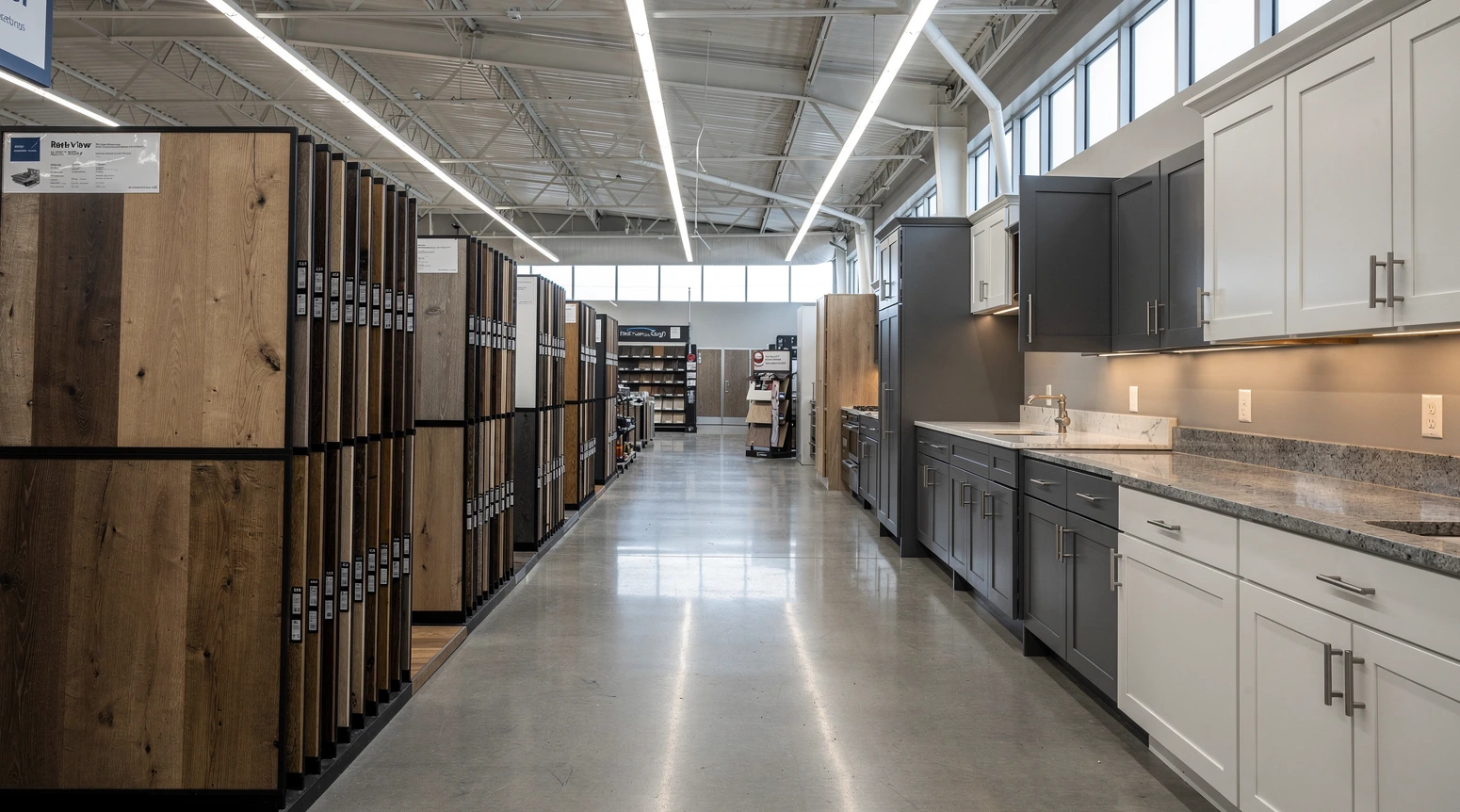
Neighborhood Intelligence, Inc., the Nasdaq-listed owner of Bed Bath & Beyond, Overstock and The Container Store, has walked away from its agreement to buy F9 Brands, the parent of Lumber Liquidators and Cabinets To Go. The company said the seller failed to satisfy the closing conditions attached to the roughly $150 million transaction. Retail Dive reported the termination on September 8, and Inside Retail US carried it the following day.
The deal was announced on April 8, 2026 and was designed to give the buyer a national installed-products platform spanning cabinets, flooring, closets and building-products distribution. Its collapse leaves the acquirer with the services ambition intact and the largest piece of the assembly missing.
In short
- What happened: Neighborhood Intelligence canceled its agreement to acquire F9 Brands, owner of Lumber Liquidators and Cabinets To Go, a transaction valued at about $150 million when announced in April 2026.
- Stated reason: the seller could not satisfy the closing conditions within the contemplated timeframe, according to statements attributed to executive chairman and CEO Marcus Lemonis. No price dispute or regulatory objection has been reported.
- What was lost: roughly $522 million in F9 net delivered sales for fiscal 2025, more than 200 Lumber Liquidators stores, more than 100 Cabinets To Go stores, and a wholesale channel serving about 4,400 independent retailers and contractors.
- Tariff overlay: cabinets, vanities and upholstered wooden furniture carry a 25% Section 232 duty today, with an increase to 50% (cabinets and vanities) and 30% (upholstered wooden furniture) deferred to January 1, 2027.
- What remains: the buyer keeps Elfa, Closet Works and SFV Construction Services, and says it will continue the home services strategy through the brands it already owns.
What exactly did Neighborhood Intelligence call off?
The terminated transaction is the acquisition of F9 Brands, a privately held group of home-improvement and building-products businesses. F9 Brands is the operating arm associated with F9 Investments, the Miami Beach investment firm run by Tom Sullivan, who founded Lumber Liquidators in 1994. The agreement was signed in April 2026 and had been expected to close after the buyer’s annual shareholder meeting in May, per the company’s own announcement of the transaction.
Neighborhood Intelligence confirmed the termination in early September. Per statements attributed to Lemonis, the decision rested on unmet closing conditions rather than on a change of view about the sector. “We evaluate opportunities continuously, and this is one of many transactions we considered that we elected not to pursue,” Lemonis said, according to Retail Dive.
Inside Retail US carried a second quote framing the choice in capital-allocation terms. “Disciplined capital allocation and protecting shareholder value are central to how we evaluate every transaction,” Lemonis said. Neither the buyer nor the seller has publicly identified which specific conditions went unmet.
The consideration was mostly paper, not cash
The structure matters for reading the outcome. According to the April announcement, the headline figure of roughly $150 million broke down into about $37 million in cash and approximately 16 million buyer shares, valued in the release at around $107 million. A further $25 million was structured as a one-time earnout payable if F9 reached $20 million of EBITDA within five years.
Roughly $40 million of existing lender financing was also to roll into the combined entity. That means the cash outlay at closing was a small fraction of the headline number, and the bulk of the consideration was equity whose value moved with the buyer’s own share price between April and September.
A stock-heavy deal cuts both ways. It conserves cash for a company that is still loss-making at the adjusted EBITDA line, but it also makes the seller’s economics sensitive to the acquirer’s trading performance during a long signing-to-closing gap.
Why do closing conditions kill deals that price agreement does not?
Closing conditions are the contractual gates that must be cleared between signature and completion. They typically cover audited financial statements, third-party consents, lender and landlord approvals, the accuracy of representations at closing, and the absence of a material adverse change. A signed agreement is a commitment to complete only if those gates open.
In multi-brand carve-outs of the kind F9 represents, consents are usually the binding constraint. A group assembled from bankruptcy purchases and separate operating companies carries leases, supplier agreements, franchise-style arrangements and asset-based lending facilities that each may require counterparty sign-off before a change of control.
Nothing in the public record indicates a regulatory problem. No antitrust challenge has been reported, which is consistent with the modest overlap between the buyer’s existing store base and F9’s flooring and cabinet formats. Sellers preparing for this kind of process usually spend a year cleaning up exactly these items, a discipline covered in our guide to preparing a retail brand for due diligence.
The five-month gap was unusually long
Signing in April with an expected close after a May annual meeting implied a short runway. The deal instead ran into September before being abandoned. Extended gaps raise the probability that a condition fails, because the target keeps trading and its financial position keeps moving.
For a business exposed to housing turnover and big-ticket discretionary spend, five months is a meaningful stretch of trading. Any covenant tied to a minimum EBITDA level, a working-capital floor or an inventory valuation becomes harder to satisfy in a soft demand period.
What a material adverse change clause actually requires
Most purchase agreements let a buyer walk if the target suffers a material adverse change between signing and closing. The bar is deliberately high, and courts in Delaware have historically been reluctant to find one, requiring a durationally significant deterioration rather than a bad quarter.
That reluctance is why acquirers rarely rely on the clause alone. It is far more common for a deal to fail on a specific, checkable condition: a consent that never arrived, a financial statement that could not be delivered in the agreed form, or a covenant that the target could not meet on the closing date.
The public language here points to the checkable kind. Describing the seller as unable to satisfy conditions within the contemplated timeframe frames the problem as delivery and timing, not as a dispute about whether the business deteriorated.
What is F9 Brands and why was it worth $150 million?
F9 Brands is not a single retailer. It is a collection of home-improvement assets built up under Tom Sullivan, most of them acquired at distressed valuations. Its fiscal 2025 net delivered sales were approximately $522 million, according to the April announcement.
The group’s chief executive, Jason Delves, was named to lead the buyer’s home services division under the terminated agreement. The April release credited Delves with growing F9 from about $145 million in sales in 2019 to the $522 million reported for fiscal 2025.
Lumber Liquidators: a bankruptcy estate reassembled
The flooring business is the best-known piece. LL Flooring Holdings filed for Chapter 11 protection in August 2024 with 430 stores. F9 Investments acquired 219 of those stores plus the intellectual property for cash consideration reported in the range of $40 million to $43 million, while 211 stores were closed.
F9 agreed to preserve jobs for up to 1,000 store employees and reverted the banner to its original Lumber Liquidators name. Sullivan had been a public critic of the company’s management for years before buying it back out of bankruptcy.
The commercial logic of that purchase was simple. A going-concern flooring chain with a recognized name and roughly half its former footprint was bought for a fraction of what it would have cost to build.
Cabinets To Go and the wholesale channel
Cabinets To Go operates more than 100 stores and is positioned as a national specialty retailer of cabinets, countertops and related accessories. Southwind Building Products supplies roughly 4,400 independent retailers and contractors, giving the group a wholesale distribution arm alongside its own stores.
Gracious Home and Thos. Baker sit at the higher end of the portfolio in home decor and outdoor furnishings. Combined inventory across the group was described as roughly $130 million at the time of the announcement.
| Component | What it is | Scale disclosed in April 2026 |
|---|---|---|
| Lumber Liquidators | Hardwood and waterproof flooring retail | More than 200 stores |
| Cabinets To Go | Cabinets, countertops, accessories | More than 100 stores |
| Southwind Building Products | Wholesale building-products distribution | About 4,400 independent accounts |
| Gracious Home / Thos. Baker | Home decor and outdoor furnishings | Not separately disclosed |
| Group total | F9 Brands, fiscal 2025 | About $522m net delivered sales; about $130m inventory |
How did the tariff regime change the value of these assets?
Every category in the F9 portfolio sits inside the Section 232 wood products action. A proclamation issued on September 29, 2025 set a 25% tariff on certain upholstered wooden furniture, kitchen cabinets and vanities. The rate was scheduled to rise to 50% on January 1, 2026.
That escalation did not happen on schedule. A proclamation signed on December 31, 2025 deferred the increase by a year. Cabinets and vanities are now set to move to 50% and upholstered wooden furniture to 30% on January 1, 2027.
For a buyer signing in April 2026, that timetable placed the acquisition roughly nine months ahead of a step-change in landed cost on the group’s core categories. Cabinets To Go and Southwind both sell into exactly the tariff lines involved.
The same clock is squeezing listed home-furnishings retailers
The pressure is not specific to F9. Public home-furnishings names are managing the same deferral, as we covered in the run-up to RH’s second-quarter report and the 25% furniture tariff, which lands in the last full quarter before the step-up.
Retailers with heavy import exposure have spent 2026 pulling forward inventory, renegotiating vendor terms and shifting sourcing. Those actions cost working capital, and working capital is precisely what a leveraged carve-out has least of.
| Category | Section 232 rate now | Scheduled from January 1, 2027 | Relevant F9 exposure |
|---|---|---|---|
| Kitchen cabinets and vanities | 25% | 50% | Cabinets To Go, Southwind |
| Upholstered wooden furniture | 25% | 30% | Gracious Home, Thos. Baker |
| Timber and lumber derivatives | Covered by the same action | Subject to the deferred schedule | Lumber Liquidators, Southwind |
Who actually absorbs the duty on a cabinet sale?
Tariffs are paid by the importer of record, which in these formats is usually the retailer or its distribution arm. Whether the cost reaches the shelf depends on category elasticity and on how much of the assortment is domestically produced.
Kitchen cabinets are a considered purchase tied to a project budget, so shoppers tend to trade down within the category rather than abandon the project. That behavior protects unit volumes and compresses gross margin, which is the harder of the two outcomes for a leveraged operator.
Flooring behaves differently because substitution across materials is easier. A customer facing a higher price on engineered hardwood can move to luxury vinyl plank without changing the project scope, which shifts mix rather than reducing revenue.
A retailer that sells both categories can steer that substitution and keep the customer. That cross-category hedge was one of the more durable arguments for combining Cabinets To Go and Lumber Liquidators under a single owner.
None of this proves the tariff schedule caused the termination. The stated reason was unmet closing conditions. But it does explain why a lender or a landlord reviewing a change-of-control request in mid-2026 might have asked harder questions than the same party would have asked in 2024.
What does the buyer still own after walking away?
Neighborhood Intelligence retains a portfolio assembled through a rapid sequence of acquisitions. It includes Bed Bath & Beyond, Overstock, buybuy BABY, Kirkland’s, The Container Store, Elfa and Closet Works. Kirkland’s Home was acquired for about $10 million.
On the services side, the company keeps Elfa and Closet Works in storage and organization, plus SFV Construction Services for installation. The company said it will continue to build the home services strategy around those assets.
What it does not have is the anchor. Flooring and cabinets are the two highest-ticket, highest-attach categories in a residential remodel, and both were to arrive with existing store networks and installer relationships.
Closets are a category, not a platform
Elfa and Closet Works are credible in storage systems, but the addressable spend in a closet project is a fraction of a kitchen or a whole-floor replacement. Building a “concept to completion” proposition without cabinets or flooring means either sourcing those categories through third parties or acquiring them later at a different price.
Installation capacity is the other gap. SFV Construction Services provides a base, but F9 would have brought contractor relationships attached to roughly 4,400 wholesale accounts, which is a distribution asset that is slow and expensive to replicate.
Why does the corporate name keep changing?
The buyer has carried three identities in a short span. It traded as Beyond, Inc. under the ticker BYON, then renamed itself Bed Bath & Beyond, Inc. with the ticker BBBY, and on August 14, 2026 amended its certificate of incorporation in Delaware to become Neighborhood Intelligence, Inc. Nasdaq trading under the ticker NXH began on August 17.
The company is also relocating its headquarters from Murray, Utah to Nashville, Tennessee. Management has described three strategic pillars: omnichannel retail, home services and home ownership.
The third pillar explains the naming shift. The company announced definitive agreements in June 2026 to acquire Fathom Holdings, a technology-driven residential real estate brokerage, which pushes the business beyond merchandise into the transaction that precedes most home spending.
| Period | Corporate name | Ticker | Positioning |
|---|---|---|---|
| Through 2025 | Beyond, Inc. | BYON | Online marketplace holding company |
| 2025 to August 2026 | Bed Bath & Beyond, Inc. | BBBY | Banner-led home retail |
| From August 14, 2026 | Neighborhood Intelligence, Inc. | NXH | Retail, home services and home ownership |
Can the balance sheet support this kind of buying?
The most recent reported quarter shows a business improving on the top line but still short of profitability. Second-quarter fiscal 2026 revenue was $361.2 million, up 28% year over year, and the second consecutive quarter of growth after nineteen quarters of decline.
Gross margin expanded 310 basis points to 26.8%, producing gross profit of about $97 million. Adjusted EBITDA was negative $12.2 million, a decline of $4.1 million from the prior year, and the adjusted diluted loss per share was $0.53.
Lemonis has told investors the company can remove more than $50 million of annualized cost over twelve months by consolidating businesses onto one platform, eliminating non-performing assets, and cutting duplicative third-party software agreements and locations. The company has also filed for a $200 million stock sale.
Growth is being bought, not generated
The 28% revenue increase reflects acquisitions rather than a like-for-like recovery in the legacy banners. That is a legitimate strategy, but it makes the cost of equity the binding constraint, because each deal is largely paid for in shares.
Against a negative adjusted EBITDA line, adding a $522 million revenue business with its own $40 million of lender financing would have moved the leverage profile materially. Declining to complete a stock-funded deal is consistent with the capital-discipline language the company used.
| Metric | Q2 FY2026 | Year-over-year change |
|---|---|---|
| Net revenue | $361.2m | Up 28% |
| Gross margin | 26.8% | Up 310 basis points |
| Gross profit | About $97m | Higher |
| Adjusted EBITDA | Negative $12.2m | Down $4.1m |
| Adjusted diluted EPS | Loss of $0.53 | Loss |
What happens now to Lumber Liquidators and Cabinets To Go?
Both chains remain under F9 ownership. Nothing in the reported statements indicates store closures, and the businesses were trading normally through the signing period. For customers and store staff, the immediate practical effect is continuity.
The strategic position is less comfortable. A seller that runs a public sale process and does not complete usually finds the next round harder, because prospective buyers ask why the first one failed and price that uncertainty in.
F9 also loses the balance-sheet benefit the transaction would have delivered. Rolling roughly $40 million of lender financing into a larger listed parent would have changed the refinancing conversation for a group built from distressed purchases.
Suppliers and landlords will re-underwrite
Vendors extending trade credit to Cabinets To Go and Lumber Liquidators had a reasonable expectation that a listed counterparty was arriving. That expectation is now withdrawn, and credit teams typically respond by tightening terms or shortening payment windows.
Landlords face the same reassessment. Store leases signed or renewed on the assumption of a stronger covenant may now be renegotiated, and stores at the weaker end of the estate become closure candidates in the next lease cycle.
The distressed-buyback playbook has limits
Buying a bankrupt chain from its own founder is a well-tested value trade. The purchase price reflects the estate’s distress, the surviving stores inherit brand awareness that would cost years of marketing to rebuild, and the closed locations take the loss-making leases with them.
The difficulty comes at the exit. A group assembled that way has a short audited history under common ownership, and the pieces were bought at different times under different structures.
That is precisely the profile that makes closing conditions hard to satisfy. Consolidated statements, clean consents and a single lending structure are exactly what a public acquirer needs and what a recently assembled group is least likely to have ready.
How does this compare with other recent home-adjacent retail deals?
The pattern across 2026 has been consolidation attempts meeting financing reality. Terminated and stalled transactions are not unusual in a sector where interest costs, tariffs and soft big-ticket demand all press on the same models at once.
Private equity holders of grocery and specialty assets are running into similar timing problems, which is why we have tracked the likelihood that Heritage Grocers returns to the block rather than clearing a sale in the current window. Sponsors would rather wait than accept a discount.
Cross-border retail M&A has been more resilient where the buyer holds a strategic rather than a financial rationale, as in Seven & i’s move on a Zabka stake. Strategic buyers can absorb a slower payback than a levered platform builder can.
| Feature | Neighborhood Intelligence and F9 | Typical strategic retail deal |
|---|---|---|
| Consideration | Mostly acquirer stock plus small cash | Cash or cash-and-debt |
| Buyer profitability | Negative adjusted EBITDA | Positive operating income |
| Signing to expected close | About one month, ran to five | Three to nine months, planned |
| Target history | Assembled from bankruptcy purchases | Continuous operating history |
| Outcome | Terminated on closing conditions | Usually completes once signed |
What does this mean for the home improvement category?
The category is not collapsing, but it is being repriced. Big-ticket remodel spending responds to housing turnover and financing costs, and both have been unhelpful through 2026.
The large listed players have absorbed that with scale and services. Results from Home Depot’s second quarter and the professional-customer strategy behind Lowe’s $8.8 billion Pro bet show where the volume is going: to operators who can serve contractors, not just walk-in consumers.
That is exactly the position F9 would have handed to Neighborhood Intelligence. Losing it does not remove the strategic logic, it removes the shortcut.
Installed services remain the defensible layer
Product margins in flooring and cabinets are compressed by tariffs and by transparent online pricing. Installation, measurement and project management carry better economics and are far harder for a marketplace to disintermediate.
Any retailer chasing this model needs three things at once: the product, the installer network and the financing. F9 offered two of the three in a single transaction, which is why the price looked defensible even against a loss-making acquirer.
What should the market watch next?
The first item is the Fathom Holdings transaction. If that deal closes on its original terms, the pattern is a company that is selective rather than unable to complete acquisitions.
The second is whether F9 finds another buyer or a refinancing. A quiet recapitalization would suggest the closing conditions were financial; a fresh sale process at a similar price would suggest they were procedural.
The third is the January 1, 2027 tariff step-up. If cabinets and vanities move to 50%, the economics of every cabinet retailer in the United States change, and asset values in the category will be marked accordingly.
The fourth is the buyer’s cost-reduction claim. Removing more than $50 million of annualized cost while integrating a real estate brokerage is a demanding sequence for a management team that has also changed the company’s name, ticker and headquarters within a single year.
A fifth item is the equity currency itself. A company paying for acquisitions largely in stock needs its shares to hold value through each signing-to-closing gap, and a $200 million registered stock sale adds supply into that same window.
Watch also for whether the company reopens talks on any part of the F9 portfolio rather than the whole. Buying Cabinets To Go on its own would be a smaller, cleaner transaction than absorbing a five-brand group with mixed reporting histories.
Finally, the January tariff date interacts with the buying calendar. Any acquirer of cabinet assets will want the deal signed and closed either well before the step-up or well after the market has repriced for it, and the intervening months are the least attractive time to transact.
What a failed deal costs each side
The buyer’s direct costs are advisory fees and management attention, both real but recoverable. The larger cost is strategic: a stated platform ambition now has a visible hole in it, and the next seller knows the company has walked once.
The seller’s position is worse. Running a sale process reveals financial detail to a competitor-adjacent party, unsettles vendors and staff, and consumes a year of management time that was not spent on operations.
Neither side has disclosed a break fee. In transactions where the failure is attributed to the seller’s inability to satisfy conditions, a reverse termination fee payable by the buyer would not normally be triggered.
Frequently asked questions
Who is Neighborhood Intelligence and what was it called before?
It is the Nasdaq-listed parent of Bed Bath & Beyond, Overstock, buybuy BABY, Kirkland’s and The Container Store. It traded as Beyond, Inc. under the ticker BYON, then as Bed Bath & Beyond, Inc. under BBBY, and adopted the Neighborhood Intelligence name on August 14, 2026, with Nasdaq trading under NXH from August 17.
How much was the F9 Brands deal worth?
Approximately $150 million as announced in April 2026. That comprised about $37 million in cash, roughly 16 million acquirer shares valued in the release at about $107 million, and a $25 million earnout contingent on F9 reaching $20 million of EBITDA within five years. Around $40 million of existing lender financing was also to roll into the transaction.
Why was the acquisition canceled?
The buyer said F9 was unable to satisfy the closing conditions within the contemplated timeframe. Executive chairman and CEO Marcus Lemonis framed the decision as routine portfolio discipline, saying the company evaluates opportunities continuously and elected not to pursue this one. No regulatory objection or price dispute has been reported.
What does F9 Brands own?
Lumber Liquidators, Cabinets To Go, Southwind Building Products, Gracious Home and Thos. Baker. The group reported approximately $522 million in net delivered sales for fiscal 2025 and roughly $130 million of inventory at the time of the April announcement.
Is Lumber Liquidators closing stores?
No closures have been announced in connection with the terminated deal. The chain was reassembled by F9 Investments from the LL Flooring Chapter 11 process in 2024, which involved acquiring 219 of 430 stores while 211 were closed at that time. It currently operates more than 200 stores.
How do Section 232 tariffs affect cabinets and flooring?
A proclamation issued on September 29, 2025 applied a 25% tariff to certain upholstered wooden furniture, kitchen cabinets and vanities. A scheduled increase to 50% was deferred by a proclamation signed on December 31, 2025 and is now set for January 1, 2027, with upholstered wooden furniture moving to 30% on the same date.
Does this affect Bed Bath & Beyond or Overstock customers?
No. The terminated transaction concerned a separate group of flooring and cabinet businesses that the company does not own. Existing banners continue to operate unchanged.
What is the Fathom Holdings deal?
Neighborhood Intelligence announced definitive agreements in June 2026 to acquire Fathom Holdings, a technology-led residential real estate brokerage. That transaction underpins the company’s third strategic pillar, home ownership, alongside omnichannel retail and home services.
Is the company profitable?
Not at the adjusted EBITDA line. In the second quarter of fiscal 2026 it reported revenue of $361.2 million, up 28% year over year, gross margin of 26.8%, and negative adjusted EBITDA of $12.2 million, with an adjusted diluted loss per share of $0.53.