
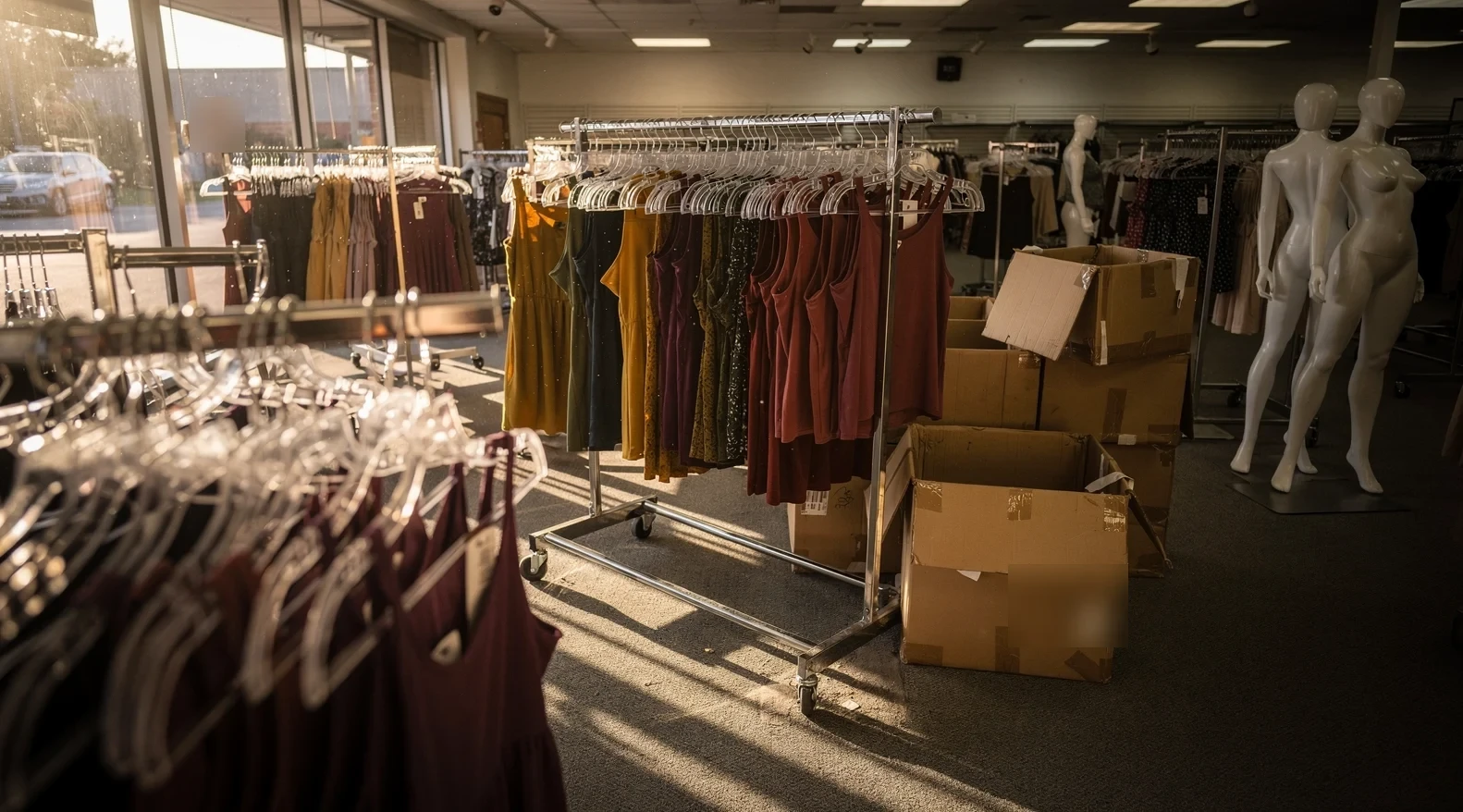
The Cato Corporation, the Charlotte, North Carolina value-fashion chain that has anchored strip malls across the American South for eight decades, will close roughly 120 stores in fiscal 2026 after adding about 70 more closures to its plan on September 18. The company said the additional stores are all at the end of their leases, will cost between $1.0 million and $1.3 million to exit, and will not carry rent into 2027. The figure is roughly triple the “up to 40” closures the retailer guided in March, and it lands six weeks after a second quarter in which net income fell to $1.1 million from $6.8 million a year earlier.
In short
- About 120 closures in fiscal 2026: Cato added roughly 70 stores to its closure list on September 18, on top of the 14 it shut in the first half and the wave already planned for the back half.
- Lease-end exits, not a bankruptcy: every additional store is at the end of its lease; exit costs are $1.0–1.3 million, mostly signage, fixtures and returning store systems to headquarters.
- The reason is the customer’s wallet: CEO John Cato cited “negative pressure on our customers’ discretionary income” and said the marginal stores are not expected to “improve appreciably.”
- Second-quarter numbers explain the timing: sales fell 6% to $163.9 million, same-store sales fell 3.7% and gross margin dropped to 32.8% from 36.2%.
- The tariff refund cushioned the first quarter: a $5.7 million pre-tax IEEPA refund claim lifted Q1 gross margin to 37.2%; that one-off is gone, and the store base is being cut to size.
What did Cato announce on September 18?
In a press release issued at 7:00 a.m. Eastern on September 18 and filed with the SEC as an exhibit to a Form 8-K, The Cato Corporation (NYSE: CATO) said it “plans to close approximately 70 additional underperforming stores in the third and fourth quarters.” Combined with closures already executed or planned, the company put total planned closures at “approximately 120 stores in fiscal 2026.” Cato’s fiscal year ends in late January, so the fourth quarter here runs through January 2027.
The release describes a routine that turned into a purge. Cato reviews roughly one-third of its store portfolio each year, deciding whether to exercise lease options or negotiate extensions based on sales trends and current and projected profitability. In prior years, marginal stores were often renewed for a few more years on the assumption that trading would recover. This year the company decided not to wait.
John Cato, chairman, president and chief executive officer, put it plainly: “In light of the current economic environment, especially with the negative pressure on our customers’ discretionary income, we do not expect these marginal stores to improve appreciably.” He added that the company is “closing more stores than expected this year” and expects the exits to “have a positive impact on our operating results in fiscal 2027 and beyond.”
The cost of walking away
Because each of the roughly 70 additional stores is at lease end, Cato is not paying lease-termination fees. The company expects to spend between $1.0 million and $1.3 million through the end of 2026 to exit them, primarily for disposal of external signage and fixtures and for returning store systems to the corporate office. On shopappy’s arithmetic that is roughly $14,000 to $19,000 per store, a fraction of what a mid-lease exit would cost.
The market read the announcement as clean-up rather than crisis. RTTNews reported the shares trading up 5.88% at $2.52 in the early afternoon of September 18, and Investing.com had them up 5.46% in the premarket minutes after the release. For a stock that has spent most of 2026 near multi-decade lows, a cost-out plan that carries no debt and no rent tail was, for one session at least, welcome news.
How did a 40-store plan become 120?
The escalation tracks the company’s own guidance across three earnings releases. On March 19, reporting fiscal 2025 results, Cato said it planned to open up to 10 new stores and close up to 40 underperforming stores in fiscal 2026. That outlook was already cautious: the company had closed 48 stores in fiscal 2025 and ended the year with 1,069 stores in 31 states, down from 1,117 a year earlier.
By the first quarter, reported on May 21, Cato had opened two stores and closed six, leaving 1,065 stores. The second quarter, reported on August 20, saw another eight closures, taking the count to 1,057 stores as of August 1. That is 14 closures in the first half. Reaching “approximately 120” for the year therefore implies roughly 106 closures in the third and fourth quarters, the vast majority of them concentrated in the holiday period.
Fashion United described the September move as Cato tripling its closure plan for the year. Chain Store Age reported the same numbers under the headline that Cato “cites current economic environment.” TheStreet, which has tracked the chain’s contraction for several years, noted that the retailer’s store count had already fallen by 246 locations over the previous four years before this year’s cuts.
| Date | Event | Store count | Closure guidance for FY2026 |
|---|---|---|---|
| March 19, 2026 | FY2025 results | 1,069 (Jan 31, 2026) | Close up to 40, open up to 10 |
| May 21, 2026 | Q1 results | 1,065 (May 2, 2026) | Unchanged; 6 closed, 2 opened in Q1 |
| August 20, 2026 | Q2 results | 1,057 (Aug 1, 2026) | 8 closed in Q2; “challenging back-half conditions” |
| September 18, 2026 | Additional closures | 1,057 (last reported) | About 70 more in Q3–Q4; about 120 for the year |
Source: company press releases filed with the SEC; shopappy compilation.
If the company executes the full plan and opens no further stores, the chain would finish fiscal 2026 at roughly 950 locations. That would take Cato below 1,000 stores for the first time in many years, a threshold the company has not itself commented on. A guide to how chains decide which stores to close first explains why lease-expiry clusters, rather than a store’s individual sales, tend to set the timing of waves like this one.
What do the second-quarter numbers say?
The closure decision follows a quarter that undid most of the progress Cato reported in the spring. For the second quarter ended August 1, 2026, sales fell 6% to $163.9 million from $174.7 million a year earlier. Same-store sales declined 3.7%. Net income was $1.1 million, or $0.06 per diluted share, compared with $6.8 million, or $0.35 per diluted share, in the second quarter of 2025.
Margins tell the sharper story. Gross margin fell to 32.8% of sales from 36.2%, a 340 basis point decline, while selling, general and administrative expenses rose to 33.0% of sales from 32.8%. When SG&A exceeds gross margin at the quarterly level, a retailer is losing money on operations before interest and other income; Cato’s small profit for the quarter came from the other lines of the income statement.
John Cato’s second-quarter statement anticipated the September decision. Results, he said, “in large part stem from persistent pressure on customer discretionary income from inflation, fuel prices, and elevated interest rates.” The company said it anticipated “challenging back-half conditions.” Four weeks later the closure list grew by 70.
First half: flat comps, a shrinking margin
For the first six months, sales were $333.3 million, down 2.9% from the prior year, with same-store sales flat. First-half net income was $10.5 million, or $0.53 per diluted share, but that figure leans heavily on the first quarter. Gross margin for the half was 35.0% of sales, down from 35.6%, and SG&A was 32.4% of sales.
The balance sheet remains the company’s main defense. Cato reported cash and cash equivalents of $35.1 million and short-term investments of $58.7 million as of August 1, 2026, with inventory of $82.5 million. Stockholders’ equity stood at $157.3 million at the end of fiscal 2025. There is no bankruptcy story here; there is a retailer with cash, no meaningful debt disclosed in its releases, and a store base its customers are no longer visiting often enough.
| Metric | Q1 FY2026 (to May 2) | Q2 FY2026 (to Aug 1) | Q2 FY2025 (to Aug 2, 2025) |
|---|---|---|---|
| Sales | $169.5m (+0.7%) | $163.9m (-6.0%) | $174.7m |
| Same-store sales | +3% | -3.7% | n/a |
| Gross margin | 37.2% | 32.8% | 36.2% |
| SG&A as % of sales | 31.8% | 33.0% | 32.8% |
| Net income | $9.3m ($0.47/share) | $1.1m ($0.06/share) | $6.8m ($0.35/share) |
| Stores closed in quarter | 6 | 8 | n/a |
| Store count at quarter end | 1,065 | 1,057 | 1,101 |
Source: Cato Corporation quarterly releases; shopappy compilation.
Why did the tariff refund matter so much?
Cato’s first quarter looked like a recovery. Sales rose 0.7% to $169.5 million, same-store sales rose 3%, and net income nearly tripled to $9.3 million, or $0.47 per diluted share, from $3.3 million. Gross margin jumped to 37.2% of sales from 35.1%. But the company was explicit about the cause: the improvement was “driven by a $5.7 million pre-tax tariff refund claim,” partially offset by more merchandise sold at markdown.
That refund is Cato’s share of the money flowing back to importers after the Supreme Court struck down the tariffs imposed under the International Emergency Economic Powers Act. Strip the $5.7 million out and first-quarter gross margin would have been roughly 33.8% of sales on shopappy’s arithmetic, below the prior year’s 35.1%. The underlying trend, in other words, was already negative in the spring; the refund masked it for a quarter.
John Cato said as much in May: “Our results significantly benefited from the refund claim of IEEPA tariffs in the quarter. Our sales trend softened as the quarter continued in part due to higher fuel prices pressuring our customers’ discretionary income.” The second quarter, with no refund and the same fuel prices, showed what the business looks like unassisted.
A small refund in a very large pool
The scale of Cato’s refund is instructive next to its larger peers. Walmart has disclosed about $2.9 billion in IEEPA refunds, Target about $994 million, Amazon about $600 million and Costco roughly $800 million that it has said it will pass to members, according to company disclosures compiled in shopappy’s earlier reporting. Off-price chains sit in the middle: TJX at about $331 million, Ross at about $253 million, and Burlington at $55 million, which it chose to reinvest in prices. Cato’s $5.7 million is a rounding error in that table, but at Cato’s scale it was worth more than the entire second-quarter profit five times over.
| Retailer | Disclosed IEEPA refund | Stated use |
|---|---|---|
| Walmart | about $2.9bn | Price rollbacks |
| Target | about $994m | No buybacks announced; retained |
| Costco | about $800m | Passed to members |
| Amazon | about $600m | Not specified |
| TJX | about $331m | Includes $112m in bonuses |
| Ross Stores | about $253m | Not specified |
| Burlington | $55m | Reinvested in prices |
| Cato | $5.7m (pre-tax claim, Q1) | Recognized in gross margin |
Source: company disclosures as reported by shopappy and the companies’ own earnings materials. Figures are rounded.
How that refund money gets deployed across the sector is the subject of a wider debate. Burlington’s decision to spend its $55 million tariff refund on prices is one model; Cato, with no pricing power to speak of against Walmart and the off-price majors, simply booked the money and moved on. Importers still waiting on later phases of the refund program will see the oldest, finally liquidated entries handled when CBP opens Phase 3 of the CAPE refund process on October 6, but for a retailer of Cato’s size the refund is a one-time event, not a strategy.
Who is Cato, and why does its store base matter?
Cato was founded in 1946 by Wayland Cato Sr., Wayland Cato Jr. and Edgar Thomas in Charlotte, North Carolina, starting with five main-street stores. The business model has barely changed since: value-priced women’s apparel, sold from low-overhead locations in strip shopping centers in small and mid-sized markets, mostly across the Southeast, Southwest and Midwest. The company operates under three banners: Cato, the core fashion chain; It’s Fashion, a younger, trend-led concept launched in 1987; and Versona, a boutique-style accessories and apparel format launched in 2011 for lifestyle centers.
That footprint is both the company’s moat and its exposure. Strip-center rents are low and leases are typically short, which is why Cato can walk away from 70 stores for around $1 million in exit costs. But the customer base skews toward households for which a spike in gasoline prices or a higher credit-card rate shows up directly in the apparel budget. Cato’s own releases across 2026 name inflation, fuel prices and interest rates as the three pressures on “discretionary income,” and none of them is within the company’s control.
Per-store economics under pressure
Fiscal 2025 sales of $646.8 million across an average of roughly 1,090 stores implies annual revenue of about $590,000 per store, on shopappy’s arithmetic. With gross margin at 33.3% for the year and SG&A above 32% of sales, the average store is close to break-even at the four-wall level before corporate costs. Stores in the bottom third of that distribution, the ones the company describes as “marginal,” would be loss-making, which is why the company says closing them should lift operating results in 2027.
That logic is sound but has a limit. A smaller chain spreads its corporate overhead across fewer stores, and it also loses the buying scale that lets a value retailer negotiate with apparel vendors. The closures fix the profit and loss statement one lease at a time; they do not fix the traffic problem in the stores that remain.
How does Cato compare with the rest of US retail in 2026?
Cato’s closures arrive in a year that has, until now, been unusually calm for US store counts. Coresight Research’s midyear review tracked 3,321 store closures through June 2026, down 44.1% from 5,941 at the same point in 2025, and 3,215 openings, down 23%. The net store loss narrowed from 1,765 to just 106. Coresight counted 10 retail bankruptcies in the first half, against 32 a year earlier, and projects about 6,428 closures and 4,482 openings for the full year.
Against that backdrop, 120 closures from a single specialty chain stands out. The most direct comparison is not another fashion retailer in trouble but the off-price giants that sell in the same price band. As shopappy reported in its analysis of why US off-price is likely to add 400 stores in 2027, TJX, Ross and Burlington are still opening stores at pace, in many cases into the same strip centers and the same small markets where Cato is retreating.
The week of Cato’s announcement made the contrast visible. Toys “R” Us said it would open 120 new US stores this holiday season, as reported by Retail Dive and USA Today, a number that exactly mirrors Cato’s closures. Scrubs & Beyond said it would close all of its US stores and go digital-only, per Coresight’s week-37 tracker. And Gordon Companies, a 49-year-old Christmas decor retailer whose products are sold at Target and Walmart, filed for Chapter 11 in New York, according to Retail Dive.
Three retailers, three different answers to the same consumer: one is betting on holiday foot traffic, one is abandoning physical retail entirely, and one has run out of road. Cato sits in none of those camps. It is keeping the stores that pay and dropping the ones that do not, which is the least dramatic option and, on its own numbers, the most rational.
| Retailer | September 2026 announcement | Type | Reported by |
|---|---|---|---|
| Cato | About 70 more closures; about 120 for fiscal 2026 | Lease-end exits, no bankruptcy | Company release, SEC 8-K |
| Toys “R” Us | 120 new US stores for the holiday season | Expansion | Retail Dive, USA Today |
| Scrubs & Beyond | Closing all US stores, pivot to digital | Format exit | Coresight Research, VMSD |
| Gordon Companies | Chapter 11 filing ahead of the holidays | Bankruptcy | Retail Dive, Buffalo Business First |
Source: publisher reports as cited; shopappy compilation.
How does this compare with Cato’s earlier contractions?
Cato has been shrinking for years, but never at this pace. The company ended fiscal 2024 with 1,117 stores and fiscal 2025 with 1,069, a net reduction of 48 that matches the 48 closures it reported for the year. TheStreet, which has followed the chain closely, puts the four-year decline at 246 stores before 2026 began, an average of roughly 60 a year. A 120-store year would double that run rate and, combined with the earlier waves, take the chain down by more than a quarter from its footprint at the start of the decade.
What is different this time is the framing. Earlier closures were presented as routine portfolio management, the annual review of one-third of the leases producing a steady trickle of exits. The September release explicitly breaks with that habit: stores that in prior years would have been renewed for a few more years are now being let go because management no longer expects the trading environment to rescue them. That is a judgment about the customer, not about the real estate.
The other difference is the profit picture behind the decision. Fiscal 2025 produced a net loss of $5.9 million, or $0.31 per diluted share, on sales of $646.8 million that were up 0.7% and year-to-date same-store sales that were up 4%. Cato lost money in a year when comps were positive, which points to a cost base and a margin structure that no longer fit the sales line. Removing 120 low-productivity leases is the fastest lever the company has to change that arithmetic before the next fiscal year.
| Fiscal year | Year-end store count | Stores closed | Full-year sales | Net result |
|---|---|---|---|---|
| FY2024 (to Feb 1, 2025) | 1,117 | not restated in 2026 releases | about $642m (implied) | not restated |
| FY2025 (to Jan 31, 2026) | 1,069 | 48 | $646.8m (+0.7%) | Net loss $5.9m |
| FY2026 plan (to Jan 2027) | about 950 (implied) | about 120 | H1 $333.3m (-2.9%) | H1 net income $10.5m, incl. $5.7m refund |
Source: Cato Corporation releases; FY2024 sales implied from the reported 0.7% growth; year-end FY2026 count implied by shopappy from the closure plan with no further openings.
Which stores will close, and when?
Cato has not published a store-by-store list, and the September 18 release gives no state breakdown. What it does say is that every additional store is at the end of its lease and will be gone by the end of 2026, with closing costs recognized through year-end. In practice, lease-end closures in strip centers tend to be executed in the weeks after the holiday sell-through, when inventory is lowest, so shoppers should expect a heavy cluster of “everything must go” activity in December and January.
The company’s 31-state footprint is concentrated in the South and lower Midwest, and its earlier closures this year, as tracked by TheStreet and local outlets, have followed the same geography. Because the chain reviews a third of its leases each year, the closures will be scattered across dozens of markets rather than concentrated in a single metro area. Local press coverage, mall operator notices and the company’s own store locator are the reliable signals; viral “full closing list” posts are not. For readers trying to check a specific location, shopappy’s guide to verifying a viral store-closure rumor covers the sources that actually update.
What happens to employees
The release does not give a headcount for the affected stores. Cato’s strip-center format typically runs with a small team per store, and the company has not indicated whether staff will be offered transfers to nearby locations. Nor has it filed anything suggesting a corporate restructuring: the $1.0–1.3 million cost estimate covers physical exit only, with no severance line disclosed. Any state WARN Act notices would surface only if individual closures crossed the relevant employee thresholds, which is unlikely for stores of this size.
What does this mean for the rest of the year?
The immediate effect is on the fourth quarter, Cato’s weakest period. Last year’s fourth quarter, ended January 31, 2026, produced a net loss of $10.7 million, or $0.55 per share, on sales of $150.0 million, with gross margin sinking to 29.2%. Closing roughly 100 stores during that quarter will reduce sales further in the short term while adding little cost; the company’s bet is that the stores it sheds were contributing revenue but not profit.
The bigger question is what Cato is left with. A 950-store chain with a cash-rich balance sheet, no debt disclosed, and a customer who is spending less on clothing is a stable but shrinking business. The company’s guidance language has moved from “tempered” in March to “challenging back-half conditions” in August to “we do not expect these marginal stores to improve appreciably” in September. Each step has been accompanied by a bigger closure number.
Investors will get their next read in late November, when Cato typically reports third-quarter results, and a fuller picture in March 2027 when the company sets its fiscal 2027 plan. If the September logic holds, that plan will describe a smaller chain with better per-store profitability. Whether it also describes a chain that can grow is a separate question the company has not tried to answer.
The read-across for landlords
For strip-center owners in Cato’s markets, 100-plus lease non-renewals in a single quarter is meaningful. Cato boxes are small and inexpensive to re-let, and the off-price and discount chains still expanding in 2026 are natural candidates for the space. But the same consumer pressure that emptied Cato’s racks applies to the next tenant, and Coresight’s midyear data shows openings falling as well as closures. The net effect is likely to be a slower re-leasing cycle rather than a rush of new signings.
Frequently asked questions
How many stores is Cato closing in 2026?
Approximately 120 stores in fiscal 2026, which ends in late January 2027. The company announced roughly 70 additional closures on September 18, 2026, on top of closures already completed or planned. It closed 14 stores in the first half of the year.
Is Cato going out of business or filing for bankruptcy?
No. The company has not filed for bankruptcy and its releases show $35.1 million in cash and $58.7 million in short-term investments as of August 1, 2026. The closures are lease-end exits of underperforming stores, with a total exit cost of $1.0 million to $1.3 million.
Why is Cato closing stores?
CEO John Cato cited “negative pressure on our customers’ discretionary income” from inflation, fuel prices and elevated interest rates, and said the company does not expect its marginal stores “to improve appreciably.” Second-quarter sales fell 6% and same-store sales fell 3.7%.
When will the additional Cato stores close?
During the third and fourth quarters of fiscal 2026, which run through the end of January 2027. The company said exit costs will be recognized through the end of 2026 and that it will pay no rent on these locations beyond 2026, which points to closures clustered in December and January.
Which Cato stores are closing?
Cato has not published a list. Its September 18 release gives no state or city breakdown. The chain operates in 31 states, concentrated in the Southeast, Southwest and Midwest, and closures are expected to be scattered across many markets because the company reviews about one-third of its leases each year.
How many stores does Cato have now?
1,057 stores in 31 states as of August 1, 2026, down from 1,101 a year earlier and from 1,069 at the end of fiscal 2025. If the full closure plan is executed with no new openings, the chain would end fiscal 2026 at roughly 950 stores.
What are Cato’s store brands?
Cato operates three formats: Cato, its core value-priced women’s fashion chain; It’s Fashion, a younger, trend-focused concept launched in 1987; and Versona, a boutique-style accessories and apparel format launched in 2011.
How did tariff refunds affect Cato’s results?
A $5.7 million pre-tax IEEPA tariff refund claim lifted first-quarter gross margin to 37.2% from 35.1% and helped net income nearly triple to $9.3 million. The refund did not recur in the second quarter, when gross margin fell to 32.8% and net income dropped to $1.1 million.
How did the stock react to the closure announcement?
Shares rose on September 18. RTTNews reported the stock up 5.88% at $2.52 in early afternoon trading, and Investing.com reported a 5.46% premarket gain. Investors appear to have read the announcement as a low-cost clean-up of loss-making stores rather than a sign of distress.
Cato’s investor relations page, which hosts the September 18 release and the quarterly results cited above, is available at catocorp.gcs-web.com.