
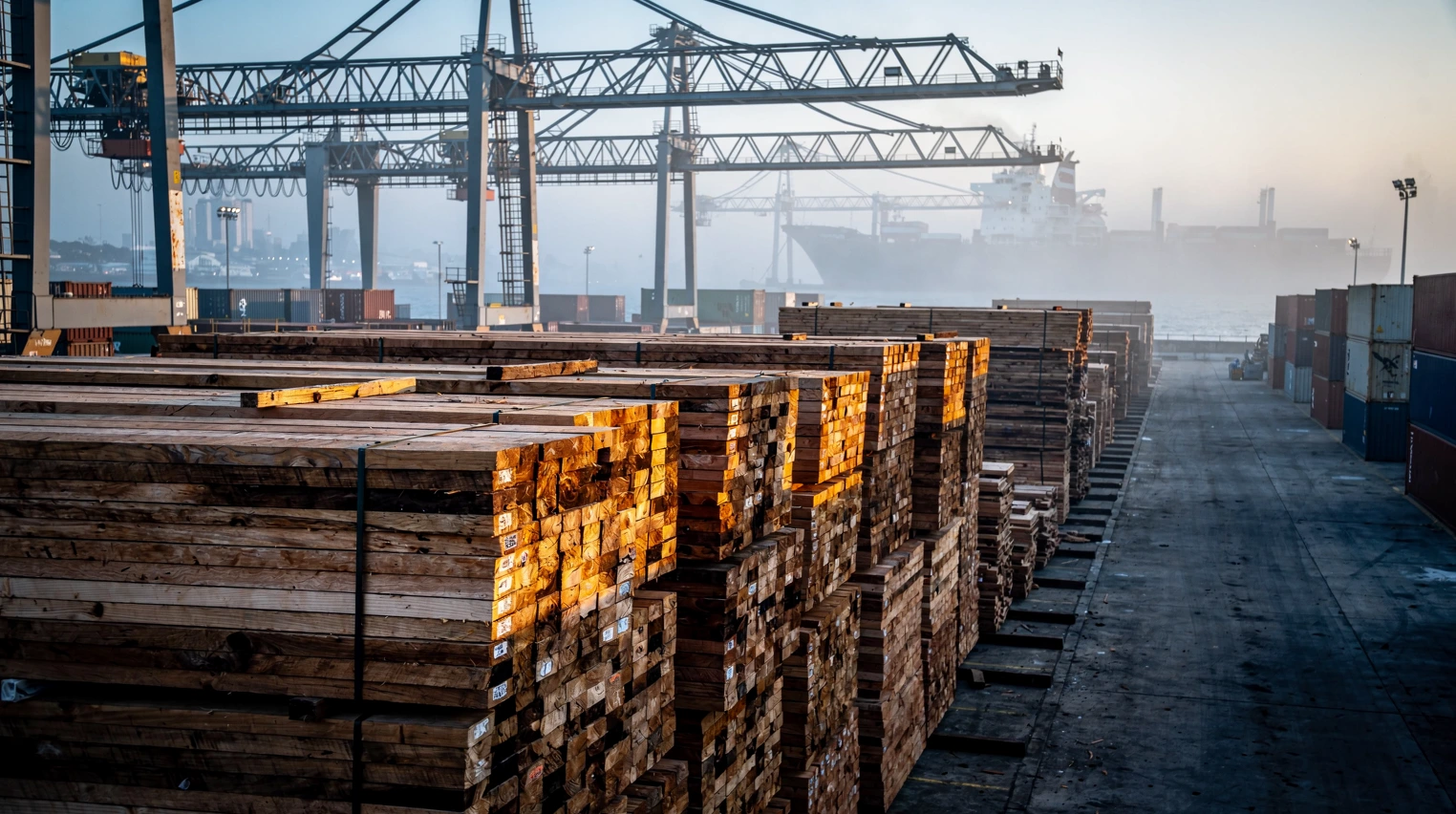
The US Department of Commerce faces a statutory reporting deadline on October 1, 2026 that could reset import costs across furniture, cabinetry, flooring and home improvement retail. The obligation sits inside Proclamation 10976, the Section 232 wood products order signed on September 29, 2025, and it asks the Secretary of Commerce a narrow question with a wide blast radius: should hardwood timber and lumber carry a new duty of their own?
In short
- The deadline is October 1, 2026. Clause 9 of Proclamation 10976 requires the Secretary of Commerce to give the President an update on hardwood timber and lumber imports, their markets and the domestic industry.
- The report can trigger new duties. Its stated purpose is so the President can decide whether an additional duty on hardwood timber or lumber, plus duties on derivatives of those products, is warranted.
- Today’s rates are unchanged. Softwood timber and lumber sit at 10 percent, upholstered wooden products at 25 percent, and kitchen cabinets and vanities at 25 percent, including parts imported for use in them.
- The escalation was pushed to 2027. A proclamation signed December 31, 2025 moved the jump to 30 percent on upholstered furniture and 50 percent on cabinets and vanities from January 1, 2026 to January 1, 2027.
- Derivatives are the retail exposure. Hardwood feeds flooring, dining and bedroom furniture, cabinet doors, mouldings and veneer, so a hardwood duty would reach far past raw lumber importers.
Retail finance teams have spent a year modelling the softwood tariff and the cabinet escalation. The hardwood file has drawn less attention because nothing has happened on it yet. That changes this week, because the proclamation set a hard date and that date is now three days away.
What does the October 1 deadline actually require?
Proclamation 10976 was published in the Federal Register on October 6, 2025, at Volume 90, Number 191, pages 48127 to 48142. Most of the coverage at the time focused on the headline rates. The reporting obligation sits further down, in clause 9, and it is written in mandatory language.
The clause reads: “By October 1, 2026, the Secretary shall provide the President with an update on imports of hardwood timber and lumber, their markets, and the domestic industry, so that the President may determine whether imposing an additional duty on imports of hardwood timber or lumber, such as the phased import duty recommended by the July 1, 2025, report, as well as any additional duties on derivatives of such products, is warranted to address a threat to national security.”
The exact wording carries three separate hooks
First, the report is an update, not a fresh Section 232 investigation. The underlying national security finding already exists, which means the President does not need a new 270-day statutory process before acting. That removes the usual lead time importers rely on.
Second, the clause names a specific remedy already on the table: “the phased import duty recommended by the July 1, 2025, report.” The Commerce report that founded this action recommended a phased structure, so the policy design work has been done.
Third, the clause explicitly extends to “any additional duties on derivatives of such products.” Derivatives is the word that matters for retail. Raw hardwood lumber is a commodity trade. Hardwood derivatives include flooring, furniture components, veneer, mouldings and cabinet parts.
Why a deadline is not the same as an action
The proclamation obliges the Secretary to deliver a report. It does not oblige the President to act on it, and it sets no deadline for a decision afterwards. Three outcomes are therefore live: no action, a phased hardwood duty on raw material only, or a phased duty plus a derivative list.
There is also a fourth path written into the same clause. The Secretary is directed to inform the President “of any circumstance that, in the Secretary’s opinion, might indicate that the increase in duty rate provided for in this proclamation is no longer necessary.” The same report that can add duties can, in principle, argue for removing them.
Where do wood product tariffs stand right now?
The rate card has been stable since the start of 2026, which is unusual in this tariff cycle. Nothing changed in the spring or summer rounds. The table below sets out what importers are paying today and what is currently scheduled.
| Product scope under Proclamation 10976 | Rate today | Scheduled from Jan 1, 2027 | Originally scheduled |
|---|---|---|---|
| Softwood timber and lumber | 10% | 10% (no change scheduled) | 10% |
| Certain upholstered wooden products | 25% | 30% | 30% from Jan 1, 2026 |
| Kitchen cabinets and vanities, plus parts imported for use in them | 25% | 50% | 50% from Jan 1, 2026 |
| Hardwood timber and lumber | No Section 232 duty | Under review, report due Oct 1, 2026 | Not scheduled |
All of these rates took effect at 12:01 a.m. eastern daylight time on October 14, 2025. The duties are additive to any other duties, taxes, fees and charges that already apply to the goods, so the Column 1 HTSUS rate stacks on top for most origins.
One relief mechanism runs the other way. Products tariffed under Proclamation 10976 are carved out of the reciprocal tariff regime established by Executive Order 14257, and out of the Brazil and Russia orders (Executive Orders 14323 and 14329). Where a wood product is caught by both the wood proclamation and the automobile proclamation, the automobile terms govern.
Why is the January 2027 escalation the bigger cliff?
On December 31, 2025 the President signed an amending proclamation, published in the Federal Register on January 9, 2026, that revised clause 5. The revision moved the escalation dates out by a full year. Upholstered wooden furniture goes to 30 percent on January 1, 2027, and kitchen cabinets and vanities go to 50 percent on the same date.
The stated reason was negotiation. The proclamation records that the Trade Representative had advised of “productive negotiations of agreements with multiple countries” and that delay would produce a better outcome. It is a bargaining posture rather than a change of view on the underlying finding.
That matters for how retailers should read the hardwood report. The administration has shown it will trade timing for leverage in this file, which cuts both ways. A hardwood duty announced in the fourth quarter of 2026 could just as easily carry an effective date in mid-2027 as an immediate one.
The two clocks now converge
Until now, cabinet and furniture importers had one date to plan around: January 1, 2027. If the hardwood report produces an action, a second effective date lands in the same window. Companies that sell both case goods and cabinetry would absorb two rate changes inside one planning cycle.
The interaction is not theoretical. Cabinet parts are already in scope at 25 percent. If hardwood derivatives were added separately, a cabinet door blank could be caught by whichever line item Customs and Border Protection classifies it under, and importers would need to know which duty applies rather than assume the lower one.
Which retailers carry the most exposure?
The exposure map is not the same as the revenue map. What matters is the share of cost of goods that crosses a border as wood, and how much of that is hardwood rather than softwood or engineered board.
Home furnishings specialists sit at the sharp end. RH and Williams-Sonoma both disclosed material tariff effects through fiscal 2026, and according to company filings and press reports Williams-Sonoma filed for roughly $198 million in tariff refunds while RH filed for about $69 million. Our earlier preview of RH reporting its second quarter at a 25 percent furniture tariff set out how resourcing costs showed up before the rate itself moved.
RH reported that first-quarter revenue was reduced by about $45 million because of tariff-related resourcing, which pushed backorder and special-order balances higher. Williams-Sonoma reported roughly $60 million of incremental tariff cost sitting in inventory. Those are timing effects as much as margin effects, and they unwind unevenly.
North American manufacturing is the visible hedge
Market reaction to the September 2025 announcement separated importers from domestic producers cleanly. Wayfair and Williams-Sonoma shares fell on the news while La-Z-Boy gained about 2 percent and Ethan Allen rose about 1.8 percent, with Ethan Allen making roughly 75 percent of its products in North America.
The pattern reversed on the delay. When the escalation was pushed to 2027, RH and Wayfair shares rose, according to reporting at the time. Investors are treating the wood file as a pure sourcing-geography trade, which is a reasonable first approximation but misses the hardwood question entirely.
Marketplace-led sellers are harder to read. Wayfair reported second-quarter net revenue of $3.5 billion, up 7.5 percent year on year, with US revenue up 8.7 percent, orders up 6 percent and active customers up 3.3 percent. Volume growth of that shape can mask input cost pressure for several quarters.
Consumer prices have already moved
The tariff has passed through to shelf prices in the categories most directly in scope. Consumer price index readings showed living room, kitchen and dining room furniture up 4.6 percent year on year in November, against a period when the headline rate had been at 25 percent for barely six weeks.
That figure is useful as a calibration point rather than a forecast. It reflects a 25 percent duty on a subset of imported items inside a category that also contains domestic production and older inventory bought before the tariff landed.
A hardwood duty would work through a different part of the same basket. Solid hardwood dining and bedroom furniture, hardwood flooring and hardwood-faced cabinetry would take the cost, while upholstered goods and particleboard-based assortments would be largely unaffected.
How would a hardwood duty differ from the softwood tariff?
Softwood and hardwood are different trades with different geographies, and treating them as one wood category is the most common analytical error in this file. Softwood lumber is a construction input dominated by Canadian supply and priced off framing demand. Hardwood is an appearance-grade material used in visible surfaces.
Hardwood sits in the bill of materials differently
In a framing package, softwood is most of the cost and substitution is limited. In a dining table or a shaker cabinet door, hardwood is a visible surface layer over engineered substrate, so it is a smaller share of unit cost but a species-specific one. Oak, maple, walnut and cherry are not interchangeable to a buyer looking at a finish sample.
That asymmetry changes the pass-through arithmetic. A 10 percent duty on framing lumber moves the price of a house. A 10 percent duty on hardwood lumber moves a component cost that may be 8 to 15 percent of a finished item, so the retail price effect is smaller per point of duty but harder to design around.
The United States is a hardwood exporter, not just an importer
This is where the hardwood file gets politically complicated. The US is a major hardwood producer and has historically been a large exporter, particularly of oak and other temperate species. The domestic industry’s problem has been export demand, not only import competition.
US hardwood exports to China have declined for roughly eight years, according to industry trade data and USDA reporting. China banned US log imports in March 2025, which disrupted established supply chains. China’s overall lumber imports under HS heading 4407 totalled about 24 million cubic meters in 2025, down roughly 10 percent from 2024.
USDA agricultural trade office reporting notes renewed Chinese buyer interest in US hardwood logs and lumber following the 2026 leaders’ summit, though there is no confirmation that Chinese tariffs on those products would fall. US lawmakers have separately urged the administration to prioritise hardwood lumber over raw logs in the China trade framework, on the argument that exporting logs lets foreign sawmills capture the processing margin.
That framing points somewhere other than an import tariff. If the domestic hardwood industry’s binding constraint is Chinese demand and log-versus-lumber export mix, an import duty on hardwood does comparatively little. The negotiating agenda that ran through the G20 trade ministerial and its most-favoured-nation rewrite is arguably the more relevant lever for that industry.
What are the two side doors in the proclamation?
Even if the President takes no action on the October 1 report, two mechanisms inside Proclamation 10976 can expand the tariff’s reach without any new proclamation. Both were written into the original order and both are administered by Commerce.
The inclusions process
Clause 16 directs the Secretary to “establish a process for including additional wood products within the scope of the tariffs described in this proclamation.” The Secretary may add a product where inclusion would reduce or eliminate the national security threat and is consistent with the proclamation’s purpose.
The listed test is import behaviour. Relevant factors include “whether imports of the wood product have increased in a manner that threatens to impair the national security or otherwise undermines the objectives set forth in this proclamation.” In practice that reads as a circumvention test: if a product surges after the tariff lands, it becomes a candidate.
The process may accept requests from domestic producers and other interested parties. That is the same architecture used for steel and aluminium derivatives, where petitions from domestic mills drove most additions. Retailers importing wood components should assume their categories are visible to the petitioners.
The undervaluation trigger
Clause 17 is less discussed and more unusual. It directs the Secretary to “establish a process for determining whether there is a threat of undervaluation of wood product imports subject to tariffs pursuant to this proclamation.”
The remedy contemplated is a change in tariff form rather than rate. The proclamation states that where undervaluation is a threat, “it may be appropriate for specific, compound, or mixed tariffs to be imposed.” A specific duty is charged per unit or per cubic meter rather than as a percentage of declared value.
For importers, a shift from ad valorem to specific duty is a structural change, not a rate change. It removes the benefit of low declared values and makes duty cost independent of negotiated price. It also complicates first sale valuation strategies that many furniture importers rely on.
What do the country carve-outs mean for sourcing?
Proclamation 10976 is not a uniform global tariff. Three jurisdictions have ceilings written into the text, and those ceilings change the relative economics of sourcing origins in a way that is easy to miss.
| Origin | Section 232 wood treatment | Practical effect |
|---|---|---|
| United Kingdom | Section 232 wood tariff shall not exceed 10% | Caps UK exposure below the 25% furniture and cabinet rates |
| European Union | Section 232 duty plus Column 1 HTSUS rate shall not exceed 15% combined | Combined ceiling, so the effective 232 component varies by HTSUS line |
| Japan | Section 232 duty plus Column 1 HTSUS rate shall not exceed 15% combined | Same combined ceiling as the EU |
| All other origins | Full scheduled rate, additive to existing duties | Vietnam, Malaysia, Indonesia, Mexico and China carry the headline rates |
The UK ceiling derives from the May 2025 Economic Prosperity Deal terms, and the EU and Japan ceilings from the framework agreements negotiated in 2025. The proclamation states the intent that originating wood products from the EU and Japan not exceed 15 percent all-in.
These ceilings are structural, not discretionary, which makes them durable planning inputs. A cabinet programme sourced from Italy or Poland carries a different all-in duty profile from the same programme sourced from Vietnam, and the gap widens if the January 2027 escalation lands as written.
One operational detail catches importers out. Goods in scope that enter a US foreign trade zone on or after the effective date must be admitted in privileged foreign status, not domestic status. That locks the classification and duty rate at admission, so an FTZ no longer defers the rate risk.
How did the wood products tariff get here?
The hardwood question is the last open item in a file that has been running for more than eighteen months. Understanding the sequence explains why the October 1 report is a checkpoint rather than a surprise.
| Date | Step | What it established |
|---|---|---|
| March 2025 | Section 232 investigation into timber, lumber and derivative products initiated | Opened the national security inquiry at Commerce |
| July 1, 2025 | Secretary of Commerce transmits the investigation report | Found a threat to national security and recommended remedies, including a phased hardwood duty |
| September 29, 2025 | Proclamation 10976 signed | Set 10% softwood, 25% upholstered wooden products, 25% cabinets and vanities |
| October 14, 2025 | Rates take effect at 12:01 a.m. EDT | Duties become payable on entry for consumption |
| December 31, 2025 | Amending proclamation signed | Moved the escalation from January 1, 2026 to January 1, 2027 |
| October 1, 2026 | Hardwood update due to the President | Decision point on hardwood duties and hardwood derivatives |
| January 1, 2027 | Scheduled escalation | Upholstered wooden products to 30%, cabinets and vanities to 50% |
The findings that underpin any hardwood action
The Commerce findings recorded in the proclamation are broad. The Secretary concluded that wood product imports were “weakening our economy, resulting in the persistent threats of closures of wood mills and disruptions of wood product supply chains,” and diminishing capacity utilisation across the domestic industry.
The national security argument rests on end uses rather than on economics alone. The proclamation cites wood in defence infrastructure, munitions transport, missile defence components and thermal protection systems, alongside communications, energy and transportation infrastructure.
It also records a finding that the United States “possesses ample raw materials and industrial capacity to meet domestic wood products demand” while domestic production remains underdeveloped. That framing supports adding hardwood rather than excluding it, because the same capacity argument applies to hardwood mills.
Why the July 2025 recommendation matters more than the October report
Clause 9 does not ask the Secretary to design a new remedy. It points back to “the phased import duty recommended by the July 1, 2025, report” as the template. The policy option is already specified, which shortens the path from report to proclamation.
A phased duty means a schedule rather than a single rate. On the softwood and furniture precedent, that would likely mean an opening rate with a step-up twelve months later, which is exactly the structure clause 5 used before it was amended.
Importers modelling scenarios should therefore treat a phased structure as the central case rather than a flat rate. The planning question is not only how high but how fast, and the answer to the second question determines whether a sourcing shift is feasible before the step-up.
What should retail buyers and finance teams do before October 1?
The report itself may not be published. Section 232 reports to the President are frequently withheld or released in summary, and clause 9 imposes no publication duty. The first visible signal may be a proclamation, a Federal Register notice, or nothing at all for weeks.
That argues for preparing the classification work now rather than waiting for a headline. Four steps are practical inside a three-day window and the weeks that follow.
- Pull the HTSUS lines for every hardwood input and hardwood-faced finished good in the assortment, separated from softwood and engineered board lines.
- Quantify the share of landed cost that is hardwood by origin, so a duty scenario can be run at 5, 10 and 15 percent without a new data pull.
- Check FTZ and bonded warehouse positions for goods that would be caught by an admission-date rule.
- Confirm whether current supplier contracts allocate new duties to the vendor, the importer of record, or neither.
Home improvement retailers have the most granular version of this problem because they carry both raw lumber and finished cabinetry. The pressures we set out around Lowe’s second quarter and its Pro segment bet show how mixed baskets absorb input cost differently from pure home furnishings retail.
Refund mechanics are a separate workstream
Section 232 duties are not in the same legal position as the tariffs currently generating refund claims, and importers should not conflate the two. The operational lesson transfers, though: refund processing at scale is slow and document-dependent, as the CBP refund phase scheduled for October 6 has demonstrated across the importer base.
Teams that kept clean entry-level records through the 2025 and 2026 rounds have recovered faster than those reconstructing after the fact. That is the argument for tagging hardwood entries now, before any duty exists, rather than after one does.
What happens after the report lands?
The realistic sequence is that Commerce delivers on or near October 1 and the White House says nothing immediately. Under this proclamation, the visible artefact of a decision would be a new proclamation amending 10976, followed by a CBP guidance message and HTSUS modifications.
Clause 11 gives the Secretary, in consultation with the International Trade Commission and CBP, the job of determining what HTSUS modifications are needed and publishing them in the Federal Register. That notice is the operational trigger importers should monitor, not the political announcement.
Watch the negotiation track in parallel. Clause 10 requires the Trade Representative to keep updating the President on wood product negotiations, and the December 2025 amendment reiterated that obligation. A country reaching an agreement is carved out of the escalation by the plain text of clause 5.
Compliance teams already tracking wood supply chains for other reasons have a head start. The due diligence datasets built for the EU deforestation regime overlap heavily with what a hardwood duty scenario needs, and our coverage of the EUDR final scope and its compliance countdown maps the species and origin fields that transfer directly.
The signal that would confirm an action is coming
Three observable markers would raise the probability materially. A Federal Register notice opening or reopening a wood products inclusions window is the clearest. A CBP CSMS message referencing hardwood HTSUS subheadings is the second. Public comments filed by domestic hardwood associations in the days around the deadline are the third.
Absent those, the base case is drift. The administration has already shown in this file that it prefers to hold the escalation as leverage rather than spend it, and the same logic applies to opening a new hardwood front while wood negotiations are live.
The full text of the underlying order is available on the Federal Register page for Proclamation 10976, including the Annex I product lists that define scope.
Frequently asked questions
What exactly is due on October 1, 2026?
An update from the Secretary of Commerce to the President on imports of hardwood timber and lumber, their markets and the domestic industry. It is required by clause 9 of Proclamation 10976 and its stated purpose is to let the President decide whether an additional duty on hardwood, or on derivatives of hardwood, is warranted.
Does the deadline mean hardwood tariffs start on October 1?
No. The deadline applies to the report only. No duty takes effect automatically, and the proclamation sets no deadline for a presidential decision after the report is delivered. Any new duty would require a further proclamation and HTSUS modifications published in the Federal Register.
What are the current Section 232 rates on wood products?
Softwood timber and lumber are at 10 percent. Certain upholstered wooden products are at 25 percent. Kitchen cabinets and vanities are at 25 percent, including parts imported for use in them. All took effect on October 14, 2025 and are additive to existing duties.
When do the higher furniture and cabinet rates start?
January 1, 2027, under the amendment signed on December 31, 2025. Upholstered wooden products go to 30 percent and kitchen cabinets and vanities go to 50 percent. Those increases were originally set for January 1, 2026 and were delayed by one year to allow negotiations to continue.
Are any countries exempt or capped?
The proclamation caps the wood tariff on United Kingdom origin goods at 10 percent. For the European Union and Japan, the Section 232 duty combined with the Column 1 HTSUS rate is not to exceed 15 percent. Countries reaching an agreement with the United States on the wood products threat are carved out of the scheduled escalation.
What is the difference between hardwood and softwood for tariff purposes?
Softwood timber and lumber are already covered at 10 percent under the proclamation. Hardwood timber and lumber are not currently subject to a Section 232 wood duty, which is precisely why the October 1 report exists. The two have different HTSUS classifications, different source geographies and different end uses.
Could Commerce add products without a new presidential decision?
Yes, through the inclusions process in clause 16. The Secretary may add wood products to the tariff scope where import trends threaten national security or undermine the proclamation’s objectives, and the process can take petitions from domestic producers and other interested parties.
What is the undervaluation provision and why does it matter?
Clause 17 directs Commerce to set up a process to identify undervaluation risk in tariffed wood imports. Where a threat is found, specific, compound or mixed tariffs may be imposed instead of percentage duties. That would make duty cost independent of declared value and disrupt valuation strategies built around low transfer prices.
How should importers prepare before any action lands?
Separate hardwood inputs and hardwood-faced goods from softwood and engineered board in the classification data, quantify hardwood content as a share of landed cost by origin, review foreign trade zone positions given the privileged foreign status rule, and confirm how supplier contracts allocate new duties between vendor and importer of record.