
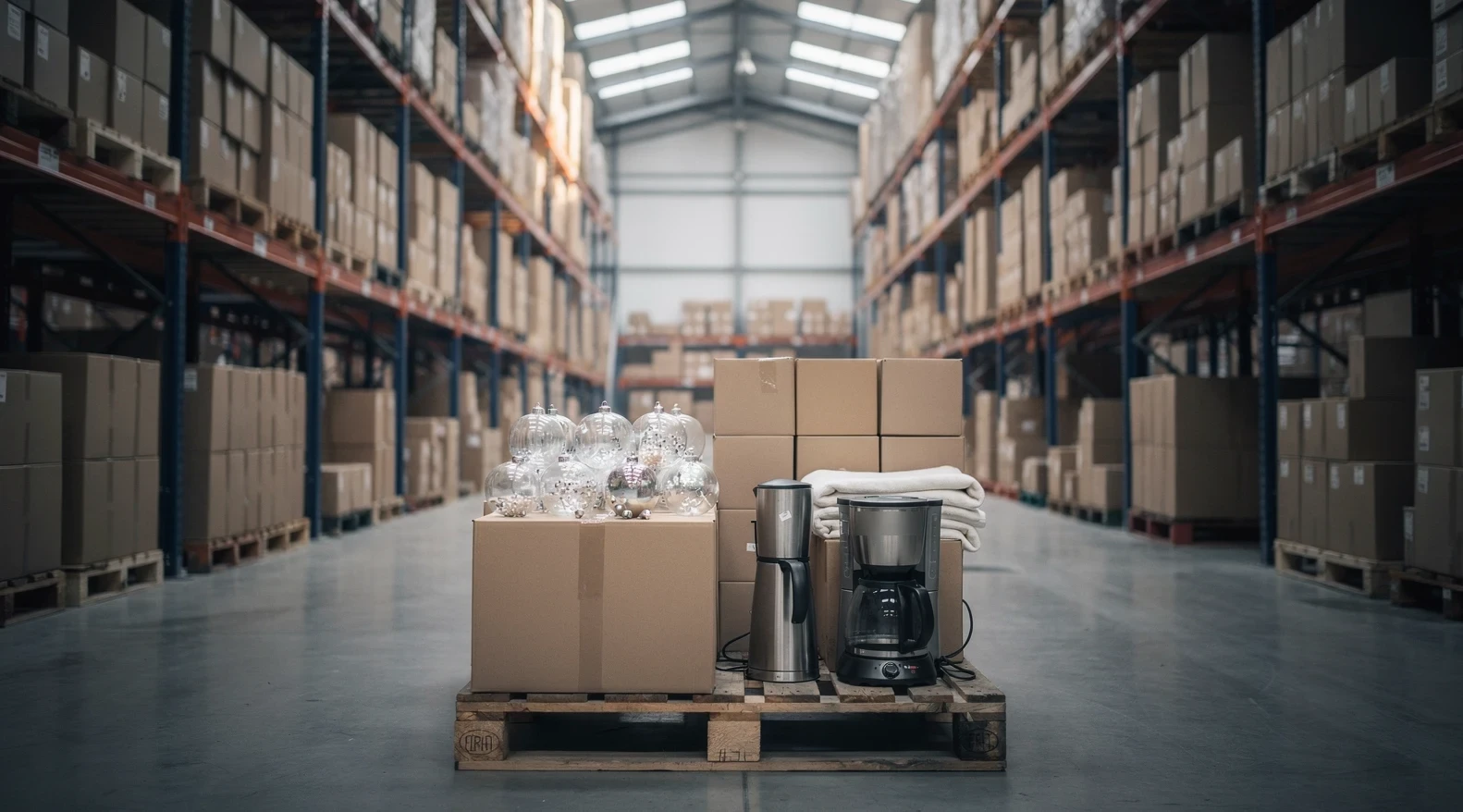
The United States and China have published the first two product lists produced by the U.S.-China Board of Trade, naming roughly USD 30 billion of trade on each side that both governments say could qualify for more favorable tariff treatment. The American list of Chinese goods runs to 77 product lines and is dominated by housewares, toys, seasonal decorations and small kitchen appliances. The Chinese list of American goods runs to more than 1,600 lines and is dominated by agriculture.
Ambassador Jamieson Greer released a statement on the lists on September 27, and the White House posted the underlying “30-FOR-30” documents the same day. Wire coverage followed early on September 28, with Reuters reporting the agreement shortly after 03:00 GMT and Bloomberg, CNBC, the Associated Press and CNN publishing through the morning.
For retailers and marketplace sellers, the important detail is not the headline number. It is the sentence buried in the framework language: these are recommendations, and any actual duty reduction will be “determined and implemented in accordance with each side’s domestic legal processes.”
In short
- Scope: a “30-for-30” framework covering about USD 30 billion of trade in each direction, roughly USD 60 billion in total.
- Asymmetry: the US list names 77 product lines of Chinese goods; the Chinese list names 1,619 lines of US goods, per Reuters.
- Retail relevance: the US list is unusually consumer-facing, covering toys, tableware, glass and wooden Christmas ornaments, coffee makers, toasters, blankets, bed linens and children’s car seats.
- Not yet effective: nothing has changed at the border. No effective date has been published on either side, and no Federal Register notice has been issued.
- The real deadline: the broader tariff truce was extended by two months, to January 10, 2027, which is the date that governs whether any of this survives.
What the United States and China actually announced
The Board of Trade is a bilateral mechanism that Presidents Trump and Xi established during the American president’s visit to Beijing in May 2026. Its stated remit is narrow: to manage trade in what both sides call “non-sensitive” products. It is not a negotiating forum for export controls, rare earths or advanced semiconductors.
The body’s first deliverable is the pair of lists published this weekend. Each side nominated a basket of imported goods worth approximately USD 30 billion, with the stated intention of extending reduced tariff treatment to those goods on a reciprocal basis. Greer’s statement described the exercise as unlocking improved market access for “about 30 percent of U.S. exports to China.”
China’s Ministry of Commerce framed the same announcement differently. Its language pointed to stabilizing bilateral trade and strengthening cooperation across agricultural products, energy, manufactured goods and consumer goods. The two framings are compatible, but they emphasize different halves of the deal.
This is the second concrete output from a channel that switched on with consumer goods at the top of its tariff-relief agenda only a week earlier, when Treasury Secretary Scott Bessent, Greer and Vice Premier He Lifeng met in New York. The lists give that earlier signal its first hard numbers.
What is on the US list of Chinese goods
The American list is short and, by the standards of recent trade announcements, remarkably specific. Reporting from Reuters, Bloomberg, Nikkei Asia and Al Jazeera converges on the same set of examples, which cluster into three recognizable retail departments.
Housewares and small kitchen appliances
Coffee makers and toasters appear on the list, as do microwave ovens, tableware, kitchen accessories and weighing scales. Electric shavers are included. These are categories where Chinese factories hold a dominant share of US import volume and where domestic alternatives are thin.
Greer’s statement made that logic explicit. He described the American side of the deal as benefiting consumers “with imports from China of household goods, toys, and other products that the United States generally does not import from other countries.” In other words, the categories were chosen partly because cutting their tariffs imposes little cost on American producers.
Toys, seasonal and sporting goods
Toys are on the list, alongside fireworks, artificial flowers, and glass and wooden Christmas ornaments. Nikkei Asia led its coverage on the seasonal goods. Sporting items appear too, including soccer balls and inflatable balls, and Reuters noted fish hooks among the smaller lines.
Seasonal decoration is one of the most concentrated China-sourced categories in American retail. It is also, for the same reason, one where tariff pass-through has been most visible on shelf prices over the past two years.
Blankets, bed linens and curtains are named, as are children’s car seats. Juvenile products are politically easier to relieve than most consumer categories, because safety-regulated goods with few domestic manufacturers attract little protectionist objection.
| Reported category | Retail department | Typical sourcing concentration |
|---|---|---|
| Toys, inflatable balls, soccer balls | Toys and sporting goods | Heavily China-weighted |
| Glass and wooden Christmas ornaments, artificial flowers, fireworks | Seasonal and decor | Heavily China-weighted |
| Coffee makers, toasters, microwave ovens, electric shavers | Small appliances | Heavily China-weighted |
| Tableware, kitchen accessories, weighing scales | Housewares | Heavily China-weighted |
| Blankets, bed linens, curtains | Home textiles | Mixed with South and Southeast Asia |
| Children’s car seats | Juvenile products | Heavily China-weighted |
Sourcing concentration in the table reflects the general pattern described in trade coverage of these categories rather than line-level import statistics, which the published lists do not break out.
What is on the Chinese list of US goods
The Chinese list is an order of magnitude longer at 1,619 lines, and its centre of gravity sits in agriculture rather than consumer goods. Reuters reported that Beijing plans to trim duties on corn, wheat, sorghum, meat, dairy, vegetable oils and meals. Al Jazeera’s account added poultry, eggs, peanuts, canned tomatoes, noodles and silk.
One omission dominated the wire coverage. Soybeans, by a wide margin the largest single American agricultural export to China in normal trading years, are not on the list. Reuters made that exclusion its headline.
The Financial Times and Nikkei Asia both noted the presence of unusual livestock lines, including pure-breed breeding horses and camels. Those are small-value items that pad the list count without moving trade volumes, and their prominence in coverage says something about how the list was assembled.
Beijing also flagged American fish and seafood, logs and wood products, cosmetics and medical devices for reduced duties. The wood lines are notable given that the US Commerce Department’s own hardwood and timber report is due to the President on October 1 under a separate Section 232 process. The two tracks are moving in opposite directions on the same commodity group.
Separately, China committed to importing at least 10 million metric tons of American coal in each of 2027 and 2028. Coverage put that at roughly 2 percent of China’s annual coal imports. Liquefied natural gas and oil were left out of the energy commitments.
How the relief would work, and when it could start
The most consequential technical detail is how the relief would be delivered. Reporting indicates that tariff rates on more than 90 percent of the listed products would be set at most favored nation levels, which would effectively remove the country-specific tariffs layered on top.
That is a meaningful cut, but it is not duty-free entry. MFN is the baseline rate the United States applies to imports from most trading partners under its tariff schedule, and for many housewares and toy lines that baseline is low but non-zero. A product moving to MFN sheds the Section 301 and emergency-powers surcharges while retaining whatever its underlying schedule rate happens to be.
Buyers who model this as “tariffs go to zero” will overstate the landed-cost saving. Buyers who model it as “the China premium comes off” will be closer to right. The difference matters most in categories where the MFN base rate is itself several percentage points.
The mechanics also connect to a broader argument playing out this week, where the MFN rewrite has moved to the top of the G20 trade ministerial agenda. What “most favored nation” means in practice is no longer a settled technical question.
None of it takes effect yet. That is the single most important qualification on the announcement, and it is the one most easily lost in the headline coverage.
Greer’s statement described goods that “could benefit from more favorable tariff treatment in the future.” The framework language published by the White House commits both sides only to consider the lists “with a view toward providing reduced tariff treatment to those goods in a reciprocal manner, consistent with their respective domestic laws and processes.”
On the American side, that means an executive action and a Federal Register notice amending the Harmonized Tariff Schedule before a single entry clears at a lower rate. On the Chinese side, it means a decision from the State Council’s tariff commission. Neither has been published.
No target date has been attached to either step. Importers should therefore treat the lists as a forward indicator of policy direction, not as a change in their current duty exposure.
| Date | Event | Status |
|---|---|---|
| May 2026 | Board of Trade established during the Beijing visit | Complete |
| September 20, 2026 | Bessent, Greer and He Lifeng operationalize the mechanism in New York | Complete |
| September 27, 2026 | White House publishes the 30-FOR-30 lists; Greer issues a statement | Complete |
| Before end of 2026 | First meeting of the agriculture working group | Scheduled |
| By November 2026 | Follow-up dialogue on the agreed AI communication channel | Scheduled |
| January 10, 2027 | Extended tariff truce expires | Pending |
| Not announced | Federal Register notice implementing US cuts | Not scheduled |
What this does, and does not do, for the 2026 holiday season
The timing is awkward. Holiday assortments for the 2026 season were ordered, manufactured, shipped and in most cases already cleared customs months ago. The duty on this year’s Christmas ornaments has been paid.
Retail merchandising calendars for the fourth quarter are effectively locked by late September. Promotional pricing for October events, including Amazon’s Prime Big Deal Days on October 6 and 7, was set against landed costs that already include the current tariff stack.
Any relief that does arrive would therefore land on spring 2027 buys at the earliest, and realistically on the 2027 holiday cycle for seasonal categories with long lead times. Retailers should resist the temptation to read this as in-season margin recovery.
There is one exception worth watching. Replenishment-driven categories with short lead times, including some housewares and small appliances, could see a partial benefit if implementation moves quickly in the first quarter of 2027.
What was deliberately left off both lists
The exclusions are as informative as the inclusions. On the Chinese side, soybeans are absent. On the American side, the South China Morning Post noted that rare earths were left off the record entirely, which is consistent with the Board of Trade’s explicit “non-sensitive” remit.
Energy exclusions are similarly pointed. Coal was committed in volume terms while liquefied natural gas and oil were not, which keeps the largest energy trade flows outside the framework.
Among the consumer categories reported in coverage of the American list, the highest-value China-sourced retail groups do not appear. Apparel, footwear, furniture and consumer electronics are not among the examples cited by Reuters, Bloomberg, Nikkei Asia or Al Jazeera. The published documents would need to be read line by line to confirm their complete absence, but the reported examples point clearly toward low-value, low-substitution categories.
That selection pattern has a straightforward political logic. Relieving tariffs on goods with no meaningful domestic production base generates consumer price benefit without a protectionist constituency to object.
The Board of Trade was constructed to be narrow, and its first output confirms that design. Several questions that matter more to retail sourcing than any of the 77 lines remain entirely outside it.
The treatment of low-value parcel shipments is one. The framework says nothing about de minimis policy, which has reshaped cross-border e-commerce economics more than any single tariff line on either list.
Rules of origin are another. As country-specific tariffs come off some Chinese goods and stay on others, origin verification becomes more consequential, and the framework contains no corresponding enforcement provision.
The status of existing refund litigation is a third. Importers pursuing recovery of emergency-powers duties already paid are litigating a separate question, and nothing in the lists addresses whether past collections stand.
Finally, the framework is bilateral. Goods rerouted through third countries to escape tariffs, and the compliance burden that rerouting creates for importers, sit outside a mechanism that only considers direct US-China flows.
How the numbers compare
Scale is the argument against reading too much into this. Two-way US-China trade totalled USD 495 billion in 2025, a 25 percent decline from 2024. The combined USD 60 billion covered by both lists represents roughly 12 percent of that reduced total, and only if every line is eventually implemented in full.
Deborah Elms, a trade policy analyst quoted by Al Jazeera, assessed the listed goods as items that “do not move the needle on overall trade flows,” and judged them unlikely to have a meaningful effect on consumer prices or inflation.
| Measure | US list (Chinese goods) | Chinese list (US goods) |
|---|---|---|
| Product lines | 77 | 1,619 |
| Stated trade value | About USD 30 billion | About USD 30 billion |
| Dominant character | Consumer and household goods | Agriculture and commodities |
| Average value per line | High, roughly USD 390 million | Low, roughly USD 19 million |
| Headline exclusion | Rare earths | Soybeans |
| Named beneficiary | US consumers and importers | US farmers and exporters |
The per-line averages in the table are derived by dividing the stated USD 30 billion by the reported line counts, and are indicative only. They do illustrate the structural difference: the American list concentrates value in a handful of high-volume consumer categories, while the Chinese list spreads a similar total across a long agricultural tail.
A 77-line list sitting opposite a 1,619-line list is not an accident of drafting. The two sides were solving different problems, and the shape of each list reveals which problem each government prioritized.
Washington needed consumer price relief that does not antagonize domestic manufacturers. That points to a small number of high-volume categories where American production is negligible, which is precisely what the 77 lines deliver. The average line on the American list carries roughly USD 390 million of trade.
Beijing needed breadth. A long agricultural list distributes benefit across many American farm constituencies and many Chinese importing sectors, at an average of roughly USD 19 million per line. It also allows the omission of a single dominant commodity, soybeans, without the total falling short of the USD 30 billion target.
The inclusion of pure-breed breeding horses, camels and silk on the Chinese side illustrates the mechanic. These are low-value lines that add count without adding exposure. Their presence suggests the Chinese list was assembled to reach a number rather than to maximize trade effect.
The American side did the opposite, accepting a short list because a handful of consumer categories already carry enough import value to hit the target. That asymmetry is worth remembering when either government cites its line count as evidence of ambition.
The consumer price question
Whether any of this reaches a shelf price is a separate question from whether duties fall. Tariff relief passes through to consumers only when competitive pressure forces it, and the record from the past year is mixed.
The clearest recent precedent came from Costco, which reported a USD 184 million tariff refund in its fourth quarter and said it would route the money into member prices across produce, meat, beverages, home furnishings and hardware. That was a deliberate choice by a membership retailer whose model depends on visible price leadership.
Other retailers have faced shareholder pressure to treat tariff windfalls as margin recovery instead. The same duty reduction can therefore produce a price cut at one chain and an earnings beat at another, which is why aggregate inflation effects are hard to predict from tariff schedules alone.
Elms’s assessment, that the listed goods are unlikely to meaningfully affect consumer prices or inflation, rests on scale rather than on pass-through behavior. Even full pass-through across USD 30 billion of imports is small against total US consumer spending.
Category concentration is the variable to watch. In toys and seasonal decoration, where China-sourced product dominates the assortment and price comparison is easy for shoppers, a duty cut is harder for retailers to absorb quietly.
In home textiles, where sourcing is split across several Asian markets, the same cut is easier to retain as margin because competing products from other origins anchor the shelf price. Buyers modeling consumer response should segment by sourcing concentration rather than applying a single pass-through assumption.
What retail and e-commerce operators should do this week
The correct response is preparation, not repricing. Three steps are worth taking while the implementation question is still open.
Pull your HTS codes against the published lists
The White House posted the underlying list documents alongside its U.S.-China Board of Trade release. Sourcing and compliance teams should map their top China-sourced SKUs against those documents at the tariff-line level rather than relying on the category summaries in press coverage.
Category labels in reporting are approximations. A line that reads as “tableware” in a wire story may cover a narrow subheading that excludes a large part of a buyer’s actual assortment.
Model two landed-cost cases, not one
Build a scenario at current duty rates and a second at MFN-only rates for any SKU that appears on the list. Do not model a zero-duty case unless the underlying schedule rate is genuinely zero for that heading.
The gap between those two scenarios is the size of the negotiating prize, and it is the number to bring to supplier conversations about cost sharing for spring 2027 orders.
Treat January 10 as the governing date
The two-month truce extension to January 10, 2027 matters more than the lists themselves. If the truce lapses, the framework that produced these recommendations loses its foundation before implementation can happen.
Contract terms for first-quarter 2027 purchase orders should contemplate that date explicitly, whether through duty-sharing clauses or pricing review triggers. The September summit that produced the extension, covered here when the truce extension topped the retail agenda for the Trump-Xi meeting, set a short clock rather than a long one.
How marketplace sellers should read this
Third-party sellers on Amazon, eBay and Temu face a different calculus from retail buyers, because they generally lack the contractual leverage to renegotiate supplier pricing when duties move. Three differences matter.
First, timing exposure is shorter. Many marketplace sellers replenish on four to eight week cycles rather than seasonal buys, which means they would feel any implemented cut faster than a department store would. That cuts both ways, since they also felt the original increases faster.
Second, competitive dynamics are unforgiving. In a marketplace listing where the buy box turns on price, a duty reduction that reaches one seller tends to reach all sellers sourcing the same goods within weeks. Margin capture is unlikely to survive a full replenishment cycle.
Third, the categories on the American list map closely onto marketplace bestseller lists. Housewares, small appliances, toys and seasonal decor are precisely the categories where independent sellers compete hardest, which makes this list unusually relevant to that channel.
Sellers should identify which of their top listings fall under the named headings and ask their suppliers now whether duty reduction would be shared or retained. Supplier answers given before implementation are more informative than answers given after, when the negotiating position has already moved.
What to watch next
Four signals will show whether this becomes policy or stays on paper. The first is a Federal Register notice amending the Harmonized Tariff Schedule for any of the 77 lines, which would be the first hard evidence of implementation.
The second is a corresponding announcement from China’s State Council tariff commission. Reciprocity is written into the framework, so movement is more likely to come in pairs than singly.
The third is the agriculture working group’s first meeting, which both sides indicated would happen before the end of 2026. Whether soybeans are raised there will indicate how much room the framework has to widen.
The fourth is the truce itself. January 10, 2027 is close enough that first-quarter sourcing decisions will be made without knowing the answer, which is itself a planning constraint retailers will have to price in.
Frequently asked questions
Have US tariffs on Chinese toys and household goods actually been cut?
No. The two governments have published lists of goods recommended for more favorable tariff treatment. Ambassador Greer’s statement referred to goods that could benefit “in the future,” and the framework specifies that any reduction will be implemented through each side’s domestic legal processes. No Federal Register notice has been issued and no effective date has been announced.
How many products are on each list?
The American list of Chinese goods covers 77 product lines. The Chinese list of American goods covers 1,619 lines, according to Reuters. Both lists are valued at approximately USD 30 billion of trade, which is why the framework is described as “30-for-30.”
Which retail categories appear on the US list?
Reported examples include toys, fireworks, artificial flowers, glass and wooden Christmas ornaments, soccer balls and inflatable balls, coffee makers, toasters, microwave ovens, electric shavers, tableware, kitchen accessories, weighing scales, blankets, bed linens, curtains, fish hooks and children’s car seats.
Does most favored nation treatment mean zero duty?
No. Reporting indicates more than 90 percent of listed products would move to most favored nation rates, which removes country-specific surcharges but leaves the underlying tariff schedule rate in place. For many housewares and toy headings that base rate is low but not zero, so landed-cost models should not assume duty-free entry.
Will this lower prices for the 2026 holiday season?
Almost certainly not. Holiday inventory for 2026 was ordered and cleared customs months ago at current duty rates, and fourth-quarter promotional pricing is already set. Any benefit would apply to spring 2027 buys at the earliest, and to the 2027 holiday cycle for long lead-time seasonal goods.
Why are soybeans not on the Chinese list?
Beijing did not include soybeans, which are normally the largest single American agricultural export to China by value. Reuters treated the omission as the most significant feature of the Chinese list. No official explanation for the exclusion was given in the announcement.
What happened to the trade truce?
It was extended by two months, through January 10, 2027. Both sides described the extension as providing a relatively stable and predictable policy environment for continued negotiation. That date now functions as the practical deadline for whether the list recommendations are implemented.
What else was agreed alongside the lists?
China committed to importing at least 10 million metric tons of American coal in each of 2027 and 2028, roughly 2 percent of its annual coal imports. The two sides also established an agriculture working group meeting before year-end, agreed an artificial intelligence communication channel with follow-up by November 2026, and discussed expanded market access for American financial institutions in China.
How significant is USD 60 billion in the context of US-China trade?
Two-way trade between the countries totalled USD 495 billion in 2025, down 25 percent from 2024. The combined USD 60 billion across both lists is about 12 percent of that figure, and only if fully implemented. Trade analyst Deborah Elms told Al Jazeera the listed goods “do not move the needle on overall trade flows.”