
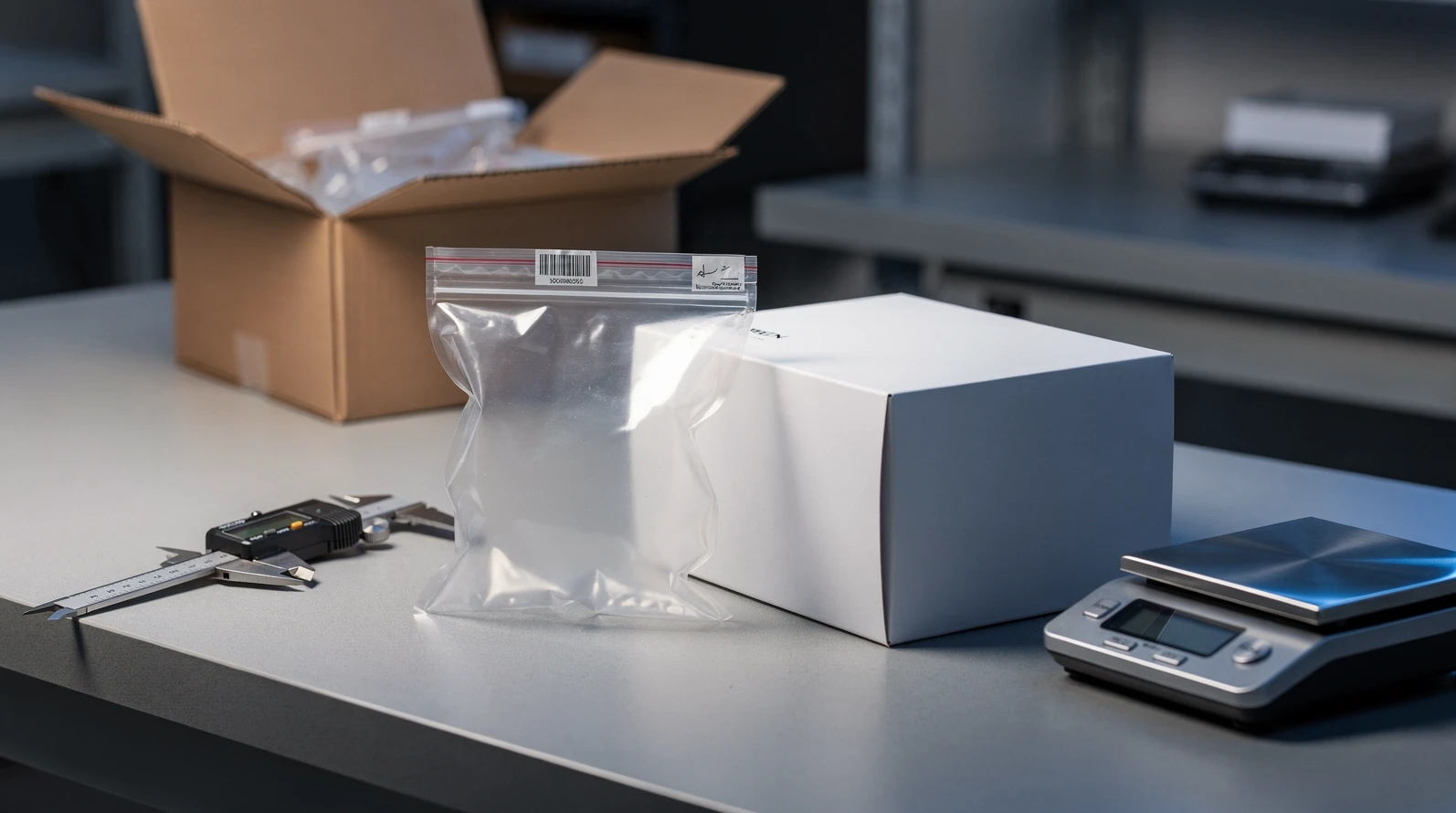
A sample is the cheapest honest conversation you will ever have with a factory. It is also the single most misread document in importing, because a good sample proves that a supplier can make one acceptable unit under ideal conditions, with the owner watching, on a bench rather than a line. The alibaba sample order process only protects you if you treat each sample as a test with a written pass mark, not as a souvenir that arrives in a padded envelope and gets approved over coffee.
This guide walks through what to order, what to measure, what to keep sealed, and where the money quietly leaks. It assumes you are a small or mid-sized brand placing a first or second production run, not a buyer with a quality team in Shenzhen. The method is deliberately low-tech: a tape measure, a kitchen scale, a freezer, a camera and a spreadsheet get you most of the way.
In short
- A sample proves capability, not consistency. One good unit tells you the factory understands your product; it tells you nothing about unit 4,000 on a Thursday night shift.
- Keep a golden sample sealed and signed. Without a physical reference held by both sides, every later quality dispute becomes an argument about memory.
- Order from two suppliers at once. Paying twice for samples is the cheapest comparative data you will ever buy, and it changes how both quote you.
- Test packaging as hard as you test the product. Most first-run returns come from transit damage and label errors, not from the item itself.
- The spec sheet is the deliverable. A sample round that does not end in a tighter written specification, with tolerances and an inspection standard, has been wasted.
What a sample does and does not prove
Buyers routinely over-read a single sample. The unit that arrives has usually been made by a senior worker or a technician, often by hand, sometimes from a competitor’s product reverse-engineered overnight. It demonstrates intent and ability. It does not demonstrate the thing you actually need, which is that 5,000 units will land inside the same tolerance band.
Separating those two questions is the core discipline. Capability is answered by one sample. Consistency is answered by multiple units, by inspecting the production run, and by the factory’s own process controls. If you remember nothing else from the Alibaba buyer playbook approach to sourcing, remember that samples and inspections answer different questions and neither substitutes for the other.
The three sample rounds worth paying for
Most products need two or three rounds before a purchase order makes sense. Compressing that into one round is the most common cause of a bad first shipment. Each round has a different job and a different pass mark.
| Round | What it is for | What you decide after it | Typical lead time |
|---|---|---|---|
| Stock or catalog sample | Confirm the supplier actually has the product class and can ship it | Whether this factory stays on the shortlist | 5–10 days |
| Custom or pre-production sample | Confirm your materials, dimensions, colors and branding can be executed | Whether the spec sheet is buildable as written | 2–4 weeks |
| Golden or shipment sample | Lock the agreed standard, made on the real line with real tooling | Whether to release the balance payment and start production | 2–3 weeks |
The stock sample is cheap and fast, and it eliminates traders who are quoting a product they have never handled. The custom sample is where your money and patience go. The golden sample is the one that matters legally and practically, because it becomes the reference every later unit is compared against.
What a sample cannot tell you
No sample reveals the factory’s scrap rate, its labor turnover, its raw material sourcing after your order is placed, or whether it will subcontract your run to a neighbor during peak season. Those are audit and inspection questions, which is why a sample round and a factory check are complementary rather than alternative spends. If the order is large enough to hurt, pair your sample program with the remote and third-party checks described in our guide to inspecting a factory before your first order.
A sample also cannot tell you whether the supplier is the manufacturer. Traders can and do produce excellent samples sourced from a genuine factory, then route production to a cheaper one. Verification of the entity itself sits upstream of sampling, and the checks in how to verify an Alibaba supplier before sending payment should be finished before you spend four weeks on a custom unit.
Golden samples and why you keep one sealed
A golden sample is a single approved unit, physically sealed, signed and dated by both buyer and supplier, that defines the standard for the production run. It is the quality equivalent of a signed contract. Without one, a dispute over color, stitch density or plastic feel becomes two parties describing an object from memory across a nine-hour time difference.
The procedure is simple and worth following exactly. Approve the unit in writing. Photograph it from six angles under neutral light, including any branding, seams and connectors. Seal it in a bag with a tamper-evident sticker, write the date, the product code and the revision number on the sticker, and sign across the seal so it cannot be reopened invisibly.
The two-sample rule
Make two golden samples, not one. You keep one sealed and the factory keeps the other, also sealed and signed. When a shipment arrives wrong, you open yours, they open theirs, and the comparison is between two objects rather than two opinions. Factories generally accept this readily, because it protects them against a buyer who changes their mind after seeing production units.
Never use your golden sample as a photography prop, a trade show display or an office demo. The moment it is handled, scuffed or exposed to sunlight, it stops being a reference. Order a third unit for marketing use and label it clearly so nobody confuses the two.
Revision control for samples
Every change to the spec creates a new revision, and every revision needs a new golden sample. Buyers who tweak a dimension by email and keep the old sealed unit end up with a reference that contradicts the written spec. Number revisions plainly (Rev A, Rev B, Rev C), record the date and the single change in each, and make sure the sticker on the bag matches the spec sheet version.
Keep a simple log. Three columns are enough: revision, change made, date approved. When a factory manager rotates out mid-project, which happens often, this log is the only thing that survives the handover intact.
Testing materials, finish and tolerances at home
You do not need a laboratory to catch the majority of sample defects. You need a method, applied the same way every time, with numbers written down. The goal is to turn subjective impressions into measurements you can quote back to the supplier.
Start with weight. Put the sample on a kitchen scale accurate to one gram and record the figure. Weight is the single most useful proxy for material substitution, because thinner steel, lighter plastic and lower-gauge fabric all show up on a scale. If the production units later weigh 12% less than the golden sample, you have an objective argument rather than a feeling.
Dimensions and tolerances
Measure every dimension that matters to fit, packaging or shipping, and measure it three times at different points. Record the actual figures next to the specified ones. Then write the tolerance you will accept, because a drawing without tolerances is not a specification, it is a wish.
Tolerance bands are product-specific, but the principle is universal: tighter costs more, so only tighten what the customer notices. A phone case needs the camera cutout held to a fraction of a millimeter and the overall length can drift. A storage box needs the opposite.
| Test | Tool you need | What a failure looks like | Why it matters at scale |
|---|---|---|---|
| Weight check | Kitchen scale, 1g resolution | Unit is lighter than spec | Material substitution, thinner gauge, hollow fill |
| Dimension check | Digital calipers, tape measure | Measurements outside the stated band | Fit failures, packaging that no longer closes |
| Color match | Pantone chip or printed swatch, daylight | Visible shift against the chip | Batch-to-batch variation, mismatched accessories |
| Finish and seams | Hands, bright light, magnifier | Burrs, flash, loose threads, glue bleed | Returns, poor reviews, perceived cheapness |
| Function cycling | Patience, a counter | Hinge, zip or switch fails early | Warranty cost and replacement shipping |
| Abrasion and wash | Cloth, water, mild detergent | Print lifts, color runs, coating peels | Complaints that arrive weeks after delivery |
Cycle the moving parts to destruction
Anything that opens, closes, snaps, zips or clicks should be cycled far beyond normal use. Open and shut a hinge 500 times while watching television. Run a zip up and down 200 times. Press a button until you are bored, then press it 100 more times.
Record where it fails and photograph the failure. Factories respond very differently to “the hinge feels weak” than to “the hinge cracked at the lower pin after 340 cycles, photo attached”. The second message produces a materials change; the first produces reassurance.
Color, smell and the things buyers forget
Judge color in daylight against a physical chip, never on a screen, and never under warm indoor bulbs. Ask for the color reference in writing on the spec sheet so later batches have something to match. Smell matters more than most buyers expect, especially for silicone, synthetic leather, rubber and anything with adhesive. A strong chemical odor on arrival often persists through to the customer and generates returns that no inspection report predicted.
Leave the sample sealed in its retail packaging for a week, then open it and smell it again. That is roughly what your customer experiences after ocean freight and a warehouse stay.
Packaging, labels and the drop test
Packaging gets a fraction of the attention the product gets and causes a disproportionate share of first-run problems. It is also the part of the sample that is easiest to test convincingly at home. Test it as a system: product, inner packaging, retail box, polybag, carton.
Ask for the full packaging set with the pre-production sample, not just the retail box. Many factories send a bare unit in bubble wrap, which means the first time you see the actual carton is when a pallet arrives. By then the barcode is printed 20,000 times.
The drop test you can run in a hallway
Transit damage follows a predictable pattern, and a crude drop test catches most of it. Drop the packed unit from roughly 1 meter onto a hard floor, once on its base, once on a side face and once on a corner. Corners are where boxes fail, so do not skip that one.
Open it afterwards and inspect both the product and the inner packaging. A product that survives while the retail box crushes is still a failure, because customers reject damaged retail packaging even when the item inside is fine. If the box deforms, the usual fixes are a heavier board grade, a different flute direction or an inner insert, all of which cost pennies at the quote stage and a fortune after printing.
Labels, barcodes and country of origin
Check every piece of printed matter against the artwork, character by character on the small items. Scan the barcode with a phone app and confirm it resolves to your product rather than to a sample code the factory reused. Confirm that the carton markings match what your freight forwarder and your warehouse expect, including gross weight, carton dimensions and piece count.
Country of origin marking is a legal requirement for most goods entering the United States, and US Customs and Border Protection publishes the marking rules on its own site. Marking requirements vary by product and by material, and they change, so verify the current rule for your classification at the CBP trade pages rather than relying on what a supplier tells you. Getting the mark wrong is one of the few sample-stage errors that can hold an entire shipment at the border.
Cold, heat and humidity
Two cheap environmental tests catch a surprising number of problems. Put the packed sample in a freezer overnight, then open it cold and flex it: brittle plastics and failed adhesives show up immediately. Leave another in a hot car or a sunny window for a day and look for warping, label lifting and color shift.
Containers routinely reach temperatures far above ambient, and goods sit in them for weeks. A product that fails a window test in August will fail somewhere between Ningbo and your warehouse.
Ordering from two suppliers to compare
Single-sourcing your sample round is a false economy. Two samples from two factories cost perhaps $150 more and deliver something no single sample can: a baseline. Without a second unit, you have no idea whether the finish you are looking at is good, average or poor for the price point.
The comparison also changes the commercial dynamic. Suppliers who know they are being sampled against a competitor quote differently, answer technical questions faster and are markedly more willing to discuss tooling. This connects directly to how you handle quantities and price, which we cover in negotiating MOQ and price with Alibaba suppliers.
Score them on paper, not from memory
Build a scorecard before the samples arrive, so you are not rationalizing after the fact. Weight each criterion according to what your customer actually notices. Then score both units blind if you can, ideally with a colleague who does not know which is which.
| Criterion | Suggested weight | How to score it |
|---|---|---|
| Spec conformance | 30% | Count deviations from the written spec, measured not felt |
| Finish quality | 20% | Visible defects per unit under bright light |
| Packaging integrity | 15% | Drop test result and print accuracy |
| Communication quality | 15% | Response time, technical depth, willingness to say no |
| Price and terms | 10% | Landed unit cost at your real order quantity |
| Lead time reliability | 10% | Did the sample arrive when they said it would |
Communication quality deserves its weight. A supplier who tells you a tolerance is unrealistic, or that a color cannot be matched in that material, is giving you information. A supplier who agrees to everything is usually planning to discover the problem during production, when it is yours.
Platform choice affects who you can sample
The pool of suppliers willing to make a custom sample for a small buyer differs substantially by platform. Domestic Chinese platforms often have lower prices and far less appetite for custom work or English-language spec discussion. If you are still deciding where to source, the trade-offs are compared in Alibaba versus 1688 versus Made-in-China for serious buyers. For the wider picture of how sourcing fits alongside marketplace strategy, our complete guide to selling on global e-commerce marketplaces sets out the full sequence from supplier to listing.
Sample costs, credits and shipping traps
Sample economics confuse buyers because the quoted sample price is rarely the real cost. The unit charge is often modest and the express freight is not. A $20 sample with $65 courier charges and a $40 brokerage fee is a $125 sample, and that is before customs charges on a commercial-value shipment.
Ask for the all-in figure in writing before approving anything: sample unit cost, tooling or setup charge, courier cost, and who pays duties and taxes on arrival. Vague answers at this stage predict vague answers later about freight and packaging.
Sample credits and what they actually mean
Many suppliers offer to refund or credit the sample cost against a production order. This is a normal and reasonable practice, but read the condition. Credits are usually conditional on an order above a stated quantity within a stated window, and they typically exclude freight, which is the larger number.
Get the credit terms in the same message as the price. If the supplier says “we will refund on order”, reply asking for the minimum quantity, the deadline and whether freight is included. A supplier who declines to put it in writing has told you what the offer is worth.
| Cost line | Typical range | The trap |
|---|---|---|
| Sample unit price | 1–5x unit price at MOQ | Quoted low to win the enquiry, then “tooling” appears |
| Tooling or setup | $50–$3,000+ | Who owns the mold is often undefined in writing |
| Express courier | $40–$120 per shipment | Charged separately and rarely credited back |
| Duties and brokerage | Varies by classification and country | Arrives as a surprise invoice after delivery |
| Revised sample rounds | Often full price again | Three rounds at full price doubles the budget |
Mold ownership is a sample-stage question
If your product needs tooling, settle ownership before the first custom sample, not after. The question is simple and the answer should be written: if you pay for the mold, do you own it, and can you move it to another factory. Many disputes that look like quality disputes are really tooling-ownership disputes, and they surface at exactly the moment you want to switch suppliers.
Payment protection on sample and tooling spend is worth understanding separately, because platform escrow terms do not cover everything buyers assume they cover. Read the escrow terms for sample and tooling payments before you send anything, because coverage is narrower than most first-time importers expect.
Declare samples correctly
Suppliers sometimes offer to under-declare a sample’s value to reduce your import charges. Treat that as a warning sign about how the supplier will handle paperwork on a full container. Accurate declaration is the importer’s responsibility in most jurisdictions, including the United States, and a supplier casually suggesting otherwise is showing you their compliance posture for free.
Writing the spec sheet the factory will build against
The output of a sample round is not a sample. It is a specification tight enough that a different engineer at the same factory, with no memory of your emails, could build the product correctly. If you cannot hand your spec sheet to a stranger and get the right unit back, the sample round is not finished.
Write it as a single document with a version number, and send it as a PDF alongside the editable file. Keep the language plain and the numbers explicit. Every adjective in a spec sheet is a future argument, so replace “sturdy” with a gauge, “matte” with a reference chip and “food safe” with a named standard.
What belongs in the document
- Bill of materials with grade, gauge or denier for each component, and named substitutions you will accept.
- Dimensioned drawing with tolerances stated per dimension, not a blanket figure.
- Color references as physical chips or named standards, plus the acceptable variation.
- Finish and surface requirements including what counts as a defect and where cosmetic defects are tolerated.
- Branding placement with measured positions, print method and size.
- Packaging specification covering board grade, print, inner protection, carton count and carton markings.
- Labeling and compliance marks required for your destination market, with responsibility stated.
- Inspection standard naming the sampling plan and the acceptance levels you will apply.
The inspection standard line is the one small buyers skip, and it is the one that decides disputes. Naming a recognized sampling plan and an acceptable quality limit in advance converts “this batch is bad” into a measurable claim. The statistical basis is widely documented, including a serviceable overview of the acceptable quality limit concept, and your third-party inspector will apply whatever you specify.
Defect classification earns its keep
Split defects into three classes and define each with examples from your own samples. Critical defects make the product unsafe or unsellable. Major defects would cause a reasonable customer to return it. Minor defects are cosmetic and visible only on inspection.
Photograph real examples from your sample rounds and put them in the spec sheet. A photo captioned “this scratch is a minor defect, this one is major” removes more ambiguity than three paragraphs of prose. Factories genuinely use these pages during production.
Lock the sample into the purchase order
Reference the golden sample and the spec revision explicitly in the purchase order text, by date and revision number. State that production must match the sealed sample and the named specification, and that both parties hold a sealed copy. This takes one sentence and is the difference between a documented standard and an informal understanding.
Compliance, labeling and where sample testing stops
Home testing answers whether a product is well made. It does not answer whether the product is legal to sell, and the two are easy to conflate after a satisfying week of drop tests. Regulatory requirements depend on the product category, the destination market and sometimes the age of the intended user.
In the United States, the Consumer Product Safety Commission publishes the requirements for consumer goods, including the categories that require third-party testing by an accredited laboratory and a certificate before import. Children’s products are treated distinctly from general-use goods, and the applicable rules are listed by the regulator on the CPSC business education pages. Requirements and thresholds change, so the current text at the regulator should be checked for your specific product rather than inferred from a similar listing.
Lab testing is a separate line item
Where accredited testing applies, build it into the sample schedule and the budget rather than discovering it after the golden sample is approved. Tests take weeks, the lab needs units, and those units should come from the same production conditions as your order. A factory that has tested a similar product before will usually have reports available, though reports belong to a specific product and material set and do not automatically transfer to yours.
Ask who holds the certificate and whose name appears as the importer on it. For most goods entering the US market the importer carries the certification duty, not the overseas factory, which makes this a question to settle during sampling rather than during clearance.
This is general information, not advice for your situation
Everything in this section is general background on how product compliance and import marking work, and it is not legal, customs or tax advice. Classification, marking, testing obligations and duty treatment turn on the specific product, its materials and its destination, and the rules are revised regularly. For a decision that carries real money or real liability, consult a licensed customs broker, a trade attorney or a qualified compliance consultant, and confirm current requirements with the relevant official source such as CBP, the CPSC or your own national regulator.
Running the sample program on a calendar
Sampling fails most often on scheduling rather than on method. Buyers discover in week three that a color chip needs to be couriered, that the factory closes for a public holiday, or that the lab needs 15 units nobody has made yet. Putting the program on a calendar before you start removes most of that friction.
Work backwards from the date you need stock on the shelf. Production and freight will take the majority of the time, so the sample window is whatever remains, and it is almost always smaller than it looks. Two custom rounds plus a golden sample is realistically 6–10 weeks before a purchase order is signed.
A workable sequence
- Week 0: supplier verification finished, shortlist of two factories, draft spec sheet issued to both.
- Weeks 1–2: stock samples received and scored, obvious mismatches eliminated.
- Weeks 2–5: custom pre-production samples made against the draft spec, questions answered in writing.
- Weeks 5–6: home testing, drop tests, environmental tests, scorecard completed, spec revised to Rev B.
- Weeks 6–9: golden sample made on the real line, two units sealed and signed, lab testing started where required.
- Week 9: purchase order references the sealed sample and spec revision, deposit released.
Build in one slip. Chinese New Year, national holidays and peak-season capacity crunches will each move your dates, and factories rarely volunteer the warning early. Asking directly which holidays fall inside your window is a thirty-second message that saves a month.
Keep the whole record in one place
By the end of a sample program you will have photographs, measurement logs, courier invoices, revision notes and a scorecard. Keep all of it in one folder named after the product and revision, because you will need it twice: once if a shipment goes wrong, and once when you reorder a year later and remember none of it. The sourcing sequence this feeds into, from first enquiry to repeat order, is laid out in the global marketplace selling guide.
FAQ on Alibaba samples
How much should an Alibaba sample cost?
Expect the unit price to run roughly 1–5 times the per-unit price at minimum order quantity, plus express freight of about $40–$120 per shipment and any tooling or setup charge. Custom samples with new tooling can cost far more. Always ask for the all-in figure, including freight and who pays import charges, before approving.
Will suppliers refund the sample cost?
Many will credit the sample unit cost against a production order, but the offer is usually conditional on a minimum quantity within a set window and usually excludes freight. Get the quantity, the deadline and the freight treatment in writing. A supplier unwilling to state the terms is offering goodwill rather than a credit.
How many sample rounds are normal before a first order?
Two to three. A stock sample confirms the supplier handles the product class, a custom pre-production sample confirms your specification is buildable, and a golden sample made on the real line locks the standard. Products with new tooling or tight tolerances often need an extra round.
What exactly is a golden sample?
It is one approved unit, sealed and signed by both buyer and supplier with the date and spec revision recorded on the seal, that defines the standard for production. Make two, so each side holds a sealed copy. Reference it by date and revision in the purchase order text.
Should I order samples from more than one supplier?
Yes, where the budget allows. A second sample gives you a quality baseline for the price point, which a single unit cannot, and it changes how both suppliers quote and communicate. The extra outlay is usually small against the cost of a bad first production run.
Can I test a sample properly without a laboratory?
You can catch most defects with a kitchen scale, calipers, a daylight color chip, a freezer, a sunny window and a hard floor for drop tests. Record numbers rather than impressions. Accredited laboratory testing is a separate requirement that applies to certain regulated product categories and cannot be substituted with home checks.
What should I do if the production run does not match the sample?
Open your sealed golden sample, ask the supplier to open theirs, and document the deviation with measurements and photographs against the named spec revision. Claims framed as measured deviations from an agreed standard are resolved very differently from complaints framed as disappointment. This is the practical reason the sealed sample and a named inspection standard exist.
Does a good sample mean the supplier is the actual factory?
No. Traders routinely supply excellent samples sourced from a genuine manufacturer and then route production elsewhere. Entity verification belongs before the sample round, and a factory check belongs alongside it for any order large enough to hurt.
How long does the whole sample program take?
Realistically 6–10 weeks from first enquiry to a signed purchase order for a custom product, longer if tooling or accredited lab testing is involved. Work backwards from your shelf date and add a buffer for national holidays and peak-season capacity, which factories rarely flag early.
None of this makes a first production run safe. It makes the failure modes visible early, while they still cost a courier charge and a week rather than a container and a season. That is the whole return on a disciplined sample program.