
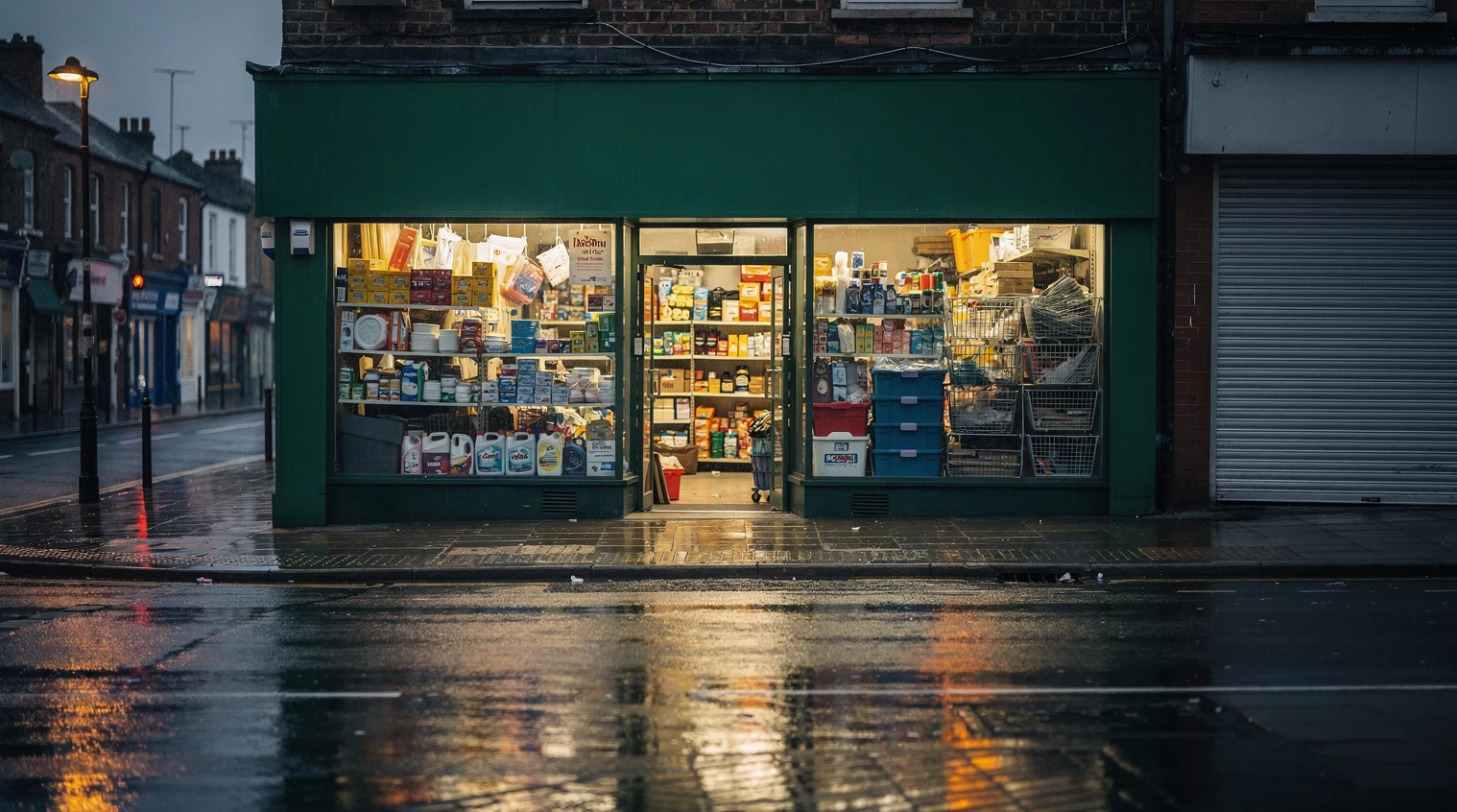
Poundland has taken the formal step its management spent the past week trying to avoid. On Thursday 29 October the discount chain filed a notice of intention to appoint administrators at the High Court, according to Reuters, Retail Week and the BBC, putting around 600 shops across the UK and Ireland and roughly 12,000 jobs at risk. AlixPartners has been lined up to act as administrator, Retail Week reported.
The filing does not mean Poundland has collapsed. Shops are open, staff are still expected to be paid on time this month, and the notice buys the business a short window of legal protection from creditors while a rescue is attempted. But it marks the moment the chain’s future moved from a sale process into an insolvency process, and it came after its owner, the US investment firm Gordon Brothers, rejected a solvent offer for the whole business and cut off access to day-to-day funding.
This report explains what was filed and why, what the next ten working days look like, what the possible outcomes are for shops and staff, and what Poundland shoppers holding gift cards, refunds or pending returns should do now.
In short
- Notice filed: Poundland lodged a notice of intention to appoint administrators at the High Court on 29 October, with AlixPartners lined up for the role, Reuters and Retail Week report.
- Breathing space: the notice gives the business around 10 working days of protection from creditor action while a rescue deal is sought.
- Funding cut off: Gordon Brothers restricted access to a lending facility used for everyday bills and wants a £30m loan repaid in full, according to the BBC via TheBusinessDesk.
- Break-up risk: a whole-business bid from Martin Property Group was rejected; retailers including Lidl, Iceland and B&M have been named as interested in parts of the estate.
- Shoppers: stores are trading, but anyone holding a Poundland gift card or waiting on a refund should use or chase it now rather than later.
What exactly did Poundland file on 29 October?
Poundland filed what is formally called a notice of intention to appoint administrators, often shortened to an NOI. Retail Week published the news at 10:50 on Thursday, and Reuters later confirmed the filing had been made at the High Court. TheBusinessDesk, citing the BBC, reported that the filing gives the business 10 days of protection from creditors, subject to the court process.
Talking Retail reported that the notice was filed by the retail business’s directors. Bally Auluk, a national officer at the shopworkers’ union Usdaw, said managing director Barry Williams had “reluctantly filed a notice of intention” to give the business time to find a rescue deal and to prevent Gordon Brothers from breaking it up.
How a notice of intention works
Under UK insolvency law, a company’s directors can file a notice of intention to appoint an administrator with the court. Once filed, an interim moratorium applies: landlords, suppliers and other creditors generally cannot take legal action, enforce security or start winding-up proceedings without the court’s permission. The company keeps trading under its existing management during that period.
The protection is short. If an administrator is not formally appointed within 10 business days, the notice lapses, although a further notice can sometimes be filed. In practice, an NOI is a pressure valve: it stops creditors from forcing the issue while the directors, the owner and potential buyers try to agree a deal that can be executed either before or immediately after an appointment.
Who has been lined up to run the process
AlixPartners, the restructuring advisory firm, has been lined up as administrator, according to Retail Week and the Guardian. AlixPartners has not publicly commented on the appointment, and as of Thursday afternoon no administrator had been formally appointed. The sale process that preceded the filing has been run since September by advisers Alvarez & Marsal, as we noted in our earlier coverage of the Poundland sale nearing a decision.
Why did Poundland head for administration now?
The short answer is a dispute between Poundland’s management and its owner over money and over who should buy the business. The events of the past ten days moved fast, and the filing on Thursday was the end point of a breakdown that became public on Tuesday.
On Tuesday 27 October, Sky News reported that Gordon Brothers had declined to back a solvent takeover offer from Martin Property Group, an Irish property company. We covered that day’s events in detail in our report on Poundland edging towards administration after its owner rejected a rescue bid. Three independent directors appointed to oversee the sale then resigned, TheBusinessDesk reported.
The funding line that was switched off
The decisive step came when Gordon Brothers restricted Poundland’s access to a lending facility used to pay everyday bills, according to the BBC as reported by TheBusinessDesk. Gordon Brothers accuses executives of breaching the loan terms by failing to submit a budget on time. Without access to that facility, a retailer of Poundland’s size cannot be confident of paying suppliers and landlords as bills fall due, which is the point at which directors have to consider an insolvency process to protect creditors.
In a letter to staff, Williams wrote: “I’m disappointed to have to tell you that Gordon Brothers have restricted access to funds.” He described the owner’s decision as “unexpected, unwanted and wholly avoidable”, according to reports in the Times and the Independent, and added: “This business simply does not deserve to go into any kind of administration.”
The £30m loan at the centre of the dispute
When Gordon Brothers bought Poundland from the Warsaw-listed Pepco Group in June 2025, it paid a nominal £1 for the business and also bought a £30m loan facility from Pepco for £1, TheBusinessDesk reported, citing the BBC. Gordon Brothers now wants that loan repaid in full.
Martin Property Group’s offer, backed by Poundland’s management, proposed paying half up front with the remainder deferred for two years until the loan matures, according to the same report. Other coverage put the bid at more than £15m, with only part paid at completion. Gordon Brothers rejected it and is understood to believe it can recover more by breaking up the business and selling shops in parcels.
What Gordon Brothers has said
Gordon Brothers did not immediately respond to Reuters’ request for comment on Thursday. In earlier statements during the week, a spokesperson told Sky News that the sale process had “surfaced a number of formal and indicative offers for significant viable parts of the business from established retail operators”, and that those options would be “objectively evaluated”.
The firm is a specialist in retail restructuring, asset disposals and liquidation sales, so a break-up is part of its normal toolkit. Its position appears to be that a fragmented sale offers a more certain recovery than a deferred payment from a single buyer. Williams has disputed that view publicly, describing the rejected bid as a “fully funded, ready-to-go bid that would have kept the business intact”.
What the managing director told staff
Reuters quoted Williams as saying it had “not been possible to identify an acceptable offer for the business as a whole”, but that “several established retail operators” had made formal offers for a significant part of the business. In the staff letter, he said: “Despite the actions of others, it is my intention to work to create the best outcome I can for you all.”
Sources quoted by TheBusinessDesk said the business is currently outperforming its forecasts. That claim has not been independently verified, but it matters to the argument over whether administration is necessary or a choice by the owner.
Which buyers are still in the frame?
The bidders fall into two groups: those who wanted to buy the whole company as a going concern, and those who want selected shops. The Guardian reported that up to eight parties may be interested in parts of the estate, and City AM has named Lidl, Iceland, B&M, The Range and Poundstretcher among them. Poundstretcher’s owner had earlier explored a combination with Poundland, as we reported when Poundland takeover talks with the Poundstretcher owner first surfaced in September.
The table below sets out the two routes now on the table and what each would mean in practice.
| Question | Whole-business sale (management-backed route) | Break-up through administration (owner’s preferred route) |
|---|---|---|
| Who buys | One buyer, such as Martin Property Group | Several retailers buy selected shops or leases |
| Shops kept open | Broadly the whole estate, at least initially | Only shops a buyer wants; the rest close |
| Staff | Employment continues across the business | Staff in acquired shops transfer under TUPE; others face redundancy |
| £30m loan | Half up front, rest deferred two years (per the BBC) | Repaid from the proceeds of asset sales, ahead of unsecured creditors |
| Poundland brand | Survives as a national chain | May survive on a smaller estate or disappear |
| Shoppers | Little visible change | Closing-down sales, local closures, gift card uncertainty |
How many shops could be left without a buyer
One industry source told the Guardian that up to 500 shops could be left without a buyer in a break-up. That figure is an estimate rather than a count of bids, and the final number will depend on which stores the bidding retailers want and on what rents landlords are prepared to accept. But it illustrates the gap between the two routes: a whole-business sale keeps the network largely intact, while a parcel sale could leave most of the estate unsold.
Regional titles have already begun listing local stores at risk, including three in Worcestershire, two in Blackpool and stores in Aberdeen, Inverness and Elgin, according to the Worcester News, the Blackpool Gazette and the Press and Journal. No closure list has been published by Poundland or by AlixPartners.
How big is Poundland now compared with a year ago?
Poundland is a smaller business than the one Gordon Brothers bought. When the High Court sanctioned its restructuring plan in August 2025, the chain had about 14,700 staff and roughly 800 stores, according to TheIndustry.fashion’s report of the hearing. The plan, approved by Sir Alastair Norris, brought up to £60m of new funding, a £30m overdraft facility and loan repayment dates pushed back to 2028, alongside rent cuts and store closures.
| Measure | August 2025 (restructuring plan) | October 2026 (administration notice) |
|---|---|---|
| Stores | About 800 (UK and Ireland) | About 600, including Dealz in Ireland |
| Staff | About 14,700 | About 12,000 (Usdaw cites 11,000) |
| Owner | Gordon Brothers, via Peach Bidco, bought for £1 in June 2025 | Gordon Brothers |
| New money | Up to £60m plus a £30m overdraft | Funding line restricted by the owner |
| Court process | Restructuring plan sanctioned, Poundland kept trading | Notice of intention to appoint administrators |
| Planned closures | 68 stores, affecting about 1,000 staff | Unknown; depends on bids |
Retail Week later reported that Poundland paused its closure programme after shutting 57 stores, putting the remaining planned closures on hold. The 2025 plan also included the closure of two warehouse sites, Darton and Springvale, affecting a further 350 jobs. Poundland was founded in 1990 and built its name on a single £1 price point, a policy it has since abandoned in favour of a wider range of prices.
The Irish business sits outside the UK process
Poundland’s group includes Dealz, a chain of around 50 shops in the Republic of Ireland. Dealz sits outside UK insolvency law, so any sale or restructuring of that part of the business would follow a separate path under Irish rules, according to reporting summarised by L’Express Franchise. Irish shoppers and staff should therefore not assume that every step in the UK process applies to them.
What does this mean for Poundland’s 12,000 staff?
For now, staff are still expected to be paid on time this month, according to TheBusinessDesk. Shop and warehouse workers will continue to work under their existing contracts during the moratorium, and if an administrator is appointed, it takes control of the business and decides which roles can be kept while a sale is pursued.
Usdaw has been the most vocal voice for workers. Auluk said Poundland staff had been “watching from the sidelines” as a multi-billion pound company jeopardised their livelihoods, adding that the owner had bought the business for £1 and was trying to extract £30m from it, Talking Retail reported. Usdaw general secretary Joanne Thomas has called on the government to do everything it can to save 11,000 jobs.
What workers are entitled to in administration
If staff are made redundant during an administration and the company cannot pay, employees can claim certain statutory amounts from the government’s Redundancy Payments Service, including statutory redundancy pay, some unpaid wages, holiday pay and notice pay, up to legal caps. These are statutory minimums rather than contractual entitlements, which is why unions focus on keeping jobs rather than relying on the safety net.
Where a buyer acquires a shop as a going concern, the TUPE regulations normally transfer staff to the new owner on their existing terms. City AM has reported that retailers bidding for parts of the estate have committed to taking on staff at the shops they acquire, but that commitment only covers stores that are actually bought.
How has the government responded?
The government has said the process is a commercial matter. The Guardian reported on Wednesday that Business Secretary Jonathan Reynolds had asked his chief business adviser, David Bickerton, to “establish the facts” about whether Gordon Brothers was unnecessarily pushing Poundland into administration. The department’s team wrote to Gordon Brothers, and a spokesperson said it was a commercial process and a decision for the owners.
Retail executives quoted by TheBusinessDesk predicted that a Poundland collapse would be the most politically contentious retail insolvency since BHS in 2016. The timing adds to the pressure: the filing came the day after the Budget, which included changes to business rates that we covered in our report on the Budget lifting rates relief to £18,000, and as retailers absorb a higher National Living Wage from April 2027.
Why ministers have limited powers here
The government has no direct power to block an owner from appointing administrators or to force a sale to a particular buyer. What it can do is apply public pressure, ask questions about how a process has been run, and, after the event, rely on the Insolvency Service to examine directors’ conduct. For a sale to a connected party in a pre-pack administration, UK rules introduced in 2021 require either creditor approval or an independent evaluator’s report, which adds some scrutiny if any buyer has links to existing owners or management.
What happens over the next ten working days?
The moratorium created by the notice runs for roughly ten working days, which takes the process into the second week of November. During that window several things can happen, and they are not mutually exclusive.
- A revived whole-business deal: Gordon Brothers and a whole-business bidder such as Martin Property Group agree revised terms, potentially executed as a pre-pack sale on appointment of administrators.
- A pre-pack to one or more buyers: administrators are appointed and immediately sell all or part of the business, with stores not included in the sale closing.
- A trading administration: AlixPartners is appointed, keeps the shops trading through Christmas, and sells stores in parcels over several weeks while running down stock in unsold sites.
- A lapse and refiling: if no appointment is made within the deadline, the notice lapses; a fresh notice may be filed if talks continue.
Suppliers are already reacting. Sky News reported that several major suppliers had begun cutting back deliveries amid concern they may not be paid on schedule this week. That matters for shoppers, because reduced deliveries can mean thinner shelves in the run-up to Christmas even if every store stays open.
Why the Christmas timing matters
The final quarter is the most important trading period for a discount variety retailer, when seasonal decorations, gifts, confectionery and party goods drive footfall. A business that can keep trading through December generates cash that improves recovery for creditors, which is one reason administrators often prefer to keep shops open through peak. Equally, any buyer of selected stores will want to know which sites trade well over Christmas before committing.
What should Poundland shoppers do right now?
Poundland stores are open and trading. Nothing in the filing changes what happens at the till today. But the period between a notice of intention and the outcome of an administration is when customer money is most exposed, so it makes sense to act now on anything that depends on Poundland’s ability to pay.
Gift cards and vouchers
Poundland has not made any public statement about gift cards. When a retailer enters administration, gift card holders are usually treated as unsecured creditors, and administrators decide whether cards will continue to be honoured. Some administrations have accepted gift cards for a period; others have suspended them on the day of appointment. The safest course is to spend any Poundland gift card balance while stores are trading normally.
Refunds, returns and faulty goods
If you are waiting for a refund, chase it now. Unpaid refunds can become unsecured claims if the business enters administration. Your statutory rights under the Consumer Rights Act 2015 still apply to faulty goods, but enforcing them against a company in administration is harder in practice.
- Paid by credit card: for a single item costing between £100 and £30,000, Section 75 of the Consumer Credit Act can make the card provider jointly liable if goods are not delivered or are faulty.
- Paid by debit card or a credit card under £100: ask your bank about a chargeback claim. It is a voluntary card scheme process with time limits, not a legal right, so act quickly.
- Paid by cash: keep receipts; you may need to claim as an unsecured creditor if the administrators do not honour returns.
- Buy now, pay later: contact the BNPL provider, which may be able to pause payments while a dispute is investigated.
Closing-down sales
If stores are closed in a break-up, shoppers can expect closing-down sales in those locations. Discounts in administration sales are typically staged, starting modest and deepening as stock runs down. Checks on fake reference prices still apply: since April 2025 the CMA has had direct powers under the Digital Markets, Competition and Consumers Act to fine retailers for misleading pricing, so a “was” price should reflect a genuine previous selling price. Shoppers comparing price cuts across chains may also find our report on UK shop price inflation hitting 2.1% useful context.
How does Poundland compare with recent UK retail collapses?
The comparison most often drawn is with Wilko, the homeware and variety chain that entered administration in 2023. Poundland bought dozens of former Wilko stores after that collapse, which means some high streets may now face losing the same unit twice. The table below compares the scale of recent high-profile UK retail insolvencies using widely reported figures.
| Retailer | Year | Stores (approx.) | Jobs (approx.) | Outcome |
|---|---|---|---|---|
| BHS | 2016 | 163 | 11,000 | All stores closed after administration |
| Debenhams | 2020–2021 | 124 | 12,000 | Stores closed; brand bought online-only by Boohoo |
| Wilko | 2023 | 400 | 12,500 | Stores closed or sold in parcels; brand bought by The Range |
| Poundland | 2026 | 600 (incl. Dealz) | 12,000 | Notice of intention filed; outcome pending |
By store count, Poundland would be the largest of the four. By headcount, it is comparable to Wilko and Debenhams. The key difference is that Poundland’s management insists the business is viable and outperforming its forecasts, while the dispute is about the owner’s preferred route to recovering its money.
What a Poundland closure would mean for town centres
Poundland is often an anchor tenant in smaller town centres and secondary shopping parades, where it drives footfall that helps neighbouring independent shops. Its stores are frequently in large units that are hard to re-let, and a wave of closures would add to vacancy rates in towns already affected by the loss of Wilko, banks and post office counters. Discount rivals such as B&M, Home Bargains, The Range and Poundstretcher may pick up some sites and some of the spending, but not all of it.
What shoppers and local businesses should watch next
The next signals will come quickly. The key milestones are a formal appointment of administrators, which would be published in the Gazette and confirmed by AlixPartners, and any statement from Poundland or the administrators setting out whether stores, online orders, gift cards and returns are affected.
- A revised Martin Property Group bid or a move by any other whole-business buyer.
- A pre-pack sale announcement naming which buyers have taken which stores.
- A store closure list, which regional newspapers have already begun anticipating.
- A gift card statement from the administrators on the day of any appointment.
- Further government comment following the business secretary’s fact-finding request.
For local independent shops near a Poundland, the practical point is footfall: if the store in your town is earmarked for closure, expect a short-term rush during any closing-down sale followed by fewer visits to the parade. Independent retailer groups have welcomed the Budget’s rates changes while warning, Talking Retail reported, that the overall cost of doing business remains too high, and a large vacant unit on a parade adds to that pressure.
Frequently asked questions
Has Poundland gone into administration?
Not yet. On 29 October Poundland filed a notice of intention to appoint administrators at the High Court, which gives it around 10 working days of protection from creditors. AlixPartners has been lined up to act as administrator, but no formal appointment had been confirmed on Thursday afternoon.
Are Poundland shops still open?
Yes. Poundland shops are open and trading normally while the notice of intention is in force. Some suppliers have reportedly reduced deliveries, so stock levels in some stores may be thinner than usual.
Can I still use a Poundland gift card?
Gift cards should still work while stores trade normally, but Poundland has not made a statement about them. If administrators are appointed, they decide whether to keep honouring cards. Spending any balance now is the safest option.
How many jobs are at risk at Poundland?
Around 12,000 jobs are at risk across about 600 shops in the UK and Ireland, according to the BBC and the Guardian. Usdaw has cited a figure of 11,000. Staff are expected to be paid on time this month.
Why did Gordon Brothers reject the rescue bid?
Gordon Brothers wants a £30m loan, which it bought from Pepco for £1, repaid in full. Martin Property Group offered half up front and the rest deferred for two years, and Gordon Brothers is understood to believe it can recover more by selling stores in parcels.
Which retailers could buy Poundland stores?
City AM has named Lidl, Iceland, B&M, The Range and Poundstretcher among parties interested in parts of the estate. The Guardian reported that up to eight parties may be interested, and that up to 500 shops could be left without a buyer in a break-up.
Will Poundland stores close?
No closure list has been published. If the business is sold as a whole, most stores could stay open. If it is broken up, only the stores that buyers want would continue trading, and the rest would be likely to close after closing-down sales.
What happens to Dealz stores in Ireland?
Dealz operates around 50 shops in the Republic of Ireland. It sits outside UK insolvency law, so any sale or restructuring of the Irish business would follow a separate process under Irish rules.
How can I get my money back if I am owed a refund?
Chase the refund now. If you paid by credit card for an item costing £100 to £30,000, you may be able to claim from your card provider under Section 75. For debit card payments or smaller credit card purchases, ask your bank about chargeback as soon as possible.