
In short
- A deadline at last: Primark plans to start home delivery in Britain by the end of 2027, after saying only “in the future” as recently as Tuesday’s results announcement.
- About two years early: George Weston, chief executive of owner Associated British Foods (ABF), told the Guardian the plan has been brought forward by about two years, helped by buying a Sheffield warehouse.
- Fees are coming: Primark says it will pass on charges “in line with the rest of the market” and use minimum order sizes, but it refuses to give a number for either.
- Nothing changes this Christmas: Primark takes control of the Sheffield site around the middle of 2027, so do not expect a delivery option this Christmas: Click & Collect remains the only way to order online.
- The demerger sets the clock: Primark is due to split from ABF in December 2027, and Weston says he hopes delivery will reassure potential investors, although he insists neither plan depends on the other.
Primark has put a date on the biggest change to how it sells clothes in the UK. The value fashion chain, which spent years arguing that delivering cheap clothes to people’s homes could never make money, now plans to be doing exactly that by the end of next year.
The timetable emerged on 3 November 2026, the day ABF reported a 12% fall in Primark’s profit. It was not in the written results, which repeat that delivery will come “in the future”. It came from Primark chief executive Eoin Tonge on the investor call and from George Weston in interviews with the Guardian, Reuters and others.
For shoppers, the headline is simple, but the detail that matters most is still missing. Primark has not said what delivery will cost, how much you must spend, how returns will work or how fast parcels will arrive. This article sets out what is confirmed, what rivals charge today, and what the plan means for shoppers, competitors and independent shops.
What did Primark actually announce?
On the results call, Tonge said: “Our plan is to launch in the U.K. by the end of the calendar year next year,” according to a transcript published by Investing.com. Weston told Reuters, as reported by Retail Systems, that the service would be introduced before the planned demerger in December 2027. Retail Systems described that as the first time the group has publicly confirmed a launch timetable.
The Guardian reports that Weston said the launch had been brought forward by about two years. It adds that Primark will begin deliveries in the UK by December next year and intends to offer the service in mainland Europe after that, without a timeframe. This is Money and Retail Week have also reported the end of 2027 date.
The date changed, the written wording did not
This is why some coverage of the results said no date had been given, including our own report on Primark’s annual results and the Direct Commerce Association’s summary. Both were accurate about the announcement published at 7am. ABF’s text says only that “the next evolution is to offer home delivery in Great Britain in the future”.
The date arrived later in the day through spoken comments. Spoken guidance can be firmer or softer than a formal commitment, and “by the end of” leaves room for a launch earlier in the year. In practice, though, Primark’s own takeover date for the warehouse makes a launch before the second half of 2027 look unlikely.
Great Britain or the whole UK?
There is one small but real inconsistency in the language. ABF’s written announcements consistently say “Great Britain”, which means England, Scotland and Wales. Tonge’s spoken comment and much of the press coverage say “the UK”, which would also include Northern Ireland.
Primark has not, in the material we have read, confirmed delivery to Northern Ireland. Shoppers there should treat it as unconfirmed until the company says otherwise. The same applies to the Republic of Ireland, where the chain trades as Penneys and which falls outside the Great Britain plan.
When can UK shoppers order from Primark online?
You can already order online for collection, but not for delivery. Primark introduced Click & Collect in November 2022 and rolled it out gradually, and it launched a mobile app for British customers earlier this year, This is Money reports. The Guardian notes the service is not available in its mainland European stores.
The route to home delivery runs through four dated steps. Only the December demerger has been stated formally in writing, and even that is an expectation rather than a certainty.
| Date | What is planned | Source |
|---|---|---|
| Christmas 2026 | No home delivery. Debenhams Group still runs its own fulfilment from Sheffield through peak trading | Debenhams Group, ABF |
| Around mid-2027 | Primark takes control of the Sheffield depot | Eoin Tonge on the results call; the Guardian |
| By end of 2027 | Home delivery begins in Britain | Tonge; George Weston via the Guardian and Reuters |
| December 2027 | Primark demerges from ABF | ABF annual results |
| Not dated | Delivery in mainland Europe | The Guardian |
What to do this Christmas
Nothing about this announcement changes how you buy from Primark this year. If you want an item from the Christmas range, which includes £1.30 children’s Christmas T-shirts according to This is Money, you need to visit a shop or use Click & Collect where it is available. Be wary of any website offering Primark clothes with home delivery as though it were an official service, because Primark does not offer one.
How much will Primark home delivery cost?
Nobody outside the company knows, and Primark is deliberately not saying. Tonge told analysts: “We are going to protect the economics further by passing on charges in line with the rest of the market.” He also said: “With this type of customer, we feel we can have minimum order sizes to protect the basket size.”
Asked by a Peel Hunt analyst whether there was a number for that minimum basket, Tonge’s answer was short. “No. To be honest with you, I think we’ve given quite a lot away in terms of what the proposition is,” he said, according to the transcript. “I don’t think we want to be giving more away at this point in time.”
The phrase “in line with the rest of the market” does give shoppers something to work with. It suggests a fee and threshold structure resembling those of other fashion retailers, rather than free delivery as a headline promise. The table below shows what several competitors display today.
| Retailer | Standard delivery | Free delivery from | Faster option | Collection |
|---|---|---|---|---|
| Primark | Not announced | Not announced | Not announced | Click & Collect already available |
| Shein | £3 | Orders over £39 | Express £9 | £3.99 to £5.99 on smaller orders |
| River Island | £4 | Orders over £15, excluding sale and markdown | Next or nominated day £5 | Free to store |
| M&S | £3.99 | Orders over £75, excluding furniture | Next or nominated day £5.99 | Free on fashion, home and beauty |
| H&M | Not shown on its help page | Members spending £40 or more | Not shown on its help page | Free to store, no minimum spend |
These figures come from each retailer’s UK delivery information as displayed on 4 November 2026. They can change with promotions and may differ at checkout, so treat them as a snapshot rather than a guarantee.
The basket maths Primark has to solve
A flat delivery charge hits a low-priced retailer harder than a mid-market one, because the fee is a larger share of the order. As a purely illustrative calculation, a £3.99 charge adds about 20% to a £20 basket but only about 8% to a £50 one. Against a single £1.30 T-shirt, the same fee would cost roughly three times as much as the item.
That is why a minimum order matters so much. It stops the smallest baskets, which could never pay for picking, packing and carriage, from reaching the warehouse at all. Whether Primark sets that minimum near River Island’s £15 free-delivery line or somewhere much higher will say a lot about which shoppers it is really targeting.
Any fee Primark does charge will also have to be displayed properly. The CMA told online retailers this week that mandatory delivery fees must be included in the total price under the Digital Markets, Competition and Consumers Act, and a charge counts as mandatory when a shopper cannot buy the product without paying it. How Primark’s rules apply will depend on whether a free collection option sits alongside its delivery service.
Will Primark charge for returns?
Primark has not said, but its owner’s reasoning points firmly in that direction. ABF’s results statement says the economics of home delivery have changed “including the introduction of return policies, minimum basket sizes and delivery fees as standard”. Tonge’s only comment on the subject was blunt: “returns is a fact of life” when you do home delivery.
Returns matter more than almost anything else in online fashion. InternetRetailing, citing Advanced Supply Chain data, has reported that return rates can reach 25–40%, particularly in fashion. A value retailer cannot absorb that on low-priced items without charging, restricting or steering returns towards its shops.
Estimates of how many retailers now charge vary, largely because they measure different groups in different ways. ZigZag data reported by InternetRetailing in October 2025 found 76% of the UK’s top 100 retailers charge for returns in some form. Ingrid’s Return Economics 2026 research says 35% of the top 100 fashion retailers charge, up from 23% in 2023. ZigZag also found that young fashion brands charged far more often (80%) than luxury businesses (11%).
| Retailer | Postal returns fee (Which?, September 2024) |
|---|---|
| Next | £2.50 |
| New Look | £2.95 |
| Zara | £2.95 |
| River Island | £2 |
| Boohoo and PrettyLittleThing | £1.99 |
| H&M | £1.99 for non-members at the time; more recent industry reporting puts it at £2.95 |
| Shein | First return label per order free, then £2.50 for extra items from the same order |
| Asos | £3.95 for customers with frequently high return rates who keep less than £40 of items |
That Which? research is now two years old, so individual fees may have moved. Its wider finding is the useful one: all the retailers in its study with physical stores offered free in-store returns, apart from Sports Direct. If Primark follows that pattern, its shops would become the cheap way to send clothes back, and returning shoppers would pass through the same tills and rails that the company wants to protect.
Your legal rights will not depend on Primark’s policy. Under the Consumer Contracts Regulations 2013, most online purchases can be cancelled up to 14 days after delivery, and you then have a further 14 days to send them back. A retailer can make you pay the return postage only if it told you so before you bought, and faulty goods fall under separate protection in the Consumer Rights Act 2015, including a 30-day right to reject.
Why has Primark changed its mind on home delivery?
For years Primark’s position was arithmetic. Picking and shipping a low-priced top costs about the same as handling an expensive one, and Weston has said historically “there just was not a way for us to make money from providing that service”, according to Sourcing Journal. This is Money reports that the company was still arguing as recently as May that its low prices and tight margins could not absorb the additional costs.
Primark’s explanation for the reversal is that the market came to it, rather than the other way round. Free returns used to be the norm in online fashion, as Which? has noted. As charges spread, the customer began paying for a larger share of the logistics.
Weston told the Guardian that delivery and returns charges common across the industry could now cover most of the logistical costs. In September he made the same point in fewer words: “The market really has come towards us in terms of pricing for delivery to people’s homes.”
The pressure on the store model is also part of this story, even if Primark presents it differently. Sales rose to £9.8bn in the 52 weeks to 12 September, but like-for-like sales fell 2.6% and adjusted operating profit dropped 12% at constant currency to £1,005m. The UK is holding up better than most markets, with like-for-like sales up 0.5%, and it makes up 39% of Primark’s sales, which is why it goes first.
Meanwhile, shoppers are moving online faster than they are returning to stores. The BDO High Street Sales Tracker for October showed online sales among its non-food retailers up 10.1%, compared with 2.2% in stores, while online fashion grew 9.0% against 2.1% in shops. A single month does not make a trend, but it does show the channel Primark has been missing.
Why does the Sheffield warehouse matter so much?
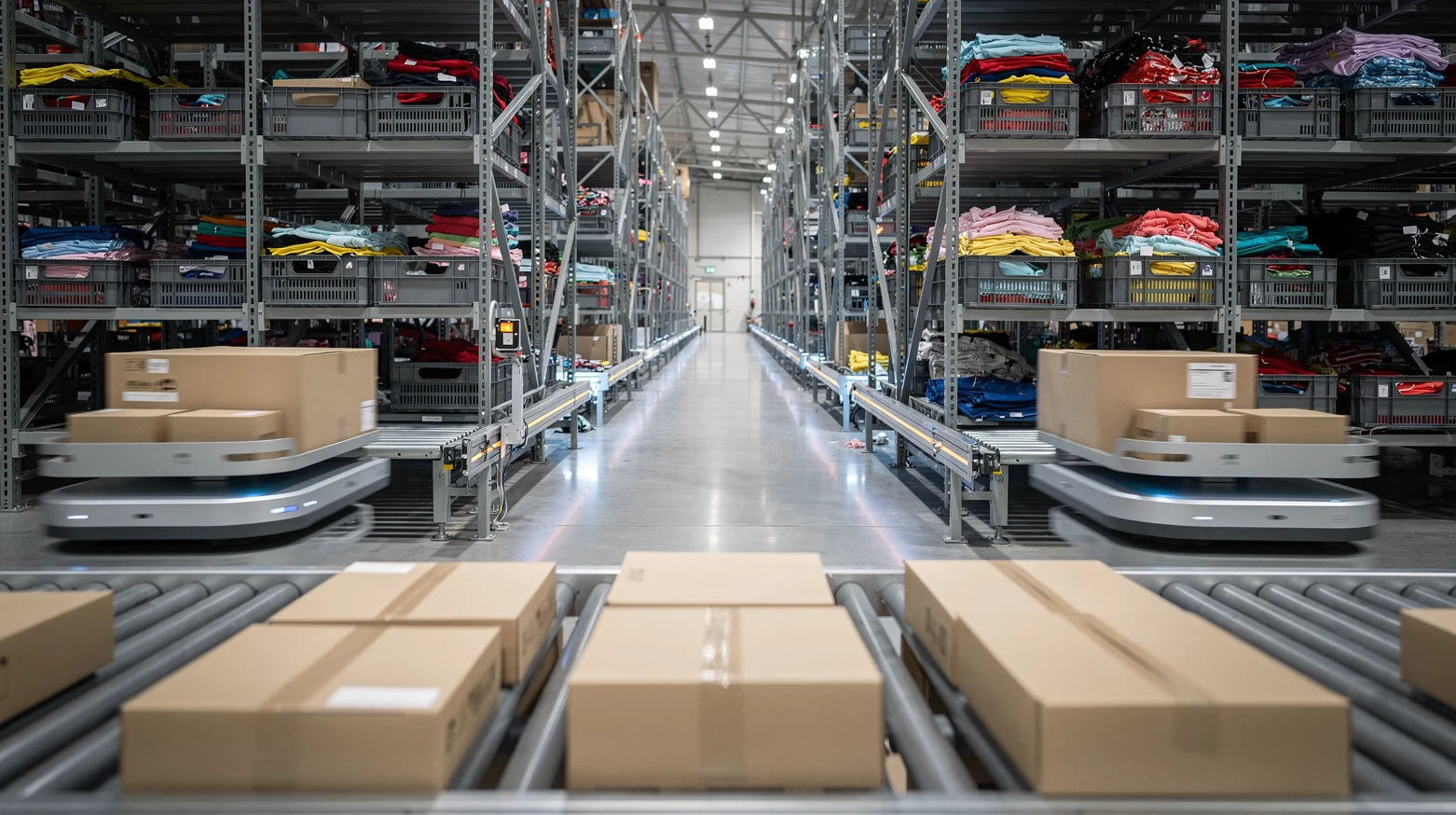
Because it is what moved the date. The Guardian reports that Primark was able to speed up the plan by buying the robot-assisted warehouse from Debenhams, the owner of Boohoo, PrettyLittleThing and Karen Millen. When ABF first confirmed home delivery and the £90m Sheffield purchase in September, it gave no timetable at all.
Buying a depot that already handles individual online fashion orders removes years of building work. Tonge told analysts: “It is a highly automated facility, and it is active at the moment, actually.” He added that Primark expects to take control “sometime in the middle of next year”.
The price comes in two stages. The September announcement put the deal at £90m in cash, including the automation equipment and a lease assignment, and TheIndustry.fashion has reported that Debenhams Group received £76.5m up front, with £13.5m due on vacant possession. That may explain why finance director Joana Edwards referred to “about GBP 75 million” in the call transcript. The same report expected vacant possession in early 2027, so Tonge’s mid-year date appears slightly later.
What happens to Boohoo and PrettyLittleThing orders?
The current occupant has to leave first, which is why the handover waits until after the peak. Debenhams Group said it has appointed GXO as its logistics partner, and that fulfilment will move from Sheffield to its Burnley site after peak trading. Orders from Debenhams Group brands placed this Christmas should therefore still come from Sheffield.
Why Primark cannot simply use its store stock
Sending clothes to stores and sending them to individual homes are different jobs. Tonge confirmed that delivery will use “a different stock pool, because obviously it is single pick fulfillment versus the pack fulfillment in stores”. The Guardian adds that Primark is working on preparing suppliers to provide stock suitable for sending to individual shoppers, as well as the bulk orders it uses for its shops.
That is a significant change for a business built around moving large quantities of a product to shops. It also creates a practical question for shoppers: an item on a rail in your local Primark may not necessarily be available for delivery, and the reverse may also be true. Primark has not explained how far the two ranges will overlap.
Costs will also rise outside the warehouse. Tonge said he expects a step-up in technology spend across the business, most of it treated as a running cost rather than capital investment. Weston has separately described the extra technology investment needed for delivery as relatively modest, because much of the digital infrastructure already exists.
Can delivery win new shoppers without emptying the stores?
This is the question investors care about most. A sale that simply moves from a shop to a parcel makes Primark less money, because the shop still has to be paid for. “The trick is to make sure that the bulk of the home delivery sales are incremental, not substitutional,” Weston said in September, according to Sourcing Journal.
Primark’s case rests on geography and habit. Weston told the Guardian: “We now know there’s a group of shoppers who don’t reject Primark but just don’t use us very often as they are too far away from a store or prefer to shop online.” Tonge said Click & Collect reaches roughly a 10-kilometre store catchment area, “so home delivery clearly unlocks more”.
Click & Collect is the evidence the company points to. Tonge told analysts that sales through the service have been “highly incremental” and that its baskets are “well ahead of store basket sizes on average”. ABF also says Click & Collect has driven footfall and additional purchases in shops, which is a benefit that home delivery, by its nature, cannot offer in the same way.
That is the limit of the comparison. A shopper picking up an order walks through a store and may buy more, while a shopper receiving a parcel at home does not. Weston nonetheless told Reuters, as reported by Retail Systems: “We’re sure it will be incremental (for sales) and profitable.” Those claims will not be tested until 2028 at the earliest, when there is a meaningful period of trading to look at.
How does the demerger fit into the timing?
The delivery launch and the demerger now sit almost on top of each other, and that is not lost on the people who will be asked to buy the shares. ABF expects to complete the separation in December 2027, leaving Primark as a standalone listed retailer and the food business as a separate company. Should Primark list in London, This is Money says its size means it would be expected to enter the FTSE 100.
Weston told This is Money: “Neither [the demerger and launching deliveries] is dependent on the other, of course. But having home delivery on the horizon, I hope will reassure potential investors in Primark that we’re creating an omnichannel retailer which is super relevant to all the shoppers in its markets.”
Analysts quoted by the same publication were more guarded. “Primark is still a strong retailer, but today it is a more mature business facing margin pressure, so it is difficult to see the demerger unlocking a significant amount of value on its own,” said Chris Beckett of Quilter Cheviot. Mark Crouch of eToro said: “Management must demonstrate that home delivery can deliver profitable growth, while ensuring both businesses emerge from the separation with stronger prospects than they have today.”
The market reaction on the day was cool, although the delivery news was only one of many factors. ABF shares fell 3.3% to 1,878p, according to This is Money, as the group warned that adjusted profit and earnings per share in the coming year would be lower than in 2026, mainly because of losses in its sugar business. ABF also expects Primark’s margin to slip to about 10%.
What does this mean for rivals and independent shops?
The obvious targets are the cut-price online specialists, but Weston does not see them as the main threat. He told the Guardian that Shein was not taking more than a “little bit” of market share from Primark, and that more of the competition came from retailers that could combine online and stores. The Guardian names H&M, Zara and supermarket clothing ranges among the rivals Primark is up against.
For those retailers, the immediate effect is limited, because there is more than a year before the first parcel ships. The longer-term risk is to their customers in areas without a nearby Primark, the same group Primark has identified as its target. Value fashion chains with established websites have that period to reinforce loyalty schemes, delivery propositions and free-return options.
Primark also says its existing tactics are working at home. UK sales rose 2%, and ABF cites Kantar data putting its UK market share at 6.9% over the 52 weeks to 13 September. Adding a delivery service to a business that is already gaining share would be a more awkward challenge for rivals than a defensive move by a struggling one.
For independent fashion shops, the picture is mixed. Primark’s existing customers are already price-led, so the direct overlap may be smaller than the headlines suggest, but a national low-price delivery option does reach towns where a Primark has never been the alternative. That is the very gap Primark says it wants to fill, and a small shop competing on price there will have less room than one competing on service, advice or a distinctive range.
Carriers also have a stake, although Primark has not named a delivery partner. Sourcing Journal reports a FarEye survey of more than 500 delivery operators in which the median cost per delivery rose 12% year on year in 2026. Any partner or contract Primark chooses will be judged against those costs and against a retail price point that leaves unusually little room for error.
Frequently asked questions about Primark home delivery
Does Primark deliver to your home now?
No. Primark does not currently offer home delivery in the UK. You can buy in its shops or, where it is available, order online and pick up in store using Click & Collect.
When will Primark home delivery start?
Primark plans to launch by the end of 2027. Chief executive Eoin Tonge said the plan is to launch “by the end of the calendar year next year”, and George Weston of ABF told Reuters it would come before the demerger in December 2027. No exact launch date has been announced.
How much will Primark delivery cost?
Primark has not announced a price. It says it will pass on charges “in line with the rest of the market”. For comparison, Shein currently shows £3 standard delivery, River Island £4 and M&S £3.99, each with a free-delivery threshold.
Will there be a minimum spend for Primark delivery?
Very likely, but the amount is unknown. Tonge said Primark feels it can have minimum order sizes to protect basket size, and he declined to give a figure when an analyst asked for one.
Will returns be free?
Primark has not said. ABF has pointed to return policies and delivery fees becoming standard across the market as one reason delivery now makes financial sense, which suggests free postal returns should not be assumed.
Will Primark deliver to Northern Ireland?
That is not confirmed. ABF’s written announcements refer to Great Britain, which excludes Northern Ireland, although some spoken comments and press reports refer to the UK. Delivery in mainland Europe is planned for later, with no timeframe given.
Why is it taking so long to launch?
Primark does not expect to control its Sheffield depot until about the middle of 2027, because Debenhams Group is still using it and will move fulfilment to Burnley after peak trading. Primark must also prepare suppliers and build a separate pool of stock for orders picked individually.
Will Primark close shops because of home delivery?
Primark has not suggested that. ABF describes its digital strategy as supporting a “strong, store-led model”, and the company opened three new UK stores in the last financial year. It says it expects delivery to bring in new customers rather than replace store visits.