
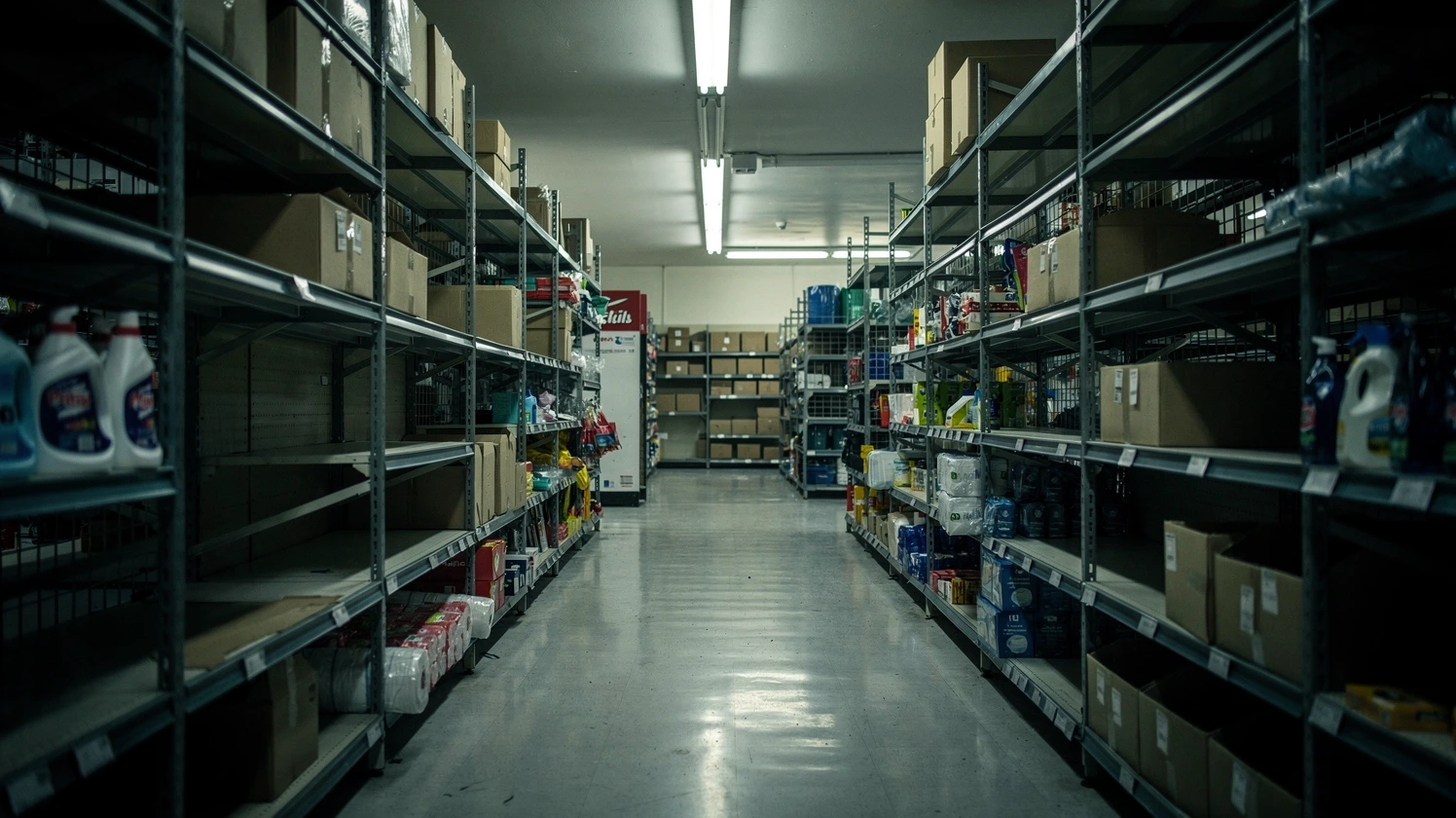
Poundland cannot buy new stock for its shops. The BBC reported on Monday evening, 9 November 2026, that about £50m held in the discount chain’s bank accounts has been frozen by its American owner, Gordon Brothers, leaving its roughly 600 shops selling down what is already on the shelves. ITV News first reported on Sunday night that the chain had been unable to pay suppliers for goods for resale since 27 October. All of this lands three days before Thursday’s deadline, when the legal protection from creditors that Poundland won in late October runs out.
This article sets out what has been reported, where the figures disagree, why an owner can switch off a retailer’s own cash, what the two leading bids look like, and what shoppers, staff and suppliers can sensibly do this week. Every figure is attributed to the outlet that published it; where two outlets give different numbers, both are shown.
In short
- Stock freeze: Poundland has not been able to pay suppliers for new stock since 27 October, ITV News reports, after Gordon Brothers restricted access to its credit facilities and trading cash.
- Cash locked away: about £50m is frozen, according to the BBC on 9 November; ITV put the inaccessible cash at about £25m as of 3 November and said it was still growing.
- Thursday deadline: the notice of intention to appoint administrators expires on Thursday 12 November; the BBC says an extension looks increasingly likely, but Sky News says directors can only seek one if creditors would not lose out.
- Bidders: City AM names Xyra Group as frontrunner with £12.5m up front, against £5m from Martin Property Group; Tesco, B&M, Poundstretcher, Iceland, The Range and Lidl are reported to want some shops only.
- Shoppers: expect thinner shelves and fewer Christmas lines; shops are trading, so spend gift card balances and chase refunds now rather than after Thursday.
What exactly has happened to Poundland’s stock?
The plain answer is that Poundland is selling stock it already holds and cannot pay for replacements. ITV News reported that since 27 October, when Gordon Brothers restricted access to the company’s credit facilities and to cash generated by trading, payments to suppliers of goods for resale have not been authorised. Some payments for essential services are still being approved, ITV said, so the lights stay on and staff are paid, but the shelves are not being refilled in the normal way.
The BBC’s business editor Simon Jack and correspondent Emma Simpson took the story further on Monday. They reported that Poundland is “unable to buy new stock to fill its shelves after being blocked by its owners from accessing cash in its bank accounts”, quoted one insider describing the business as “running on fumes”, and said about £50m had been frozen. The BBC said this means the chain’s 600 shops “are running out of stock”.
A source quoted by the BBC said access to funds had been limited because of “a tension between Gordon Brothers’ dual role as both creditor and shareholder”, but added that they expected a relaxation of funds in the next two days. Gordon Brothers had been approached for comment by the BBC at the time of publication.
How the reporting has built up since Sunday
The story has moved quickly in under 24 hours, and the order matters because later reports carry bigger numbers. ITV News published its account late on Sunday 8 November, based on a note sent to staff by Poundland’s managing director, Barry Williams, and on people familiar with the company’s finances. The Daily Express followed it on Monday lunchtime and again in the afternoon, City AM reported on the bidders at 1.58pm, Sky News added the Retail Trust row at about 3.30pm and the BBC published the £50m figure at 4.46pm.
| Outlet | When (UK time) | What it added |
|---|---|---|
| ITV News | Sunday 8 November, late evening | No supplier payments since 27 October; about £25m inaccessible as of 3 November; staff note on profit and sales |
| Daily Express | Monday 9 November, 12.26pm and 3.18pm | Gordon Brothers statement: “pursuing all avenues through the sales process” |
| City AM | Monday, 1.58pm | Xyra £12.5m versus Martin Property Group £5m; founder Steve Smith approached |
| Sky News | Monday, about 3.30pm | Gordon Brothers accused management of breaching facility terms, then froze access; extension test for directors |
| BBC News | Monday, 4.46pm | About £50m frozen; shops running out of stock; extension “increasingly likely” |
How much cash is frozen, £25m or £50m?
Both figures have been reported, and they are not necessarily in conflict. ITV News said that as of 3 November Poundland had “approximately £25 million in cash which its management was unable to access”, and that “the balance is believed to have grown as trading receipts continue to accumulate”. The BBC said on 9 November that about £50m had been frozen, attributing the figure to its own understanding rather than to a named source.
The gap between the two dates is six days of trading. A chain of 600 shops taking cash at the tills every day, while not paying for replacement stock, will see its bank balance rise quickly, so a doubling over that period is plausible. Neither outlet has published a bank statement, and Gordon Brothers has not confirmed either number, so both should be treated as reported estimates.
Other figures in the story also differ between outlets. The table below lists the main ones so readers can see which number comes from where.
| Figure | BBC | ITV News | Sky News | City AM |
|---|---|---|---|---|
| Cash frozen | About £50m (9 Nov) | About £25m (as of 3 Nov), rising | “Millions of pounds” | Not given |
| Supplier payments stopped | Not dated | Since 27 October | Unable to pay suppliers or place new orders | Not given |
| Employees | 11,000 | 10,500 | Roughly 10,500 | 12,000 |
| Shops | 600 | Not given | 600 in the UK and Ireland | 600 |
| Year to September 2026 | “Profit” of £18.1m, unaudited | EBITDA profit of £18.1m, unaudited | Not given | Not given |
Why can an owner stop a retailer using its own cash?
The answer lies in Gordon Brothers’ two roles. It bought Poundland from Pepco Group for £1 in June 2025, and it is also a lender to the business. As we set out when we looked at the £18.3m Sky News says Gordon Brothers has received from Poundland, the restructuring plan approved by the High Court in 2025 left the owner sitting at the top of the funding stack, with a working capital facility that ranks ahead of most other creditors.
Lenders usually control cash through the terms of their facilities. Retail borrowing is often secured on stock and receivables, with the takings swept into accounts the lender can monitor, and the borrower has to meet conditions to draw on it. If the lender says those conditions have been broken, it can stop further drawings. Sky News reported that Gordon Brothers “accused management of breaching the terms of Poundland’s borrowing facilities and subsequently froze access to them”.
Sky said that decision left Barry Williams and his fellow director Shaun Wills, the chief financial officer, “with no choice” but to file the notice of intention to appoint administrators, according to people familiar with the process. Gordon Brothers has not publicly set out which terms it says were breached, and Poundland management has not publicly accepted that any were.
Is Poundland profitable or not?
This is the heart of the dispute, and the two sides are using different measures. In his note to staff on Friday 6 November, seen by ITV News, Williams said Poundland had swung from an EBITDA loss of £68.1m in the year to September 2025 to an EBITDA profit of £18.1m in the year to September 2026, an improvement of £86.2m. He said like-for-like sales rose 7% in the first period of the new financial year, and that last week, which included Halloween, they were 11.4% higher than a year earlier and £1.5m ahead of budget. He called those numbers “spook-tacular”.
Williams also acknowledged that total sales were down on last year, which he put down to the closure of 115 shops during the restructuring, and that the latest figures have not been audited. Gordon Brothers takes a different view. In a letter to government last week, quoted by ITV, Mark Newton-Jones, who runs the firm’s UK operations, wrote that the company “is still not cash-generative at a sustainable level despite the turnaround efforts”, citing inflation, staffing costs and “shrinkage from severe levels of shoplifting”.
Both statements can be true at once. EBITDA strips out interest, tax, depreciation and amortisation, so a retailer can report a positive figure while still struggling to fund rent, debt payments, shop refits and stock. For context, Poundland’s last filed accounts showed a pre-tax loss of £85.2m for the year to 28 September 2025, Retail Gazette reported in September, although the business then held more than £30m of cash.
What Gordon Brothers says
Gordon Brothers has not commented directly on the stock freeze in the reports published on Monday. In a statement quoted by the Daily Express, it said it was “pursuing all avenues through the sales process” and “engaging in active discussions on offers with interested parties”. It added: “When Gordon Brothers acquired the business, it was in distress and required a radical restructure, urgent operational change and significant funding, which we provided to support the company’s ability to trade.”
The BBC reported that Gordon Brothers describes the chain as “challenged and vulnerable to any potential downturn in future trading”. City AM said Gordon Brothers declined to comment on its bid story.
What happens to the shelves before Christmas?
If stock cannot be replaced, the effect builds week by week. Fast-selling lines such as cleaning products, snacks, drinks and toiletries run out first, followed by seasonal ranges that were meant to be topped up through November and December. The Daily Express warned on Monday that Poundland’s shelves “could begin to look noticeably emptier before Christmas”.
The timing is poor for a discounter. Late November and December bring the year’s busiest trading weeks, when value chains rely on gifts, wrapping, decorations, confectionery and party food. ITV News said the freeze raises “concerns about its ability to keep going through the crucial Christmas period”. One person familiar with Poundland’s finances described the restrictions to ITV as a “stranglehold” and said Gordon Brothers “risks squeezing the life out of the very business they say they want to save”.
The BBC’s source said they expected a relaxation of funds within two days. If that happens, orders can restart, but goods ordered now will take time to arrive, particularly lines shipped from factories in Asia, which supply much of a variety retailer’s general merchandise.
Is this the first time shelves have run thin?
No. In July 2025, shortly after Gordon Brothers bought the chain, the Times reported that Poundland was struggling to keep shelves stocked because several large consumer goods suppliers had cut their payment windows, according to a summary by the law firm Stevens & Bolton. In September 2026, Retail Gazette reported, citing the Telegraph, that trade credit insurers had stopped offering new policies to some Poundland suppliers, and that a management team had travelled to Shanghai to reassure Chinese factory owners.
Trade credit insurance protects a supplier if a customer fails to pay. When insurers pull cover, suppliers tend to shorten payment terms or ask for cash up front, which drains a retailer’s cash faster. The difference now is that the constraint is not suppliers refusing to ship, but Poundland itself being unable to release payment.
What happens on Thursday 12 November?
Poundland’s directors filed a notice of intention to appoint administrators at the end of October, which we covered when Poundland filed its administration notice. Under the Insolvency Act 1986, filing that notice gives a company a short moratorium of up to 10 business days, during which creditors cannot take enforcement action without permission. The BBC and Sky both report that it expires on Thursday.
There are broadly three routes from here, and the reporting points to different probabilities for each.
| Route | What it means | What has been reported |
|---|---|---|
| Further protection while a deal is finalised | Directors seek more time to complete a solvent sale | BBC: “increasingly likely”, but “difficult to put forward if Gordon Brothers continues to block funding” |
| Solvent sale of the whole company | A buyer takes on Poundland as a going concern and pays off or settles the shareholder loan | City AM: Xyra Group is frontrunner; Martin Property Group also bidding |
| Administration | Licensed insolvency practitioners take control; shops may trade on, be sold in parcels or close | BBC: Poundland “could be broken up”; Tesco, B&M and Poundstretcher interested in shops |
Sky News added a legal condition. It reported that Poundland’s directors “will be unable to seek an extension to it unless they are confident that creditors’ interests would not be compromised by doing so”. If they cannot be satisfied of that, Sky said, they would have no choice but to appoint administrators. In practice, a continued freeze on stock purchases makes that confidence harder to reach, because a business that cannot restock is losing value every day.
Why Wednesday’s select committee session matters
Executives from Gordon Brothers will appear before the Business and Trade Committee on Wednesday 11 November. The committee chair, Liam Byrne, agreed to hear the evidence in private because of commercially sensitive talks with bidders, ITV and the BBC report. The BBC said MPs will probe whether Gordon Brothers is “genuinely pursuing a solvent rescue” and whether every realistic step is being taken to protect jobs and shops.
One observer quoted by the BBC put the pressure bluntly: “if Gordon Brothers is going in front of that committee, you don’t want to be giving the message we’re pulling up the drawbridge.” Because the session is private, any account of what is said will come through briefings and statements afterwards rather than a public transcript.
Who is bidding, and why has no deal been done?
The sticking point is a £30m loan. City AM reported that Gordon Brothers’ earlier attempts to find a solvent buyer were derailed by its demand to be paid £22.5m for its share of a loan it inherited from Pepco when it bought the business for £1. Pepco owns the remaining £7.5m of the £30m loan and has offered to defer repayment, City AM said. Sky News reported that Gordon Brothers rejected a number of going-concern offers because it would not receive adequate repayment of its share of that shareholder loan.
The bids compare as follows on the figures City AM has published. We first looked at the newest bidder when Xyra tabled its £12.5m offer for Poundland last week.
| Bidder | Up-front payment to Gordon Brothers | Shortfall against the £22.5m demand | Reported status |
|---|---|---|---|
| Xyra Group Holdings | £12.5m | £10m | “Frontrunner” (City AM); “significant progress” (BBC source) |
| Martin Property Group | £5m initially | £17.5m | Wrote to advisers on Friday asking for funding to be released to restock (Sky) |
| Rivals buying shops only | Not disclosed | Not applicable | Tesco, Poundstretcher, Iceland, B&M, The Range and Lidl reported as interested in parts (ITV) |
Who is behind Xyra?
Xyra Group Holdings is a London-based investment firm founded by Manvedeep Singh, who is 23, City AM reported. Its chief executive, Viktor Bronzovic, is a 27-year-old tech entrepreneur and former DJ, and the firm has not completed a single acquisition since it was founded in November 2024, according to City AM. There had been questions about the source of its funding, but City AM’s sources said it has made “significant progress” in providing proof of “credible backing”.
City AM also reported that Xyra has asked Poundland’s founder, Steve Smith, to lend support to its bid. Smith, who set up the retailer with his father Kevin Smith in 1990, has spoken to Xyra in recent days but does not plan to take part in any takeover effort until a deal has been completed, it is understood. He had weighed investing himself or backing Martin Property Group’s offer, and has ruled out both, City AM said.
Why the funding freeze affects the bids
A going-concern buyer is buying a trading business, stock included. Every week without deliveries leaves emptier shops and a weaker Christmas, which lowers what the business is worth to a buyer and raises the cost of restocking it after completion. Sky News said leading suppliers warn that unless “millions of pounds of funding held within Poundland’s bank account” can be accessed by management in the next couple of days, “a viable solvent takeover will become impossible”.
Martin Property Group, the Northern Irish company that wants to buy Poundland as a going concern, wrote to the retailer’s advisers on Friday calling for Gordon Brothers to release funding urgently so that stock levels could be replenished, Sky reported.
What should Poundland shoppers do now?
Poundland’s shops were trading on Monday 9 November, and nothing reported so far changes a shopper’s legal rights while the company remains outside administration. The practical risks are thinner ranges, missing seasonal lines and the possibility that, if administrators are appointed, some customer services change at short notice.
- Use gift cards and vouchers now. If a retailer enters administration, gift card holders are usually unsecured creditors, and administrators can decide whether to keep accepting cards. Spending a balance before Thursday removes that risk.
- Chase any outstanding refunds. If you are waiting for a refund to a card, keep the receipt and the bank statement line. If a refund does not arrive, your card provider may be able to reverse the payment through chargeback.
- Return faulty goods promptly. Under the Consumer Rights Act 2015, you have 30 days to reject goods that are faulty, not as described or not fit for purpose, and you deal with the retailer that sold them.
- Do not stock up on Christmas gifts you might want to return. Change-of-mind returns are a store policy, not a legal right, and administrators often tighten or suspend them.
- Check before travelling to a specific shop for a specific item. With replenishment paused, availability will vary by shop and by day.
What happens to returns and refunds if Poundland enters administration?
Administrators decide how the business trades once they are appointed, and their duty is to creditors as a whole. In past high street administrations they have often kept shops trading for weeks to sell stock, sometimes with closing-down discounts, while restricting returns and gift card use. During The Body Shop’s UK administration in 2024, for example, gift cards were not accepted in the early weeks of the process, which drew criticism from shoppers.
Your statutory rights on faulty goods do not disappear, but enforcing them becomes harder because the company may not have the money to pay. That is why paying by card matters. For most Poundland purchases, which are low value, section 75 of the Consumer Credit Act will not apply, because it only covers single items priced between £100 and £30,000 bought on a credit card. Chargeback, which card schemes run for debit and credit cards, has no minimum amount, though it is a scheme rule rather than a legal right and has time limits.
| Situation | While Poundland trades normally | If administrators are appointed |
|---|---|---|
| Faulty item bought recently | Refund, repair or replacement from the shop under the Consumer Rights Act 2015 | Rights still exist, but the administrators set the returns process; chargeback is the fallback if paid by card |
| Change-of-mind return | Store returns policy applies | Often suspended or shortened |
| Gift card balance | Accepted in shops | Administrators decide; holders are usually unsecured creditors |
| Refund already promised to a card | Should arrive in the normal way | May be delayed; ask your card provider about chargeback |
| Item over £100 on a credit card | Section 75 also applies | Section 75 claim against the card provider is unaffected by the retailer’s insolvency |
What does the freeze mean for staff and suppliers?
For the roughly 10,500 to 12,000 people employed by Poundland, depending on the outlet, the freeze adds a practical worry to the strategic one. Staff on the shop floor face customers asking about empty shelves, while the long-term question remains whether their shop will be kept by a whole-company buyer, sold to a rival or closed. The BBC noted that even a sale of the business as a whole would not guarantee that every shop stays open.
Earlier this month, Gordon Brothers gave the business secretary a commitment to prioritise bids that protect workers and shops, which we examined in our report on the Poundland owner’s jobs pledge to Jonathan Reynolds. Newton-Jones has also argued, in the letter quoted by ITV, that “approaches from some of Britain’s most well-regarded employers could see the transition of multiple hundreds of stores and continued employment for many thousands of staff”. ITV reported that none of the rivals interested in shops is understood to want the whole business.
Williams thanked Bally Auluk, USDAW’s organiser at Poundland, for his support in the staff note, according to ITV. Williams and Wills met the business minister Kate Dearden last week, a meeting Williams described to staff as a “very good discussion”.
Suppliers: unpaid since 27 October
Suppliers of goods for resale have not been paid for new orders since 27 October, according to ITV. If Poundland enters administration, most trade suppliers would rank as unsecured creditors, behind secured lenders, administration costs and preferential claims, which usually means a small fraction of what they are owed. Suppliers would therefore prefer a whole-company sale, the BBC reported, rather than hundreds of shops being sold off to other retailers.
Suppliers also cannot simply walk away. Since the Corporate Insolvency and Governance Act 2020, a supplier generally cannot end a supply contract just because its customer has entered administration or a moratorium, and needs the consent of the office holder or the court, Stevens & Bolton notes. They can, however, refuse new orders on credit before a formal process starts, and they can ask for payment up front.
Is the pressure spreading to other discounters?
There are early signs. Bloomberg reported on Monday evening that Poundstretcher is being squeezed by suppliers as Poundland’s insolvency looms, although the details of that report sit behind a paywall and have not been confirmed by other outlets. Poundstretcher is itself one of the retailers reported by ITV and the BBC to be interested in picking up Poundland shops.
The wider point is that trade credit insurers price risk across a sector, not just for one company. When a large discounter wobbles, insurers often review cover on its peers too, and suppliers who lose money on one customer become more cautious with similar ones. That can tighten terms for other value chains just as they need stock for Christmas.
The political row over the owner
The freeze has added to political pressure on Gordon Brothers. Sky News reported that the Retail Trust, the industry charity whose ambassadors include Newton-Jones, did not respond to questions about whether it continued to support his role. Richard Tice, deputy leader of Reform UK, accused Newton-Jones of hypocrisy, Sky reported.
The Daily Express said that both Reynolds and the Prime Minister, Andy Burnham, have questioned why a deal has not been done. Sky noted that Poundland operates a distribution centre in Burnham’s Makerfield constituency, and that it remains unclear whether the government plans to do anything meaningful to support the chain. We set out the earlier exchanges in our report on the warnings over government intervention at Poundland.
What should you watch for this week?
Three dates and one decision will settle what happens next. The first signal could come before Wednesday, if the BBC’s source is right that funds will be relaxed within two days. A release of cash would allow Poundland to restart orders and would make an extension of creditor protection easier to justify.
- Tuesday 10 and Wednesday 11 November: whether Gordon Brothers releases funds for stock, and any statement from Poundland management or bidders.
- Wednesday 11 November: Gordon Brothers executives give evidence in private to the Business and Trade Committee.
- Thursday 12 November: the notice of intention expires; watch for further protection, a sale announcement or the appointment of administrators.
- Late November and December: whether shelves recover in time for the main Christmas trading weeks.
Shopappy will update its coverage as each of these points is reached. Until then, the status is as reported on the evening of 9 November: shops trading, supplier orders frozen, bidders negotiating and a deadline on Thursday.
Frequently asked questions
Is Poundland closing down?
Not as of 9 November 2026. Its shops are trading, but its protection from creditors expires on Thursday 12 November. It could be sold as a whole, given more time, or placed into administration, in which case shops could be sold in groups or closed.
Why are Poundland’s shelves empty?
ITV News reports that Poundland has not been able to pay suppliers for new stock since 27 October, after its owner Gordon Brothers restricted access to its credit facilities and trading cash. The shops are selling existing stock but cannot fully replace it.
How much money has Gordon Brothers frozen?
The BBC reported about £50m on 9 November. ITV News reported about £25m as of 3 November and said the figure was growing as takings built up. Gordon Brothers has not confirmed either figure.
Can I still use a Poundland gift card?
Shops were accepting payments as normal on 9 November. If administrators are appointed, they decide whether gift cards are honoured, and holders are usually unsecured creditors, so the safest step is to spend any balance now.
Can I return something to Poundland if it goes into administration?
Your Consumer Rights Act 2015 rights on faulty goods remain, but administrators set the returns process and often suspend change-of-mind returns. If you paid by card and cannot get a refund, ask your card provider about chargeback.
Who wants to buy Poundland?
City AM reports that Xyra Group Holdings is the frontrunner with £12.5m up front, ahead of Martin Property Group at £5m initially. Tesco, Poundstretcher, Iceland, B&M, The Range and Lidl are reported by ITV to be interested only in some shops.
Is Poundland making a profit?
Its managing director told staff that EBITDA moved from a £68.1m loss to an £18.1m profit in the year to September 2026, according to ITV, but the figures are unaudited. Gordon Brothers says the business is not cash-generative at a sustainable level.
What happens to Poundland staff?
Between 10,500 and 12,000 jobs are at stake, depending on the outlet. A whole-company sale would keep most staff with one employer, while a break-up could see some shops and workers move to rivals and others close.