UK retail sales grew by 1.5% year on year in October 2026, according to the British Retail Consortium (BRC) and KPMG Retail Sales Monitor published at 00:01 on Tuesday 10 November. Food did the heavy lifting, while non-food sales were flat as shoppers held off on sofas, fridges and washing machines until the Black Friday deals arrive later this month.
The figures cover the four weeks from 4 October to 31 October. They land alongside separate Barclays card data showing overall consumer spending up 2.3%, the strongest growth since July 2025, but retail spending up just 0.5% once fuel, entertainment and hospitality are stripped out. Put together, they show a high street that is busy enough on essentials but very quiet on anything that can wait.
In short
- Total UK retail sales rose 1.5% in October 2026, up from 1.3% in September and in line with the 12-month average, per the BRC-KPMG monitor.
- Food sales grew 3.2%, helped by Halloween falling on a Saturday and by government advice for households to keep emergency supplies.
- Non-food sales were flat: in-store non-food fell 1.1% while online non-food rose 1.8%, lifting online’s share of non-food to 38.6%.
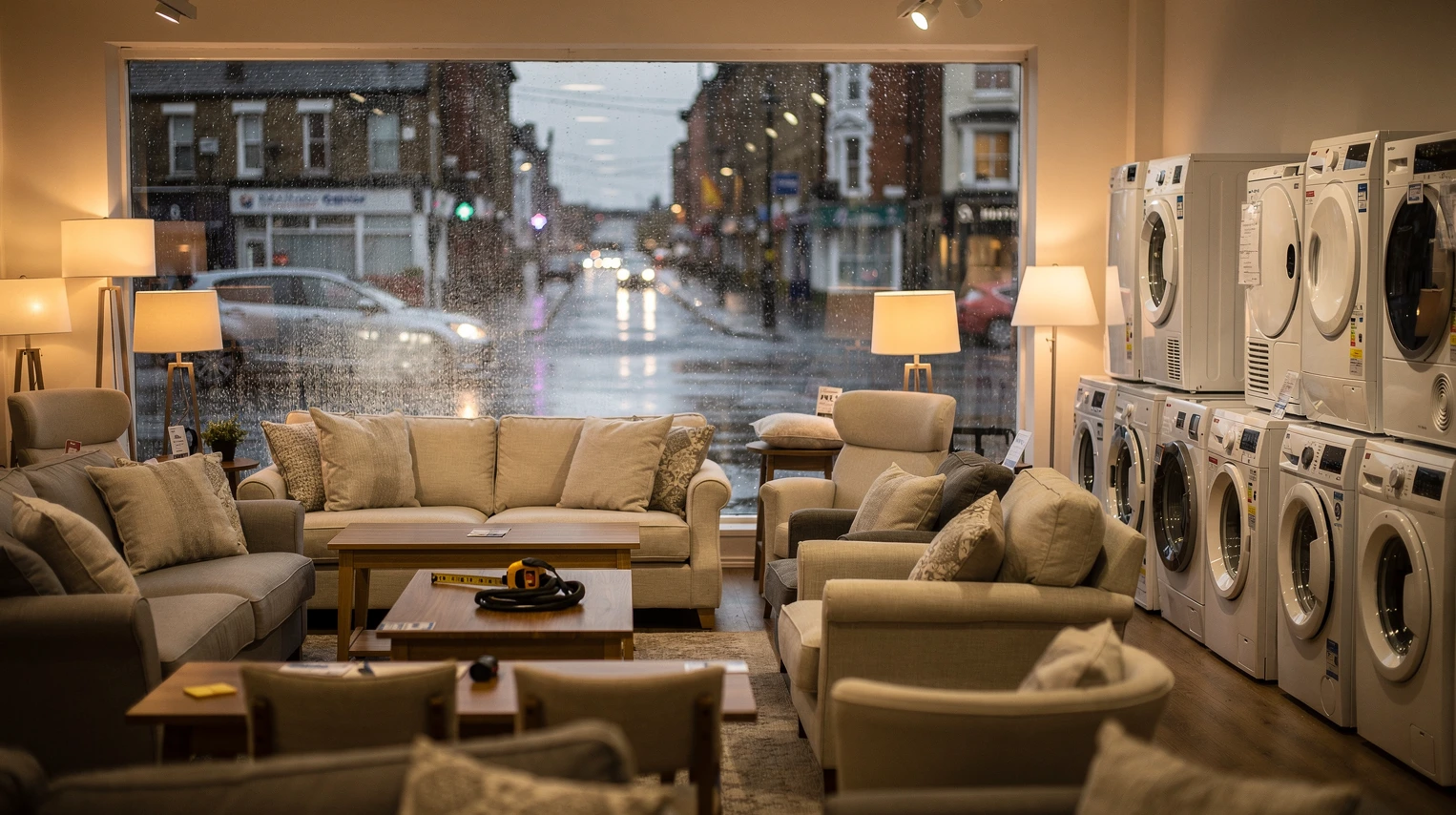
- Big-ticket categories such as furniture and white goods performed badly as shoppers waited for Black Friday on 27 November.
- Barclays card spending rose 2.3%, but 22.7% growth in fuel spending did much of the work, and all five of its consumer confidence measures dipped before the Budget.
What did the BRC-KPMG monitor show for October 2026?
The headline number is modest rather than dramatic. Total retail sales rose 1.5% on the same month a year earlier, compared with 1.3% in September and 1.6% in October 2025. Alliance News, which reported the full data set, noted that October’s figure matched the 12-month average growth rate of 1.5%, and the PA news agency pointed out it was above the three-month average of 1.2%.
Like-for-like sales, which strip out changes in shop floor space, rose 1.1% after 1.0% in September, according to investingLive’s summary of the release. That is the measure most retailers watch, because it shows whether existing stores and websites are taking more money rather than simply whether the estate has grown. A gain of about one per cent is positive, but it is thin when set against rising costs.
The split between food and non-food tells the real story. Food sales rose 3.2%, faster than September’s 2.5% and above the 12-month average of 3.0%, although slower than the 3.5% recorded in October 2025. Non-food sales were flat, against growth of 0.1% a year earlier.
| BRC-KPMG measure | October 2026 | September 2026 | October 2025 | 12-month average |
|---|---|---|---|---|
| Total retail sales | +1.5% | +1.3% | +1.6% | +1.5% |
| Like-for-like sales | +1.1% | +1.0% | not reported | not reported |
| Food sales | +3.2% | +2.5% | +3.5% | +3.0% |
| Non-food sales | 0.0% | not reported | +0.1% | not reported |
| In-store non-food | -1.1% | +0.1% | +0.1% | -0.5% |
| Online non-food | +1.8% | +0.7% | 0.0% | +1.5% |
| Online share of non-food | 38.6% | not reported | 38.2% | not reported |
Figures as reported by Alliance News, PA, Furniture News and investingLive from the BRC-KPMG release. Cells marked “not reported” were not included in the published coverage we could verify.
Why the monitor measures value, not volume
The BRC-KPMG monitor tracks the value of sales in pounds, not the number of items bought. That matters a great deal in a month when prices were rising. The BRC’s own shop price index showed shop price inflation reaching 2.1% in October, the highest in around two and a half years, with ambient groceries and furniture leading the rise.
If shop prices are up about 2.1% and sales values are up 1.5%, a simple subtraction suggests shoppers took home slightly less stuff in volume terms than a year earlier. That is our rough calculation, not a BRC estimate, and the two surveys use different baskets and periods. But it fits the picture painted by retailers: more money is going through the tills because things cost more, not because people are buying more.
There is also a calendar point to bear in mind. The October period ran for four weeks from 4 to 31 October, and Halloween landed on the final Saturday, so the last weekend of the month captured both the Halloween shop and an ordinary weekend food shop. In October 2025, Halloween fell on a Friday. Small shifts like this can move food sales by a fraction of a percentage point either way.
Why did shoppers hold back on big purchases in October?
The BRC was blunt about the reason. “October was subdued for retailers, as shoppers delayed spending ahead of Black Friday and Christmas,” said Helen Dickinson, chief executive of the BRC. “Big-ticket categories, such as furniture and white goods, performed badly as customers waited for November deals.”
That behaviour is now deeply ingrained in UK shopping. Black Friday falls on 27 November this year, and several large retailers have already started discounting. Currys, AO.com and Boots launched their early Black Friday 2026 sales on 28 October, which gives anyone planning a big purchase every reason to keep comparing prices for a few more weeks.
The Budget effect on household confidence
The Chancellor’s Budget on Wednesday 28 October also weighed on decisions. Linda Ellett, UK head of consumer, retail and leisure at KPMG, said: “With consumers facing higher household costs, caution ahead of the Budget, and some waiting for Black Friday deals, overall sales growth was modest.”
Barclays found the same caution in its survey data. All five of its consumer confidence measures dipped in October in the run-up to the Budget. Confidence in the UK economy slipped to 23% from 26% in September, and confidence in the ability to spend on non-essentials fell to 50% from 54%, although both are broadly in line with October 2025 (22% and 51%).
Retail sales do not happen in a vacuum, and the household budget was being squeezed from several directions at once. Barclays said fuel spending climbed 22.7% after diesel passed £2 a litre for the first time. The BRC also pointed to rising interest rates and energy bills, and investingLive reported that money markets were pricing further Bank of England rate rises after the move to 4%.
Fuel is not counted in the BRC’s retail sales figures, but it competes for the same household budget. A family that spends noticeably more filling the car each week has less left over for a new coat or kitchen gadget, and the Barclays data shows that squeeze happening in real time. investingLive described the oil price rise as acting like a tax on households, which tends to hit discretionary spending first.
Ms Dickinson used the release to press the government again: “Shoppers and businesses face mounting costs, including rising interest rates and energy bills, adding to the pressures already pushing up prices. Government must move faster to cut back the taxes and regulations making it harder for retailers to keep prices down.”
Which categories grew and which struggled?
The monitor does not publish a full category table in its public release, but the commentary from the BRC and KPMG identifies the main winners and losers. On the plus side were food, clothing and footwear, and seasonal “cosy” items. On the minus side were furniture and white goods, the categories most exposed to Black Friday promotions.
| Category | October direction | Reason given | Source |
|---|---|---|---|
| Food and cupboard staples | Up (food +3.2%) | Government emergency-supplies advice, Halloween on a Saturday, higher prices | BRC |
| Halloween snacks, costumes, decorations | Up | 31 October fell on a Saturday | BRC |
| Clothing and footwear | Up | Colder weather and storms | KPMG |
| Duvets and “cosy essentials” | Up | Lower temperatures | KPMG |
| Furniture | Down (“performed badly”) | Waiting for November deals | BRC |
| White goods | Down (“performed badly”) | Waiting for November deals | BRC |
| Grocery (card spend) | Down 0.3% | Supermarkets -0.9%, food and drink specialists +4.6% | Barclays |
Clothing: more transactions, less money
Clothing is a good example of how the two surveys can appear to disagree. KPMG said clothing and footwear purchases grew in October as temperatures dropped. Barclays, which tracks card payments, found clothing transactions rose 5.2% while clothing spending fell 1.8%.
Barclays reads that as more frequent but lower-value purchases. In practice, that looks like shoppers buying a coat, jumper or pair of boots when the weather turned, but choosing cheaper lines or waiting for discounts on bigger wardrobe updates. It also helps explain why fashion retailers often talk about strong footfall days that do not always turn into strong margins.
Did government stockpiling advice boost supermarket sales?
The BRC said cupboard staples saw “a modest boost following Government advice for households to stock for emergencies”. Alliance News led its report on that point, describing October sales as “boosted by government stockpiling advice”. The advice in question is the government’s Be Ready campaign, which asks households to keep enough supplies for three days if services are disrupted.
Shopappy reported in October that the campaign led to a wind-up radio sell-out after the Be Ready checklist was published, with torches and power banks also in demand. The BRC’s comment is the first time the trade body has linked the campaign to measurable grocery sales growth, though it described the effect as modest rather than a rush.
It is worth keeping that in proportion. Food sales growth of 3.2% is only 0.2 percentage points above the 12-month average, and lower than October 2025. Food inflation, Halloween and the extra weekend shopping day all played a part. Nothing in the BRC data suggests panic buying, and the official advice itself warns against it.
Specialists beat supermarkets on Barclays data
Barclays’ card data adds a twist. Overall grocery spending fell 0.3% year on year, but food and drink specialists, a category that includes butchers, bakers, delicatessens and similar shops, recorded growth of 4.6%. Supermarkets saw a 0.9% decline.
The two sets of numbers are measuring different things. The BRC collects sales data from its member retailers, which include the large grocers, while Barclays sees card transactions across its customer base. The gap between them is a reminder that no single survey gives the full picture, but the specialist result is a welcome sign for independent food shops going into the Christmas season.
For shoppers who want to stay prepared without overspending, the practical approach is to add a few long-life items to the normal weekly shop over several weeks rather than buying everything at once. Supermarket own-brand tins, pasta and bottled water are usually the cheapest way to build up a small store, and multibuy offers on long-life goods are common in the run-up to Christmas.
How did online shopping perform against the high street?
October was a clear win for online in the BRC-KPMG data. In-store non-food sales fell 1.1% year on year, worse than both September and October 2025 and below the 12-month average of a 0.5% decline. Online non-food sales rose 1.8%, the best figure in the run of data reported, beating September’s 0.7%, flat sales a year earlier and the 12-month average of 1.5%.
As a result, the online penetration rate (the share of non-food items bought online) rose to 38.6% from 38.2% in October 2025. Ms Dickinson put it down to the weather: “Dreary weather meant online sales fared better.” Shopappy covered the impact of storms on shopping trips earlier this month, when UK footfall fell 4.7% in October, with high streets down 5.2% after storms Austen and Boelo.
Other trackers point the same way
The direction matches other October data, even if the size differs. BDO’s High Street Sales Tracker, which measures mid-market retailers, showed UK online sales jumping 10.1% in October while in-store sales grew only 2.2%. The BDO panel is smaller and weighted towards fashion and lifestyle chains, which is why its swings tend to be larger.
For online sellers, the numbers say two things. First, demand moved online when it was wet and windy, so delivery promises and stock availability matter more than usual heading into peak. Second, online growth of under 2% across the BRC panel is still small, which means online sellers are fighting for share rather than riding a rising tide.
A 38.6% online share means that roughly 39p in every pound spent on non-food items with BRC members now goes through a website or app. That share has edged up only slowly over the past year, from 38.2% in October 2025, which suggests the big pandemic-era jump has settled into steady, weather-driven drift. A wet month nudges it up; a sunny one pulls it back.
| October 2026 tracker | Online measure | In-store or high street measure | What it covers |
|---|---|---|---|
| BRC-KPMG Retail Sales Monitor | Online non-food +1.8% | In-store non-food -1.1% | Sales value, BRC member retailers, 4–31 October |
| BDO High Street Sales Tracker | Online +10.1% | In-store +2.2% | Like-for-like sales, mid-market retailers |
| BRC-Sensormatic footfall | n/a | Total footfall -4.7%, high streets -5.2% | Visits to shopping destinations |
| Barclays Consumer Spend | n/a | Retail spending +0.5% | Card spending across Barclays customers |
The trackers differ because they measure different things. The BRC counts the value of sales at its member retailers across the whole month, BDO uses a like-for-like panel of mid-market chains, footfall counts people rather than money, and Barclays counts card payments made by its own customers. When all four point in the same direction, as they do for online outperforming physical stores in October, the signal is more reliable than any single number.
What does the Barclays card data add?
Barclays publishes its consumer spending figures on the same morning as the BRC monitor, and this month the two surveys sit side by side neatly. According to Barclays, overall card spending grew 2.3% year on year in October, up from 2.0% in September and the highest growth since July 2025.
Essential spending rose 3.1%, up from 2.5%, but a 22.7% rise in fuel spending accounted for much of that. Non-essential spending grew 1.9%, up slightly from 1.8%, with entertainment strong. investingLive reported that entertainment had its best month since September 2024 as tickets for the Glastonbury festival went on sale.
The key retail number from Barclays is the 0.5% growth in retail spending. That is lower than the BRC’s 1.5%, and it sits well below the shop price inflation rate. On Barclays’ measure, the typical cardholder spent a bit more on fuel and going out, and very little more in shops.
That gap between overall spending and retail spending has become a familiar pattern. Households appear to be protecting experiences such as concerts, festivals and eating out, while trimming spending on goods. For shops, that means competing not only with other retailers but with every other claim on a family’s spare cash.
Barclays’ survey also asked about festive plans. It found 40% of consumers are cutting back now so they have more money for Christmas, rising to 53% of Gen Z and 54% of Millennials. Among those who celebrate Christmas, 58% expect it to cost more than last year, and 34% have already started buying presents.
Jack Meaning, chief UK economist at Barclays, said: “As the squeeze on consumers’ spending power begins to build, it is reassuring to see resilient numbers in October, albeit alongside signs that consumers are becoming more cautious and that the summer optimism over the economic outlook is starting to fade.” He added that the Chancellor’s cost-of-living measures “look set to provide welcome support for people at the margins” but, for many, “do not fundamentally change the outlook for the year ahead”.
What do the figures mean for UK shoppers this November?
For shoppers, October’s data is mostly a confirmation of what many households are already doing: buying essentials, putting off big purchases and watching prices closely. The more interesting question is what happens next, because retailers are now banking on a strong November.
The BRC said retailers “are hoping pent-up demand translates into stronger spending through November and December, as they work hard to deliver great choice and value for households this Christmas”. In plain terms, shops that saw furniture and appliance sales fall in October are likely to compete hard on price around Black Friday to win those delayed purchases back.
Practical points for anyone planning a big purchase
If you have been waiting to buy a sofa, fridge, washing machine or television, the data suggests you are far from alone, and that retailers know it. That tends to mean more promotions, but not always better deals. It pays to track the price of the specific model you want over a few weeks rather than relying on “was” prices.
UK rules on pricing have also tightened. Under the Digital Markets, Competition and Consumers Act 2024, the Competition and Markets Authority (CMA) can fine businesses directly for misleading pricing practices such as fake countdown clocks or drip pricing. Shopappy’s Black Friday guide covers how those rules apply to this year’s early sales.
Paying by credit card can also add protection on larger purchases. Under section 75 of the Consumer Credit Act 1974, a credit card provider is jointly liable with the retailer if something goes wrong with a single item costing more than £100 and up to £30,000, for example if the retailer fails to deliver or goes out of business. Debit card payments do not have section 75 cover, although chargeback may be available.
- Check the price history of the exact model, not a similar one.
- Compare delivery charges and installation or removal fees, which can wipe out a discount on white goods.
- Remember that you normally have 14 days to cancel most online orders under the Consumer Contracts Regulations, though some exceptions apply.
- Check delivery dates if the item is needed before Christmas, especially for bulky goods.
Shoppers who are budgeting for Christmas, as 40% of Barclays’ respondents said they are, may also find it useful to set a spending limit before the Black Friday weekend starts. Promotions are designed to create urgency, and a written list of what you actually need is one of the simplest ways to avoid buying things you did not plan to.
What do the figures mean for UK retailers and online sellers?
For retailers, October was a month of cash flow pressure in the categories that can least afford it. Furniture and electricals carry high stock values and long lead times, so a quiet October means more stock sitting in warehouses waiting for November. If Black Friday demand disappoints, discounting into December becomes more likely.
Ms Ellett at KPMG said growth “will be welcomed by a retail sector that desperately needs to offset cost increases with some strong sales as the promotional and festive season gets into full swing”. Those cost increases include the National Living Wage rise to £13.21 an hour due next April, higher employer National Insurance contributions, energy bills and business rates, all of which the BRC has repeatedly raised with the Treasury.
There is also a timing risk in delivery and logistics. If a large share of delayed spending lands in a short window around Black Friday and Cyber Monday, warehouses, carriers and customer service teams face a sharper peak than in a year when spending is spread more evenly. Retailers that promise next-day delivery on bulky items will need the capacity to keep that promise.
For independent shops and marketplace sellers on Amazon, eBay, Etsy or Vinted, the online share figure is the one to watch. A rise in online penetration to 38.6% of non-food means more of the market is shifting to channels where visibility depends on search ranking, reviews and delivery speed.
The specialist food result in the Barclays data also matters to smaller businesses. Growth of 4.6% for food and drink specialists against a fall at supermarkets suggests that local butchers, bakers and delis have held on to loyal customers despite the cost of living pressure. With Small Business Saturday on 5 December, independent shops will be hoping that trend continues into the festive weeks.
For marketplace sellers, the practical lesson from October is to have stock and listings ready before demand arrives rather than reacting to it. Buyers who have spent October comparing prices will move quickly once they see a deal they trust, and clear delivery dates, honest pricing and good reviews are what tend to win those orders.
How does October fit the wider 2026 picture?
October’s BRC figure was the strongest since June, investingLive reported, but the year has been a slow one overall. The monitor’s 12-month average growth rate is 1.5%, which is barely enough to keep pace with prices. September’s official figures were weaker: the Office for National Statistics reported that retail sales volumes in Great Britain fell 0.4% in September, with online and non-store sales down 2.2% as warm weather left winter clothing unsold.
That ONS data series measures volumes, not values, and it is the official benchmark. The ONS is due to publish its October retail sales figures later this month, which will show whether the BRC’s value-led growth translated into more goods actually leaving the shelves. Given the shop price inflation figures, a flat or only slightly positive volume reading would not be a surprise.
November is the month that decides the year for many retailers. Black Friday on 27 November and Cyber Monday on 30 November will show whether the pent-up demand the BRC described is real. December then brings the Christmas trading updates from the big chains, starting in early January.
Between now and then, a few more data points will help. The BRC-Sensormatic footfall monitor for November, due in early December, will show whether shoppers returned to high streets once the weather improved. The BRC’s shop price index for November will show whether Black Friday discounting is pulling inflation down, and the Barclays and BRC-KPMG monitors for November will give the first hard read on Black Friday itself.
The risk the BRC and KPMG both highlighted is that household costs keep climbing faster than wages. Fuel, energy, interest rates and food prices are all pulling in the same direction, and confidence measures dipped before the Budget. If shoppers decide that the Black Friday deals are not good enough, retailers could face a long and expensive run of discounting into the new year.
Frequently asked questions
How much did UK retail sales grow in October 2026?
Total UK retail sales rose 1.5% year on year in October 2026, according to the BRC-KPMG Retail Sales Monitor published on 10 November. That was up from 1.3% in September and in line with the 12-month average. Like-for-like sales rose 1.1%.
Why were non-food sales flat in October?
The BRC said shoppers delayed spending ahead of Black Friday and Christmas, with big-ticket categories such as furniture and white goods performing badly as customers waited for November deals. Caution before the Budget on 28 October and higher household costs also held spending back, according to KPMG.
Did online shopping grow in October 2026?
Yes. Online non-food sales rose 1.8% year on year while in-store non-food sales fell 1.1%, according to the BRC-KPMG data. Online’s share of non-food sales rose to 38.6% from 38.2% a year earlier, which the BRC linked to dreary weather.
Did the government’s emergency supplies advice affect sales?
The BRC said cupboard staples saw a modest boost following government advice for households to stock for emergencies, which refers to the Be Ready campaign. The trade body described the effect as modest, and food sales growth of 3.2% was only slightly above the 12-month average.
What is the difference between the BRC and Barclays figures?
The BRC-KPMG monitor measures the value of sales reported by BRC member retailers. Barclays measures card spending across its customers, including fuel, hospitality and entertainment. Barclays showed overall spending up 2.3% in October but retail spending up only 0.5%.
Are UK shoppers buying more or just paying more?
Mostly paying more. The BRC’s shop price index showed inflation of 2.1% in October, higher than the 1.5% growth in sales values, which suggests volumes were roughly flat or slightly down. The official ONS volume figures for October are due later in November.
When is Black Friday 2026 in the UK?
Black Friday 2026 is on Friday 27 November, followed by Cyber Monday on 30 November. Several retailers, including Currys, AO.com and Boots, started early Black Friday promotions on 28 October.
Should I wait for Black Friday to buy a big appliance?
Retailers who saw weak furniture and white goods sales in October are likely to discount these items in November. It is still worth tracking the price of the exact model over several weeks, checking delivery and installation charges, and being wary of countdown clocks or “was” prices that cannot be checked.