
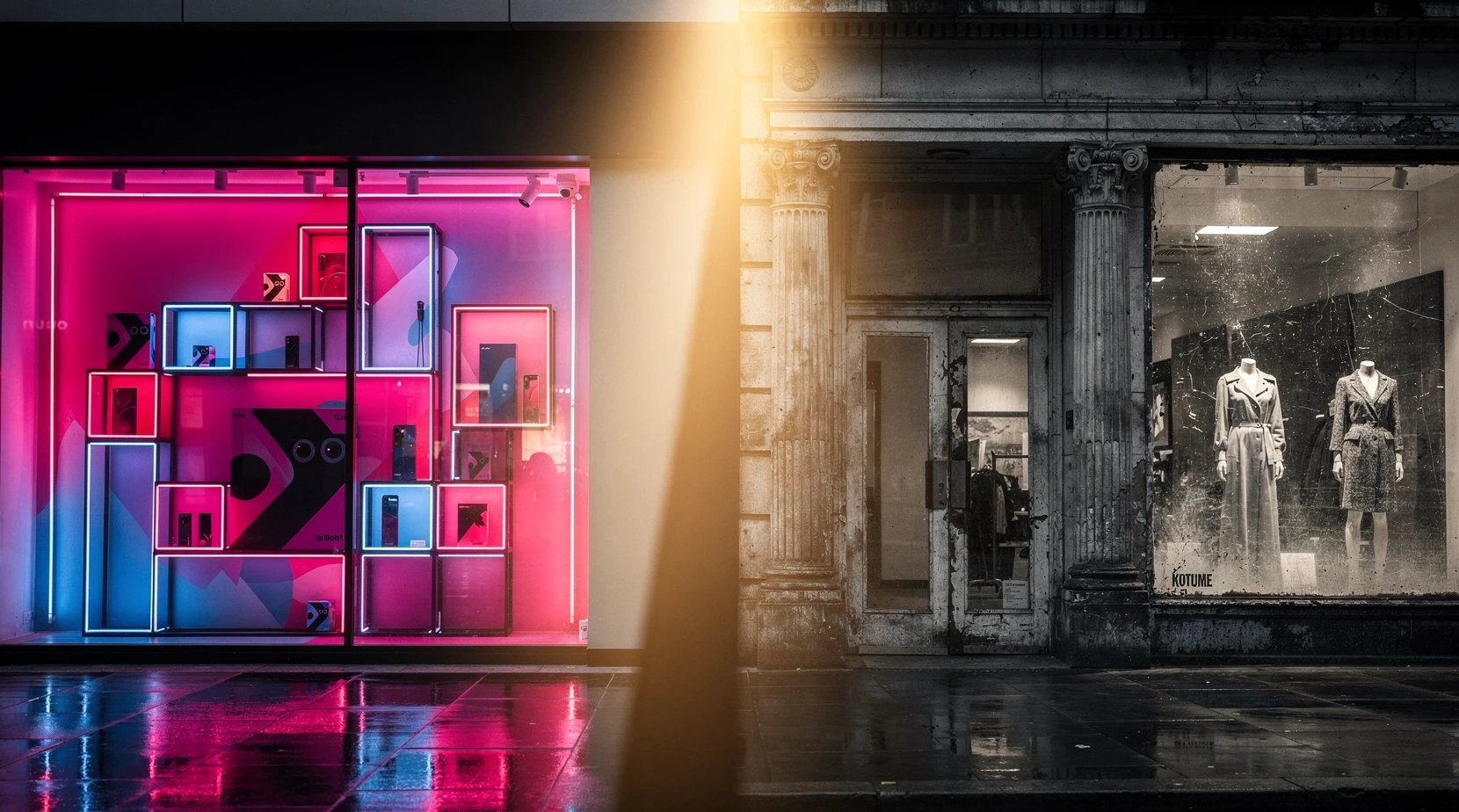
Challenger brand positioning is the single sharpest weapon a young retailer can carry into a market that legacy players have owned for decades. Done well, it lets a 30-person team take meaningful share from a 30,000-person incumbent within three or four years. Done badly, it leaves a brand stuck in the middle, undifferentiated and quietly burning cash. This guide walks through how the smartest US challengers actually do it, what the playbook looks like in 2026, and why so many incumbents still cannot copy the moves even when they see them coming. For the broader strategy context, see our pillar on the modern brand playbook for retail and e-commerce.
In short
- Positioning is a choice, not a tagline. Challengers win because they say no to most of the market on purpose.
- Legacy retailers compete on assortment and price. Challengers compete on point of view, identity, and a tight category claim.
- The five repeatable moves are: name an enemy, narrow the audience, own one product truth, build a ritual, and weaponize the founder voice.
- Distribution follows positioning, not the other way around. Wholesale, retail media, and DTC all become easier once the claim is sharp.
- Most failed challengers blur the claim within 18 months trying to chase the next adjacent buyer.
What does challenger brand positioning actually mean in 2026?
A challenger brand is a company that is neither the market leader nor a sleepy niche operator. It has the ambition of a leader, the resources of a niche player, and the willingness to behave differently from both. Positioning is the deliberate choice of where that brand sits in the customer’s head relative to alternatives, and what specific job it claims to do better than anyone else.
In 2026 the term gets applied loosely to any startup with a clever Instagram grid, but the strict version matters. A real challenger has identified a category convention that customers quietly dislike, refused to play by it, and built a coherent product, price, and story around that refusal. Everything else is window dressing.
The companies that get this right share three traits. They can answer the question “who are we for, and who are we not for” in one breath. They can describe the incumbent behavior they are rejecting without naming a competitor outright. And every retail buyer, investor, and new hire walks away with roughly the same story after talking to them for ten minutes.
That consistency is the part legacy brands struggle to replicate. Decades of line extensions, regional teams, and acquired sub-brands tend to produce a positioning statement that reads like a committee meeting, because it usually was one. Challengers benefit from being too small to compromise.
Why do legacy retailers struggle to respond?
The honest answer is that incumbents are usually optimized for a different game. Department stores, big-box chains, and mass beauty conglomerates built their operating models around assortment depth, supplier leverage, and store footprint. Those advantages are real, but they are not the assets that win a positioning war.
When a legacy retailer tries to launch a sub-brand to fight a challenger, it tends to hedge. Marketing wants edge, merchandising wants margin, legal wants safety, and the parent brand wants halo. The output is a product line that looks 70 percent like the challenger but rounds off every interesting corner. Customers can feel the difference within one purchase cycle.
There is also a measurement problem. Incumbents grade their teams on quarterly revenue and gross margin per square foot. Those metrics push toward broad appeal and discount cycles, which are the opposite of what builds a sharp identity. A challenger CEO can defend a slower first year because the cap table understands the trade. A category director inside a public retailer almost never has that latitude.
Finally, incumbents have legacy customers to protect. A bold repositioning that energizes 100,000 future buyers may alienate 5 million current ones, and the board math rarely supports that bet. The challenger has no such constraint, which is why the original challenger framework assumes that being smaller is an advantage when wielded honestly.
The five moves challengers make to win positioning
Across the dozens of US brand profiles our editors have published, the same five moves keep appearing. None of them are secret. What separates the winners is the discipline to hold the moves in place for years even when growth gets bumpy.
- Name an enemy. Not always a company. Often it is a category behavior: greasy formulas, opaque pricing, fast-fashion waste, sugary kids’ snacks, generic gym culture. The enemy gives the brand a reason to exist and tells the customer which team they are joining by buying.
- Narrow the audience on purpose. The first 50,000 customers are the brand. Challengers describe that core buyer in painful detail, including who they explicitly do not want, and then design product, copy, and store experience around that person.
- Own one product truth. Not three benefits, not a feature matrix. One claim a buyer can repeat to a friend without a brochure. “Mattress in a box.” “Glasses for $95.” “Razors shipped to your door.” That single sentence carries the brand into press, retail buyers, and dinner-party conversations.
- Build a ritual. Subscription cadence, unboxing sequence, in-store experience, app habit. The ritual converts a product into behavior, and behavior into loyalty that does not require constant performance marketing.
- Weaponize the founder voice. Even after professional CEOs take over, the founder’s worldview stays loud in the brand. It shows up in podcast interviews, packaging copy, hiring criteria, and customer service tone. It is the cheapest way to keep a brand honest at scale.
Teams looking to understand how reporters decode these moves brand by brand can read our explainer on the brand profile method used in the ShopAppy newsroom. The same lens works for internal strategy reviews.
How does positioning show up across the funnel?
Positioning is not a marketing layer that sits on top of the business. In a real challenger, the claim shapes every touchpoint, including ones the chief marketing officer does not control. The contrast with legacy retail is easiest to see when you walk through the funnel side by side.
| Stage | Legacy retailer default | Challenger brand move |
|---|---|---|
| Awareness | Broad reach campaigns, celebrity endorsements, mass TV | Founder-led content, narrow podcast partnerships, earned press tied to a point of view |
| Consideration | Feature comparison, loyalty perks, price-match guarantees | A single product claim repeated everywhere, customer testimonials that sound like the buyer |
| Purchase | Promo-driven, channel-agnostic, conversion KPIs | Full-price DTC first, then selective wholesale, premium unboxing ritual |
| Retention | Email blasts, generic loyalty points, win-back discounts | Subscription cadence, refill ritual, community access tied to identity |
| Advocacy | Referral incentives, ratings volume | Customer-as-character storytelling, UGC built into product use |
The bottom row matters more than most teams realize. Challenger brands treat customer-generated content as a structural input, not a campaign. The team behind a strong DTC launch will design the product, packaging, and post-purchase email so that users naturally produce content the brand can amplify. Our guide on how retailers run UGC campaigns at scale gets into the operational side of that.
Notice that none of these moves require a bigger budget than the incumbent has. They require a sharper choice about where to spend. That is the trade legacy teams keep refusing to make.
What mistakes kill a challenger brand’s edge?
Most challenger brands do not lose to incumbents. They lose to themselves, usually around year three, when the original positioning starts to feel constraining and growth pressure pushes the team toward “and also” thinking. The pattern is consistent enough to predict.
The first mistake is audience drift. The brand was built for a specific buyer, and that buyer is now well served. Instead of going deeper into adjacent needs of the same person, the team chases a new demographic that is bigger but does not share the original worldview. The product line bloats. The voice softens. Margins compress. Within a year, the brand reads like a generic mid-market retailer.
The second mistake is channel sprawl. A DTC challenger lands a major retail partnership, then a second, then a third. Each partner asks for an exclusive SKU or a promotional cadence the brand was specifically built to avoid. The shelf presence grows, the brand identity erodes, and the DTC base feels betrayed.
The third mistake is leadership translation loss. The founder moves to chair, a professional operator takes over, and the operator interprets the brand through a generic CPG lens. Decisions that used to be made by reflex now require a steering committee, and the steering committee tends to round corners. Six quarters later, the brand has the cost structure of a challenger and the soul of an incumbent.
The fourth mistake is metric capture. The CFO installs a marketing-mix model that rewards short-term ROAS. The brand starts spending into bottom-of-funnel channels that convert today and starve the top-of-funnel storytelling that built the identity. Two years later, when the paid channels saturate, there is nothing left to lift demand. The fix is uncomfortable: protect a non-trivial share of spend for brand work that has no clean attribution.
Examples from US retail and e-commerce
Concrete cases make the framework easier to internalize. The four examples below are deliberately drawn from different categories to show that the pattern travels.
Direct-to-consumer eyewear
A vertically integrated eyewear brand entered a market dominated by a single Italian conglomerate that controlled both manufacturing and most retail shelves. The challenger named the enemy without naming the company, framed the category as opaque and overpriced, set a flat price point that fit in a tweet, and built a home try-on ritual that legacy optical chains could not match without cannibalizing their store traffic. The positioning has held for more than a decade because the team has consistently refused to dilute the price claim.
Performance beauty
A skincare challenger launched into a category where premium meant department-store counters and confusing ingredient stories. The brand’s claim was clinical transparency: ingredient percentages on the front of the bottle, prices that fit a college student’s budget, and a science-led voice that treated the buyer as an adult. The aesthetic was austere on purpose, because every visual cue was meant to read as the opposite of the heritage prestige category.
Better-for-you snacks
A snack brand entered an aisle dominated by legacy CPG giants with deep grocery relationships. Rather than fight on slotting fees, the challenger built initial demand through a tight community of fitness customers, used that demand to walk into buyer meetings with proof of velocity, and refused to expand the line until the core SKU was a top-three seller in its segment. The positioning leaned on protein content and ingredient honesty, both backed by labels that were legible at arm’s length.
Modern home goods
A direct-to-consumer mattress brand collapsed a category that had been built around showroom theater and confusing price negotiations. The product truth was a single mattress, shipped in a box, with a 100-night trial. The positioning was so clean that within two years, every legacy mattress retailer had launched its own bed-in-a-box sub-brand, and most of those sub-brands rounded the corners enough to feel like compromises. Editors looking at how to write up cases like this can use our guide to writing retail brand stories that are actually worth reading as a checklist.
The shared thread across all four is restraint. None of these brands launched with a 40-SKU catalog. None of them tried to be everything to everyone. Each picked a fight, won the fight, and only then extended the line.
How do challenger brands price into a legacy category?
Pricing is often the most under-discussed lever in challenger positioning, and the one that makes the strongest signal. A challenger that quietly matches the incumbent’s price ladder is telling the market it is a follower, regardless of what its brand book says. A challenger that sets a price the incumbent literally cannot match without restructuring its own business is telling a much louder story.
The cleanest examples come from categories where the legacy player carries large fixed costs that the challenger has engineered around. A direct-to-consumer brand that owns its supply chain can hold a lower price than a wholesale-distributed incumbent without giving up margin, because it has cut out two layers of markup. The price becomes both a product claim and an argument about how the category should work.
The other strong pattern is the flat-price tier. When every other product in a category has confusing pricing tied to options, materials, or features, a challenger that puts one number on the box reframes the entire purchase decision. The buyer no longer has to compare specifications; they only have to decide whether the brand is worth that single price. Most legacy retailers cannot copy the move because their merchandising systems are not built to give up the optionality that drives their average order value.
The trap to avoid is positioning on price alone. A brand that is cheaper but otherwise indistinguishable will be undercut by a private-label SKU within two years. The challengers that hold up are the ones whose price is downstream of a real structural choice, not a discount strategy. The price should make the positioning story easier to believe, not be the story itself.
How do retail buyers read a challenger pitch?
For any brand with ambitions beyond pure DTC, the retail buyer meeting is the moment where positioning gets stress-tested by someone who sees 30 pitches a week. The buyers who run categories at the top US retailers have heard every flavor of “premium,” “clean,” “modern,” and “founder-led.” They are looking for the brand that can explain in two minutes which exact shelf set it disrupts, who buys it that does not buy the incumbent, and what the velocity looks like in a comparable store environment.
The challengers that walk out of those meetings with a planogram slot are usually the ones that arrived with proof, not aspiration. A short sell sheet that pairs the positioning claim with three months of direct sales data, repeat rates, and a tight demographic read carries more weight than any deck of brand imagery. Buyers are running a portfolio bet, and a brand that has done the homework on its own metrics gives them the data they need to defend the slot internally.
None of this softens the positioning. If anything, it sharpens it. A buyer who can repeat the brand’s one-sentence claim back to the merchant team after a single meeting is the most reliable channel partner a challenger can have. That repetition is positioning at work, two layers downstream from the customer.
Which tools, partners, and signals matter in 2026?
The mechanics of building a challenger brand have changed less than the surrounding stack. The skills are the same; the tools are sharper and the timing windows are tighter. A few categories of vendor and signal worth tracking right now:
- Customer research panels. Lightweight community platforms that let founders run weekly qualitative reads with the core buyer, instead of waiting for quarterly survey rounds.
- Retail media intelligence. Tools that surface how the brand is showing up on Amazon, Target, and Walmart compared with the incumbent. The data is uneven, but the directional signal is often enough.
- Creator and community CRMs. Platforms that let a small team manage 50 to 500 long-term creator relationships without losing context, instead of treating creators as a paid-media line item.
- First-party data warehouses. Once a brand crosses about 100,000 customers, the ability to query behavior across channels becomes a competitive moat. Most challengers underinvest here for too long.
- Editorial and PR partners that understand the category. A small set of writers who actually understand the segment is worth more than a broad mass-market agency contract.
On the signals side, watch the four indicators below. They give an early read on whether a brand’s positioning is still working or has started to drift.
- Unprompted brand recall. Ask new customers how they first heard of the brand. If the answers cluster around one or two specific stories, the positioning is intact.
- Word-of-mouth ratio. The share of new customers acquired through referral or organic search relative to paid. A healthy challenger sits above 40 percent. Below 25 percent is a warning.
- Repeat purchase by cohort. Cohorts from the first two years should keep buying. If repeat rates collapse, the brand has likely drifted from the original buyer’s needs.
- Press tone. Coverage should still feel curious and slightly contrarian. When the brand starts getting written about as a generic category leader, positioning has eroded even if revenue has not yet.
For broader strategic context on how these signals fit into a brand operating model, see again the pillar guide on the modern brand playbook for retail and e-commerce, which lays out the full architecture our brand desk uses when reviewing a company.
How should a team actually use this in a planning cycle?
Most strategy decks include a slide titled “positioning” that has not been opened in 18 months. That is the wrong artifact. A challenger brand should treat positioning as a living document that the senior team rereads at the start of every quarter and stress-tests against the past 90 days of evidence.
A useful working ritual is the 90-minute positioning review. The team gathers customer interview clips, top-performing organic content, retail buyer feedback, and the last quarter’s product roadmap. They ask three questions: did we get clearer about who we are for, did we hold the line on what we said no to, and did any decision in the last 90 days quietly contradict the positioning. The answers usually surface drift before it becomes structural.
That ritual is also the moment to decide which adjacent moves are on-brand and which are not. A challenger that has earned the right to extend should extend in the direction of its original buyer’s deeper needs, not toward a new buyer entirely. The discipline to say no to the bigger but wrong opportunity is what compounds over the second half of the decade.
FAQ
What is the difference between a challenger brand and a niche brand?
A niche brand serves a small audience well and does not aspire to category leadership. A challenger has leader-sized ambitions and behaves accordingly. Both can be profitable, but challengers are explicitly trying to redraw the category, not just live inside it.
How long does it take to build defensible challenger positioning?
The claim usually clarifies within the first year, but defensibility takes three to five years of consistent execution. The brands that hold up over time are the ones that resisted the pressure to broaden in years two and three.
Can a legacy retailer launch a challenger sub-brand from the inside?
It is possible but rare. The successful examples share two traits: a separate P&L, and a leadership team that the parent company has agreed not to interfere with operationally. Without both, the parent brand’s reflexes pull the sub-brand back toward the middle.
Is challenger positioning still relevant in a retail media and Amazon-dominated world?
Yes, and arguably more relevant. Retail media surfaces every product side by side, which makes undifferentiated brands invisible. A sharp positioning claim is what makes a buyer click on the second-cheapest option instead of the cheapest.
How much of a brand’s budget should go to brand versus performance?
There is no universal split, but challenger brands that grow durably tend to protect 30 to 50 percent of spend for brand-building work that is not directly attributable. Going below 25 percent for more than two quarters usually correlates with weaker organic and word-of-mouth growth later.
What is the most common reason a challenger brand stalls?
Audience drift. The team is rewarded for growth, chases a buyer who does not share the original worldview, and ends up with a confused identity that resonates with no one in particular.
How do I know if my brand has real positioning or just a tagline?
Ask five people on different teams to describe who the brand is for and what it refuses to do. If their answers rhyme, the positioning is real. If you get five different decks, you have a tagline.
Where can I find more practical guidance like this?
The ShopAppy brands pillar and our brand profile method explainer together cover the strategic frame and the reporting lens we use across the newsroom.