
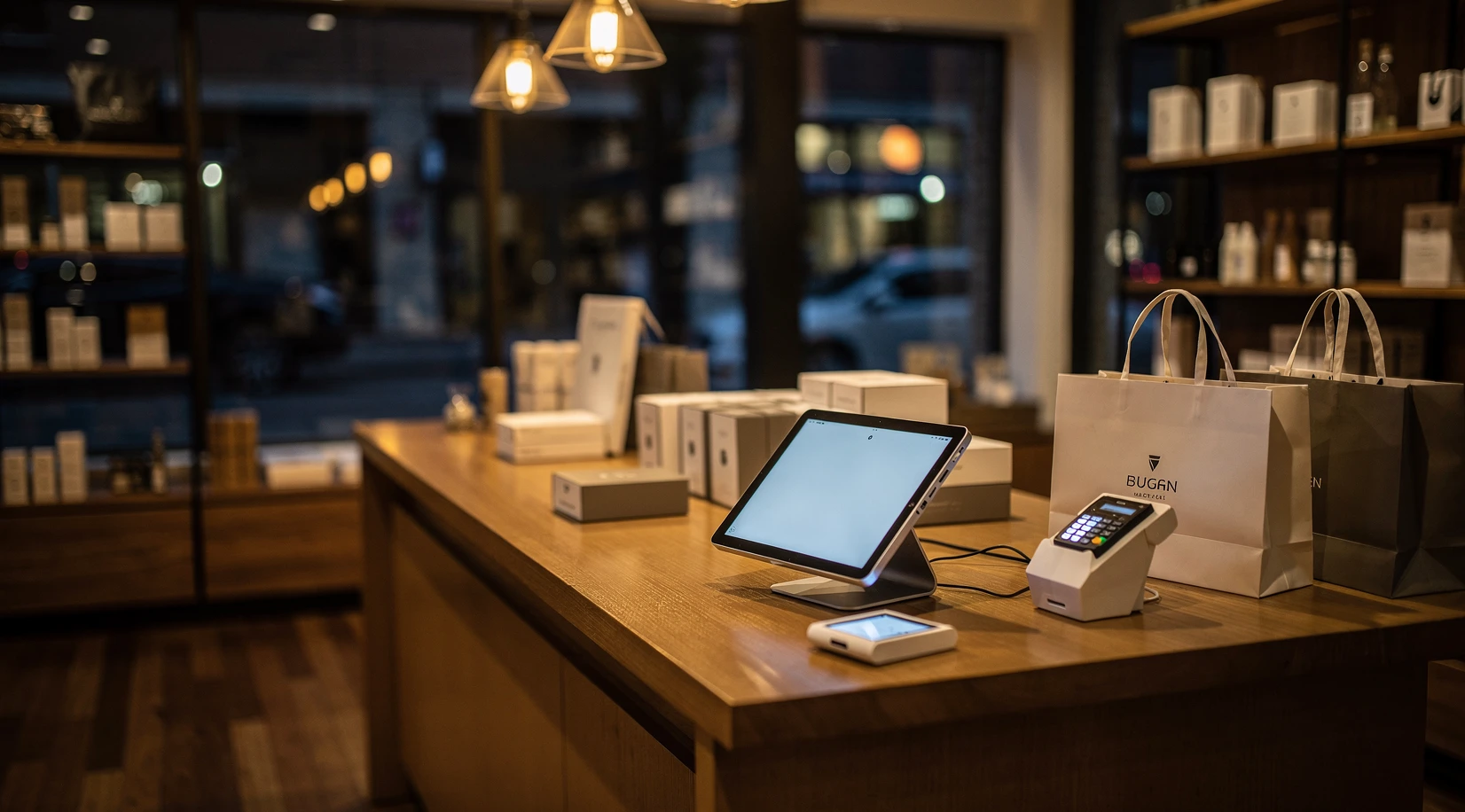
Main street operators spent the last five years rebuilding their tech stacks under pressure. The 2020 to 2023 wave forced everyone, from single-door boutiques on commercial corridors to multi-location independents, to add curbside, online ordering, contactless payments, loyalty apps, and a real social presence. By 2026 the dust has settled, vendors have consolidated, and the rough categories of main street tools 2026 look different than they did even eighteen months ago. This guide walks through which tools actually matter for independents and small chains this year, which vendors are worth a hard look, and which combinations the strongest operators are running.
If you want the strategic frame around this, the future of local retail and main street commerce pillar covers where the channel is heading. This article is the operator’s how-to: which tools, which budgets, which trade-offs.
In short
- POS and payments have converged. The strongest 2026 stacks treat the register as the single source of truth for inventory, customers, and channel orders.
- Local SEO and Google Business Profile matter more than ever because Google’s AI Overviews increasingly pull in storefront data, reviews, and proximity signals.
- Loyalty has gotten lighter. SMS-first programs are outperforming heavy app-based loyalty for stores under 5,000 transactions per month.
- Inventory and replenishment software with demand sensing has dropped in price enough that even single-store operators can justify it.
- Workforce and scheduling tools are now the second biggest line item after POS, and they are paying for themselves through reduced overtime and tighter labor-to-sales ratios.
Why this topic matters in 2026
The structural backdrop has changed. Foot traffic on commercial corridors has stabilized at roughly 85 to 92 percent of 2019 levels in most US metros, with a handful of revitalized downtowns above 100 percent. That recovery did not happen by accident. It tracks closely with how aggressively local operators adopted modern tools and how local district associations invested in placemaking. We covered the broader pattern in how main street districts are reinventing themselves post-pandemic, and the tooling layer is where individual store owners can actually move the needle.
At the same time, big-box and department-store pullback has continued. The signals are mixed but mostly negative for legacy mall anchors, as we unpacked in our piece on department store closures and reading the signals correctly. That pullback is a structural opportunity for main street. Customers displaced from a closing Macy’s, Kohl’s, or regional chain need somewhere to go for non-grocery essentials, gifts, and apparel. The independents that have the right tech to convert those one-time visits into repeat customers are taking real share.
There is also a quieter trend: the gap between digitally mature main street stores and the rest is widening. A 2025 survey from the National Retail Federation found that independents using three or more integrated digital tools (POS, e-commerce, marketing automation) reported revenue growth roughly twice as fast as peers using one or none. The tools described below are not optional anymore for operators who want to grow.
Key terms and definitions
The vendor language has gotten messy. Before going further, here are the working definitions used throughout this guide.
- POS (point of sale): the software and hardware where the actual transaction happens. In 2026 this almost always includes inventory, customer records, and reporting in one place.
- Unified commerce: a vendor’s claim that in-store, online, and channel sales (Instagram, TikTok Shop, marketplaces) all run from one inventory and customer database. Worth scrutinizing because the claim is easy and the reality is hard.
- Demand sensing: software that suggests reorder quantities based on sales velocity, weather, local events, and seasonality. Used to be enterprise-only. Now starts around $80 per month.
- Headless commerce: a setup where the storefront (website) is decoupled from the back end. Useful for operators with strong brand needs, overkill for most main street stores.
- Local SEO: the practice of getting found in Google Maps, AI Overviews, and “near me” queries through Google Business Profile, citations, reviews, and on-page signals.
- Conversational commerce: customers buying or booking through SMS, WhatsApp, Messenger, or in some cases voice. Growing fast for service-heavy main street categories.
How it works in practice: the 2026 reference stack
The best operators in 2026 are not running ten tools. They are running five to seven, with deep integration. Here is the reference stack that keeps showing up at our editorial roundtables and in vendor pipelines.
| Layer | What it does | Typical monthly cost (single store) | Examples |
|---|---|---|---|
| POS and payments | Transactions, inventory, customers, channel sync | $70 to $250 | Square for Retail, Shopify POS, Lightspeed Retail, Clover |
| E-commerce storefront | Online store synced to POS | $30 to $120 | Shopify, BigCommerce, Square Online |
| Local SEO and reviews | GBP optimization, review requests, citations | $50 to $200 | Birdeye, Podium, Whitespark, NiceJob |
| Loyalty and SMS | Customer retention, automated campaigns | $40 to $150 | Marsello, Klaviyo (small business plan), Postscript, Attentive |
| Inventory and demand sensing | Reorder suggestions, supplier management | $80 to $300 | Inventory Planner, StockTrim, Cin7 Core |
| Workforce and scheduling | Shifts, time clock, labor cost tracking | $30 to $90 | Homebase, 7shifts, When I Work, Deputy |
| Bookkeeping and reporting | Books, sales tax, multi-channel reporting | $30 to $80 | QuickBooks Online, Xero, A2X |
Total monthly software cost for a well-equipped single-door main street store in 2026 lands between $330 and $1,190. Most independents we talk to spend $450 to $700 per month. That is meaningfully more than 2019 but the per-transaction cost is lower because revenue and average order value have grown alongside the tooling.
How the stack actually integrates
Integration is where most operators get burned. The pattern that works:
- Choose the POS first. It is the data backbone. Pick one that the rest of your stack already integrates with natively.
- Add the storefront from the same vendor if possible (Shopify POS plus Shopify online, Square for Retail plus Square Online, Lightspeed Retail plus Lightspeed eCom).
- Layer review and SMS tools on top, because they read from POS customer data and write campaigns back into it.
- Add inventory and demand-sensing software last, because it pulls historical data and needs at least 90 days of clean transactions to work well.
Common mistakes and how to avoid them
The most expensive mistakes we see are not about choosing the wrong vendor. They are about choosing in the wrong order, or about combinations that fight each other.
Mistake 1: picking the storefront before the POS
Plenty of stores started with a Squarespace or Wix site during the pandemic and then bolted on a POS later. The result is usually two inventory systems, two customer databases, and constant reconciliation work. If you are still in that bucket, the cleanest path in 2026 is to migrate the storefront to whatever your POS vendor offers, even if it is slightly less polished, because the data unification pays for itself within a quarter.
Mistake 2: over-investing in loyalty before basic retention is solid
A points-based app loyalty program is expensive to run and expensive in mental load. Most main street stores under 5,000 transactions per month should start with SMS list growth, a welcome series, and a winback campaign. That is 80 percent of the impact at 20 percent of the cost. Move to a heavier loyalty program only after the SMS basics are running.
Mistake 3: ignoring Google Business Profile because the website ranks
A surprising number of operators still treat their website as the only digital storefront. In 2026 Google’s AI Overviews and the local pack pull data from Google Business Profile, reviews, and proximity. If your GBP has stale hours, a generic description, no products listed, and fewer than 50 reviews, you are invisible to a meaningful share of intent-driven shoppers. The fix is straightforward and mostly free, just time-consuming.
Mistake 4: buying a unified commerce platform you do not need
Vendors love selling “unified commerce” to single-door operators. Most of those operators do not need it. If you do not sell on marketplaces, do not have multiple locations, and do not run wholesale, a standard POS plus storefront combo from the same vendor is unified enough. Save the $500-plus per month for inventory or marketing.
Mistake 5: skipping workforce tooling
The unglamorous category is the one with the fastest payback. A $40 per month scheduling tool that cuts two hours of weekly overtime saves several hundred dollars per month at a typical hourly rate. Most operators we surveyed in 2025 reported labor-cost reductions of 4 to 8 percent within 90 days of adopting Homebase, 7shifts, or similar tools.
Examples from US retail and e-commerce
Concrete operator examples, names omitted to protect their margins:
Example 1: a 1,400 square foot apparel boutique in Asheville
Stack: Shopify POS, Shopify online store, Klaviyo for email and SMS, Marsello for loyalty, Inventory Planner for replenishment, Homebase for scheduling. Monthly software spend: about $520. Reported outcomes from 2024 to 2025: 31 percent revenue growth, average order value up 18 percent, repeat customer rate from 22 to 38 percent. The owner credits SMS welcome flows and the loyalty program for most of the repeat-customer lift.
Example 2: a hardware store in a Midwest small town
Stack: Lightspeed Retail, Lightspeed eCom, Birdeye for reviews, QuickBooks Online, Deputy for scheduling. Monthly spend: about $430. Reported outcomes: cut stockouts on top 200 SKUs by 60 percent after one full year of Lightspeed’s built-in reorder logic. Online orders went from negligible to 9 percent of revenue, mostly for click-and-collect on small contractor supplies.
Example 3: a three-location coffee and gift shop in the Pacific Northwest
Stack: Square for Retail, Square Online, Postscript for SMS, Cin7 Core for multi-location inventory, 7shifts for labor. Monthly spend: about $1,050. The multi-location workload justifies the heavier stack. Same-store sales growth of 11 percent in 2025, but the bigger win was operational: labor as a percentage of revenue dropped from 28 percent to 23 percent after consolidating scheduling.
Example 4: a downtown gift shop on a revitalized main street corridor
Stack: Square for Retail, Square Online, NiceJob for reviews, Mailchimp. Monthly spend: about $180. Smaller stack, fits the size of the business (single owner-operator, no employees). Heavy reliance on placemaking and walk-in traffic. The lesson here is that not every operator needs the full reference stack. Match the tools to the business model.
Tools, partners and vendors worth knowing
Below is the honest take on the leading vendors in each category, based on operator interviews, vendor briefings, and published benchmarks. No vendor in this guide is paying for placement.
POS and payments
The four serious contenders for main street retail in 2026 are Shopify POS, Square for Retail, Lightspeed Retail, and Clover. Each has clear strengths.
- Shopify POS is the strongest for operators who lead with online or social commerce. Cleanest integration to TikTok Shop, Instagram, and major marketplaces. Hardware is decent but not its strength.
- Square for Retail is the easiest to set up and the cheapest to start. Best for operators under $1 million in revenue and for service-and-retail hybrids (think a salon with retail).
- Lightspeed Retail wins for inventory-heavy stores with deep catalogs (hardware, sporting goods, specialty grocery, wine). The B2B and supplier features are genuinely better than competitors.
- Clover is sold through processors and banks. Pricing varies wildly. Best when bundled with a merchant services relationship you already trust.
Local SEO and reviews
Local search has moved fast. The vendors that matter:
- Birdeye and Podium are the enterprise-grade options. Excellent automation, expensive ($300 to $500 per month range when fully featured).
- NiceJob sits in the middle and is the value pick for stores under $2 million.
- Whitespark is the specialist for citations and local SEO audits. Great as a one-time engagement.
- Free tier: Google Business Profile itself. Spend an hour a week on it, post weekly, respond to every review, upload fresh photos monthly. That alone moves the needle for most operators.
According to the US Census Bureau Monthly Retail Trade Survey, non-store retail continues to grow faster than brick-and-mortar in aggregate, but the gap narrows when in-store operators have a solid digital front door. Local SEO is that front door for foot traffic.
Loyalty and SMS
The category has bifurcated:
- SMS-first tools like Postscript, Attentive, and Klaviyo SMS. Higher revenue per send than email, faster compounding, but list growth requires discipline.
- Loyalty platforms like Marsello, Yotpo, and Smile.io. Heavier setup, more useful for stores with a real repeat-customer base (more than 30 percent of revenue from repeats).
- SMS plus loyalty bundles are emerging. Marsello in particular has gotten strong reviews from main street operators in 2025 and 2026.
Inventory and demand sensing
This is where 2026 really differs from 2022. Inventory Planner and StockTrim now cost under $100 per month for single-store operators and produce reorder recommendations that beat manual approaches by a wide margin. Cin7 Core (formerly DEAR Systems) is the upgrade pick for multi-location or wholesale operators. The biggest mistake here is buying too early: wait until you have at least 90 days of clean POS data before turning these tools on.
Workforce and scheduling
Homebase is the runaway leader for stores under 25 employees because its free tier is genuinely useful. 7shifts and When I Work are roughly equivalent at the paid tiers. Deputy is the upgrade for compliance-heavy operations (multi-state, complex overtime rules).
Bookkeeping and reporting
QuickBooks Online still owns this category for US main street. Xero has a small but loyal following. A2X is the unsung hero, automating the reconciliation between Shopify, Amazon, or Etsy payouts and your accounting system. If you sell on multiple channels, A2X pays for itself in saved bookkeeper hours within a month.
Buying playbook: how to upgrade your stack in 2026
If you are starting from scratch or doing a major refresh, this is the sequence that has the highest probability of success.
- Audit your current data hygiene. Pull the last 90 days of transactions. If categories, SKUs, and customer records are messy, fix that before adding tools. Garbage in, garbage out is brutal in 2026.
- Choose the POS. This is the irreversible decision. Run two pilots if you can, side by side on the same counter, for at least four weeks each.
- Migrate the storefront. Same vendor if possible. Plan for a two-week parallel run, not a hard cutover.
- Layer in Google Business Profile and reviews. Free first, paid tool only if you have more than 200 reviews to manage or multiple locations.
- Start SMS. Postscript or Klaviyo SMS. Welcome flow, abandoned cart, winback. That is enough for the first six months.
- Add scheduling. Homebase or 7shifts. Track labor as a percent of sales weekly.
- Wait 90 days. Then add inventory software. Once your POS has clean velocity data, demand sensing actually works.
- Add loyalty last, if at all. Only after SMS is running well and you can articulate why your customers would join.
This sequence intentionally avoids buying everything at once. The biggest predictor of tooling failure on main street is not budget; it is organizational capacity to actually use what you bought. Spread the rollout over six to nine months and you will get more out of every dollar.
What to watch for the rest of 2026
Three trends are moving fast enough that operators should pay attention:
- AI-assisted local search. Google’s AI Overviews are eating a growing share of “near me” intent. The signals that feed Overviews come from Google Business Profile, product feeds, structured data on your website, and review velocity. Operators who invest here in the first half of 2026 will be measurably ahead by the second half.
- Embedded financing. Square, Shopify, and Lightspeed all now offer working-capital advances based on transaction data. Rates vary. Worth knowing about but read the fine print before drawing.
- Conversational commerce. SMS purchase flows, in particular for repeat orders and pickup, are growing. Not yet mainstream for general retail but breaking through for grocery, florists, and quick-service food adjacent to retail.
For the broader strategic context on how these tools fit into the future of the channel, the future of local retail and main street commerce pillar is the place to start. It also unpacks how the in-person experience itself is evolving, which complements the tooling questions covered here.
One more useful read on the strategic case for staying physical: our piece on what main street retail still gets right that e-commerce never will argues that the right tooling does not replace the in-person edge, it amplifies it. The vendors above are most valuable when they make staff faster at delivering the human side of the experience, not when they substitute for it.
FAQ
What is the minimum reasonable software budget for a single main street store in 2026?
Around $250 to $350 per month gets you a competent POS with payments, a basic e-commerce storefront from the same vendor, free Google Business Profile management, free Homebase for scheduling, and a small SMS plan. You can run a credible operation at that level. Past about $700 per month for a single store you usually hit diminishing returns unless you have specific needs (heavy inventory, multi-channel, wholesale).
Should I migrate off my current POS if it mostly works?
Not unless you have a concrete reason. POS migrations are painful and risk data loss. The good reasons to migrate: your current POS does not integrate with your storefront, customer data lives in three places, inventory is permanently off, or you cannot get clean reports. If those apply, migrate. If not, stay put and invest in the surrounding tools instead.
Is Shopify or Square better for main street retail?
Both work. Shopify is stronger for operators who lead with online or social commerce, have heavier brand needs, or expect to scale beyond one location. Square is faster and cheaper to set up, has better in-person hardware out of the box for many use cases, and works well for service-plus-retail hybrids. There is no universal answer, just a fit question.
How important are reviews in 2026?
Very. Review count, recency, and rating now feed Google’s AI Overviews directly. A store with 200 recent reviews at 4.7 stars beats a store with 50 reviews at 4.9 in most local searches. Set up a review-request automation (Birdeye, Podium, NiceJob, or even the free Google review link in your POS receipts). Reply to every review, positive or negative, within a week.
Do I need a separate e-commerce platform if I am mostly a brick-and-mortar store?
Yes, but keep it simple. An online storefront from the same vendor as your POS, with click-and-collect enabled, captures more value than a fancy independent site. Many main street stores see 5 to 15 percent of revenue come through the online store, mostly as buy-online-pick-up-in-store. That alone justifies $30 to $50 per month.
What about TikTok Shop, Instagram Shop, and other social commerce?
Worth the time investment if your category is visual (apparel, gifts, home, beauty). Shopify and Square both have native integrations now. Skip it if your category is functional (hardware, office supplies, pet food). The traffic from social commerce is much weaker for non-visual goods.
How do I avoid vendor lock-in?
Export your customer list, sales history, and product catalog at least quarterly. Every major POS supports CSV export of these three datasets. Store copies somewhere outside the vendor. That alone protects you against the most common lock-in risks. Beyond that, choose vendors with public APIs (Shopify, Square, Lightspeed) over closed ones.
What is one upgrade most main street stores ignore but should not?
Scheduling and labor tools. Homebase, 7shifts, and When I Work routinely produce 4 to 8 percent labor-cost reductions in the first 90 days. For a typical main street store, that is more dollars per month than nearly any other software category will save you. It is the least exciting upgrade and the most reliable.
Closing thought
The 2026 toolset for main street is genuinely good. The vendors have matured, the prices have come down, and the integrations work. The differentiator is not whether you have the tools, it is whether you use them with discipline. Pick the reference stack that fits your business size, install in the right order, and give each tool 90 days to prove its value before adding the next one. That is the path that the operators outgrowing their peers in 2025 and 2026 are following.