
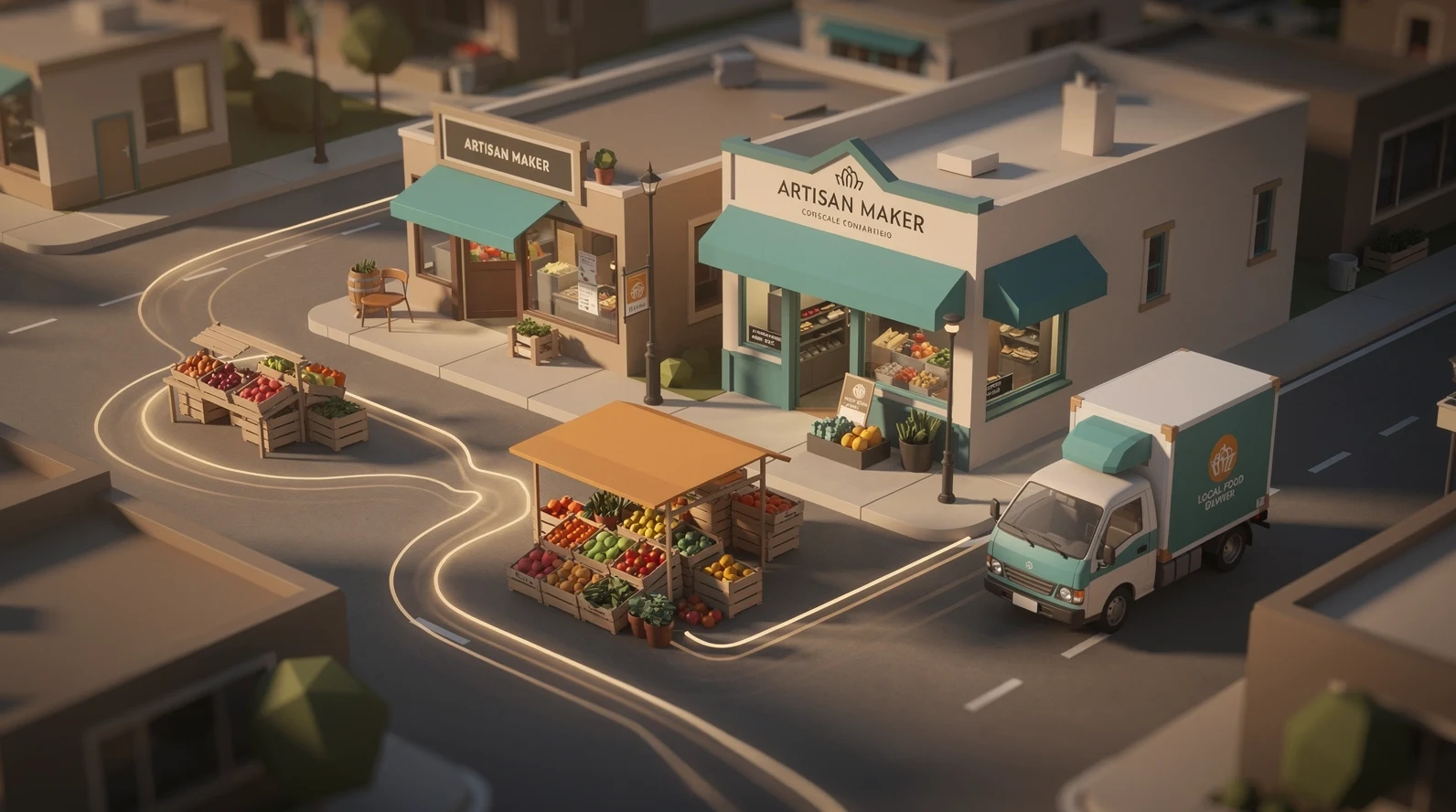
Every few years a wave of venture money chases the next big horizontal marketplace, and almost every cycle the loudest names burn through capital and disappear. The quieter story is the one worth studying. A small group of local marketplaces, platforms that match nearby buyers with nearby sellers in food, independent retail and specialty goods, have built durable businesses without dominating headlines. They did not win by outspending Amazon. They won by being useful in a specific place, to a specific community, in a way a national platform structurally cannot replicate.
This guide looks at three of those quiet successes, what they have in common, and what their playbook means for retailers, founders and operators planning a local commerce move in 2026. The lessons are practical rather than theoretical, because the businesses themselves were built on operations, not slogans. If you run an independent shop, sit on a chamber of commerce, or are weighing whether to build or join a local marketplace, the patterns below are the ones that actually correlate with survival.
In short
- Local marketplaces win on density, not reach. The quiet successes dominated one metro or one category before expanding, rather than spreading thin across the country to chase a growth chart.
- Supply curation beats open listings. Each platform vetted sellers and shaped the catalog, trading raw selection for trust, repeat purchase and a defensible local identity.
- Logistics is the product. Delivery windows, pickup routines and fulfillment reliability mattered more than app design, because a missed local delivery breaks trust faster than a slow national parcel.
- Unit economics came before scale. The durable players proved a profitable order in one market first, then cloned the model city by city instead of subsidizing nationwide growth.
- The moat is the community relationship. National platforms can copy features overnight, but they cannot copy a maker network, a farmer roster or a neighborhood reputation built over years.
Why local marketplaces matter again in 2026
Local commerce never went away, but the economics around it have shifted in ways that favor focused marketplaces. Customer acquisition costs on the large ad platforms have climbed for a decade, which erodes the advantage that well funded horizontal players once held. When paid traffic is expensive for everyone, a platform with organic community demand and word of mouth has a structural cost advantage that compounds over time.
At the same time, consumer behavior has tilted back toward provenance. Shoppers increasingly want to know who made a product, where food came from, and whether their money stays in the local economy. That preference is not universal, and it does not override price for most categories, but it is strong enough in food, gifts, home goods and specialty retail to sustain a marketplace built around it. The same instinct that drives interest in farmers markets and independent shops translates online when the experience is reliable.
The macro backdrop reinforces the point. E-commerce now accounts for a meaningful and rising share of total US retail sales, with the US Census Bureau tracking online penetration through its quarterly retail e-commerce data. As more spending moves online, the question for independent sellers is not whether to be online but through which channel. A national marketplace offers reach but commoditizes the seller. A local marketplace offers a smaller audience but a relationship, and for many independent businesses that trade is worth making.
This is the same dynamic reshaping high streets and main streets, and it sits at the center of the future of local retail. Local marketplaces are one of the few digital models that strengthen rather than hollow out the physical shopping district around them, because the sellers are usually the same businesses that anchor those districts. Understanding why a handful of them succeeded quietly tells you a lot about where the next decade of community commerce is heading.
What counts as a local marketplace, and what does not
Precision matters here, because the term gets stretched to cover very different things. A local marketplace, in the sense used throughout this guide, is a platform that intermediates transactions between buyers and sellers who share a geographic relationship, where that locality is central to the value proposition. The proximity is the point, not an afterthought.
That definition excludes a few things people often lump in. A national marketplace with local search filters is still a national marketplace. A single retailer’s own delivery app is a store, not a marketplace, because it lacks third party sellers. A classifieds board with no transaction layer is closer to a listings service than a true marketplace. The distinction sharpens once you ask who owns the customer relationship and who takes a cut of the sale.
The three structural types
Local marketplaces tend to fall into three structural buckets, and the three quiet successes in this guide each represent one. The first is hyperlocal consumer delivery, where the platform aggregates nearby producers and delivers to households inside a defined radius. The second is local business supply, a business to business model that connects independent retailers with the makers and brands that stock their shelves. The third is local to national specialty, where geographically rooted sellers reach a national audience for products that are hard to find elsewhere.
Each type has a different customer, a different logistics shape and a different defensibility. Understanding which type you are building or joining is the first strategic decision, because the playbooks do not transfer cleanly between them. For a deeper primer on how these models stack up against the giants, see our explainer on how local marketplaces compete with national platforms.
| Marketplace type | Who sells | Who buys | Core logistics challenge | Primary moat |
|---|---|---|---|---|
| Hyperlocal consumer delivery | Farmers, food makers, local producers | Nearby households | Reliable last-mile delivery windows | Producer roster and route density |
| Local business supply (B2B) | Makers and independent brands | Independent retailers and shops | Net terms, returns, catalog quality | Two-sided network of vetted supply |
| Local to national specialty | Regional restaurants and artisans | National consumers | Perishable shipping and packaging | Curated, hard-to-find catalog |
The three marketplaces, and what they did differently
The three examples below were chosen because they grew without the constant fundraising noise that usually surrounds marketplace startups, and because each one represents a distinct structural type. The figures discussed are illustrative of how these models typically behave rather than audited disclosures, and the goal is to extract repeatable lessons rather than to celebrate any single brand.
Market Wagon: the hyperlocal food network
Market Wagon built an online farmers market that aggregates local farmers and food producers and delivers their goods to households across a growing list of US metro areas. Founded in the Midwest, it expanded city by city rather than launching nationally, treating each metro as its own self-contained network of producers and customers. The model is asset light on the production side, since the farmers grow and make the food, and operationally intense on the delivery side.
What it did differently was treat the producer roster as the product. Rather than opening listings to anyone, it recruited and curated local farms, which gave shoppers confidence that the food genuinely came from nearby. Each new market only launched once enough local supply existed to make the catalog worth browsing, a discipline that kept the early experience strong. That patience is the opposite of the growth-at-all-costs instinct that sinks many marketplaces.
The delivery model also reflected hard operational lessons. Fixed weekly delivery windows let the platform batch orders into efficient routes, which is the only way hyperlocal perishable delivery comes close to working economically. Customers traded same-day convenience for lower cost and fresher local food, and the predictability built a habit. The lesson is that constraints, chosen deliberately, can be a feature rather than a limitation.
Faire: the wholesale layer under independent retail
Faire approached local commerce from the supply side, connecting independent retailers with the makers and brands that fill their shelves. Instead of selling to consumers, it rebuilt the wholesale relationship that independent shops historically managed through trade shows and sales reps. By moving that process online and adding net payment terms plus free returns on opening orders, it removed the two biggest risks a small shop faces when stocking an unproven product.
The defensibility came from the two-sided network. Once thousands of makers and tens of thousands of shops were transacting on the platform, the value to each new participant grew, a classic network effect that is hard for a latecomer to dislodge. The platform invested heavily in curation and discovery so that a shop owner could find products likely to sell in their specific neighborhood. That recommendation layer turned a catalog into a merchandising partner.
The quiet part of the success was that it strengthened physical local retail rather than competing with it. Every order on the platform stocked a real shop on a real street, which made the marketplace a tailwind for main street rather than a threat. This is the inverse of the usual marketplace story and a large part of why independent retailers adopted it without resentment. It is also why this model dovetails so naturally with the broader revival of independent shops.
Goldbelly: local flavor at national scale
Goldbelly took the third path, connecting regionally famous restaurants, bakeries and food artisans with consumers anywhere in the country. The local element is the source, a specific deli, a specific barbecue joint, a specific regional specialty, while the demand is national. It solved the hardest problem in the category, shipping perishable and fragile food across the country without ruining it, by investing in packaging, cold chain and vendor onboarding.
Its curation was ruthless by design. The platform sought out iconic and hard-to-find foods rather than accepting any seller, which made the catalog itself a reason to visit even without an immediate purchase intent. Scarcity and provenance became the merchandising story, and gifting became a major use case because the products carried a sense of place. A pie from a famous regional bakery is a better gift than a generic one precisely because it could not be bought locally.
The operational lesson is that the marketplace absorbed the complexity the sellers could not handle alone. A beloved local bakery has no capacity to build national cold-chain logistics, so the platform provided it as a service. That division of labor, local makers focus on the product while the marketplace owns the hard logistics, recurs across all three examples and is one of the clearest patterns in the category.
How the quiet winners actually work
Strip away the brand specifics and a common operating system emerges. The durable local marketplaces share a small set of design choices that compound into an advantage over time. None of them are flashy, which is precisely why they get overlooked by founders chasing a more exciting story.
The first shared trait is supply-side curation. Open marketplaces optimize for selection, but local marketplaces optimize for trust, and trust requires vetting who sells. By controlling supply quality, these platforms avoided the race to the bottom on price and counterfeit risk that plagues open listings. The catalog became a signal of quality rather than a firehose to filter.
The second trait is owning the hard logistics. Whether it was batched weekly delivery routes, wholesale returns handling or perishable cold-chain shipping, each platform took on the operational burden that individual sellers could not manage. This is what justified the take rate and what made the platform genuinely necessary rather than a thin intermediary that sellers would eventually route around.
Density before breadth
The third and perhaps most important trait is the discipline to win one market before opening the next. Local marketplaces have brutal economics when spread thin, because delivery routes, supply rosters and brand awareness all improve with density. A platform with a hundred orders a week in one city is healthier than one with ten orders a week in ten cities, even though the second sounds more impressive on a fundraising slide.
This density-first approach also changes the unit economics in the operator’s favor. Denser routes lower the cost per delivery, a larger local supply base improves the catalog, and concentrated marketing builds word of mouth faster. The compounding only works if you stay in one place long enough to let it, which is why patience is a competitive weapon in this category and impatience is the most common cause of death.
Take rates that the market can bear
The fourth trait is pricing the platform fee against the value delivered rather than against a venture target. Sellers tolerate a commission when the marketplace clearly brings demand or removes work they could not do themselves. When the take rate outruns the value, sellers disintermediate, building their own channels and using the marketplace only for discovery. The quiet winners calibrated fees to keep sellers genuinely better off, which kept supply loyal.
Common mistakes that sink local marketplaces
For every quiet success there are many failures, and the failure modes are remarkably consistent. Recognizing them early is most of the battle, because the mistakes are usually structural rather than tactical and they are hard to reverse once baked in.
The most common error is premature geographic expansion. Founders read traction in one city as proof the model works everywhere and expand before the first market is truly profitable. They then spread marketing, operations and management attention across markets that each lack the density to work, and the whole system runs at a loss until the money runs out. The chart looks like growth right up until it looks like collapse.
The second mistake is neglecting one side of the marketplace. A platform that obsesses over consumer experience while starving sellers of demand, or vice versa, breaks the two-sided balance that makes a marketplace function. Healthy marketplaces grow both sides in proportion, and the hard discipline is sometimes throttling demand growth until supply can serve it well. Overselling a thin catalog burns the customers you spent to acquire.
Confusing a marketplace with a media business
A subtler failure is treating audience as the goal. Some local platforms accumulate large followings and content engagement but never convert that attention into reliable transactions, leaving them with the cost structure of a marketplace and the revenue of a blog. Attention is not commerce, and the gap between the two is where many community-driven platforms quietly stall.
This is visible in markets where local shops have a strong online presence but weak online sales. Research from European markets shows e-commerce growth often bypassing domestic and local shops entirely, a pattern documented in our coverage of how local shops miss e-commerce growth even as overall online spend climbs. A marketplace only fixes that gap if it actually moves transactions, not just visibility.
Underpricing the logistics
The final recurring mistake is underestimating fulfillment cost. Last-mile delivery, perishable handling and returns are expensive, and many local marketplaces subsidize them to drive early growth without a credible path to covering the cost at scale. When the subsidy ends, either prices jump and customers leave or the losses continue and the business fails. The quiet winners priced logistics honestly from the start, even when it meant slower growth.
Tools, partners and vendors worth knowing
Building or running a local marketplace in 2026 does not require building every system from scratch, and knowing the ecosystem saves both time and capital. The tooling landscape has matured considerably, which lowers the barrier to launching a focused local platform compared with a decade ago.
On the platform layer, marketplace-specific commerce software now handles multi-vendor catalogs, split payments and commission accounting out of the box. Headless commerce backends paired with multi-vendor extensions let operators launch without months of custom engineering. The build-versus-buy decision usually favors buying the commerce plumbing and concentrating engineering effort on the local logistics that differentiate you.
On payments, splitting a single customer payment across multiple sellers while taking a platform fee is a solved problem through marketplace payment products from the major processors. These handle seller onboarding, compliance and payout scheduling, which is otherwise a significant regulatory and operational burden. Getting payouts right early matters, because sellers judge a platform partly on whether they get paid reliably and on time.
Logistics and discovery partners
Logistics is where most local marketplaces should focus their vendor selection. Local courier networks, route-optimization software and, for perishables, cold-chain packaging suppliers are the partners that determine whether the operational core works. For some hyperlocal models, parcel lockers and pickup points reduce last-mile cost dramatically compared with door-to-door delivery, and worth evaluating early.
On the demand side, community-driven discovery channels matter more than broad paid advertising. Neighborhood social platforms, local newsletters and partnerships with chambers of commerce reach the exact audience a local marketplace needs at low cost. The trade-offs between the major community platforms are real, and our comparison of Nextdoor commerce versus Facebook Marketplace for local sellers covers where each one fits. The point is to acquire customers through channels that reinforce the local identity rather than commoditize it.
A practical playbook for 2026
If the lessons above were distilled into a sequence, it would look less like a growth hack and more like a patient operating plan. The order matters, because skipping steps is what creates the failure modes described earlier. The playbook is deliberately unglamorous.
Start by choosing a single market and a single category narrow enough to dominate. The goal in the first phase is not revenue but density and a repeatable, profitable order. Recruit supply before chasing demand, because an empty catalog converts no one, and curate that supply tightly to establish a quality signal from day one. A small, excellent catalog beats a large, mediocre one in local commerce every time.
Once a single market shows a profitable contribution margin per order and organic repeat purchase, only then consider a second market, and treat it as a fresh launch rather than an extension. Clone the playbook, rebuild local supply, and resist the urge to centralize before the model is proven twice. Price the platform fee to keep sellers genuinely better off, and price logistics to cover its true cost rather than to flatter early growth.
Throughout, measure the things that predict durability rather than the things that look good in a deck. Repeat purchase rate, contribution margin per order, supply retention and route density tell you whether the business is healthy. Gross merchandise value and total markets tell you almost nothing about survival. The quiet successes optimized for the first set, which is exactly why they are still operating while louder competitors are not. That focus on durable local commerce is, in the end, what the future of local retail rewards.
One adjacent lesson is worth borrowing from the broader retail world. The rise of grocery private label shows how curation and a trusted house standard can win share against larger branded competitors, and the same principle applies to a curated local catalog. Trust, consistency and a clear point of view beat raw selection when customers are choosing where to spend locally.
| Metric | What it signals | Vanity trap to avoid |
|---|---|---|
| Contribution margin per order | Whether each sale actually makes money after logistics | Gross merchandise value, which hides losses |
| Repeat purchase rate | Whether customers form a habit and reduce acquisition cost | Total registered users, most of whom never return |
| Supply retention | Whether sellers stay because the platform helps them | Total sellers onboarded, including churned ones |
| Route or order density | Whether unit economics improve as the market matures | Number of markets launched, which dilutes focus |
Frequently asked questions
What is a local marketplace in simple terms?
A local marketplace is an online platform that connects buyers and sellers who share a geographic relationship, where being local is central to the value rather than incidental. Examples include a platform delivering food from nearby farms to local households, or one connecting independent shops with the makers who stock them. The defining feature is that proximity is the point, not just a search filter on a national service.
Why do local marketplaces succeed when so many fail?
The durable ones win on density rather than reach, dominating one market or category before expanding, and they own the hard logistics that individual sellers cannot manage alone. They curate supply to build trust, price their platform fee so sellers stay genuinely better off, and prove profitable unit economics in one market before cloning the model. The failures usually expand too early, subsidize logistics they cannot afford, or let one side of the marketplace starve.
What is the biggest mistake new local marketplaces make?
Premature geographic expansion is the most common fatal error. Founders read traction in one city as proof the model works everywhere and spread their marketing, operations and attention across markets that each lack the density to be profitable. The whole system then runs at a loss until funding runs out, which is why winning one market completely before opening the next is the single most important discipline.
How do local marketplaces make money?
They typically take a commission on each transaction, sometimes supplemented by seller subscription fees, promoted-listing fees or delivery charges. The commission is sustainable only when the platform clearly brings demand or removes work the seller could not do alone, such as last-mile delivery or perishable shipping. When the take rate outruns the value delivered, sellers build their own channels and use the marketplace only for discovery.
Are local marketplaces a threat to independent shops?
It depends on the model. Consumer-facing delivery marketplaces can compete with physical shops for the same customers, but business-to-business supply platforms strengthen independent retail by helping shops stock products that sell. The healthiest local marketplaces tend to reinforce the local economy rather than extract from it, which is also why communities adopt them without the resentment aimed at some national platforms.
What tools do I need to build a local marketplace?
You need a multi-vendor commerce platform for the catalog and orders, a marketplace payments product to split payments and handle seller payouts, and logistics partners suited to your model such as local couriers or cold-chain packaging. The common advice is to buy the commerce and payments plumbing rather than build it, and concentrate your own engineering and operations on the local logistics that actually differentiate you.
How long does it take a local marketplace to become profitable?
There is no fixed timeline, but the realistic measure is profitability per order in a single market rather than for the whole company. A focused platform can reach a positive contribution margin per order in one dense market within its first year or two, while company-wide profitability often comes much later as fixed costs spread across more markets. The mistake is judging health by total scale instead of by the economics of a single mature market.
Can a local marketplace compete with Amazon or other national platforms?
Not on price, selection or delivery speed, and trying to compete on those terms is a losing strategy. Local marketplaces win on the things national platforms structurally cannot copy: a curated local supply network, a community relationship built over years, and provenance that matters to shoppers in food, gifts and specialty goods. The strategy is to be indispensable in a narrow place rather than adequate everywhere.
The throughline across all three quiet successes is that they treated local commerce as an operating challenge rather than a marketing one. They earned trust through curation, owned the logistics that justified their existence, and grew only as fast as the unit economics allowed. For anyone building in this space in 2026, that patient, density-first approach is not the exciting story, but it is the one that is still standing when the funding cycles turn.