
In short
- Automation is now an SMB decision, not just an enterprise one. Falling robot prices, subscription pricing, and labor shortages put real systems within reach of retailers shipping a few hundred orders a day.
- Start with the bottleneck, not the brochure. The fastest payback in 2026 comes from fixing one slow step (picking, packing, or cycle counts), not from rebuilding the whole warehouse.
- Software comes before steel. A clean warehouse management system and accurate inventory data are prerequisites; automating a messy process just makes the mess faster.
- Robotics-as-a-service changes the math. Monthly per-robot pricing converts a six-figure capital project into an operating expense you can cancel, which lowers the risk of a wrong bet.
- Plan for 18–36 months. Most SMB retailers see meaningful labor and accuracy gains within two peak seasons, provided they phase the rollout instead of attempting a single big-bang cutover.
Warehouse automation used to be a story about Amazon, Ocado, and the kind of distribution centers you tour with a hard hat. In 2026 it is increasingly a story about a 40-person apparel brand in Ohio, a regional pet-supply seller, and a Shopify merchant who outgrew the spare-room-and-shelving stage two holidays ago. This guide explains what warehouse automation actually means for a small or mid-sized retailer this year, what it costs, where it pays off, and how to avoid the mistakes that turn a promising project into expensive shelving.
Why warehouse automation matters for SMB retailers in 2026
Three forces have converged to push automation down-market. The first is labor. Warehouse and storage roles remain hard to fill and expensive to keep, and turnover in fulfillment work routinely runs well above other sectors, according to figures published by the U.S. Bureau of Labor Statistics. When you cannot reliably staff a second shift in November, a machine that works at a steady pace becomes a planning tool, not a luxury.
The second force is customer expectation. Same-day and next-day delivery, once a big-retailer flex, is now table stakes in many categories. Meeting those promises from a manual warehouse means hiring against unpredictable demand, and that is exactly where small teams break. The pressure shows up across the whole chain, from the shelf to the front door, a theme we cover in the broader picture of modern retail logistics from warehouse to doorstep.
The third force is price. The cost per autonomous mobile robot has fallen sharply over the past five years, and vendors now lease them by the month. That shift, combined with cloud warehouse software, means a retailer no longer needs a capital budget worthy of a public company to deploy a working system.
There is a fourth, quieter force: data. Cloud warehouse software now generates the granular records that make automation pay, from item-level velocity to dock-to-stock timing. That visibility lets even a small team spot the slow step precisely instead of guessing, which is the prerequisite for spending automation money well.
Put simply, automation in 2026 is less about replacing people and more about protecting throughput when you cannot find enough of them. The retailers winning with it treat machines as capacity insurance for peak weeks rather than a year-round headcount cut.
It also reframes seasonality. A manual operation has to hire and train a temporary workforce every autumn, absorb the productivity dip while they learn, and lay them off in January. A partly automated one carries a stable core team and rents extra machine capacity for the spike, which is cheaper, faster to spin up, and far less disruptive to manage.
Key terms and definitions
The category is full of acronyms that vendors use loosely. Getting the vocabulary straight saves you from buying the wrong thing. The table below maps the common terms to what they actually do and when an SMB should care.
| Term | What it is | When it fits an SMB |
|---|---|---|
| WMS (warehouse management system) | Software that tracks inventory, locations, and order workflows | Almost always first; the foundation everything else plugs into |
| AMR (autonomous mobile robot) | A self-navigating robot that carries goods or shelves to workers | When walking time dominates picking labor |
| AS/RS (automated storage and retrieval) | Machines that store and fetch goods in dense racking | When floor space, not labor, is the binding constraint |
| GTP (goods-to-person) | A workflow where product comes to a stationary picker | High-volume, small-item operations such as cosmetics or supplements |
| Pick-to-light | Lights that guide manual pickers to the right bin | Low-cost first step before full robotics |
| Conveyor and sortation | Powered belts that move and divert cartons automatically | When packing and shipping are the choke point |
| RaaS (robotics-as-a-service) | Renting robots on a monthly subscription | When you want capacity without capital risk |
You do not need all of these. Most successful SMB rollouts combine a solid WMS with one physical layer, usually AMRs or pick-to-light, and leave the rest for later. The acronym soup matters far less than honestly naming the step that is slowing you down today.
How warehouse automation works in practice
Automation is a chain of small decisions about where a human adds value and where a machine does. The goal is to remove the steps that are repetitive, error-prone, or physically wasteful, and to keep people on judgment-heavy work such as quality checks and exception handling.
Receiving and putaway
Goods arrive, get checked against the purchase order, and get assigned a storage location. Automation here ranges from barcode scanning that updates stock instantly to robots that ferry pallets to dense racking. For most SMBs, the high-value move is simply enforcing scan-on-receipt so the WMS always knows what is on hand. Accurate intake data is what makes every later step trustworthy.
Storage and slotting
Where you put an item decides how far someone walks to pick it. Software-driven slotting places fast movers near pack stations and groups items that sell together. AS/RS takes this further by storing goods in compact racking that a machine retrieves on demand, which can triple density in the same footprint. SMBs short on space, not staff, often start here.
Picking
Picking is usually the single largest labor line in a warehouse, and walking is usually the largest waste inside picking. Goods-to-person systems and AMRs attack that directly by bringing product to a stationary worker or shortening routes. A picker at a goods-to-person station can handle several times the lines per hour of a worker walking aisles, which is why this is the step most vendors lead with.
Packing and shipping
Once items are gathered, automation can verify the order by weight, print labels, build cartons, and divert parcels to the right carrier lane. Automated packing reduces both errors and dimensional-weight surcharges by matching box size to contents. This is where small operations often find a quick win because the equipment is cheaper than full picking robotics.
Inventory accuracy and cycle counting
Robots and drones can count stock overnight, flagging discrepancies before they become oversells. For an omnichannel seller, inventory accuracy is the difference between honoring a same-day promise and refunding an angry customer. The deeper you go into automation, the more it rewards clean underlying data, which is why a capable WMS is the real first purchase, as we explain in choosing a WMS for a growing retail brand without overpaying.
What warehouse automation costs and how to phase it
Budgeting is where SMB projects most often go wrong, because vendors quote headline systems while buyers need a phased path. The realistic question is not what a full goods-to-person installation costs, but what the smallest useful step costs and how quickly it pays back. The table below sketches typical 2026 entry points; figures are directional and vary widely by region, volume, and vendor.
| Layer | Typical entry cost | Pricing model | Payback driver |
|---|---|---|---|
| Cloud WMS | Low monthly subscription | Per user or per order | Fewer errors, less overselling |
| Pick-to-light | Modest one-time fit-out | Capital purchase | Faster, more accurate manual picks |
| AMR fleet (RaaS) | Per-robot monthly fee | Subscription | Reduced picker walking time |
| Conveyor and sortation | Mid five figures and up | Capital, sometimes financed | Higher packing and shipping throughput |
| AS/RS or goods-to-person | Six figures and up | Capital or long lease | Density plus labor at high volume |
The pattern that works is sequence by payback, not by ambition. Fix the data layer first with a WMS, add a low-cost physical layer that targets your worst bottleneck, prove the gain over a peak season, and only then commit capital to dense storage or robotics. Robotics-as-a-service is especially useful for SMBs because it converts a risky capital bet into a monthly cost you can scale up for the holidays and trim in January.
One more budgeting note: integration and change management routinely cost as much as the hardware. Plan for the software work to connect your WMS to your store, your carriers, and your accounting tools, and plan for the time your team needs to learn new workflows.
Common mistakes and how to avoid them
Most failed automation projects do not fail because the technology is bad. They fail because the rollout ignored the operation around it. These are the patterns that recur.
Automating a broken process
If your pick paths are chaotic and your inventory counts are wrong, a robot just executes the chaos faster. Clean up slotting, enforce scanning, and stabilize your data before you add machines. Automation amplifies whatever process it sits on top of, for better or worse.
Buying for peak instead of the average
It is tempting to size a system for your busiest week, but that leaves expensive equipment idle for ten months. Size the permanent system for your steady-state volume and use flexible capacity, such as seasonal AMR rentals or temporary labor, to absorb the holiday spike.
Ignoring integration early
A robot that cannot talk to your WMS, and a WMS that cannot talk to your sales channels, creates manual reconciliation that erases the savings. Confirm the integrations exist and work before signing, and budget for the connector development you will inevitably need.
Underestimating change management
Your team has muscle memory for the old workflow. New stations, new scanners, and new exception rules need training, clear ownership, and a few weeks of patience. Projects that treat the rollout as purely a hardware install tend to stall at adoption.
Locking into a single vendor too early
Proprietary systems that only talk to one supplier’s hardware can trap you when prices rise or the roadmap stalls. Favor open standards and platforms that let you mix robots, software, and carriers from different vendors. The flexibility costs a little upfront and saves you from an expensive rebuild when your needs change, which they will.
None of these mistakes is exotic. They are the predictable result of treating automation as a purchase rather than a change program, and every one of them is avoidable with honest measurement and a phased plan.
Examples from US retail and e-commerce
The clearest signal that automation has gone mainstream is how broadly it is being funded. Amazon has committed billions to robotics across its network and pledged tens of thousands of jobs alongside it, a scale that pulls the entire vendor ecosystem forward and pushes prices down for everyone else, as covered in our report on Amazon’s multibillion robotics pledge and faster delivery. When the largest buyer invests at that scale, components get cheaper and the talent pool deepens, which benefits the small retailer two tiers down.
Mid-market US retailers are following with smaller, targeted deployments. Regional grocers and pet-supply sellers have adopted goods-to-person zones for their fast-moving small items, while apparel brands lean on automated sortation to handle high return volumes. The common thread is narrow scope: one zone, one workflow, one measurable gain, rather than a wholesale rebuild.
Speed expectations are the accelerant. As the race to compress delivery windows intensifies, the warehouse becomes the place that promise is won or lost, a dynamic we track in our analysis of the US 30-minute delivery race through holiday 2026. You cannot promise fast doorstep delivery if your pick-and-pack step takes hours, so automation inside the building is what makes ambitious last-mile promises credible.
That connection runs further still. The same forecasting and routing intelligence now reaches beyond the four walls into the street, where autonomous delivery is reaching everyday retail. SMBs do not need to own that layer to benefit from it; they need a warehouse organized enough to feed it cleanly.
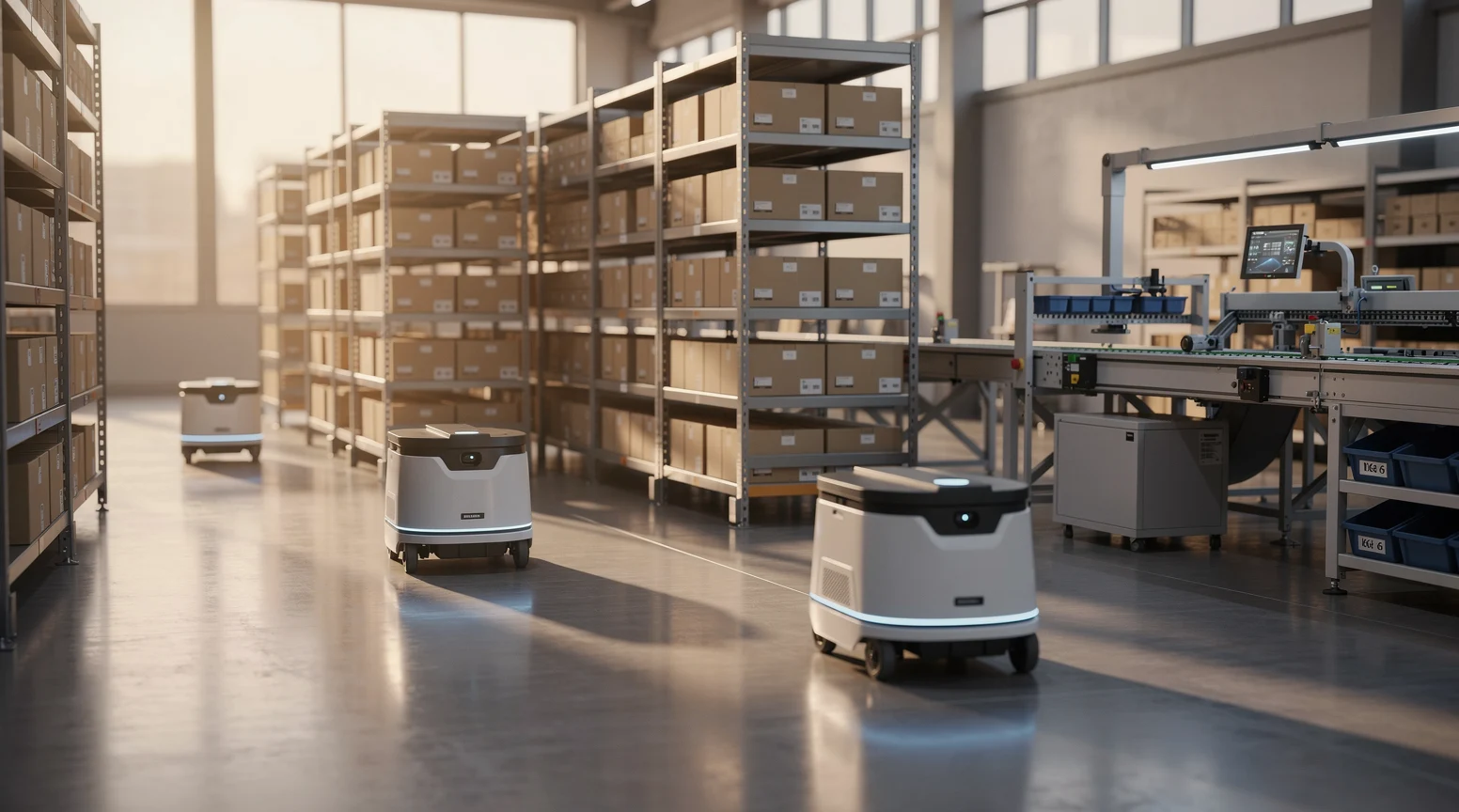
Consider a stylized but typical case. A direct-to-consumer supplements brand shipping around 600 orders a day was missing same-day cutoffs every November because pickers spent most of their shift walking a sprawling racking layout. Rather than rebuild, the brand kept its existing shelving, added a modest subscription fleet of autonomous mobile robots to carry totes between zones, and re-slotted its 200 fastest items near the pack bench. Picking throughput roughly doubled in the affected zone, and the team hit its holiday cutoffs without a third seasonal hire.
The lesson generalizes. The retailers getting value are not the ones spending the most; they are the ones who diagnosed a single expensive step and applied the cheapest credible fix to it. A grocer with a space problem reaches for dense storage, while an apparel seller drowning in returns reaches for sortation. Matching the tool to the actual constraint is the whole game, and it is why a generic answer like buy robots so often disappoints.
Tools, partners and vendors worth knowing
The vendor landscape splits into a few clear groups. Knowing which group solves which problem keeps sales calls focused.
Warehouse software platforms
Cloud WMS providers serve the SMB tier with subscription pricing and prebuilt connectors to common storefronts and marketplaces. This is the layer to evaluate first, because it determines how well every later piece of hardware will perform. Prioritize platforms with strong integrations to the sales channels you already run.
Robotics and RaaS providers
A growing field of vendors offers autonomous mobile robots and goods-to-person systems on monthly subscriptions, which is the most SMB-friendly way to test robotics without a capital commitment. Look for providers that let you scale the fleet seasonally and that publish realistic throughput numbers for your order profile.
Third-party logistics with built-in automation
If running your own automated warehouse is too much, modern 3PLs now operate automated facilities you can rent into. This lets a small brand buy the outcome, faster and more accurate fulfillment, without owning any equipment. The trade-off is less control and per-order pricing that can bite at scale.
Systems integrators
For anything beyond a single subscription product, a good integrator earns their fee by connecting software to hardware to your sales channels. Underbudgeting this role is the most common reason promising deployments stall. A short scoping engagement before you buy hardware usually pays for itself.
Measuring the return: the metrics that matter
Automation projects live or die on whether you can prove the gain, and most SMB teams measure the wrong things. Headline robot speed is almost meaningless if it does not move a metric tied to cost or customer experience. Before you sign anything, agree on the handful of numbers you will track from day one.
The most useful operational metric is lines picked per labor hour, because picking is usually the largest controllable cost in the building. Pair it with order accuracy, measured as the share of orders shipped without a pick or pack error, since accuracy failures generate refunds, returns, and support tickets that dwarf the picking saving. Together these two numbers capture most of the value a system creates.
On the financial side, track cost per order shipped rather than total labor cost, because volume swings make raw labor figures misleading. A system that holds cost per order flat while your volume doubles is delivering real leverage, even if your total payroll rises. Add inventory accuracy and dock-to-stock time, the hours between goods arriving and being available to pick, to round out the picture.
| Metric | What it tells you | Healthy direction |
|---|---|---|
| Lines per labor hour | Picking productivity | Rising after rollout |
| Order accuracy | Quality of fulfillment | Above 99% and climbing |
| Cost per order shipped | True unit economics | Flat or falling as volume grows |
| Inventory accuracy | Trust in stock data | Above 98% |
| Dock-to-stock time | Speed of intake | Hours, not days |
Set a clear baseline before any equipment arrives, because the most common reporting failure is having no honest before-picture to compare against. Run the new system through a full peak season, then compare like-for-like weeks year over year rather than against a quiet month. That single discipline separates a defensible business case from a vendor anecdote.
Watch the soft metrics too
Numbers on a dashboard miss two things that quietly decide success. The first is worker retention: a less physically punishing job tends to keep staff longer, which lowers hiring and training costs that rarely show up in the automation business case. The second is your ability to say yes to growth, such as a new sales channel or a same-day promise, without panic-hiring. Both are real returns even when they resist a tidy spreadsheet line.
How to build your automation roadmap
A workable plan for 2026 fits on one page. Start by measuring where labor and errors actually concentrate, because intuition is often wrong about which step is slowest. Then sequence the work so each phase funds the next.
- Stabilize the data. Implement or upgrade your WMS and enforce scan-based receiving and picking until counts are reliable.
- Target the worst bottleneck. Add one low-cost physical layer, such as pick-to-light or a small AMR fleet on subscription, aimed squarely at the slow step.
- Prove it over a peak. Measure lines per hour, accuracy, and labor cost before and after across one busy season.
- Scale or pivot. If the gain holds, expand the fleet or add density with AS/RS. If it does not, the subscription model lets you stop without stranded capital.
The retailers who succeed treat automation as a series of reversible experiments rather than one irreversible bet. That mindset, more than any specific robot, is what separates a system that pays for itself from a warehouse full of regret.
Keep the bigger goal in view as you sequence the work, because the warehouse is one link in a chain that ends at the customer’s door, as we map out in modern retail logistics from warehouse to doorstep. Every gain inside the building only counts if it shows up as a faster, more reliable delivery promise.
The strategic takeaway for 2026 is that the barrier to entry has genuinely fallen. Subscription pricing, cloud software, and a maturing vendor field mean a retailer shipping a few hundred orders a day can now run automation that was strictly enterprise-only five years ago. The winners will not be the ones with the biggest budget; they will be the ones who measure honestly, fix the real bottleneck, and keep every step small enough to reverse. Treat your first project as a bet you can walk away from, prove the numbers across one peak, and let the results decide how far you scale.
Frequently asked questions
Is warehouse automation realistic for a retailer shipping only a few hundred orders a day?
Yes. At that volume the entry point is usually a cloud WMS plus a low-cost layer such as pick-to-light or a small subscription robot fleet. Full goods-to-person systems rarely make sense yet, but the software and a targeted physical fix often pay back within a single peak season.
Should I buy robots or rent them?
For most SMBs, renting through robotics-as-a-service is the safer first move. It converts a six-figure capital risk into a monthly cost you can scale for the holidays and cancel if the gain does not materialize. Consider buying only once you have proven, stable, year-round volume.
What is the single most important first step?
Getting your inventory data accurate, which almost always means a capable warehouse management system and disciplined scanning. Automating on top of bad data simply produces wrong results faster, so the software foundation comes before any hardware.
How long until automation pays for itself?
Plan for 18–36 months, with the software and low-cost layers paying back fastest. Most retailers see meaningful labor and accuracy gains within two peak seasons if they phase the rollout rather than attempting a single large cutover.
Will automation let me cut my warehouse team?
Usually it lets you do more with the team you have, rather than shrinking it. The common outcome in 2026 is protecting throughput when you cannot hire enough seasonal staff, and shifting existing workers from walking and counting to quality checks and exceptions.
Do I need to own a warehouse to benefit?
No. Many third-party logistics providers now run automated facilities you can rent into, so you buy faster, more accurate fulfillment as a service. The trade-off is less control and per-order pricing that can become expensive at higher volumes.
What integrations should I confirm before signing a contract?
Verify that the system connects cleanly to your storefronts and marketplaces, your shipping carriers, and your accounting or ERP tools. Missing integrations create manual reconciliation work that quietly erases the savings the automation was supposed to deliver.
How do I size a system without overbuying for the holidays?
Size your permanent system for steady-state volume and cover the seasonal spike with flexible capacity such as rented robots or temporary labor. Building for peak leaves expensive equipment idle most of the year and lengthens payback considerably.
Where does warehouse automation fit in the wider logistics picture?
It is the engine room of fast fulfillment. Clean intake, accurate stock, and quick pick-and-pack are what make ambitious last-mile and same-day promises credible, which is why the warehouse is increasingly where the customer experience is actually won.