
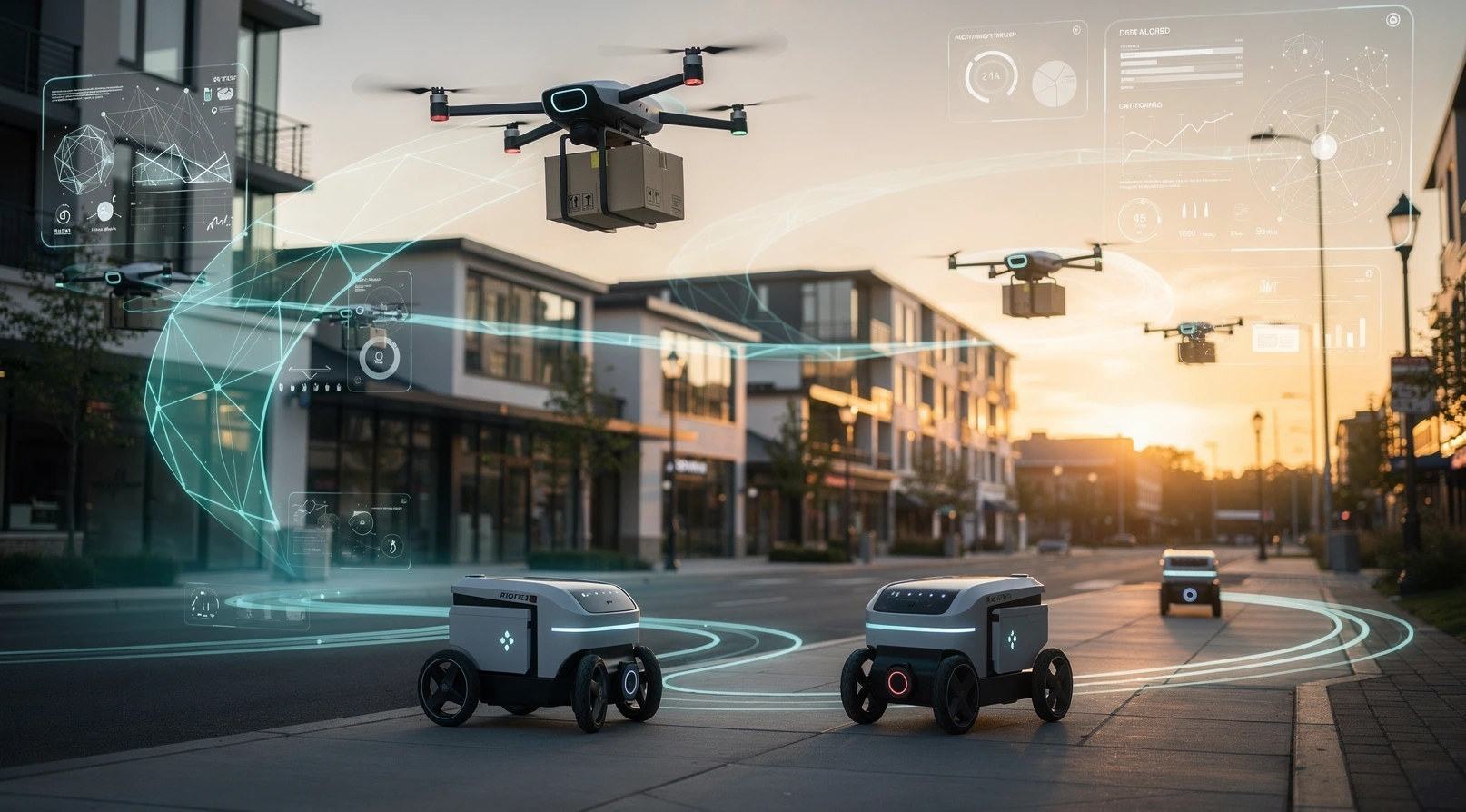
Autonomous last-mile delivery is on track to cross a threshold that has eluded it for a decade: by the end of 2026, the pattern of recent signals suggests sidewalk robots and delivery drones will move decisively beyond restaurant takeout into everyday retail, fulfilling grocery, pharmacy, and small-parcel orders at meaningful volume in pilot metros. The likely tell will be the 2026 holiday quarter, which on current trajectory is set to become the first peak season in which a non-trivial share of last-mile orders in cities such as Dallas, Phoenix, and parts of Los Angeles arrive without a human driver. This is a forecast, not a certainty, and the section on caveats below explains where it could break.
The thesis rests on three independent signals from the past few weeks, each pointing the same direction from a different angle: a scale milestone in the air, a scope expansion on the sidewalk, and a regulatory unlock in Washington. None of these on its own would justify the call. Together, the pattern suggests the sector is shifting from experiment to operating infrastructure faster than the consensus assumes.
In short
- The prediction: autonomous last-mile delivery likely crosses from food into everyday retail (grocery, pharmacy, parcels) at meaningful pilot-metro volume by year-end 2026, with the 2026 holiday quarter as the first checkpoint.
- Signal 1 (air): Walmart and its drone partners passed one million U.S. drone deliveries on 29 May 2026, with roughly 40 percent of that total flown in a single quarter.
- Signal 2 (sidewalk): Serve Robotics announced its first commercial non-food vertical on 2 June 2026, signalling that the same fleet built for dinner is being pointed at laundry, pharmacy, grocery, and retail.
- Signal 3 (regulation): the FAA’s Part 108 beyond-visual-line-of-sight rule is moving toward a final text in 2026, the structural unlock that lets routine drone delivery scale past the waiver bottleneck.
- How to check it: watch the next two earnings cycles and holiday-season disclosures for delivery counts, new non-food verticals, and the Part 108 timeline. A future observer can mark this yes or no by early 2027.
Why this matters now
Last-mile delivery is the most expensive and least automated link in the retail supply chain, and that is precisely why it has resisted change. The drop from a local store or micro-hub to a doorstep is where labor cost, route density, and customer expectation collide, and it has historically swallowed a disproportionate share of fulfillment economics. For years, autonomous delivery has been a perennial “next year” story, full of pilots that never escaped a handful of neighborhoods.
What looks different in mid-2026 is that the constraint is shifting from technology to permission and unit economics, which is usually the stage right before adoption curves bend. The hardware works well enough in real streets and real airspace; the open questions are now regulatory clearance, route density, and cost per drop. When a category’s bottleneck moves from “can it work” to “is it allowed and does it pay,” the pattern across prior technology cycles suggests deployment tends to accelerate rather than stall.
The retail stakes are large because driverless delivery does not just trim a cost line, it changes what a store is for. If a supermarket or pharmacy can dispatch orders by robot and drone from existing locations, the store becomes a forward fulfillment node as much as a shopping destination, echoing the logic behind dark stores and micro-fulfillment for grocery delivery. That reframing is why the timing of these signals matters to retailers, not only to the robotics firms building the fleets.
Signal 1: Walmart and Wing cross one million drone deliveries
On 29 May 2026, Walmart announced it had passed one million drone deliveries across its U.S. operations, a number that would have read as science fiction not long ago. The more telling figure sits underneath the headline: roughly 40 percent of that cumulative million, on the order of 400,000 flights, was completed in a single quarter, Walmart’s fiscal first quarter of FY27. A milestone is a static fact; a milestone that is 40 percent fresh is a slope.
The operational detail reinforces the read. Walmart described drone deliveries running from 66 store locations across four states and five metro markets, with average order-to-doorstep times around 23 minutes and a fastest recorded drop under five minutes. Texas alone accounted for more than 200,000 of the million, the kind of regional concentration that tends to appear when a service moves from novelty to habit in a lead market.
The partner structure matters for the forecast. The expansion is run primarily by Wing, the Alphabet drone unit, alongside Zipline, and Wing has signalled plans to reach more than 270 Walmart store locations, stretching geographically from Los Angeles toward Miami. A network that grows from dozens of stores toward a few hundred is the difference between a demo and a distribution layer.
None of this proves the everyday-retail crossover by itself, because Walmart already sells groceries and general merchandise, so its drone drops are not pure-play takeout to begin with. That is part of the point. The most scaled drone program in the country is anchored to a general retailer, not a restaurant aggregator, which biases the whole category toward grocery and household goods. It also sits alongside the platform economics covered in our analysis of why Walmart’s profit growth will lean on ads and membership through FY27, where faster, cheaper delivery is part of the flywheel.
Signal 2: Serve Robotics steps beyond food
If drones are the air signal, sidewalk robots are the ground signal, and on 2 June 2026 Serve Robotics gave the clearest scope-expansion tell yet. The company announced a partnership with NoScrubs, an on-demand laundry service, which it described as its first commercial urban delivery partnership outside prepared food. The specific vertical, laundry, matters less than what it represents: the same robots built to carry dinner being repurposed for non-food errands.
Management framed it explicitly. Chief executive Ali Kashani said that “the same Serve robots that bring you dinner will soon bring you your laundry and more,” and the announcement named dry cleaning, retail, pharmacy, and grocery as the verticals on the roadmap. When a company tells you the categories it intends to enter, that is not proof, but it is a stated intention from the operator with the most ground-side data, and it deserves weight.
The capacity behind the claim looks real rather than aspirational. Serve reported a fleet of roughly 2,000 robots across the U.S., including around 500 in Los Angeles, and in its first quarter the company described being active across dozens of cities in multiple states, with revenue up several-fold year over year. A platform of that size is the precondition for adding verticals; you cannot diversify what you have not first scaled.
The strategic logic is the part worth dwelling on. Sidewalk delivery has fixed costs in robots, mapping, and operations that are easier to justify when spread across many order types rather than one. Layering laundry, pharmacy, and grocery onto an existing food fleet is the classic move to lift utilization and route density, the same instinct that drove platforms to bundle everyday items into the automation-heavy logistics buildouts now reshaping fulfillment. Higher utilization is how a unit-loss business inches toward a unit-profit one.
Signal 3: The FAA’s Part 108 rule moves toward a final text
The third signal is the least visible and arguably the most important, because it governs whether the air half of the thesis can scale at all. The FAA’s proposed Part 108 rule would create a standardized framework for routine beyond-visual-line-of-sight (BVLOS) drone operations, replacing the slow, per-operator waiver system that has capped commercial drone delivery for years. The agency published the proposal in August 2025, drew more than 3,000 comments through an October 2025 window, and is working toward a final rule expected in 2026.
The mechanics of the rule are what make it a genuine unlock rather than a procedural footnote. Part 108 would replace per-flight waivers with operational-area approvals, set risk categories tied to population density, and define standardized roles and detect-and-avoid requirements. In plain terms, it converts drone delivery from a case-by-case privilege into a licensable, repeatable operation, which is the legal precondition for moving from dozens of stores to hundreds.
Timing is the hedge here, and it cuts both ways. A final rule expected “in 2026” with phased implementation thereafter means the full regulatory tailwind may not arrive until late in the year or beyond, and government timelines slip routinely. That said, the direction of travel is unusually clear: an administration that has pushed to accelerate the timeline, an agency mid-process, and an industry that has already pre-built capacity in anticipation. You can review the proposal directly on the regulator’s site rather than relying on summaries. The FAA’s drone rulemaking pages track the current status.
What the pattern suggests
Read individually, each signal is suggestive; read together, they describe a system clearing its three classic barriers at once. Scale is being demonstrated in the air (a million drone deliveries, 40 percent in one quarter). Scope is being expanded on the ground (a food fleet pointed at laundry, pharmacy, grocery, and retail). And the regulatory gate is opening (Part 108 moving toward a final text). Adoption curves tend to bend when capability, demand, and permission align, and that alignment is what these three signals collectively suggest.
The table below lays out the signals matrix, the dimension each one addresses, and why it is hard to dismiss as noise.
| Signal | Date | Dimension | What it demonstrates | Why it is not noise |
|---|---|---|---|---|
| Walmart passes 1M drone deliveries | 29 May 2026 | Scale (air) | Drone delivery operating at retail volume, accelerating | 40 percent of total in one quarter; anchored to a general retailer, not takeout |
| Serve Robotics enters non-food | 2 Jun 2026 | Scope (ground) | Sidewalk fleet crossing from food into errands and retail | Stated roadmap names pharmacy, grocery, retail; backed by a ~2,000-robot fleet |
| FAA Part 108 toward final rule | 2026 (process) | Permission (regulation) | BVLOS drone delivery becoming licensable at scale | Replaces the waiver bottleneck; industry has pre-built capacity in anticipation |
A reasonable skeptic will note that two of the three signals are about drones and robots as a category rather than about everyday retail specifically. That is fair, and it is why the forecast is framed as a likely crossover rather than a settled one. The bridge from “autonomous delivery is scaling” to “autonomous delivery is doing your grocery and pharmacy run” rests on the stated roadmaps and on the simple economics of utilization, both of which point the same way without guaranteeing the destination.
Wider context: the economics of driverless last-mile
The reason this category keeps attracting capital despite years of slow progress is the size of the prize. Last-mile is widely estimated to absorb a large share of total shipping cost, and it is the part of fulfillment most exposed to labor scarcity and wage inflation. Any technology that credibly lowers cost per drop at the doorstep attacks the single worst line in the delivery P&L.
The catch, and it is a serious one, is that autonomous delivery has not yet proven durable unit profitability at scale. Sidewalk-robot and drone operators have generally run losses while they build fleets, map cities, and absorb the fixed costs of autonomy. The bull case is that utilization and density eventually flip the economics; the bear case is that the fixed costs stay stubbornly high and the flip never arrives, a tension familiar to anyone who has weighed the trade-offs in choosing the systems that run modern fulfillment.
Two structural tailwinds make 2026 different from prior false dawns, however. The first is that the fleets are now large enough to spread fixed costs across real volume, which is exactly why adding non-food verticals matters. The second is that the regulatory and capital environment has shifted from skeptical to encouraging, with large retailers and well-funded operators treating autonomy as core infrastructure rather than a moonshot.
There is also a competitive-dynamics angle. Once one major retailer demonstrates that drones and robots can shave minutes and dollars off delivery, rivals face pressure to match the capability or cede a convenience advantage. That dynamic, more than any single press release, is what tends to turn an isolated pilot into a category arms race.
Prior precedents: how this kind of crossover has played out
Forecasts are sturdier when anchored to precedent, so it is worth asking how analogous “platform crosses from one vertical into adjacent ones” stories have unfolded. The pattern is consistent: a platform proves a use case in a narrow vertical, builds dense operations, then layers adjacent categories onto the same infrastructure to lift utilization. The table below maps the analogy.
| Precedent | Starting vertical | Adjacent expansion | Lesson for autonomous delivery |
|---|---|---|---|
| Food-delivery apps | Restaurant takeout | Grocery, convenience, retail, pharmacy | Same logistics layer extends to new order types once density exists |
| Ride-hailing fleets | Passenger rides | Food, parcels, freight | Idle capacity gets monetized across verticals to improve economics |
| Warehouse robotics | Pallet and case handling | Each-pick, store fulfillment, returns | Automation spreads from the easiest task to harder adjacent ones |
| Autonomous delivery (now) | Prepared food | Laundry, pharmacy, grocery, parcels | The crossover appears to be at the same inflection the precedents passed |
The precedents are not destiny, and the analogy has limits, since drones and sidewalk robots face physical and regulatory constraints that software-only platforms did not. But the directional lesson is hard to ignore: once the infrastructure exists and density is achievable, operators almost always reach for adjacent verticals, because that is where the marginal economics improve fastest. Serve’s laundry move and Walmart’s grocery-anchored drone network are textbook versions of that reach.
Implications for retailers, platforms, and investors
For retailers, the near-term implication is that the store footprint is quietly becoming a delivery asset, not just a sales floor. Grocers, pharmacies, and general merchandisers with dense store networks are positioned to dispatch autonomous orders from locations they already operate, which favors incumbents with physical proximity to customers over pure online players in the specific game of speed. The retailers most exposed to upside are those treating delivery as infrastructure now rather than waiting for the technology to be obviously safe.
For delivery platforms, the strategic question is whether to own the autonomy or rent it. Some, like Walmart, are partnering with specialist drone operators; others are building or acquiring robotics capability directly. The likely outcome over the next year is a mixed ecosystem, with platforms orchestrating a blend of human couriers, sidewalk robots, and drones depending on order type, distance, and density, rather than a single winner-takes-all model.
For investors, the signals argue for watching operating metrics over narrative. The numbers that will confirm or refute this thesis are concrete: drone-delivery counts and their quarter-over-quarter slope, the number of new non-food verticals an operator like Serve actually launches, cost-per-delivery disclosures, and the Part 108 timeline. Revenue growth alone is not the tell; the tell is whether utilization and density are visibly bending unit costs toward profitability.
There is a retail-media and convenience dimension too. Faster, cheaper, more reliable delivery raises the value of the customer relationship and the data around it, reinforcing the broader shift in where retail profit pools sit, a theme we explored in why in-store retail media will cross from pilot to scale by holiday 2026. Delivery and monetization are increasingly two sides of the same flywheel.
Caveats: what could go wrong
The most important counter-signal is that unit economics may simply not work at scale, and this is not a minor quibble. Autonomous delivery operators have generally been loss-making, and some have seen their share prices fall over the past year as investors question the path to profitability. If the cost of robots, drones, mapping, remote supervision, and maintenance stays high, the crossover into low-margin categories like grocery could expose rather than solve the economics. Adding more verticals does not help if every drop still loses money.
The second risk is regulatory slippage. The Part 108 timeline is the linchpin of the air thesis, and government rulemaking slips routinely, especially after a disruptive period in Washington. If the final rule arrives late in 2026 or drifts into 2027, drone delivery stays bottlenecked in the waiver system, and the air half of the forecast weakens considerably even if the ground half holds.
The third risk is physical and seasonal. Drones are weather-sensitive and payload-limited, sidewalk robots are slow and geographically constrained to dense, navigable areas, and the 2026 holiday peak brings cold, wind, and rain to much of the U.S. exactly when volume spikes. A peak season is a stress test, and it is plausible that autonomous channels handle a smaller share of holiday volume than the run-rate suggests because the worst weather coincides with the highest demand.
A fourth, quieter risk is public acceptance. Community pushback on drone noise, sidewalk congestion, and safety has stalled deployments before, and a single high-profile incident could trigger restrictions that slow the whole category. The base case here is crossover, but a sober reader should hold these four counter-signals alongside it, because any one of them could push the verdict from “yes by year-end” to “yes, but later.”
The verdict to watch for
To keep this falsifiable, here is the scorecard. The prediction counts as confirmed if, by early 2027, at least two of the following are true: a major drone program reports a clear step-up in delivery volume beyond the current run-rate; a sidewalk operator has launched live non-food retail, pharmacy, or grocery delivery beyond a single pilot; and the FAA has finalized or substantially advanced Part 108. It counts as wrong if autonomous channels remain confined to food and a few demo neighborhoods, or if regulatory and economic friction visibly stalls expansion.
On the current balance of evidence, the crossover looks more likely than not within the timeframe, with the holiday quarter as the first real test and the early-2027 disclosures as the verdict. The signals point one way, the precedents rhyme, and the counter-signals are real but not yet decisive. That is the definition of a forecast worth making early rather than loud.
FAQ
What exactly is the prediction, and when can it be checked?
The prediction is that autonomous last-mile delivery, by sidewalk robot and drone, likely crosses from prepared food into everyday retail (grocery, pharmacy, parcels) at meaningful pilot-metro volume by the end of 2026. The first checkpoint is the 2026 holiday quarter, and the clearest verdict should be visible in operator disclosures and earnings by early 2027.
Why frame this as a forecast rather than something already happening?
Pieces of it are already happening, which is why the signals are credible, but the full crossover into routine non-food retail delivery at scale has not yet arrived. The forecast is about trajectory and timing: the pattern suggests the threshold is likely to be crossed within the year, not that it has already been crossed.
Are drones or sidewalk robots more important to the thesis?
They address different parts of it, and the thesis is stronger because both are moving. Drones provide speed over distance and are gated mainly by regulation; sidewalk robots provide dense, short-range coverage and are gated mainly by economics and geography. The crossover likely shows up as a blend rather than one technology winning outright.
What is the single biggest reason this could be wrong?
Unit economics. Autonomous delivery operators have largely run losses, and if cost per drop does not fall as fleets scale, expanding into low-margin grocery and parcel delivery could deepen the problem rather than solve it. Utilization and density have to bend the cost curve for the crossover to be durable.
How central is the FAA’s Part 108 rule?
It is the linchpin for the drone half of the thesis. Part 108 would replace the slow per-operator waiver system with a standardized framework for routine beyond-visual-line-of-sight flight, which is the legal precondition for scaling from dozens of stores to hundreds. If it slips well into 2027, the air side of the forecast weakens.
Which retailers are best positioned if the crossover happens?
Incumbents with dense physical store networks, particularly grocers, pharmacies, and general merchandisers, because they can dispatch autonomous orders from locations they already operate. The store becomes a forward fulfillment node, which favors proximity to customers over pure-play online scale in the specific contest of fast, cheap delivery.
Does this mean human delivery drivers go away in 2026?
No, and that is not the claim. The likely 2026 outcome is a mixed model in which a growing but still minority share of orders in select metros is handled by robots and drones, with human couriers continuing to carry the bulk of volume. The significance is the direction and slope, not a sudden replacement.
What numbers should I track to test this myself?
Watch drone-delivery counts and their quarter-over-quarter growth, the number of genuinely new non-food verticals operators launch, any cost-per-delivery or contribution-margin disclosures, and the FAA’s Part 108 status. Those four metrics, rather than headline revenue, are what will confirm or refute the crossover.
How does this connect to broader retail automation trends?
Last-mile autonomy is the consumer-facing edge of a wider automation wave that also includes warehouse robotics and micro-fulfillment. The same economic pressure, high labor cost and thin delivery margins, is driving investment across the chain, from the distribution center to the doorstep. Delivery is simply the most visible and most regulated frontier of that shift.