
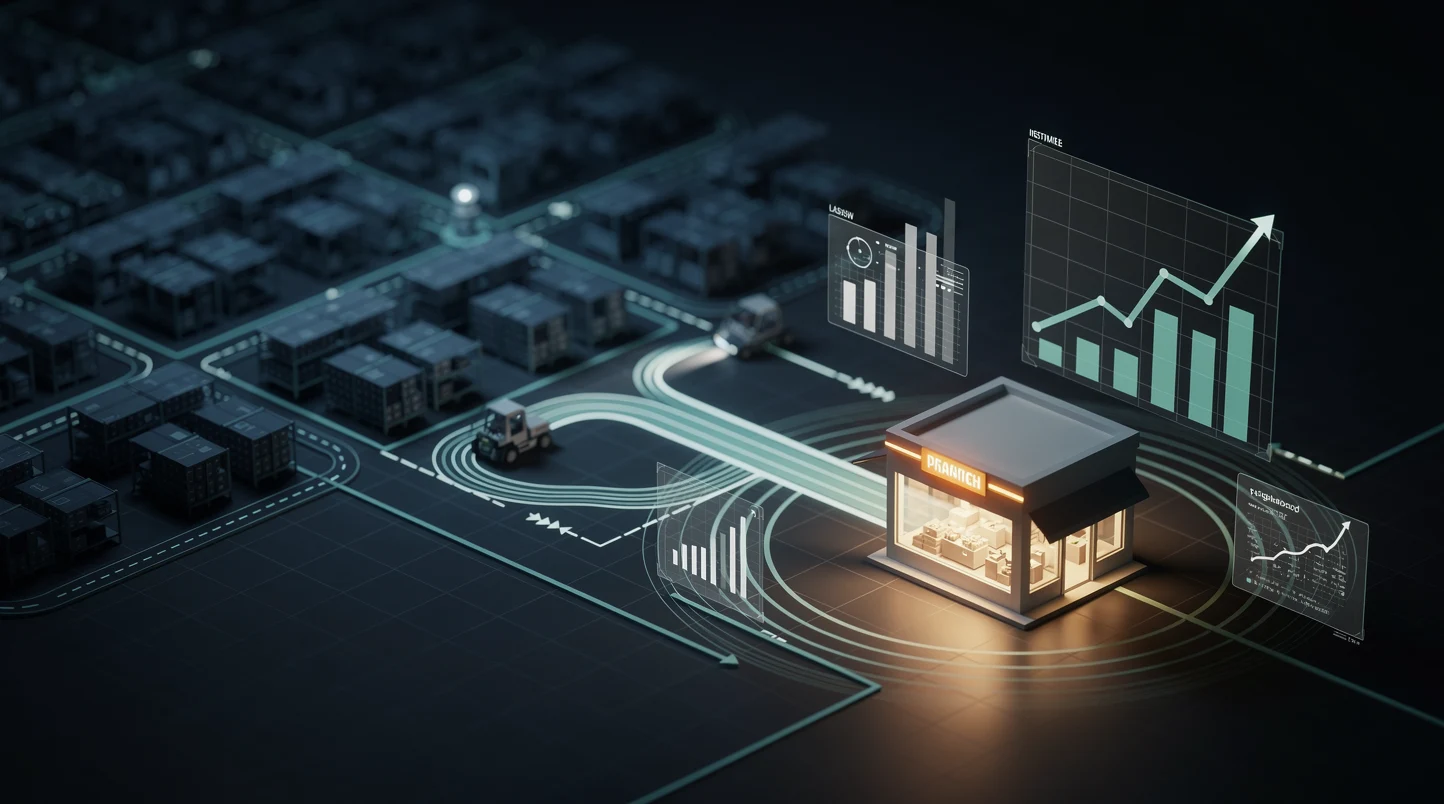
The expensive bet that defined a decade of grocery e-commerce, the standalone robotic mega-warehouse, is quietly being unwound. The pattern across the last month suggests that more US and North American grocers will retreat from dedicated automated customer fulfillment centers toward store-based and hybrid picking through the second half of 2026, with the verdict checkable across third and fourth quarter earnings (roughly October 2026 to February 2027). Automation is not dying; it is migrating off the centralized dark warehouse and into the store, the loading dock, and smaller attached micro-units. The companies that built the centralized model are the ones now walking away from it, and that is the tell that matters.
In short
- The prediction: the standalone automated grocery customer fulfillment center (CFC) is fading, and at least one or two more North American grocers are likely to announce CFC closures or store-based pivots before year-end 2026, checkable through Q3 and Q4 grocery earnings.
- Signal 1: Kroger’s first quarter fiscal 2026 results (reported June 18, 2026) showed e-commerce turning profitable ahead of schedule, with management crediting store-based fulfillment and the closure of three automated centers.
- Signal 2: Ocado, the company that invented the CFC blueprint, has pivoted toward a small store-based system and is hunting partners beyond Kroger after cutting around 5% of its workforce.
- Signal 3: the counter-current is real but narrower than it looks: Symbotic’s roughly $5bn Walmart in-store program and Walgreens’ robotic micro-units show automation surviving inside the store, not in distant dark warehouses.
- Why it matters: the capital model for grocery delivery is being rewritten in real time, and the precedent points to store-led economics, not robot-led economics, defining who reaches profitability first.
Why this matters now
For most of the past decade, the consensus answer to online grocery economics was automation at scale. The thesis held that grocery delivery loses money on manual store picking, so the fix was to build large, highly automated customer fulfillment centers that could assemble orders faster and cheaper than a human walking the aisles. Kroger’s multi-billion-dollar partnership with Ocado was the flagship expression of that idea in the United States.
That consensus is now breaking in public. The signals of the last month do not point to incremental tuning; they point to a structural reversal in how the largest grocers intend to fulfill online orders. When the firm that pioneered a model and its largest customer both move away from it inside the same quarter, the pattern is rarely a coincidence.
The timing is not random either. Grocery e-commerce penetration has stabilized rather than exploded, which changes the math: if online volume grows at a measured pace, the fixed cost of a dedicated robotic warehouse is harder to absorb than planners assumed in 2020. The pressure to show channel profitability, not just channel growth, is now the dominant theme on grocery earnings calls. That pressure is what is forcing the architecture decision into the open, much as it has reshaped adjacent debates over sub-30-minute grocery delivery economics.
It helps to be precise about why the original thesis looked so compelling. A human picker walking a 40,000-item store to assemble a 50-line basket is slow, and the labor cost per order can run into double-digit dollars before delivery even begins. The promise of automation was to compress that pick into minutes inside a purpose-built grid, then amortize the robot across thousands of orders a week. On paper, the unit economics inverted in favor of the machine once volume crossed a threshold.
The flaw was always that threshold. The model only works if the dedicated asset runs near capacity, and capacity was sized for an online grocery boom that arrived more slowly and less evenly than the 2020 forecasts assumed. A robotic warehouse sized for a metro that delivers half the projected orders does not deliver half the savings; it delivers a stranded fixed cost. That gap between forecast and reality is the quiet force behind every signal in this piece.
Signal 1: Kroger’s e-commerce turns profitable on store-based picking
Kroger reported first quarter fiscal 2026 results on June 18, 2026, and the headline for this thesis was buried in the fulfillment commentary. Total sales reached roughly $46.1bn, up from about $45.1bn a year earlier, and adjusted e-commerce sales grew 19%. The more important disclosure was qualitative: the e-commerce business, including retail media, became profitable ahead of schedule.
Management tied that profitability directly to a shift toward store-based fulfillment, stronger delivery economics, and the closure of three fulfillment centers. The company said it retained nearly all of the affected households, moving them onto store-based delivery and pickup rather than losing them. In other words, switching off the automated centers did not cost Kroger the customers those centers were built to serve.
This builds on a costly admission. Kroger took a roughly $2.6bn impairment in the third quarter of fiscal 2025 and closed automated customer fulfillment centers in Pleasant Prairie, Wisconsin; Frederick, Maryland; and Groveland, Florida, in January 2026. Those were the showcase Ocado-powered sites meant to prove the centralized model. The Q1 results are the first clean data point suggesting the post-closure network is not just cheaper but actually profitable.
The forward guidance reinforces the read. Kroger maintained full-year targets of 1% to 2% identical-sales growth excluding fuel, per-share earnings of $5.10–$5.30, and free cash flow of $2.7bn–$2.9bn, and signaled that e-commerce profitability should accelerate through the year as store-based fulfillment scales and cost to serve falls. For context on how recently the company was still defending its outlook under margin pressure, see our earlier coverage of how Kroger held its 2026 outlook as price cuts squeezed grocery margins.
The retained-household detail deserves emphasis because it neutralizes the strongest defense of the CFC. The bull case for centralized automation always rested on service quality: faster, more accurate, fresher orders that would win and keep customers. If turning the centers off had triggered a wave of churn, the impairment would read as a costly retreat. Instead, Kroger kept the customers and improved the economics, which suggests the service premium the CFC was supposed to deliver was not large enough to justify its cost.
There is a credibility point here too. Management teams rarely volunteer that a multi-billion-dollar strategy was a mistake, so the language matters. Framing store-based fulfillment as the engine of newfound profitability is a public reweighting of the entire fulfillment philosophy, delivered on the record to investors. That is a far stronger signal than an analyst note or a single facility closure, and it is likely to give cover to peers who have been quietly skeptical of their own automation bets.
Signal 2: Ocado abandons the model it invented
The second signal is arguably more telling than the first, because it comes from the supply side. Ocado built the customer fulfillment center category and sold it globally as the future of grocery. As of early 2026, Ocado is accelerating a pivot away from the capital-intensive CFC toward a far smaller, store-based automation system.
The new system is a different animal. Per reporting around Ocado’s strategy shift, it occupies roughly 4,000–5,000 square feet, holds about 20,000 products, and combines grid-based robotics with human workers plus pickup ports for delivery drivers. The target customer is a retailer with around $5m–$8m in annual online sales, a fraction of the volume a full CFC was designed to justify.
The commercial backdrop sharpens the point. Ocado’s exclusive arrangement with Kroger ended in late 2025, its Canadian partner Sobeys closed a Calgary CFC in January, and Ocado eliminated roughly 5% of its workforce, on the order of 1,000 jobs. Chief executive Tim Steiner has described positive conversations with US retailers, but specifically about the smaller store-based system, not new CFCs. That distinction is the entire story.
When a vendor reprices and re-engineers its flagship product down by an order of magnitude, it is responding to demand that has moved. Ocado is not the only grocery automation name under leadership and strategy pressure, a theme we covered when Ocado stepped up its CEO succession search with founder Steiner under pressure. The pivot suggests the company now expects its growth to come from store-attached automation, not from selling more dark warehouses.
Consider the sales motion the smaller system implies. A platform aimed at retailers doing $5m–$8m in annual online sales is a fundamentally different business from one selling regional CFCs to national chains. It targets a much larger pool of mid-sized grocers, demands a faster and cheaper deployment, and competes head-on with the micro-fulfillment specialists Ocado once dismissed. The company is, in effect, conceding that its addressable market is now the store, not the warehouse.
The Sobeys closure in Calgary adds a second independent data point on the demand side. It is one thing for an exclusive US partner to step back; it is another for a separate international partner to shut a CFC in the same window. Two partners on two continents pulling back from the same architecture, while the vendor itself re-engineers around something smaller, is a coherent story rather than a series of isolated disappointments. The weight of evidence points one way.
Signal 3: the counter-current, automation moves into the store
The third signal is the one that keeps this prediction honest. Automation in grocery and big-box retail is not in retreat everywhere; in places it is accelerating. The nuance is where the robots are going. They are moving into and beside stores rather than into distant centralized warehouses.
Symbotic is the clearest example. The company holds a contract reported at around $5bn to install roughly 600 micro-fulfillment centers inside Walmart stores beginning in 2026, and it reached GAAP profitability while expanding its platform. On February 4, 2026, Symbotic announced the acquisition of autonomous forklift maker Fox Robotics, a business with close Walmart ties, broadening its automation stack from storage into dock and yard movement.
Walgreens points the same way. The pharmacy chain has been adding to an existing network of robotic micro-fulfillment centers, including a facility in West Jordan, Utah, designed to support nearly 96 stores in the region. These are not city-scale dark warehouses; they are smaller, store-adjacent automation nodes feeding a dense cluster of physical locations.
Read together, the three signals describe a sorting, not a collapse. The expensive, centralized, build-it-and-they-will-come CFC is losing favor, while store-based picking and smaller store-attached automation gain ground. This is consistent with the broader US retail automation-capex wave we expect before holiday 2026, which is concentrating spend closer to the customer rather than in remote fulfillment campuses.
The Symbotic and Walmart relationship is worth reading carefully, because it is easy to misinterpret as a vote for the old model. The roughly 600 units are micro-fulfillment centers placed inside stores, not regional dark warehouses serving home delivery. Walmart is automating the flow of goods through its existing physical footprint, which is a bet on the store as the center of gravity, the same instinct driving Kroger’s store-based pivot. The Fox Robotics acquisition extends that logic into the dock and yard rather than into a new class of standalone facility.
Walgreens reinforces the density argument. A single micro-unit supporting nearly 96 stores is a hub-and-spoke design built around an existing retail network, not a speculative warehouse hoping to fill capacity from a wide catchment. The common thread across all three signals is that capital is flowing toward assets anchored to stores that already have traffic, and away from assets that must generate their own demand to justify the build.
What the pattern suggests
The synthesis is that grocery fulfillment is bifurcating into two viable models and one fading one. The fading model is the standalone, centralized, fully automated CFC built to serve a wide region from a single site. The two survivors are store-based and hybrid picking, where the existing store doubles as the fulfillment node, and store-attached micro-automation, where robots sit inside or beside a store rather than in a separate campus.
The signals matrix below maps each data point to what it most likely indicates and what a future observer can check.
| Signal | Date | What it shows | Lead indicator for |
|---|---|---|---|
| Kroger Q1 FY2026 e-commerce turns profitable | Jun 18, 2026 | Store-based fulfillment can be profitable after CFC closures | Other grocers copying the store-led playbook |
| Ocado pivots to small store-based system | Early 2026 | The CFC inventor is repricing down by an order of magnitude | Frozen CFC order book; growth shifting to store-attached units |
| Symbotic and Walgreens scale in-store automation | Feb to Mar 2026 | Automation thrives inside the store, not in dark warehouses | Capital flowing to store-adjacent, not centralized, robotics |
The competing fulfillment models can be compared on the dimensions that actually decide the economics: upfront capital, utilization risk, speed to launch, and labor exposure. The table below sets them side by side.
| Model | Upfront capital | Utilization risk | Speed to deploy | Labor intensity |
|---|---|---|---|---|
| Centralized automated CFC | Very high | High (single big asset) | Slow (years) | Low once built |
| Store-based and hybrid picking | Low | Low (uses existing store) | Fast (weeks) | High |
| Store-attached micro-automation | Medium | Medium | Moderate (months) | Medium |
The pattern suggests that the deciding variable is utilization risk, not theoretical pick efficiency. A robot that runs at 40% of designed throughput is more expensive than a person who only works when there are orders to fill. Store-based picking converts a fixed cost into a variable one, which is exactly the trade a grocer wants when online demand grows steadily rather than explosively.
This reframing also explains why the surviving models cluster at the store. Proximity is doing double duty: it shortens the last mile and it borrows demand certainty from a location that already sells to walk-in shoppers. A store-attached micro-unit inherits a customer base rather than betting on one, which lowers the utilization risk that sank the centralized design. The economics reward whoever can fill capacity, and the store is the cheapest place to find guaranteed throughput.
None of this requires automation to be technically inferior, which is an important nuance. The grids work, the throughput claims are largely real, and in a high-volume metro a CFC can still pencil out. The argument is narrower and more durable: in a world of steady rather than explosive online growth, the model that minimizes the cost of being wrong about volume will win, and store-based fulfillment minimizes exactly that cost.
Wider context: the build-versus-flex debate beyond grocery
This is not only a grocery story. The same tension between heavy centralized infrastructure and lighter, distributed, demand-flexible capacity is playing out across e-commerce logistics. The lesson recurring across categories is that owning a giant automated asset is only an advantage if you can keep it full.
Platform players are reaching the same conclusion from the other direction, choosing to control fulfillment closer to demand rather than over-building remote capacity. We have tracked that move in marketplace logistics, including the case for why TikTok Shop is likely to push in-house fulfillment across Europe, where proximity and flexibility beat raw automated scale during a demand ramp.
There is also a financial-discipline through-line. The 2020 to 2022 era rewarded growth and rewarded bold capital commitments to automation. The 2025 to 2026 era rewards free cash flow and punishes stranded assets, which is precisely what a half-utilized CFC becomes. Kroger’s $2.6bn impairment is the cautionary case study that every grocery CFO has now read.
Robotics-as-a-service complicates the picture in a way that supports the prediction rather than undermining it. As more automation is offered on a usage-based contract, the appeal of owning a vast bespoke warehouse shrinks further, because flexible capacity can be rented closer to the store. The direction of travel, owning less and flexing more, is consistent across all three signals.
The grocery case also rhymes with what happened in general merchandise a few years earlier. Operators that over-built remote capacity into a demand curve that flattened spent the following cycle rationalizing it, while those that flexed capacity closer to customers preserved optionality. The pattern recurs because the underlying error is the same: treating a demand forecast as a commitment and then pouring concrete around it. Store-based fulfillment is, in part, a hedge against forecasting itself.
Implications for grocers, suppliers, and investors
For grocers, the near-term implication is that the safe strategic default has flipped. Two years ago, announcing a large automated fulfillment center signaled ambition; today it signals risk. The likely playbook for the next several quarters is to lead with store-based and hybrid picking, layer in store-attached micro-automation where order density justifies it, and avoid new standalone CFC commitments unless volumes are already proven.
For automation suppliers, the market is splitting. Vendors positioned for in-store and store-adjacent systems, including the smaller Ocado unit, Symbotic’s in-store program, and micro-fulfillment specialists, are aligned with where demand is heading. Vendors whose economics depend on selling large centralized CFCs face a harder road and will likely need to reprice or re-architect, which is exactly what Ocado has begun to do.
For investors, the watch list is concrete. The signals to monitor are e-commerce profitability disclosures at grocers (Kroger has now set a public benchmark), any further CFC closures or impairments, the composition of Ocado’s order book at its next interim results, and whether Symbotic’s in-store rollout pace holds. A grocer that announces a new standalone automated CFC in this climate would be the genuine surprise.
For shoppers, the practical effect is likely to be more delivery and pickup served from the local store, with marginal differences in speed but improved availability and, over time, better economics that reduce pressure to raise delivery fees. The customer experience may change less than the balance sheet behind it.
There is a strategic timing element too. The next two earnings seasons fall either side of the holiday peak, which is when fulfillment strategy is stress-tested hardest. A grocer that sails through peak on store-based picking will have powerful evidence to cite, while any operator still leaning on under-filled automated capacity will face awkward questions about returns on that capital. The reporting calendar itself is likely to accelerate the narrative this prediction describes.
For private-equity and strategic acquirers, the bifurcation creates a sorting of assets into the prized and the discounted. In-store and store-adjacent automation platforms with proven deployment speed become more attractive targets, while owners of centralized CFC capacity may find those assets repriced or repurposed. The Symbotic move to absorb Fox Robotics is an early example of consolidation around the parts of the stack aligned with where demand is heading.
Caveats: what could go wrong
The strongest counter-signal is Walmart. If Symbotic’s roughly $5bn in-store automation program delivers the throughput and cost gains Walmart expects, it would prove that automation at scale can pay off and could pull the industry back toward heavier robotics. The honest framing is that Walmart is not contradicting the thesis so much as refining it: its automation is going into stores and distribution flow, not into standalone regional CFCs serving home delivery. Still, a decisive Walmart win could re-legitimize big automation faster than expected.
A second caveat is the labor ceiling. Store-based picking trades capital risk for labor exposure, and if wage inflation reaccelerates or labor markets tighten sharply, the variable-cost advantage could erode. In that scenario, the pendulum could swing back toward automation precisely because human picking becomes too expensive.
A third caveat is demand. The store-led model looks best when online grocery grows steadily. If a fast-delivery arms race forces volumes much higher very quickly, dedicated automated capacity could become attractive again to handle peak throughput that stores cannot absorb. The prediction assumes measured growth, which is the base case but not a certainty.
The scenarios table below frames the range of outcomes and what would confirm or break the thesis.
| Scenario | Rough likelihood | What confirms it |
|---|---|---|
| Store-led pivot spreads (base case) | Likely | More grocers cite store-based fulfillment for e-commerce profit by Q4 |
| Walmart automation win re-legitimizes scale | Plausible | Symbotic rollout hits targets; rivals announce new centralized capacity |
| Labor costs force a swing back to robots | Lower | Wage spike erodes store-picking economics into 2027 |
FAQ
What exactly is the prediction and when is it checkable?
The prediction is that more North American grocers will retreat from standalone automated customer fulfillment centers toward store-based and hybrid fulfillment through the second half of 2026. It is checkable across third and fourth quarter grocery earnings, roughly from October 2026 to February 2027, and at Ocado’s next interim results.
Does this mean grocery automation is dead?
No, and that distinction is central. The signals point to the decline of the large centralized CFC specifically, while store-based picking and smaller store-attached automation are gaining. Automation is relocating into the store rather than disappearing.
Why is Kroger’s quarter such an important signal?
Because it is the first clean evidence that switching off automated centers can improve, not harm, e-commerce economics. Kroger reported e-commerce profitability ahead of schedule and credited store-based fulfillment after closing three automated sites, while keeping nearly all affected households.
Why does Ocado’s pivot matter so much?
Ocado invented and globally marketed the CFC model, so its move to a much smaller store-based system is a supply-side admission that demand has shifted. When the original champion reprices its flagship down by an order of magnitude, it is following the market, not leading it.
Is not Walmart proof that big automation works?
Walmart is the key counter-signal, but its automation is concentrated inside stores and distribution flow rather than in standalone CFCs for home delivery. If Walmart’s in-store program delivers strong results, it could re-legitimize heavier automation, which is the main risk to this view.
What is the difference between a CFC, a micro-fulfillment center, and store-based picking?
A CFC is a large standalone automated warehouse serving a wide region. A micro-fulfillment center is a smaller automated unit, often inside or beside a store, serving a local cluster. Store-based picking uses staff to assemble online orders from the existing store shelves, with little or no dedicated automation.
Which companies are most exposed if this prediction holds?
Automation vendors whose economics depend on selling large centralized CFCs are most exposed, which is why Ocado has begun re-architecting toward a smaller system. Suppliers aligned with in-store and store-adjacent automation, including Symbotic and micro-fulfillment specialists, are better positioned.
What would prove this prediction wrong?
A major grocer announcing a new standalone automated CFC, a clear Walmart-led demonstration that centralized scale wins, or a wage spike that makes store picking uneconomic would each weaken the thesis. The cleanest disproof would be several grocers committing fresh capital to centralized automated warehouses for home delivery.
How should retailers act on this now?
The pattern suggests leading with store-based and hybrid fulfillment, adding store-attached micro-automation only where order density justifies it, and avoiding new standalone CFC commitments without proven volume. Watching Kroger’s profitability trajectory and Ocado’s order book gives a low-cost way to track whether the shift is accelerating.