
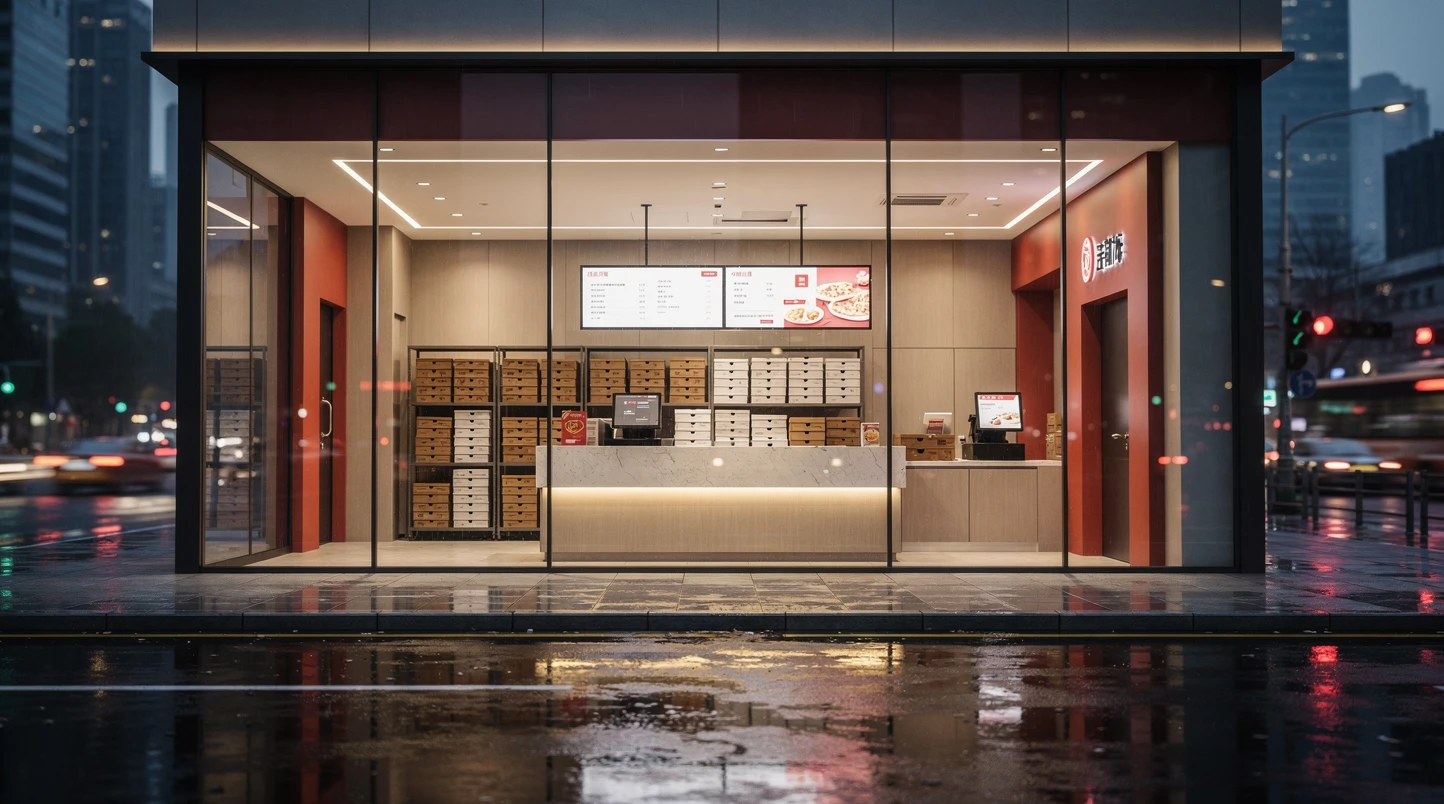
Domino’s Pizza China crossed another threshold in the early hours of July 6, when its operator DPC Dash confirmed that the chain reached 1,550 stores across 75 cities by the close of the first half of 2026. The update, issued to the Hong Kong Stock Exchange where the company trades under the ticker 1405.HK, showed 235 net new outlets opened between January and June, a pace that keeps the American brand’s Chinese franchise among the fastest-growing large restaurant networks in the country.
The headline number lands at an awkward moment for Chinese consumer businesses. Domestic demand has stayed soft, price competition has intensified across food and retail, and same-store sales at DPC Dash remained negative through the second quarter. The company is, in effect, running two stories at once: an aggressive rollout of new locations and a cautious defense of sales at the stores it already operates. How those two threads resolve will shape whether Domino’s China can keep compounding at its recent rate.
This report breaks down what DPC Dash disclosed, how the numbers compare with earlier quarters and with the wider Domino’s system, and why the expansion continues even as the Chinese consumer stays guarded.
In short
- 1,550 stores, 75 cities: DPC Dash added 235 net new outlets in the first half of 2026, entering 15 new cities and lifting Domino’s China to the brand’s second-largest international market by store count.
- Loyalty at 41.9 million: Membership climbed from 30.1 million a year earlier, a roughly 39% increase that underpins the company’s digital-first ordering model.
- Sales still negative: Same-store sales growth stayed negative in the second quarter, though the company said May and June turned slightly positive after a run of sales initiatives.
- Ahead of the build plan: Opened, under-construction and signed stores reached about 89% of the full-year target of roughly 350 net new stores, up from 65% at the end of March.
- Backed by a profitable base: DPC Dash reported 2025 revenue of RMB 5.38 billion (about USD 747 million) and net profit of RMB 141.9 million, giving the expansion a firmer financial footing than in its loss-making years.
What Domino’s Pizza China just reported
DPC Dash is the exclusive master franchisee for the Domino’s brand in mainland China, Hong Kong and Macau. Its second-quarter operational update, released overnight, is not a full earnings statement but a closely watched read on store growth, membership and sales momentum ahead of interim financial results later in the year.
The core disclosures were straightforward. As of June 30, 2026, the network stood at 1,550 stores across 75 cities. Of those, 532 sat in Tier 1 cities and 1,018 in lower-tier markets, a split that shows how far the chain has moved beyond its original base in Beijing, Shanghai, Guangzhou and Shenzhen. The company entered 15 new cities in the first six months and added 235 stores on a net basis.
Management framed the momentum around the build pipeline rather than sales alone. By the end of June, stores that were open, under construction or signed represented about 89% of the full-year 2026 target, a sharp rise from 65% at the end of the first quarter. In practical terms, DPC Dash has locked in most of the real estate it needs to hit its stated goal of roughly 350 net new stores this year, reducing the execution risk that usually clouds aggressive rollout plans.
The membership and ranking signals
Two secondary metrics carried weight. Loyalty program membership reached 41.9 million, up from 30.1 million a year earlier. And within Domino’s global network of more than 22,300 stores, DPC Dash said its Chinese outlets held all of the top 70 positions in the brand’s first 30-day sales ranking, a measure of how strongly new stores open. At the end of the first quarter, the company held the top 50 spots, so the widening lead points to opening-week demand that has held up even as established stores struggle.
Those opening numbers matter because they are the clearest evidence that the brand still has pull in new markets. A restaurant chain can mask weak underlying demand by opening stores, but only if each new store draws customers. On DPC Dash’s own disclosure, the newest Chinese Domino’s outlets are opening stronger than any others in the worldwide system.
Why 1,550 stores signals a different China playbook
The most revealing figure is not the headline count but the tier split. With 1,018 of 1,550 stores now in lower-tier cities, roughly two-thirds of the network sits outside China’s largest metros. That is a reversal of the pattern most Western restaurant brands followed for two decades, when they clustered in Tier 1 cities and treated smaller markets as a distant afterthought.
DPC Dash has instead used lower-tier expansion as its primary growth lever. Smaller cities carry lower rents and labor costs, less direct competition from international rivals, and a rising cohort of consumers curious about Western fast food. The trade-off is thinner brand awareness at launch and greater dependence on delivery and digital marketing to build a customer base quickly.
The approach has drawn comparison with the broader race to reach China’s inland and smaller-city shoppers, a race that is also reshaping online retail. The same demographic shift is visible in the way marketplaces have pushed discount formats and price wars into second and third-tier cities, a dynamic that has fed directly into the recent debate over China’s e-commerce rules. Beijing’s move to expand its e-commerce law and widen the net over platforms reflects how much economic weight now sits in these markets, and how sensitive regulators have become to cut-throat competition there.
A delivery-native footprint
Domino’s model has always leaned on delivery, and in China that leaning is close to absolute. The brand competes less with sit-down restaurants than with the sprawling ecosystem of food-delivery apps and local pizza and fast-food operators. Every new store functions as a delivery node as much as a dine-in location, which lets DPC Dash place smaller, cheaper footprints in dense residential zones rather than prime retail frontage.
That structure changes the economics of expansion. A delivery-weighted store needs a smaller catchment to reach break-even, which is part of why the company can push into so many new cities without waiting for each to mature. It also ties the brand’s fate tightly to its app and loyalty base, because delivery customers rarely pass a physical storefront and must be reached digitally.
The loyalty engine: 41.9 million members and what it buys
Loyalty membership is the quiet backbone of the DPC Dash story. The jump to 41.9 million members, from 30.1 million a year earlier and 38.8 million at the end of the first quarter, gives the company a direct channel to a large and growing base of repeat buyers. In a delivery-first business, that owned audience is the closest thing to a moat.
The membership growth also reframes the expansion. New stores are not just betting on walk-in discovery; they plug into an existing pool of tens of millions of members who can be nudged toward a newly opened location through the app. That reduces the ramp time for a fresh store and helps explain the strength of those first 30-day sales rankings.
Membership economics
Large loyalty bases lower customer-acquisition costs over time, because a returning member is far cheaper to serve than a newly acquired one. For DPC Dash, the 12-month cohort of first-time buyers reported earlier in the year, around 17.6 million, feeds the top of a funnel that the loyalty program then works to retain. The more of that flow the company can convert into members, the less it has to spend chasing new demand.
The playbook echoes the way digital-first retailers and super-apps across Asia have treated membership as the central asset. The logic that drives a payments and shopping platform to build a super-app is the same logic that drives a pizza chain to obsess over its app: control the relationship, own the data, and lower the cost of the next sale. The pattern is visible in moves like Kaspi’s super-app push into new markets, where a loyalty-and-payments loop becomes the growth flywheel.
Digital ordering as default
DPC Dash routes the large majority of its orders through digital channels, which lets it personalize promotions, manage delivery logistics and gather granular data on ordering patterns. That data advantage compounds: the more the company knows about when and what its members order, the more precisely it can time discounts and menu pushes to defend sales without eroding margin across the board.
It is a model that also insulates the brand somewhat from the softness in physical retail traffic. When shoppers pull back from malls and high streets, a business built on app-based home delivery feels the change differently than one that depends on footfall past a storefront.
Same-store sales still negative: reading the demand signal
The uncomfortable part of the update is same-store sales. DPC Dash confirmed that same-store sales growth stayed negative through the second quarter of 2026, continuing a run of pressure that has dogged the company and much of Chinese consumer spending. The one bright spot: management said May and June delivered slightly positive same-store sales after a series of sales initiatives, hinting at a possible inflection.
Negative same-store sales alongside rapid store growth is a familiar and risky combination. It means the average existing store is selling less than it did a year earlier, and the network’s overall revenue growth is being carried by new units rather than by deepening demand at mature ones. If that pattern persists, each new store adds revenue but dilutes the average, and the model’s quality depends on new-store economics staying strong.
The involution problem
The backdrop is a Chinese market caught in what local commentary calls involution, a self-defeating spiral of price cuts and promotions that lifts volume but crushes margins. Food and retail operators have slashed prices to hold share, training consumers to wait for discounts and making it harder for anyone to raise average tickets. DPC Dash’s negative same-store sales sit squarely inside that dynamic.
The comparison with grocery is instructive. Where a Western grocer like Sainsbury’s posting five straight quarters of like-for-like gains reflects a market with pricing discipline, China’s operators are fighting the opposite condition. Positive like-for-like sales are hard to come by when the entire category is discounting to defend volume.
Reading the May and June inflection
The claim that same-store sales turned slightly positive in the final two months of the quarter is the update’s most forward-looking detail. If it holds, it would suggest the sales initiatives, likely a mix of value bundles, app-led promotions and menu refreshes, are beginning to stabilize demand at existing stores. If it fades, the second quarter’s positive tail will read as noise rather than a turn. The interim financial results due later in the year should clarify which it is.
How DPC Dash stacks up against Domino’s globally and Chinese peers
Domino’s China has become a standout inside the global system. On store count it now ranks as the brand’s second-largest international market, and its new stores open stronger than anywhere else in a network of more than 22,300 outlets. That combination of scale and opening strength is unusual, and it is the main reason the parent brand and investors have paid close attention to the Chinese franchise.
The table below tracks the network’s trajectory over the past 18 months, showing how store count, city coverage and loyalty membership have moved together.
| Period | Total stores | Cities | Net new stores | Loyalty members |
|---|---|---|---|---|
| End 2024 | 1,008 | ~39 | – | ~24 million |
| End 2025 | 1,315 | 60 | 307 (full year) | ~32 million |
| Q1 2026 (Mar 31) | 1,462 | 72 | 147 (quarter) | 38.8 million |
| H1 2026 (Jun 30) | 1,550 | 75 | 235 (half year) | 41.9 million |
The picture is one of steady acceleration in reach paired with equally steady growth in the owned membership base. The store count has risen by more than half in eighteen months, while city coverage has nearly doubled.
Where the network sits by tier
The tier breakdown underlines the lower-tier strategy and frames the competitive set the chain faces in each type of market.
| Market type | Stores (H1 2026) | Share of network | Primary competition |
|---|---|---|---|
| Tier 1 cities | 532 | ~34% | Established Western and premium local chains |
| Lower-tier cities | 1,018 | ~66% | Local fast food, delivery-only kitchens, value operators |
| Total | 1,550 | 100% | – |
In Tier 1 markets, Domino’s competes against entrenched international brands and a deep bench of premium local operators. In lower-tier cities, the field is more fragmented, dominated by local fast food and delivery-only kitchens, which is precisely where a recognized global brand with a slick app can carve out share fastest.
The financial base: what 2025 results say about durability
Expansion at this pace only makes sense if the underlying business can fund it. On that measure, DPC Dash enters the second half of 2026 in a stronger position than at any point in its history as a public company. For the full year 2025, the company reported revenue of RMB 5.38 billion, about USD 747 million at current exchange rates of roughly RMB 7.2 to the dollar, up 24.8% year over year.
Profitability improved sharply. Net profit for 2025 came in at RMB 141.9 million, around USD 20 million, up 157% from RMB 55.2 million in 2024. On an adjusted basis the company reported net profit of RMB 187.9 million, about USD 26 million, a 43% increase. Store-level operating margin held at 13.7%, the figure that ultimately determines whether adding stores adds profit.
From cash burn to compounding
The trajectory matters because DPC Dash spent its earlier years as a public company absorbing losses while it built density. Reaching sustained profitability, with net profit more than doubling in a single year, changes the calculus: the company can increasingly fund new stores from operating cash flow rather than leaning on external capital. That is the difference between a growth story that depends on investor patience and one that can compound on its own.
The listing itself is part of the story. DPC Dash went public on the Hong Kong Stock Exchange in 2023, joining a wave of Asian consumer and retail businesses using public markets to fund expansion. That wave has continued into 2026, with listings such as Dien May Xanh’s USD 505 million IPO in Vietnam underscoring how regional retailers are tapping equity markets to bankroll store growth.
The margin question
The one caveat is that a 13.7% store-level operating margin, healthy as it is, must be defended against the same-store sales pressure and discounting that define the current market. If price competition deepens, margins could compress even as revenue grows, and the quality of the expansion would suffer. The profitability gains of 2025 give DPC Dash a cushion, but not an unlimited one.
New leadership and the SCPG partnership
The update arrived alongside signals about how DPC Dash intends to sustain its growth. In May 2026 the company appointed Joanne Xie as Chief Marketing Officer. Xie brings more than 20 years of marketing experience, having previously served as Vice President of Marketing at McDonald’s China and held marketing roles at Coca-Cola and Mondelez. The hire deepens a leadership bench already anchored by chief executive Aileen Wang, herself a McDonald’s China veteran.
The McDonald’s lineage is not incidental. DPC Dash has effectively imported the operational discipline and marketing playbook of the world’s largest fast-food operator and applied it to a delivery-heavy pizza business in China. A marketing chief steeped in that tradition is well suited to the task ahead: defending same-store sales through sharper value messaging without triggering a margin-destroying race to the bottom.
The shopping-mall pipeline
On the real estate side, the company pointed to a partnership with SCPG Group, described as one of China’s leading shopping-mall operators with more than 220 projects across 55 cities. For a chain building out its store pipeline at speed, a relationship with a major landlord smooths one of the hardest parts of expansion: securing consistent, well-located sites on workable terms.
The tie-up also hints at a modest rebalancing toward higher-visibility locations inside malls, which can lift brand awareness in newer markets even for a delivery-led business. Mall sites carry higher rents, but they also bring foot traffic and signage that a tucked-away delivery kitchen cannot, and they can seed the loyalty base in a city where the brand is still new.
The macro backdrop: a cautious Chinese consumer and price wars
None of DPC Dash’s decisions can be read outside the state of the Chinese consumer. Household spending has stayed cautious through 2026, weighed down by a weak property market, uneven income growth and a broad reluctance to trade up. Deflationary pressure has crept across consumer categories, and operators have responded with aggressive discounting that has become a defining feature of the market.
That environment cuts both ways for a company like DPC Dash. On one hand, value-conscious consumers can be receptive to affordable, convenient meals, and a well-run delivery brand can win share from pricier or less digital rivals. On the other hand, the same caution suppresses average order values and keeps same-store sales under pressure, exactly the strain visible in the second-quarter numbers.
Regulators push back on the race to the bottom
Chinese authorities have grown visibly uneasy about the price wars. Regulators have summoned major platforms over what they describe as excessive competition, pressing the country’s commerce sector to shift from ruinous discounting toward quality and innovation. The intervention signals that the discount spiral has reached a level policymakers see as economically damaging.
For restaurant operators, the regulatory mood is a mixed blessing. Any cooling of the most destructive discounting could ease the pressure on same-store sales across the industry. But it also injects uncertainty into promotional strategy at a moment when value messaging is one of the few levers left to defend demand. The same tension is playing out in the region’s e-commerce price wars, where Amazon and Flipkart reopened a sale-season battle in India that shows how far platforms will go to win share in price-sensitive Asian markets.
What to watch next
The operational update sets up several clear tests for the second half of 2026. The first is whether the slightly positive same-store sales in May and June extend into the third quarter or fade. A sustained return to positive like-for-like sales would validate the sales initiatives and materially improve the quality of the expansion.
The second is the completion of the build plan. With opened, under-construction and signed stores already at about 89% of the full-year target, the company is on track to hit roughly 350 net new stores. Delivering that without straining the balance sheet or diluting store-level margins would confirm that the model scales.
Key risks on the horizon
Several risks could interrupt the story. Persistent deflation and weak consumer confidence could keep same-store sales negative regardless of company effort. A deepening price war could compress the 13.7% store-level margin. And the sheer pace of openings raises the perennial franchising risk that new stores cannibalize nearby existing ones, worsening the same-store trend the company is trying to reverse.
Against those risks sit real strengths: a profitable base, a 41.9 million-member loyalty program, the strongest new-store openings in the global Domino’s system, and a locked-in real estate pipeline. The next set of results will show whether those strengths are enough to turn rapid expansion into durable, profitable growth, or whether the soft consumer forces DPC Dash to choose between growth and margin.
The bigger read for global retail
Beyond Domino’s itself, the update is a useful gauge of Chinese consumer demand at a granular level. When a delivery-first, digitally sophisticated operator with the strongest new-store openings in its worldwide system still cannot post positive same-store sales, it says something about the depth of the current caution. The store growth shows conviction; the sales trend shows the ceiling. Reconciling the two is the central task facing DPC Dash, and a signal worth watching for anyone tracking where Chinese consumption goes next.
Frequently asked questions
How many stores does Domino’s Pizza China have now?
As of June 30, 2026, DPC Dash operated 1,550 Domino’s stores across 75 cities in mainland China. That figure includes 532 stores in Tier 1 cities and 1,018 in lower-tier markets, after 235 net new stores were added in the first half of 2026.
What is DPC Dash?
DPC Dash Ltd is the exclusive master franchisee for the Domino’s Pizza brand in mainland China, Hong Kong and Macau. It is listed on the Hong Kong Stock Exchange under the ticker 1405.HK and led by chief executive Aileen Wang, a former McDonald’s China executive.
Why are same-store sales negative if the chain is growing?
Store count and same-store sales measure different things. DPC Dash is opening many new outlets, which lifts total revenue, but the average existing store sold slightly less than a year earlier amid weak Chinese consumer demand and heavy discounting. The company said May and June turned slightly positive, hinting at a possible stabilization.
How large is Domino’s China within the global brand?
By store count, mainland China is Domino’s second-largest international market. Within a global network of more than 22,300 stores, DPC Dash said its Chinese outlets held all of the top 70 positions in the brand’s first 30-day sales ranking, meaning its new stores open stronger than any others worldwide.
Is DPC Dash profitable?
Yes. For the full year 2025 the company reported net profit of RMB 141.9 million (about USD 20 million), up 157% from 2024, on revenue of RMB 5.38 billion (about USD 747 million). Adjusted net profit was RMB 187.9 million and store-level operating margin was 13.7%.
How big is the Domino’s China loyalty program?
Loyalty membership reached 41.9 million as of June 30, 2026, up from 30.1 million a year earlier and 38.8 million at the end of the first quarter. The program is central to the company’s delivery-first, digitally driven ordering model.
What is DPC Dash’s store target for 2026?
The company is targeting roughly 350 net new stores for the full year 2026. By the end of June, stores that were open, under construction or signed represented about 89% of that target, up from 65% at the end of March.
Who are the key executives at DPC Dash?
Aileen Wang serves as chief executive, drawing on eight years at McDonald’s China. In May 2026 the company appointed Joanne Xie as Chief Marketing Officer; she previously held the marketing lead at McDonald’s China and worked at Coca-Cola and Mondelez.
What is the biggest risk to the expansion?
The main risk is that persistent weak consumer demand and industry-wide price wars keep same-store sales negative and compress the 13.7% store-level margin. Rapid openings also raise the risk of new stores cannibalizing nearby existing ones, which could worsen the same-store sales trend.