
Vietnam’s largest listed retailer has put a price on one of its crown jewels. Mobile World Investment Corporation (HOSE: MWG) has spun off its consumer electronics chain Dien May Xanh through an initial public offering that raised more than 13.3 trillion dong, or about 505 million dollars at current exchange rates of roughly 26,000 dong to the dollar. According to Vietnam Investment Review and The Investor, both citing the completed subscription, the sale was covered to 93 percent of the shares on offer and values the business at close to 3.4 billion dollars ahead of a planned debut on the Ho Chi Minh Stock Exchange in the first week of August.
The transaction matters well beyond Hanoi and Ho Chi Minh City. Inside Retail Asia and Vietcetera describe it as Vietnam’s first multi-billion-dollar valuation IPO of 2026 and the country’s largest market debut in roughly five years. It arrives weeks before Vietnam is due to be reclassified as a secondary emerging market by FTSE Russell, a change that index compilers expect to draw billions of dollars of passive and active money into the market.
For a retail sector that has spent 2026 watching Western chains cut guidance and Chinese marketplaces squeeze margins, the Dien May Xanh listing is a rare growth story with a hard number attached. This report unpacks what was sold, how the book was built, why Mobile World chose to carve the chain out now, and what investors are actually buying.
The context is a Southeast Asian consumer market that has become one of the few reliable pockets of growth in global retail. Vietnam’s economy has expanded at a pace well above regional peers, its middle class is broadening, and formal chains continue to take share from independent shops. Those tailwinds are the reason a domestic electronics retailer can command a valuation that would have looked improbable a few years ago.
In short
- The deal: Mobile World spun off electronics chain Dien May Xanh in an IPO that raised more than 13.3 trillion dong (about 505 million dollars).
- The demand: Investors took up 93 percent of the roughly 179.5 million shares offered at 80,000 dong (about 3.03 dollars) each.
- The valuation: The pricing implies a market capitalisation near 102 trillion dong (about 3.4 billion dollars), Vietnam’s first billion-dollar-valuation listing of the year.
- The buyers: Around 2,646 investors participated, with institutions taking roughly 90 percent of the volume and foreign funds dominating the institutional book.
- What is next: A Ho Chi Minh Stock Exchange listing is expected in early August, with parent Mobile World retaining about 86 percent of the chain.
What did Mobile World actually announce?
Mobile World Investment Corporation confirmed that the book for Dien May Xanh, known locally as the abbreviation DMX, closed with more than 166.4 million shares allocated. That represents about 93 percent of the shares on offer and roughly 13.1 percent of the voting stock once the enlarged share count is counted. The rest of the equity stays with the parent group.
The shares were priced at 80,000 dong, equivalent to about 3.03 dollars. Multiplying that price across the enlarged share base of roughly 1.27 billion shares produces a valuation of around 102 trillion dong, or close to 3.4 billion dollars. Vietnam Investment Review reported the raise at more than 13.3 trillion dong, in line with the share count and offer price.
Post-offering, the chain will carry charter capital of about 12.68 trillion dong, or roughly 488 million dollars, according to figures reported by The Investor. Mobile World will hold close to 86 percent of that capital, keeping the spun-off unit firmly inside the group’s consolidated accounts. The float that reaches the public market is therefore modest relative to the total business.
The next step is a listing on the Ho Chi Minh Stock Exchange, the country’s main board, which the company expects in the first week of August. Vietcap Securities acted as lead underwriter and adviser, and the State Securities Commission of Vietnam signed off on the offering earlier in the year.
Why is Dien May Xanh being carved out now?
Mobile World has spent two years pushing a strategy that analysts call a sum-of-the-parts unlock. The parent runs several distinct retail chains under one listed holding company, and management has argued that the market undervalues the group by pricing it as a single conglomerate rather than a collection of category leaders.
A sum-of-the-parts unlock
By floating Dien May Xanh as a standalone entity, Mobile World creates a directly investable electronics retailer with its own share price and disclosure. Vietcetera described the move as a way to convert a hidden asset inside a diversified holding company into a high-quality consumer stock that domestic and foreign funds can hold on its own terms. Management has signalled it may eventually list its mobile phone chain and its grocery business the same way.
The logic mirrors the wider wave of ownership restructuring reshaping global retail, where operators split off faster-growing units to attract dedicated capital. Similar reasoning has driven the pace of consolidation and carve-outs in adjacent retail categories through 2026, as boards look for cleaner equity stories that stand on a single addressable market.
The parent’s listed comparators
Vietnam’s public markets already host consumer names, but few pure electronics retailers of this scale. That scarcity value is part of the pitch. Regional peers offer a reference point for how investors reward disciplined value retail in Asia.
MINISO, the Chinese variety-store operator, recently launched a large buyback to signal that its own equity was undervalued, a reminder that Asian value retailers are actively managing their share stories through capital returns. Dien May Xanh is taking the opposite route, issuing equity rather than retiring it, but both moves reflect the same competition for a limited pool of consumer-facing capital in the region.
How was the order book built?
The subscription details give a clearer picture of who wanted the stock. The Investor reported that around 2,646 investors participated in the offering, a mix of large institutions and a long tail of individual buyers.
Who bought the shares
Institutions dominated the allocation, taking roughly 90 percent of the volume. Within that institutional slice, foreign capital accounted for about 73 percent and domestic institutions for around 17 percent, according to the reported breakdown. Approximately 30 institutional groups representing some 60 domestic and foreign funds were involved.
The remaining volume went to roughly 2,600 individual investors, underscoring the retail appetite that has built up during Vietnam’s long IPO drought. One named participant, board member Robert Alan Willett, subscribed for 325,000 shares, a signal of insider alignment that offering documents tend to highlight.
The price and the dividend promise
At 80,000 dong per share, the offering came with a stated dividend of 4,000 dong, or about 15 US cents, giving a yield of roughly 5 percent at the IPO price. That is a meaningful cash return for a growth retailer, and management has framed a long-term policy of paying out at least half of annual net profit.
The combination of a growth narrative and a dividend floor is deliberate. It broadens the potential shareholder base beyond pure growth funds to income-oriented investors, a useful hedge in a market where liquidity can be thin and sentiment can swing hard on macro headlines.
What does Dien May Xanh sell, and how big is it?
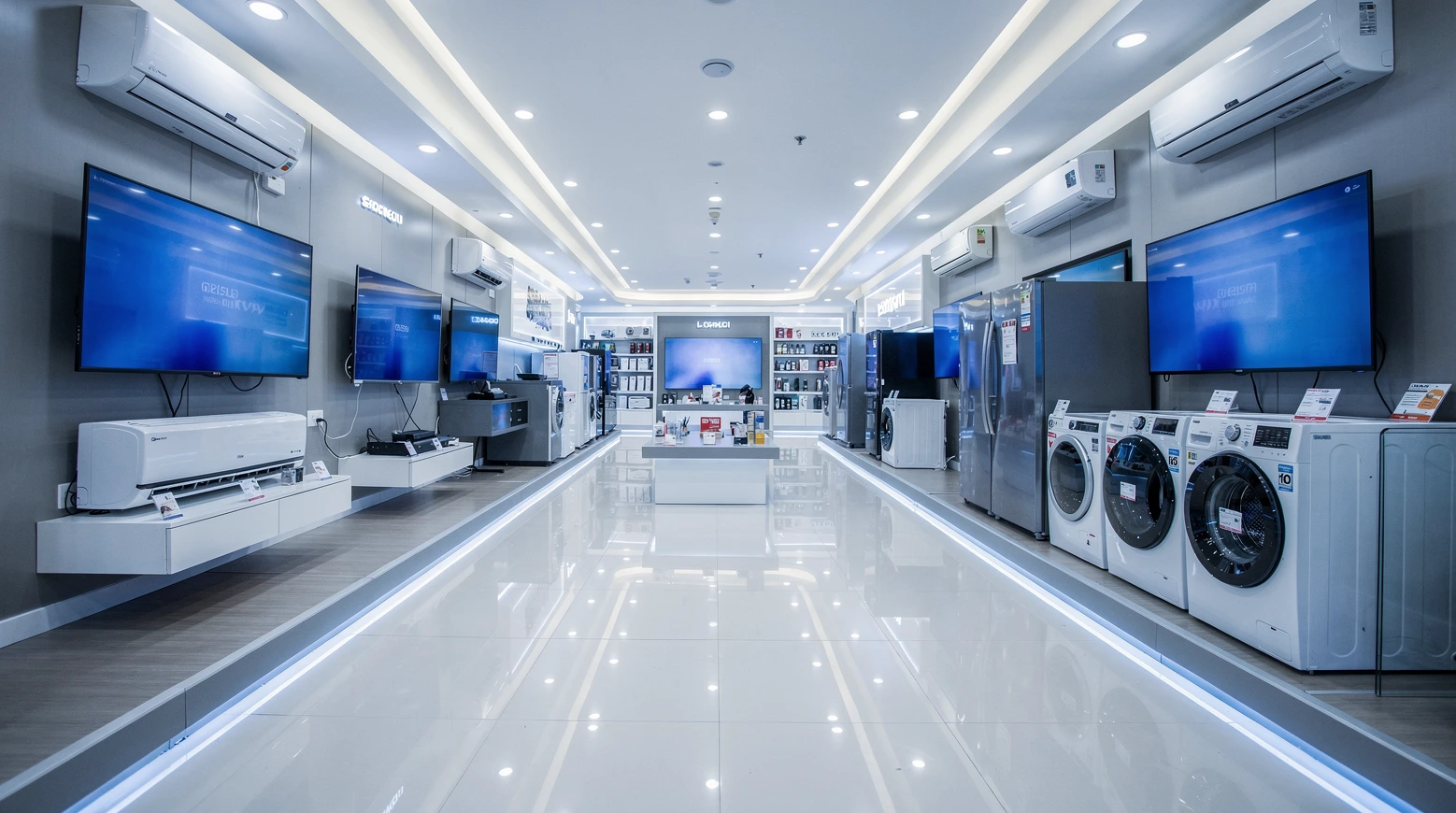
Dien May Xanh is one of Vietnam’s largest consumer electronics retailers. It sells smartphones, televisions, refrigerators, air conditioners, washing machines and other home appliances through a nationwide network that management puts at close to 3,000 stores. Group data for the end of May 2026 counted just over 2,000 stores under the core Dien May Xanh banner.
The chain is the single biggest engine inside Mobile World. Vietcetera noted that it contributed about 44 percent of the parent’s revenue in 2025, and disclosures cited by The Investor put its share of group net profit at roughly 80 percent. In the first five months of 2026, the segment’s revenue ran above 2 billion dollars, up about 33 percent year on year.
To understand the spin-off, it helps to see the whole Mobile World portfolio. The group is not a single chain but a federation of category specialists, each at a different stage of maturity.
| Mobile World chain | Category | Approx. stores (May 2026) | Role in group |
|---|---|---|---|
| Dien May Xanh | Consumer electronics and appliances | ~2,000 | Largest profit driver, now spun off |
| The Gioi Di Dong and TopZone | Mobile phones and Apple retail | ~1,012 | Mature cash generator |
| Bach Hoa Xanh | Grocery and fresh food | ~3,051 | Growth engine, largest revenue share |
| An Khang | Pharmacy | ~416 | Emerging vertical |
| AVAKids | Mother and baby | ~95 | Small format experiment |
| EraBlue | Electronics, Indonesia joint venture | ~245 | Overseas expansion bet |
By the end of May 2026, group revenue across all chains reached about 79.2 trillion dong for the first five months, up roughly 29 percent year on year. Bach Hoa Xanh, the grocery arm, contributed around 29 percent of that revenue, while the mobile phone chains added about 22.5 percent.
How does the electronics chain make money?
Understanding the investment case means looking at the unit economics that sit underneath the headline valuation. Dien May Xanh operates a high-volume, thin-margin model that depends on scale, supplier terms and store productivity rather than premium pricing.
The revenue mix
The chain sells across several big-ticket categories: mobile phones and tablets, televisions and audio, large appliances such as refrigerators and washing machines, and cooling products including air conditioners and fans. Cooling appliances in particular carry seasonal swings tied to Vietnam’s hot months, which can concentrate sales and profit into specific quarters.
Management has guided to strong near-term growth. According to figures reported by The Investor, the company is targeting revenue growth of roughly 30 percent and net profit growth of about 50 percent for 2026, with the profit line rising faster than sales as operating leverage improves. Over the longer run to 2030, the group has framed more measured compound annual growth targets of around 11 percent for revenue and 16 percent for net profit.
The margin story
The gap between the near-term profit surge and the longer-run targets tells its own story. The immediate jump reflects a recovery from a tougher period for Vietnamese electronics demand, when price wars compressed margins across the sector. The steadier long-term numbers are a more realistic guide to a mature big-box electronics business.
The table below summarises the reported financial markers that underpin the offering.
| Metric | Reported figure | Context |
|---|---|---|
| Segment revenue, first 5 months 2026 | Over 2 billion dollars | Up about 33 percent year on year |
| Share of parent revenue (2025) | ~44 percent | Largest single contributor |
| Share of parent net profit | ~80 percent | Core profit engine |
| 2026 revenue growth target | ~30 percent | Recovery from weaker prior period |
| 2026 net profit growth target | ~50 percent | Operating leverage effect |
| 2030 revenue CAGR target | ~11 percent | Mature-phase guidance |
Those numbers explain why the book drew heavy institutional demand. A dominant category position, a recovering margin, a stated dividend and a credible growth runway are the ingredients emerging-market funds look for, and Vietnam offers few listed vehicles that combine all four.
How does the deal compare with Vietnam’s recent IPO record?
The most striking feature of the Dien May Xanh listing is its scale in a market that has produced very little primary supply. Vietnam has upgraded steadily as an economy, but its equity market has lagged, with few sizeable IPOs in recent years. A billion-dollar-valuation float is, by local standards, an event.
Placed against other recent Asian retail and marketplace stories, the deal looks less like an outlier and more like part of a broader regional repricing of consumer businesses. The table below sets the transaction in context using publicly reported figures.
| Company or event | Market | Type | Reported scale |
|---|---|---|---|
| Dien May Xanh | Vietnam | IPO and spin-off | ~505m dollars raised, ~3.4bn dollars valuation |
| EraBlue (planned) | Indonesia | Future IPO ambition | Targeting 500 stores before a listing |
| MINISO buyback | Hong Kong listing | Share repurchase | HK$2bn programme |
| Coupang regional push | Japan and Taiwan | Market expansion | Multi-year international investment |
The comparison is not exact, since a buyback and an IPO move in opposite directions on supply, but it shows how Asian consumer operators are all competing for a similar pool of investor attention. Vietnam’s advantage in that contest is growth: the domestic economy is expanding faster than most, and organised retail is still taking share from traditional trade.
What does the FTSE Russell upgrade mean for the timing?
Timing is rarely accidental with a deal this size. FTSE Russell is due to reclassify Vietnam as a secondary emerging market, a status change that Vietcetera reported takes effect in September 2026. That reclassification is expected to unlock significant foreign inflows.
Estimates cited in local coverage suggest the upgrade could draw around 6 billion dollars of passive money tracking the relevant indices, plus a further 15 to 20 billion dollars of active capital, foreign direct investment and private equity over roughly five years. A fresh, large-cap consumer stock listing weeks before that shift is well positioned to capture some of that flow.
The macro backdrop is more mixed. Consumer demand across Asia has been uneven in 2026, and even the region’s largest market has wobbled, with China posting its first retail sales decline since 2022 earlier in the year. Vietnam has so far avoided that kind of contraction, but the read-across is a reminder that regional consumer sentiment is not uniformly strong.
How ambitious is the regional expansion story?
Part of the bull case for Dien May Xanh rests on what Mobile World has learned building electronics retail outside Vietnam. The group’s Indonesian joint venture, EraBlue, is the clearest evidence that its store model can travel.
EraBlue and the Indonesia bet
EraBlue reached about 245 stores by the end of May 2026, and its revenue rose roughly 93 percent year on year. The venture turned its first profit, close to 3 million dollars, in 2025. Management’s stated goal is to grow EraBlue toward 500 stores and, eventually, its own listing in the Indonesian market.
That trajectory matters because Indonesia is a far larger consumer market than Vietnam, and a proven playbook there would reframe the group as a regional operator rather than a domestic champion. The same logic of picking one or two markets and going deep has defined recent Asian expansion strategies, including Coupang’s decision to deepen its position in Japan rather than scatter capital across many new countries.
Domestic white space
At home, Mobile World still sees room to grow. The company has talked about pushing its grocery format northward from central Vietnam and opening stores at a pace of roughly 1,000 per year across the group. Organised retail penetration in Vietnam remains low relative to more developed neighbours, leaving a long runway for format expansion.
What are the risks for investors?
A strong subscription does not erase the risks that come with a concentrated, consumer-cyclical business in a frontier-to-emerging market. Investors buying the story need to weigh several factors.
Concentration and margin pressure
Consumer electronics is a low-margin category exposed to discounting, promotional cycles and the timing of new product launches. Any slowdown in Vietnamese consumer spending would hit big-ticket appliance sales quickly. The pressure to protect margin while chasing volume is a familiar tension across Asian retail, echoing the pivot from land-grab growth to margin discipline playing out in India’s quick commerce sector.
Governance and free float
With the parent retaining about 86 percent of the chain, the public float is small and liquidity could be limited in the early months of trading. Minority investors will also depend heavily on the parent’s capital allocation decisions, since Mobile World controls the board and the group treasury. Related-party dynamics between the listed subsidiary and its majority owner are a standard governance watch item in spin-offs of this kind.
Macro and currency exposure
Foreign investors taking most of the institutional book are also taking dong exposure. Currency moves, interest rate shifts and the pace of the FTSE Russell inflows will all shape the post-listing performance as much as the retailer’s own execution. A stock priced for growth has less cushion if any of those variables turns.
What does the listing mean for Vietnam’s retail sector?
The Dien May Xanh float is bigger than one company’s balance sheet. It is a proof point for the argument that Vietnamese organised retail has matured to the point where it can command international capital at scale.
A signal to other operators
A successful, heavily subscribed listing lowers the perceived risk for other domestic retailers weighing public markets. If Mobile World can price a chain near 3.4 billion dollars and draw a foreign-dominated book, rivals and private-equity backers of other formats have a clearer template for their own exits. That demonstration effect can matter more than the individual deal.
It also validates the strategy of separating conglomerates into focused, listed units. For years, holding-company structures in the region traded at a discount because investors struggled to price mixed portfolios. A clean carve-out that the market rewards encourages boards elsewhere to consider the same surgery.
Competition and consolidation
Fresh public capital tends to accelerate competition. A listed Dien May Xanh with a visible currency for acquisitions and a lower cost of equity is better placed to invest in stores, logistics and online channels. That raises the bar for smaller electronics chains and traditional independent dealers that still hold meaningful share in Vietnam.
Over time, that pressure often drives consolidation, as weaker operators sell or exit. The dynamic is familiar across retail globally, where access to capital markets separates the chains that scale from those that stall. Vietnam’s electronics segment, still fragmented outside the top players, is a candidate for exactly that kind of shakeout.
What happens next?
The immediate milestone is the listing itself, expected on the Ho Chi Minh Stock Exchange in the first week of August. The opening days of trading will test whether the strong primary demand carries into the secondary market, particularly given the thin free float.
Beyond the debut, watch three markers. First, whether Mobile World follows through on signals that its mobile phone chain and grocery arm could be listed separately, which would extend the sum-of-the-parts strategy. Second, EraBlue’s progress toward 500 stores and its own IPO in Indonesia. Third, the actual scale of foreign inflows once the FTSE Russell upgrade takes effect in September.
Analysts will also scrutinise the first full set of standalone results the chain reports as a listed company. Standalone disclosure removes the cover a subsidiary enjoys inside a consolidated group, and the market will judge the business on its own margins, inventory turns and same-store trends. That transparency is the price of the higher valuation the spin-off aims to capture.
For now, the headline is simple. A Vietnamese retailer has priced a spin-off at close to 3.4 billion dollars, drawn a heavily foreign institutional book, and reopened a market that had gone quiet on large listings. Investors who want a detailed record of the offering can consult the parent group’s investor relations disclosures on its official corporate site.
Frequently asked questions
How much did the Dien May Xanh IPO raise?
The offering raised more than 13.3 trillion dong, equivalent to about 505 million dollars at exchange rates near 26,000 dong to the dollar, according to Vietnam Investment Review. Investors took up roughly 93 percent of the shares on offer.
What is Dien May Xanh?
Dien May Xanh, often shortened to DMX, is one of Vietnam’s largest consumer electronics and home appliance retailers. It operates close to 3,000 stores nationwide and is the biggest profit contributor to parent company Mobile World Investment Corporation.
What valuation does the IPO imply?
At the offer price of 80,000 dong per share, the enlarged share count implies a market capitalisation of around 102 trillion dong, or close to 3.4 billion dollars. Local coverage describes it as Vietnam’s first multi-billion-dollar valuation IPO of 2026.
When will the shares start trading?
Mobile World expects Dien May Xanh to list on the Ho Chi Minh Stock Exchange in the first week of August 2026. Vietcap Securities acted as lead underwriter, and the State Securities Commission of Vietnam approved the offering.
Who bought the shares?
About 2,646 investors participated, according to The Investor. Institutions took roughly 90 percent of the volume, with foreign funds accounting for around 73 percent of the institutional allocation and domestic institutions about 17 percent. The remainder went to roughly 2,600 individual investors.
Why is Mobile World spinning off the chain?
Management is pursuing a sum-of-the-parts strategy, arguing that listing its category-leading chains separately unlocks value the market overlooks in a diversified holding company. It has signalled that its mobile phone and grocery chains could eventually list the same way.
How does EraBlue fit into the story?
EraBlue is Mobile World’s electronics joint venture in Indonesia. It reached about 245 stores by May 2026, grew revenue roughly 93 percent year on year, and turned its first profit in 2025. Management aims to expand it toward 500 stores and pursue a separate Indonesian listing.
How does the FTSE Russell upgrade affect the deal?
Vietnam is due to be reclassified as a secondary emerging market by FTSE Russell in September 2026. Local estimates suggest the change could attract around 6 billion dollars of passive inflows plus 15 to 20 billion dollars of active capital over five years, benefiting large new listings like this one.
What are the main risks?
Key risks include the low-margin nature of consumer electronics, exposure to any slowdown in Vietnamese consumer spending, a small public float that could limit liquidity, heavy dependence on the majority-owner parent, and currency risk for the foreign investors who took most of the institutional allocation.