
Burberry Group returned to growth across every product division for the first time in three years in its opening quarter, a milestone that Chief Executive Joshua Schulman seized on as proof that his turnaround plan is taking hold. Yet the reaction in London told a more complicated story, with the shares falling around 5% in early trading on Friday even as the numbers cleared analyst expectations.
The British heritage house reported that comparable retail sales rose 5% in the 13 weeks to 27 June 2026, its fiscal first quarter, powered by a 12% jump in the Americas and a 9% rebound in Greater China. The results, released to the market on the morning of 17 July, mark one of the clearest signs yet that Burberry’s long and painful reset is beginning to convert brand noise into paying customers.
In short
- Group comparable sales rose 5% in the quarter to 27 June, with total retail revenue of £455 million (about USD 610 million at roughly 1.34 dollars to the pound), up from £433 million a year earlier.
- The Americas led with 12% growth and Greater China rebounded 9%, more than offsetting a 3% decline in EMEIA, Burberry’s largest region, which was dragged down by the Middle East conflict and softer tourist spending.
- All four divisions grew together for the first time in three years, with outerwear up double digits and e-commerce rising in the mid teens, its eighth consecutive quarter of growth.
- Shares still fell around 5% in early London trading, as investors weighed a cautious first-half wholesale outlook and a slightly lower near-term gross margin against the improving top line.
- Schulman framed the print as validation of the Burberry Forward strategy, while the cost program remains on track to deliver roughly £100 million of annualized savings by the end of the current financial year.
What did Burberry actually report?
Burberry’s first-quarter trading update covered the 13 weeks to 27 June 2026, the opening stretch of its 2026 to 2027 financial year. Comparable store sales, the industry’s preferred measure because it strips out new and closed locations, rose 5% against the same period a year earlier. Total retail revenue reached £455 million, up from £433 million in the prior-year quarter.
The number matters because Burberry spent much of the previous two years in retreat. Comparable sales had been falling for most of that stretch, and the group swung to a statutory operating loss in its 2025 financial year before clawing back to profit in the year to March 2026. A 5% gain, modest by the standards of luxury’s boom years, reads very differently against that backdrop.
Retail revenue is only part of Burberry’s model. The company also sells through wholesale partners and collects licensing income, and management guided that wholesale revenue in the first half is expected to grow at a high-single-digit rate. That guidance points to a broader recovery than the retail line alone suggests, though wholesale remains a smaller and more volatile contributor.
The headline that mattered most
For Schulman, the single most important sentence was not the group figure but the divisional breakdown. Burberry said womenswear, menswear, accessories and childrenswear all grew in the quarter, the first time in three years that every category advanced at once. In a house that has struggled to define its post-2023 identity, breadth of demand is a more durable signal than any single hit product.
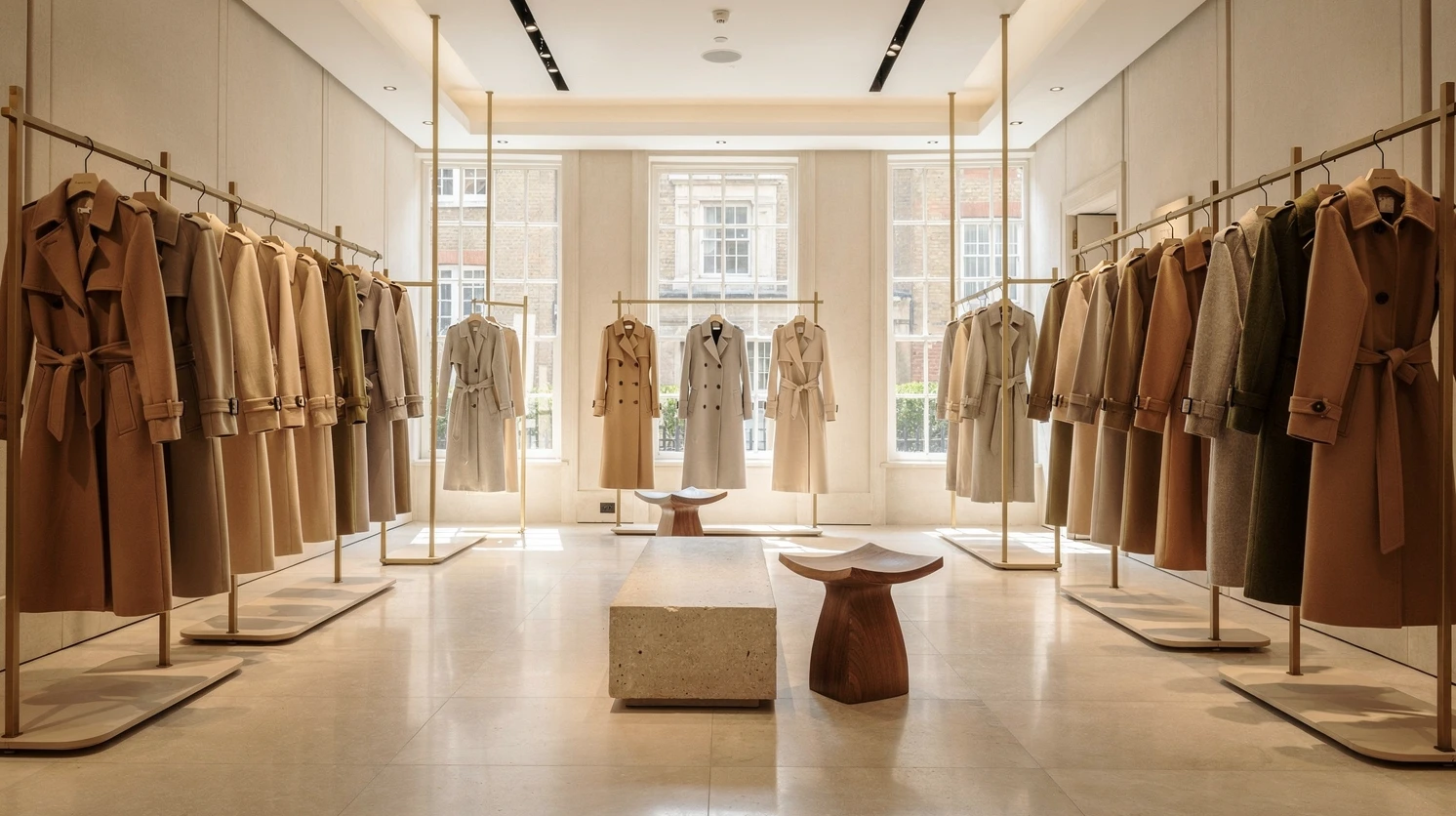
Outerwear, the category most associated with the Burberry name, grew by double digits and again outpaced the group. Management pointed to strong demand for the trench coat and lighter rainwear as the “Portraits of an Icon” campaign drew new shoppers toward the brand’s core heritage products. That concentration on outerwear is deliberate, and it is central to how Schulman intends to rebuild pricing credibility.
Why did the share price fall on a positive quarter?
The market’s response was the day’s real puzzle. A 5% comparable-sales gain that beat consensus would, in a calmer year, have been rewarded. Instead Burberry shares dropped around 5% in early London dealing, with intraday estimates ranging from roughly 4.7% to 5.4% depending on the timestamp.
Part of the answer is expectation. Luxury stocks have run hard in 2026 on hopes of a Chinese consumer recovery, and Burberry’s own shares had climbed sharply into the print. When a stock is priced for acceleration, an in-line-to-slightly-better quarter can trigger profit-taking rather than fresh buying.
The other part is the fine print. Management flagged that first-half gross margin is expected to be slightly lower year over year, before a fuller recovery in the second half, and that the wholesale channel still carries risk. Investors who had extrapolated a smooth margin ramp found reasons for caution in the detail, even as the demand signal improved.
A pattern seen across apparel this season
Burberry is not alone in watching a solid quarter meet a skeptical market. The same dynamic played out when Levi Strauss shares slid despite a second-quarter beat, as soft forward guidance overshadowed the reported numbers. In a nervous tape, apparel investors have repeatedly punished caution about the next two quarters even when the last one looked healthy.
That reflex speaks to how fragile confidence in discretionary spending remains. Shoppers are still buying, but retail chief executives are reluctant to promise that the pace will hold, and equity markets have grown allergic to hedged outlooks. Burberry, halfway through a multi-year fix, is an especially easy target for that skepticism.
How did each region perform?
The regional split is where Burberry’s quarter becomes genuinely interesting. The Americas, long a secondary market for the brand, led with 12% comparable growth, extending a run of strength in the United States that has surprised much of the luxury sector. Greater China grew 9%, a striking reversal after a 5% decline in the same quarter a year earlier.
Asia Pacific outside China added 3%, a steadier if less dramatic contribution. The weak spot was EMEIA, which covers Europe, the Middle East, India and Africa and remains Burberry’s largest region by revenue. Comparable sales there fell 3%, or a milder 1% once the Middle East is excluded.
Management attributed the EMEIA softness to the ongoing conflict in the Middle East, which has hit both local demand and the tourist flows that European luxury depends on. Fewer Gulf and international travelers passing through London, Paris and Milan translate directly into thinner store traffic for a brand that leans heavily on flagship locations.
Comparable sales by region, Q1 FY2027
| Region | Comparable sales growth | Prior-year comparison |
|---|---|---|
| Americas | +12% | Continued outperformance |
| Greater China | +9% | Reversal from a 5% decline |
| Asia Pacific | +3% | Steady growth |
| EMEIA | -3% (-1% excl. Middle East) | Hit by conflict and weaker tourism |
| Group | +5% | Broad-based recovery |
The pattern inverts the geography that defined luxury for a decade. For years Greater China drove growth while the West lagged, and brands built their store networks and inventory plans around that assumption. Burberry’s quarter shows a house now leaning on American demand while it waits for a fuller Chinese recovery to take hold.
The China rebound in context
A 9% gain in Greater China is meaningful, but it needs framing. The comparison is against a weak prior-year quarter, and the wider Chinese consumer picture has been uneven. Earlier in 2026, official data showed China retail sales falling 0.6% in a rare monthly decline, the first drop of its kind since 2022, which unsettled brands that had counted on a smooth reopening dividend.
Against that macro noise, Burberry’s China result reads as brand-specific traction rather than a rising tide. The house has refreshed its store network and leaned on outerwear and gifting, categories that travel well with Chinese shoppers. Whether the 9% figure marks a durable turn or a favorable base effect will only become clear over the next two quarters.
What is the Burberry Forward turnaround plan?
Schulman took charge of Burberry in July 2024, arriving from Michael Kors and Coach with a reputation for stabilizing brands that had drifted. By November 2024 he had set out Burberry Forward, a strategy built on reasserting the brand’s British heritage, refocusing on outerwear and scarves, and rebuilding a coherent pricing architecture after years of erratic positioning.
The plan also carried a hard financial edge. Burberry announced a cost program targeting roughly £100 million of annualized savings, alongside a reduction in headcount and a simplification of its product range. The company said in Friday’s update that it delivered about £80 million of those savings in the year to March 2026 and remains on track to reach the full £100 million run rate by the end of the current financial year.
Restructuring charges tied to the program are expected to be modest in the current year, at around £5 million. That relatively small figure signals that the heavy lifting on costs is largely behind the company, and that future savings should flow through to profit rather than being consumed by one-off charges.
Why outerwear sits at the center
The strategic bet on outerwear is not nostalgia. Trench coats and rainwear are Burberry’s highest-authority products, the items customers most readily associate with the brand and most willingly pay full price for. Rebuilding around them lets Burberry defend margins and re-establish a price ladder that had grown muddled under previous management.
The “Portraits of an Icon” campaign, which the company credited with drawing new customers in the quarter, sits squarely inside that logic. By putting the trench at the emotional center of its marketing, Burberry is trying to make heritage the reason a shopper walks in, then use accessories and ready-to-wear to widen the basket once they do.
The Gen Z question
Burberry also flagged double-digit growth among Gen Z shoppers, a cohort every luxury house is fighting to win and none can take for granted. Younger buyers are notoriously fickle and price-sensitive, and converting campaign attention into repeat purchases is far harder than generating a viral moment.
Still, the direction matters. A heritage brand that skews old risks slow decline regardless of any single quarter, so evidence that younger customers are engaging gives Schulman’s strategy a longer runway. The test will be retention: whether the Gen Z shoppers arriving for the campaign come back for a second and third purchase.
How does Burberry compare with its peers?
Burberry’s quarter lands amid a busy season of apparel and luxury reporting, and the cross-section is instructive. Different houses are running at very different speeds, and the market has rewarded them unevenly, often punishing caution regardless of the reported print.
Japan’s Uniqlo owner has been the clearest winner of the cycle. When Fast Retailing lifted its outlook to a record, it underlined how value-led apparel with global scale has outgrown traditional luxury. Yet even there the shares wobbled on a currency warning, a reminder that strong operating numbers do not guarantee a friendly market response.
At the top end, watch and jewelry demand has held up better than soft luxury. The record revenue reported when Watches of Switzerland crossed £1.83 billion with the United States now half of sales mirrors the American strength Burberry just posted, and points to a US consumer still willing to spend at the high end even as Europe softens.
Apparel and luxury scorecard, recent prints
| Company | Recent signal | Market reaction |
|---|---|---|
| Burberry | Comparable sales +5%, all divisions grow | Shares fell around 5% |
| Fast Retailing (Uniqlo) | Outlook lifted to record | Shares fell on yen warning |
| Watches of Switzerland | Record revenue, US now half of sales | Underlined US strength |
| Levi Strauss | Q2 beat, soft guidance | Shares slid on outlook |
The common thread is a market that has decided good enough is not good enough. Across the sector, companies that beat on the quarter but hedged on the outlook have watched their shares fall, while only unambiguous upgrades have been rewarded. Burberry, still mid-repair, was never going to deliver the clean beat-and-raise that would have satisfied that mood.
The fast-fashion pressure underneath
Sitting beneath the luxury debate is relentless pressure from ultra-low-cost players. The prospect that Shein could price a Hong Kong listing near USD 40 billion is a reminder of how much consumer spending has migrated toward speed and price. Heritage houses are not competing directly with Shein, but they are competing for share of wallet in a market where value has rarely mattered more.
That backdrop raises the stakes for Burberry’s premium repositioning. If the house can persuade shoppers that a trench coat is a durable investment rather than a discretionary splurge, it insulates itself from the value tide. If it cannot, it risks being squeezed between accessible luxury above and fast fashion below.
What did the numbers reveal about margins and guidance?
Beyond the top line, Burberry offered a careful read on profitability. Management guided that gross margin in the first half would be slightly lower than a year earlier, before improving over the full year as cost savings and a cleaner product mix flow through. That near-term dip is part of what gave investors pause.
Currency is expected to be a modest tailwind, adding an estimated £20 million to revenue over the period, while the adjusted effective tax rate was guided to a range of 27% to 30%. Neither figure is dramatic, but together they sketch a company still managing a delicate transition rather than one firing on all cylinders.
The gross-margin story is the one to watch. Burberry’s entire thesis rests on selling more product at full price, so any sustained margin pressure would undercut the case that the brand’s pricing power is genuinely recovering. A single quarter of slightly softer margin is easy to absorb; a trend would not be.
E-commerce as a quiet bright spot
Digital was one of the quarter’s understated strengths. Burberry said e-commerce grew in the mid teens, its eighth consecutive quarter of growth, a run that suggests the channel has stabilized after years of underinvestment. For a brand rebuilding its physical network, a dependable online engine takes pressure off store performance.
Mid-teens online growth also hints at healthier full-price selling, since Burberry has pulled back on the markdown-heavy tactics that once inflated digital volumes at the expense of brand equity. Growing e-commerce while defending price is exactly the combination Schulman needs to prove the reset is real.
What are the risks from here?
The clearest near-term risk is geopolitical. EMEIA is Burberry’s biggest region, and its 3% decline was driven by the Middle East conflict and the tourist slowdown that follows. As long as that disruption persists, a meaningful chunk of the brand’s revenue base will stay under pressure regardless of how well the Americas and China perform.
A second risk is the durability of the China rebound. The 9% gain flattered by a weak comparison could fade if Chinese consumer confidence stays fragile, and Burberry has less room for error there than larger rivals with deeper local roots. The macro data has been mixed enough to warrant caution.
A third risk is execution fatigue. Turnarounds are won or lost over years, and Schulman is still early in his. Cost savings have a natural ceiling, and from here Burberry has to prove it can grow revenue and margin together rather than leaning on efficiencies. The market’s muted reaction suggests investors want to see that proof before they re-rate the stock.
What to watch next
The next real test comes with the first-half results later in the year, when the wholesale guidance and the margin trajectory move from forecast to fact. If wholesale delivers its promised high-single-digit growth and gross margin turns higher in the second half, the case for a genuine recovery strengthens considerably.
Investors will also watch whether the Americas can sustain double-digit growth as US consumer conditions evolve, and whether the Gen Z engagement Burberry flagged converts into repeat purchases. Those two questions, more than any single headline number, will decide whether this quarter marked a turning point or a false dawn.
Where does this quarter sit in Burberry’s recovery arc?
To read the quarter fairly, it helps to remember how far Burberry fell. The brand lost its way in the early 2020s as a series of creative and commercial resets failed to land, prices drifted upward without the product credibility to support them, and comparable sales slid quarter after quarter. By late 2024 the shares had dropped out of the FTSE 100, a symbolic blow for a company that had long been a fixture of the blue-chip index.
The rebuild since then has been methodical rather than flashy. Schulman prioritized stabilizing the wholesale channel, clearing excess inventory, and reasserting the trench coat as the brand’s anchor before chasing headline growth. The 2026 financial year brought the group back to statutory profit, and the shares recovered enough ground over the following months to rejoin the top tier of the London market.
Seen against that arc, a 5% comparable-sales gain with every division growing is a genuine step forward, not a one-off. It is the kind of unglamorous, broad-based progress that turnaround specialists prize, because it suggests the improvement is structural rather than driven by a single viral product or a favorable currency swing.
Why the market still wants more
The gap between Burberry’s operational progress and its share-price reaction reflects the burden of a rebounding stock. Investors who bought into the recovery early have already banked substantial gains, and they are now looking for evidence that growth can accelerate into double digits rather than settle at a mid-single-digit cruise. A 5% quarter, however clean, does not clear that higher bar.
There is also the question of whether Burberry can ever reclaim the operating margins it enjoyed at its peak. The company has spoken of restoring a mid-to-high teens margin over the medium term, a level that would require both sustained revenue growth and disciplined cost control. Until that path becomes clearer, the market is likely to treat each quarter as a data point rather than a verdict.
The leadership continuity question
One quiet asset in Burberry’s favor is stability at the top. After years of churn in the creative and executive ranks, the pairing of Schulman as chief executive and Kate Ferry as chief financial officer has given the turnaround a consistent voice. Continuity matters in luxury, where brand decisions play out over multiple seasons and frequent leadership changes tend to reset the clock.
That stability does not guarantee success, but it removes one of the variables that repeatedly derailed Burberry’s earlier attempts to right itself. With the cost program nearly complete and the product strategy settled, the management team can now focus on the harder task of building durable, full-price demand across its markets.
What does this mean for the wider luxury sector?
Burberry’s update is a useful barometer because the brand sits at the crossroads of every current in the sector: an uncertain Chinese consumer, a resilient American one, a Europe hobbled by geopolitics, and a value revolution reshaping how everyone else shops. Its quarter suggests the luxury recovery is real but narrow, concentrated in the United States and in specific brand-led categories rather than broad-based.
For retail operators and marketplace sellers, the read-through is that heritage and pricing discipline are working again after a period when neither seemed to matter. Burberry’s bet on outerwear and full-price selling, if it holds, offers a template for premium brands trying to escape the discounting trap that hollowed out so many labels in the mid-2020s.
The cautious market reaction, though, is its own lesson. In 2026, delivering growth is no longer enough to win a re-rating; investors want conviction about the quarters ahead, and they will punish hedged guidance even when the reported numbers are good. Burberry gave them a genuinely improved quarter and a carefully qualified outlook, and for now the qualification won the day.
Frequently asked questions
How much did Burberry’s sales grow in the first quarter?
Comparable retail sales rose 5% in the 13 weeks to 27 June 2026, with total retail revenue of £455 million (about USD 610 million at roughly 1.34 dollars to the pound), up from £433 million in the same quarter a year earlier.
Why did Burberry shares fall despite the growth?
The shares dropped around 5% in early London trading as investors took profits after a strong run and focused on cautious guidance, including a slightly lower first-half gross margin and continued wholesale risk, rather than the improved sales figure.
Which regions drove Burberry’s growth?
The Americas led with 12% comparable growth and Greater China rebounded 9%, while Asia Pacific added 3%. EMEIA, Burberry’s largest region, fell 3%, dragged down by the Middle East conflict and weaker tourist spending.
What is the Burberry Forward plan?
Burberry Forward is the turnaround strategy set out by Chief Executive Joshua Schulman in November 2024. It focuses on reasserting the brand’s British heritage, prioritizing outerwear, rebuilding a coherent pricing structure, and delivering roughly £100 million of annualized cost savings.
Did every product division grow?
Yes. Womenswear, menswear, accessories and childrenswear all grew in the quarter, the first time in three years that every division advanced at once. Outerwear led with double-digit growth.
How is Burberry’s China business performing?
Greater China comparable sales rose 9%, reversing a 5% decline in the prior-year quarter. The gain benefits from a weak comparison, and the wider Chinese consumer picture remains uneven, so the durability of the rebound is not yet clear.
What guidance did Burberry give for the rest of the year?
Management guided to high-single-digit wholesale growth in the first half, a slightly lower first-half gross margin before full-year improvement, a currency tailwind of about £20 million, and an adjusted effective tax rate of 27% to 30%.
How does Burberry compare with other apparel and luxury names?
Burberry’s 5% growth lands mid-pack. Fast Retailing lifted its outlook to a record and Watches of Switzerland reported record revenue with strong US demand, while Levi Strauss beat on the quarter but slid on soft guidance. Across the sector, hedged outlooks have been punished regardless of the reported print.
When will Burberry report next?
The next major update is the first-half results later in the financial year, which will test the wholesale guidance and reveal whether gross margin turns higher in the second half as management expects.