
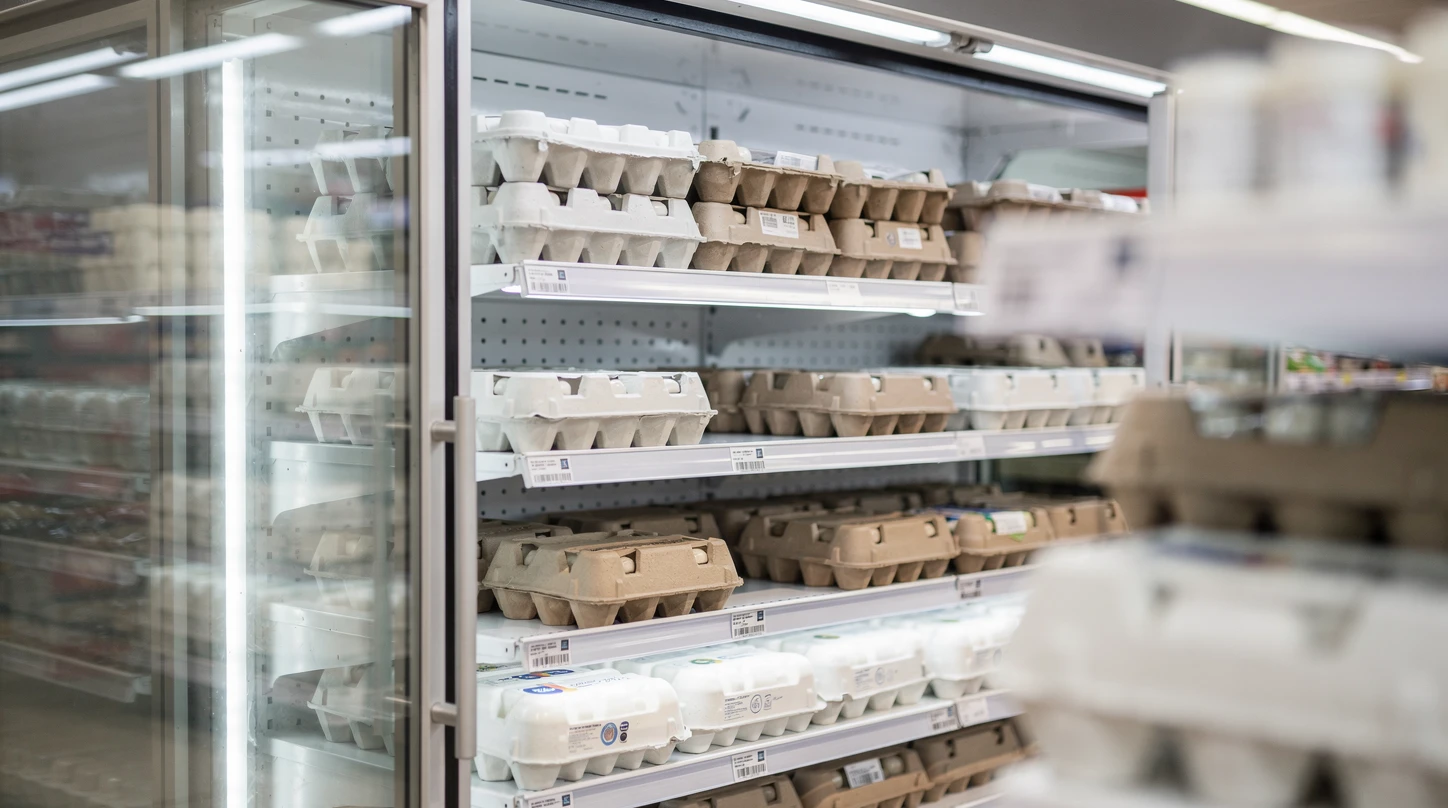
Midwest Poultry Services has recalled close to 1.6 million dozen shell eggs sold at Kroger, Brookshire Grocery and a number of smaller stores after routine company testing flagged a potential contamination with Salmonella Enteritidis. The recall, disclosed late on July 22 and reported widely through the morning of July 23, covers eggs distributed across six southern and southwestern states.
Reuters reported that the withdrawal spans roughly 19 million individual eggs and touches several supermarket private-label brands, including Kroger’s own lines. No illnesses had been reported at the time of the announcement, according to a company statement, and the recall was triggered by proactive internal testing rather than a public outbreak.
The action lands at a delicate moment for the US egg market, which is still recovering from the price shocks of 2025 and a renewed wave of avian influenza detections this summer. For grocers, it is a reminder that food-safety events can move fast, cross state lines and dent shopper trust even when the health risk is contained early.
In short
- What happened: Midwest Poultry Services recalled nearly 1.6 million dozen eggs over a possible Salmonella Enteritidis contamination.
- Where: Eggs reached Kroger and Brookshire Grocery stores plus smaller retailers across six states: Arkansas, Louisiana, Mississippi, New Mexico, Oklahoma and Texas.
- How it surfaced: The company found the risk through proactive testing at two Texas farms, and no illnesses had been linked to the eggs as of the announcement.
- The dates that matter: Affected eggs were produced June 6 to July 3, 2026, with sell-by or best-by dates of July 20 to August 17, 2026.
- Why it matters: The recall hits a fragile egg market still shaped by avian influenza and last year’s price spike, raising fresh questions about supply-chain resilience and grocer recall response.
What did Midwest Poultry Services recall?
Midwest Poultry Services, an Indiana-based egg producer, recalled a large volume of white shell eggs and brown cage-free shell eggs that were traced to two of its farms in Texas. Reuters reported the figure at close to 1.6 million dozen eggs, which works out to roughly 19 million individual eggs. Industry trackers put the retail value of the pulled stock at about $3.4 million.
The recall notice, filed with US food-safety authorities, cites the potential presence of Salmonella Enteritidis, a bacterium that can live on the outside or inside of an egg. The company said in a statement that it identified the risk through its own routine testing program, and that it is not distributing fresh eggs from its Texas farms at this time.
According to the recall details, the affected eggs were produced between June 6 and July 3, 2026, and carry sell-by or best-by dates ranging from July 20 to August 17, 2026. That window means some cartons could still have been sitting in refrigerators or on store shelves when the recall was announced, which is why the company urged shoppers to check date codes rather than assume older stock had already cleared.
Food-safety filings identify the source facilities by plant codes, and shoppers are advised to look for those markings alongside the printed dates. The producer framed the step as precautionary, noting that proactive testing is designed to catch problems before contaminated product reaches consumers in volume.
Which brands and stores are affected?
One reason the recall drew immediate attention is the spread of retail brands involved. The eggs were sold under Kroger’s banners, including the Simple Truth and Country Morning labels, as well as other names, according to coverage from Fox affiliates and Reuters. That places the recall squarely inside the private-label aisle that grocers increasingly rely on for margin.
The brand names on the carton
Because a single producer can pack eggs under many retailer and regional labels, the same lot can appear across several brand names. Shoppers who bought store-brand eggs in the affected states are being asked to check the specific date codes rather than the brand alone. The safest step, per standard food-safety guidance, is to discard or return any carton that matches the recalled dates.
Where the eggs were sold
The distribution footprint is regional rather than national. Reuters reported that Kroger-branded stores in Texas and Louisiana received the eggs, while Brookshire Grocery locations were affected across a wider set of states. Smaller independent retailers in the region also received shipments, which broadens the number of storefronts involved even though the geography is concentrated in the South and Southwest.
| Detail | What the recall covers |
|---|---|
| Producer | Midwest Poultry Services, L.P. |
| Volume | Close to 1.6 million dozen (about 19 million eggs) |
| Pathogen | Salmonella Enteritidis (potential) |
| Brands | Kroger, Simple Truth, Country Morning and others |
| Retailers | Kroger, Brookshire Grocery, smaller stores |
| States | Arkansas, Louisiana, Mississippi, New Mexico, Oklahoma, Texas |
| Production dates | June 6 to July 3, 2026 |
| Sell-by / best-by | July 20 to August 17, 2026 |
| Illnesses reported | None as of the announcement |
How was the salmonella risk found?
The recall did not begin with sick customers. According to the company, the potential contamination was identified through proactive testing at its own facilities, part of the routine sampling that egg producers run to catch Salmonella before it spreads through the supply chain. That distinction matters for how regulators and grocers respond.
When a recall is prompted by internal testing rather than a confirmed outbreak, it usually signals that controls worked as intended. The producer said it halted fresh-egg distribution from its Texas farms once the issue surfaced, a containment move meant to stop any further affected product from reaching stores while the situation is assessed.
Food-safety authorities classify recalls by severity once they review the hazard, and that classification can shift as testing continues. For now, the absence of reported illnesses suggests the early-detection approach limited exposure, though public-health agencies typically monitor for delayed cases because salmonella symptoms can take days to appear.
Why proactive testing changes the story
There is a meaningful difference between a recall that starts in a laboratory and one that starts in a hospital. Outbreak-driven recalls tend to arrive after people are already sick, which means the contaminated product has been in kitchens for days or weeks. A testing-driven recall, by contrast, is an attempt to get ahead of that timeline.
For producers, catching a problem internally is costly in the short term but valuable in the long run. It demonstrates that quality controls function, gives regulators confidence in the company’s systems, and often results in a narrower, faster recall. Midwest Poultry Services framed its action in exactly those terms, emphasizing that it moved before any consumer reported harm.
How recall classes work
US food-safety recalls are typically sorted into three classes. A Class I recall involves a reasonable probability that the product will cause serious health consequences or death. A Class II recall covers products that might cause temporary or medically reversible harm. A Class III recall applies where a product is unlikely to cause adverse effects but still violates labeling or manufacturing rules.
A salmonella risk in eggs generally sits toward the higher end of that scale, given the pathogen’s potential to cause serious illness in vulnerable groups. The exact classification for this recall will be confirmed by regulators, and it shapes how aggressively stores and public-health officials communicate the warning to shoppers.
How does an egg recall move through the supply chain?
Eggs travel a longer path than many shoppers realize, and each step is a point where traceability matters. A recall’s reach depends on how well a producer and its retail partners can pinpoint which lots went where, and how quickly they can pull them.
From farm to packing line
Shell eggs are collected at laying farms, then washed, graded, candled for defects and packed under various brand labels at a processing facility. A single producer often packs for multiple retailers, which is why one contamination event can surface under several different carton names at once. Plant codes stamped on each carton let investigators trace a package back to its source facility and production date.
From distribution to shelf
Once packed, eggs move through distribution centers to individual stores, sometimes across state lines. Cold-chain handling keeps them refrigerated along the way. When a recall is issued, retailers use the plant codes and date ranges to identify affected inventory in their systems, remove it from shelves and flag it at the register so recalled cartons cannot be sold.
The speed of that process is a real test of a grocer’s inventory technology. Modern point-of-sale systems can block the sale of a recalled item by its code, an automated backstop that reduces the chance of a shopper accidentally buying pulled stock. The more granular a retailer’s lot-level tracking, the tighter and faster the recall.
What rules govern egg safety in the United States?
Egg safety in the US is governed by a mix of federal rules aimed at reducing salmonella at every stage of production. The framework is why a producer runs the kind of routine testing that surfaced this recall in the first place.
Under the federal egg safety rule, large shell-egg producers are required to adopt measures to prevent Salmonella Enteritidis, including biosecurity, rodent and pest control, testing of poultry housing, and refrigeration requirements. When environmental or egg testing detects the pathogen, producers must take defined steps, which can include diverting eggs to treatment or, as here, halting distribution.
Oversight is shared. The Food and Drug Administration regulates the safety of shell eggs in the shell, while the US Department of Agriculture handles grading and certain egg-product rules. That division means recalls can involve more than one agency, and it is one reason public notices reference specific facilities, plant codes and testing results rather than brand names alone.
Regulators have leaned harder on prevention since a series of high-profile salmonella outbreaks over the past decade. The result is a system that expects producers to catch and disclose problems, which is precisely the sequence that played out with the Midwest Poultry Services recall.
What does Salmonella Enteritidis mean for shoppers?
Salmonella Enteritidis is one of the most common causes of egg-related foodborne illness in the United States. Unlike surface contamination that can be washed away, this strain can be present inside an intact, clean-looking egg, which is why cooking eggs thoroughly is a standard safety recommendation.
Symptoms usually appear within 12 to 72 hours of eating contaminated food and can include cramps, diarrhea, nausea, vomiting, chills, fever and headache. Most healthy adults recover without treatment, but the illness can be more serious for young children, older adults, pregnant people and those with weakened immune systems.
Public-health guidance for any egg recall is consistent: do not eat the recalled product, even if it looks and smells normal. Consumers who have the affected eggs are advised to throw them away or return them to the store for a refund, and to clean any surfaces or containers the eggs may have touched.
Why does this recall land in a fragile egg market?
The recall arrives while the US egg market is still finding its footing after an extraordinary two years. Avian influenza has reshaped supply since 2022, and prices have swung from record highs to relative calm and back toward uncertainty within a short span.
Bird flu’s long shadow
The bird flu outbreak has led to the loss of nearly 185 million birds raised for food since 2022, according to federal tallies. Fresh detections in commercial poultry flocks were confirmed across roughly a dozen states in June 2026, spanning laying-hen operations, broiler facilities and turkey farms concentrated in the Midwest and South. Each new detection tightens supply because affected flocks are culled.
Prices that finally cooled
After a brutal 2025, egg prices had come down sharply. The average retail price of a dozen eggs was about $2.19 in May 2026, down roughly 35% from the same month a year earlier, according to federal data. That is a long way from the record high near $6.23 per dozen recorded in March 2025. The broader recovery in household budgets has tracked a steadier consumer, a theme visible in the latest US retail sales figures for June, which showed modest month-on-month growth.
A recall of this size does not, on its own, reset the national price of eggs. But regional withdrawals can tighten local supply, and any signal that points back toward scarcity tends to draw attention from shoppers who lived through last year’s spike. Grocers navigating thin margins have limited room to absorb shocks, a pressure that shows up in strategies like Kroger’s price-investment reset expected around Q3 2026.
What does the recall mean for Kroger and grocers?
For Kroger, the recall is an operational and reputational test rather than a financial one. The direct cost of pulling regional stock is small against a company that reported total revenue well above $45 billion in a single quarter earlier this year. The bigger question is how cleanly the retailer executes the withdrawal and communicates with shoppers.
Grocery is a low-margin business, and food-safety events add cost precisely where retailers can least afford it. Kroger has spent 2026 defending margins against price competition, a balancing act detailed when the chain held its 2026 outlook as price cuts squeezed grocery margins. A recall does not change that math, but it consumes management attention already stretched across multiple fronts.
Private label exposure
The involvement of Simple Truth and Country Morning underlines a structural point about modern grocery. Private-label ranges are central to how supermarkets differentiate and protect margin, but they also concentrate reputational risk on the retailer’s own name. When a store brand is recalled, the shopper does not blame an outside manufacturer; the brand on the carton is the store’s.
That dynamic raises the stakes for supplier oversight. Retailers that build large private-label programs take on more responsibility for the quality controls of the producers behind them, even when a third party like Midwest Poultry Services runs the farms and packing lines.
Private label is not a side project for large grocers. Store brands now account for a substantial share of unit sales in categories like eggs, dairy and pantry staples, and they carry higher margins than comparable national brands. That makes them commercially essential and, at the same time, a concentrated point of reputational risk when something goes wrong.
The trade-off is that grocers cannot outsource accountability. A shopper who buys a Simple Truth carton associates any problem with the store, not with the contract producer whose name may not even appear prominently on the packaging. Managing that risk means auditing suppliers, verifying testing regimes and being ready to act fast when a lot is flagged.
The recall-response playbook
How a retailer handles a recall often matters more to long-term trust than the recall itself. Clear shelf removal, prompt customer refunds and transparent communication tend to limit the damage. Retail history is full of brands that recovered from crises by responding quickly and openly, a pattern examined in this look at retail crises that brands actually came back from.
The reverse is also true. Slow or opaque responses can turn a contained safety event into a lasting trust problem, especially in categories like fresh food where shoppers make repeat purchases and remember bad experiences.
How does this compare with recent egg recalls?
This is not the first large egg recall of the cycle. In 2025, a salmonella-linked recall covered about 1.7 million dozen eggs, or roughly 20.4 million eggs, and was tied to a broader outbreak that the CDC linked to dozens of infections. Analysts at the time estimated that recall could push prices up by as much as 25% in affected regions.
By contrast, the Midwest Poultry Services recall was disclosed with no reported illnesses and was driven by proactive testing rather than a confirmed outbreak. That is an important difference in public-health terms, even though the raw volume is broadly comparable.
| Feature | Midwest Poultry (July 2026) | 2025 salmonella recall |
|---|---|---|
| Volume | ~1.6 million dozen | ~1.7 million dozen (20.4M eggs) |
| Trigger | Proactive company testing | Linked to confirmed outbreak |
| Reported illnesses | None at announcement | Dozens of infections reported |
| Geography | Six southern/southwestern states | Multi-state, outbreak-linked |
| Estimated price impact | Limited, regional | Up to 25% in affected regions |
The comparison also fits a wider pattern of pressure on grocery operators this year, from margin defense to labor. Kroger and Albertsons pharmacists, for example, made headlines when nearly 800 workers voted to authorize a California strike, a reminder that food-safety events sit alongside many other operational demands.
How do egg prices sit heading into this recall?
Understanding the price backdrop helps put the recall in context. The market has traveled a long way in a short time, and the direction of travel matters as much as any single data point.
| Period | Approx. US retail price per dozen | Context |
|---|---|---|
| March 2025 | About $6.23 | Record high amid avian flu culls |
| May 2026 | About $2.19 | Down roughly 35% year over year |
| June 2026 | Volatile | Fresh bird flu detections in ~12 states |
Federal officials have described a strategy to contain avian influenza and stabilize supply, and prices had largely normalized before the summer’s new detections. The recall does not directly change those national figures, but it adds to a sense that the egg category remains prone to sudden shocks after two turbulent years.
For shoppers, the practical takeaway is narrower than the headlines suggest. A regional recall tied to specific date codes is a call to check cartons, not a signal of another nationwide price spike. Whether local prices move at all will depend on how much supply is pulled in each affected market.
What should shoppers do now?
The guidance for consumers is straightforward. Anyone in the affected states who bought store-brand shell eggs recently should check the date codes against the recalled range and the plant markings on the carton.
If the eggs match, food-safety authorities advise against eating them regardless of appearance. Shoppers can throw the eggs away or return them to the store for a refund, and should wash any surfaces, utensils or containers the eggs may have contacted with hot, soapy water.
Consumers who want to confirm the specific brands, plant codes and dates can consult the official recall notice through the US Food and Drug Administration’s recall page. Those experiencing symptoms consistent with salmonella after eating eggs are advised to contact a healthcare provider, particularly if they are in a higher-risk group.
What happens next?
The immediate steps are clear: complete the shelf removal, process refunds and let regulators finalize the recall classification. Food-safety agencies will continue to watch for any delayed illness reports, since salmonella cases can surface days after exposure.
Longer term, the recall feeds into a bigger conversation about resilience in the egg supply chain. With avian influenza still active and price sensitivity high after 2025, producers and grocers face pressure to strengthen testing, traceability and rapid-response systems. The fact that this recall began with proactive testing, rather than a wave of illnesses, is the kind of outcome those systems are designed to produce.
For the retail industry, the episode is a case study in modern food-safety management: a regional, date-coded recall, caught early, executed across multiple private-label brands, against a market backdrop that leaves little margin for error. How Kroger, Brookshire Grocery and their suppliers close it out will shape shopper confidence more than the volume of eggs pulled.
What does this mean for the wider retail industry?
Beyond the immediate recall, the event points to three themes that will follow grocers through the rest of 2026. Each sits at the intersection of food safety, technology and consumer trust.
Traceability becomes a competitive edge
The retailers that handle recalls best are the ones that can find affected stock fastest. Lot-level tracking, automated register blocks and clear supplier records turn a potential crisis into a routine operation. As recalls remain a fact of life in fresh food, investment in traceability shifts from a compliance cost toward a genuine operational advantage.
Supply-chain resilience stays under scrutiny
Avian influenza has taught the egg market that supply can vanish quickly when flocks are culled. A recall on top of that fragility reinforces the case for diversified sourcing, tighter biosecurity and closer coordination between producers and retailers. Grocers that depend on a narrow supplier base are more exposed when any single source is pulled offline.
Trust is the real currency
In a category where shoppers buy the same product week after week, trust compounds. A recall handled with speed and transparency can even strengthen a retailer’s standing, while a botched response lingers. That is why the communications around a recall often matter as much as the logistics of pulling the product.
These themes are not unique to eggs. They apply across fresh food, from produce to prepared meals, and they are becoming central to how large grocers compete. The Midwest Poultry Services recall is a small event in dollar terms, but it rehearses the exact capabilities that define a resilient food retailer.
Frequently asked questions
How many eggs were recalled?
Midwest Poultry Services recalled close to 1.6 million dozen shell eggs, which amounts to roughly 19 million individual eggs. Industry trackers estimated the retail value of the pulled stock at about $3.4 million.
Which brands and stores are affected?
The eggs were sold under Kroger banners, including the Simple Truth and Country Morning labels, and under other names. Reuters reported they reached Kroger stores in Texas and Louisiana, Brookshire Grocery locations across several states, and smaller regional retailers.
Which states are involved?
The recall covers eggs distributed in Arkansas, Louisiana, Mississippi, New Mexico, Oklahoma and Texas. The footprint is regional, concentrated in the South and Southwest rather than nationwide.
What dates should I look for on the carton?
The affected eggs were produced between June 6 and July 3, 2026, and carry sell-by or best-by dates from July 20 to August 17, 2026. Shoppers should also check the plant markings printed on the carton.
Has anyone gotten sick from these eggs?
No illnesses had been linked to the recalled eggs as of the announcement, according to a company statement. The recall was prompted by proactive company testing rather than a confirmed outbreak, though health agencies continue to monitor for delayed cases.
What is Salmonella Enteritidis?
It is a bacterium that can live on the outside or inside of an egg and is a common cause of egg-related foodborne illness. Symptoms usually appear within 12 to 72 hours and can include cramps, diarrhea, nausea, vomiting, chills, fever and headache.
What should I do if I have the recalled eggs?
Do not eat them, even if they look and smell fine. Throw them away or return them to the store for a refund, and clean any surfaces or containers they may have touched with hot, soapy water.
Will this recall raise egg prices?
A regional recall tied to specific date codes is unlikely to reset national prices on its own. Local supply could tighten in affected markets, but the wider price picture is driven more by avian influenza and production trends than by a single withdrawal.
How does this compare with the 2025 egg recall?
The volumes are broadly similar, but the 2025 recall was tied to a confirmed salmonella outbreak with dozens of infections, while the 2026 Midwest Poultry Services recall was driven by proactive testing with no reported illnesses at the time of the announcement.