
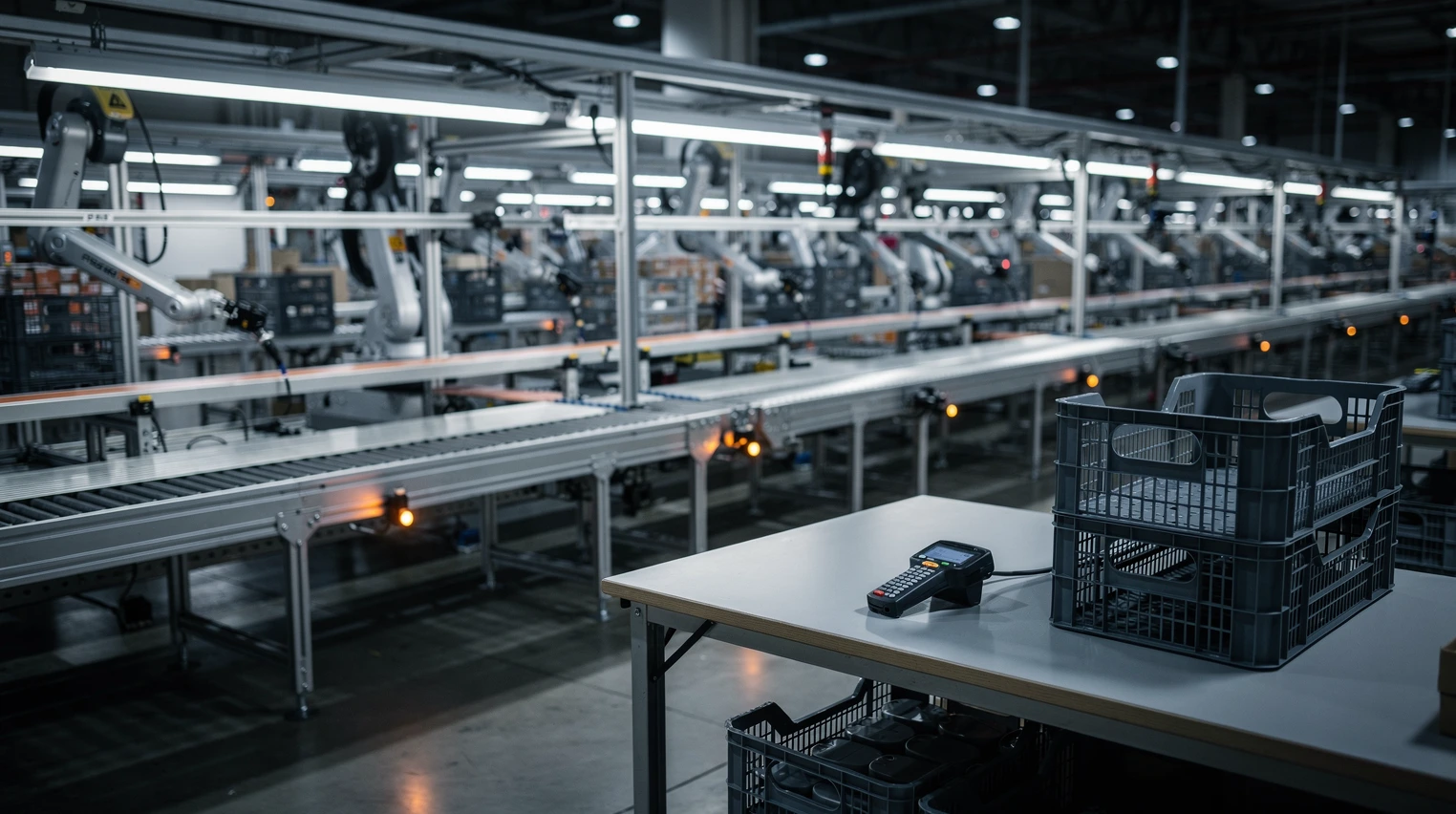
US retailers are likely to announce fewer holiday jobs in 2026 than they did in 2025, and 2025 was already the weakest peak-hiring year since 2009. The prediction here is deliberately narrow: the seasonal outlooks published in late September 2026 are likely to project a fourth-quarter retail gain below the sub-500,000 figure carried into last season, and the individual company announcements that follow through September and October are likely to cluster below the 265,000–365,000 band that trade surveys cited a year ago. This is not a demand call. Three disclosures from the last two weeks suggest the capacity retailers need for this peak has largely already been bought, and that it was bought as capital equipment rather than as temporary staff.
In short
- The prediction: holiday 2026 US retail seasonal hiring is likely to set a new post-2009 low, undercutting the 2025 trough, with the language of the announcements shifting from headcount to hours, flexibility and automation.
- The timeframe: the first checkpoint lands in late September 2026 when the seasonal outlooks publish, the second across September and October as individual retailers announce, and the definitive read arrives with the January 2027 payroll data covering the fourth quarter.
- Signal 1: Amazon lifted its 2026 cash capital expenditure guidance to roughly $220bn from about $200bn on July 30, and told investors it expects to more than double its fleet of robotic arms this year.
- Signal 2: the automation supply chain confirmed the buildout is industry-wide, with Rockwell Automation reporting e-commerce and warehouse automation sales up 30% year over year on August 4, Symbotic reporting a $22.5bn backlog on August 5, and GXO Logistics committing to 20,000 robots on August 8.
- Signal 3: the labor data diverged in a telling way, with announced retail job cuts down 84% year to date while retail payrolls still fell by 19,000 in July, a pattern that points to shrinkage by attrition rather than by layoff.
Why this matters now
Peak-season hiring has historically been the cleanest single read on how retailers expect the fourth quarter to go. It is a forced disclosure of intent: to staff a holiday, a company must commit to bodies in August and September, months before it knows what November looks like. That made the seasonal hiring number a genuine leading indicator of retail confidence for roughly two decades.
That relationship appears to be breaking, and the break is what makes this year interesting. Retailers added 543,100 jobs in the fourth quarter of 2024, already down nearly 4% on 2023. The 2025 outlook projected under 500,000 additions, the smallest seasonal gain in sixteen years, with member surveys pointing to somewhere between 265,000 and 365,000 store-level seasonal hires against 442,000 the year before. Each of those declines was read at the time as a consumer-demand warning.
The signals from the last two weeks suggest a different mechanism is now doing most of the work. Fulfillment capacity for holiday 2026 has been contracted, installed and commissioned as machinery, and the payback assumptions embedded in those contracts require the labor line to fall. If that reading is right, a weak seasonal hiring number this autumn will say considerably less about the consumer than the same number said in 2019.
The distinction matters commercially, not just semantically. A demand-driven hiring cut is cyclical and reverses when sales recover; a capex-driven one is structural and does not. Anyone reading the September announcements as a holiday sales forecast is likely to misprice the signal in both directions, and the shift toward automation as the headline item of retail earnings season has been building toward exactly this moment for several quarters.
Signal 1: Amazon books peak capacity as capital, not headcount
Amazon reported second-quarter results on July 30, 2026, with revenue of $200.6bn, up 20% year over year, and operating income of $27.5bn, up 43%. Buried under the AWS reacceleration story was the disclosure that matters here: management raised 2026 cash capital expenditure guidance to approximately $220bn, up from a prior estimate of about $200bn. Third-quarter net sales were guided to $197bn–$202bn.
The fulfillment-specific detail is more directly relevant than the aggregate. Amazon told investors it expects to more than double its fleet of robotic arms, the Cardinal and Sparrow class of machines that handle package sortation and item picking, during 2026. It also introduced a next-generation version of Proteus, an autonomous mobile robot capable of moving loads up to 1,300 pounds inside fulfillment centers.
Doubling a robotic-arm fleet within a single calendar year is not a research program. It is a deployment schedule with installation dates, commissioning windows and throughput targets attached, and the natural completion point for a retail deployment schedule is the weeks before peak. The pattern suggests that a meaningful share of Amazon’s incremental 2026 holiday throughput is intended to arrive on the capital line.
An honest caveat belongs here rather than in the caveats section, because it constrains how far this signal can be pushed. Management attributed the capex increase primarily to higher memory costs, which points at AI and data-center infrastructure rather than at conveyors and grippers. The robotics commentary and the capex raise are separate disclosures in the same release, and treating the $220bn figure as a fulfillment automation number would overstate the case considerably.
What survives that caveat is still substantial. The robotic-arm doubling was stated on its own terms, the next-generation Proteus was launched on its own terms, and neither depends on how the capex total is allocated. Amazon employed roughly 250,000 seasonal workers in each of the last two holiday periods, which makes it the single largest swing factor in the national number, and the direction of its capital commitments points one way.
Signal 2: the automation order book says this is industry-wide
A single retailer’s capital plan proves nothing about the sector. The more informative test is whether the companies that sell automation are seeing demand broaden, because their order books aggregate across buyers who do not coordinate. Three of them reported within five days of each other, and all three pointed the same direction.
Rockwell Automation reported fiscal third-quarter results on August 4, 2026, and disclosed that e-commerce and warehouse automation sales were up 30% year over year, attributed to continued investment in productivity and asset utilization by large brand owners. Management raised full-year organic sales growth guidance to 7.5%–9.5%. Its Clearpath autonomous mobile robot business continued to post strong double-digit growth and is expected to reach profitability in the fourth quarter of 2026.
Symbotic reported the following day, on August 5, with revenue of $721m, up 22% year over year, GAAP net income of $55m and adjusted EBITDA of $95m, more than double the prior-year figure. Backlog stood at $22.5bn. The company began eleven new system deployments in the quarter and lifted its count of operational systems to 56, with fourth-quarter revenue guided to $760m–$780m.
GXO Logistics, the contract logistics operator that many retailers use precisely to absorb peak volume without hiring directly, held its second-quarter call on August 8. It committed to deploying 20,000 robots across its network during 2026 and to rolling out its GXO IQ platform across roughly 50 sites in the same year. Management framed current EBIT margins of approximately 3.5%–4% against a stated goal of moving above 6%, a gap that in a labor-intensive contract logistics business is closed largely by reducing hours per unit shipped.
| Company | Reported | Automation disclosure | What it implies for peak labor |
|---|---|---|---|
| Amazon | July 30, 2026 | 2026 cash capex raised to ~$220bn; robotic arm fleet to more than double; next-generation Proteus (1,300 lb capacity) | Largest single seasonal employer adding throughput on the capital line |
| Rockwell Automation | August 4, 2026 | E-commerce and warehouse automation sales up 30% YoY; FY organic growth guidance raised to 7.5%–9.5% | Component-level demand is broad, not concentrated in one buyer |
| Symbotic | August 5, 2026 | $22.5bn backlog; 11 new deployments started; 56 operational systems; BreakPack at 50% of Walmart regional DCs | Multi-year committed capacity, with grocery and general merchandise inside it |
| GXO Logistics | August 8, 2026 | 20,000 robots in 2026; GXO IQ at ~50 sites; EBIT margin ~3.5%–4% against a 6%+ target | The outsourced peak-labor provider is itself substituting capital for hours |
The four disclosures are genuinely independent in the sense that matters: different reporting calendars, different customer bases, different points in the value chain. One buyer, one component supplier, one systems integrator and one labor-substituting service provider all raised their automation commitments inside a nine-day window. That is a different quality of evidence than four outlets reporting the same press release, and it aligns with a pattern we flagged earlier this year, when total retail logistics capex stayed flat while automation’s share of it climbed.
One qualifier deserves flagging inside the signal rather than after it. Roughly 15% of Symbotic’s backlog is expected to convert to revenue within twelve months, and GXO’s own management said humanoid robots are not expected to be in production during 2026 despite 45 completed pilots. Much of this order book is 2027 and 2028 capacity, which limits how much of it can influence the hiring plans being drafted right now.
Signal 3: retail is shrinking without anyone being fired
The third signal is the one that turns the first two from an interesting capex story into a labor prediction, and it comes from two public datasets released a day apart. Read separately, each looks unremarkable. Read together, they describe a mechanism.
The Challenger, Gray & Christmas job cut report covering July 2026, published in the first week of August, put announced US job cuts at 33,429 for the month, the lowest monthly total in two years. Retail had announced 12,946 cuts year to date, down 84% from 80,487 in the comparable prior-year period. Warehousing was down 58% year to date, at 16,328. Artificial intelligence was cited as the leading stated reason for cuts for the fifth consecutive month, at 10,970.
The Bureau of Labor Statistics employment situation report for July 2026, released on August 7, told an apparently contradictory story. Total nonfarm payrolls fell by 23,000 against an average monthly gain of 34,000 over the prior twelve months. Retail trade shed 19,000 jobs, with warehouse clubs, supercenters and other general merchandise retailers down 21,000 and gasoline stations and fuel dealers down 5,000. Transportation and warehousing showed little change over the month.
Reconciling the two is the analytical work. Announced layoffs in retail collapsed by 84% while retail employment fell by 19,000 in a single month. A sector cannot be simultaneously not firing people and losing jobs at that rate unless the shrinkage is happening through attrition without backfill, which is the quietest and most deliberate way to reduce a workforce. Nobody announces it, no severance is booked, and no press release is issued.
Attrition-without-backfill is also the specific labor posture that a completed automation deployment produces. A retailer that has commissioned new sortation capacity does not lay off the associates it replaced; it stops replacing the ones who leave, and it declines to open the seasonal requisitions it opened last year. The concentration of the July decline in warehouse clubs, supercenters and general merchandise, the formats furthest along in distribution-center automation, is consistent with that reading, though it is far from proof of it.
One methodological note keeps this signal honest. Payroll figures for any single month are noisy and subject to substantial revision, and a 19,000 decline in a sector employing millions is within the range that later revisions can meaningfully change. The signal here is the divergence between the two series rather than the precise magnitude of either.
What the pattern suggests
Put the three signals in sequence and a coherent chain emerges. Capacity was contracted and installed through 2026, the supplier order books confirm the buildout is sector-wide rather than Amazon-specific, and the labor data already shows retail headcount falling through a mechanism that produces no announcements. The seasonal hiring decision for holiday 2026 is being made against a fulfillment network that is materially more automated than the one that staffed holiday 2025.
The prediction follows from that, with a timeframe attached. The seasonal outlooks published in late September 2026 are likely to project a fourth-quarter retail gain below last year’s sub-500,000 projection. Individual company announcements through September and October are likely to come in below their 2025 equivalents where a number is given at all. The definitive check arrives in January 2027, when fourth-quarter payroll data settles the question.
A second, more falsifiable element concerns the form of the announcements rather than the totals. Target declined to publish a seasonal headcount number for 2025, saying instead that it would prioritize additional hours for current employees and lean on a 43,000-person on-demand workforce. The pattern suggests at least two more large US retailers are likely to adopt that framing this autumn, announcing hours and flexibility rather than a hiring number.
Kroger offers the template for the other half of the pattern, having cut holiday hiring by close to 30%, from 25,000 seasonal employees in 2024 to 18,000 in 2025. That was a demand-and-productivity decision taken before this year’s automation deployments landed. Signals point to several grocers and general-merchandise operators following a similar arithmetic with a larger denominator of installed capacity behind it.
| Peak season | Q4 retail additions or outlook | Store-level seasonal hires | Dominant stated driver |
|---|---|---|---|
| 2023 | ~565,000 (implied by 2024 comparison) | Not comparably surveyed | Post-pandemic normalization |
| 2024 | 543,100 actual, down ~4% YoY | 442,000 | Softening discretionary demand |
| 2025 | Under 500,000 projected, smallest in 16 years | 265,000–365,000 expected | Tariffs, inflation, early automation |
| 2026 (predicted) | Likely below the 2025 projection | Likely below 265,000–365,000 | Installed automation capacity, hours over heads |
Note the shift in the final column, which is the actual claim being made. The 2024 and 2025 declines were explained primarily by demand and cost pressure, with automation as a secondary factor. The prediction is that the 2026 decline is likely to be explained primarily by installed capacity, with demand as the secondary factor, and that the commentary accompanying the announcements will make that explicit.
Wider context: the store backroom becomes a fulfillment node
The automation story most readers know is the large regional distribution center, a building that has been getting more mechanized for a decade. The more consequential development disclosed in the last two weeks concerns a different building type, and it changes the geography of where retail labor is displaced.
Symbotic disclosed on August 5 that its BreakPack system is now deployed at 50% of Walmart’s regional distribution centers, and that the first SymMicro system is under installation at a Walmart back-of-store location, with completion expected in roughly six months. A potential contract covering 400 back-of-store systems is not included in the $22.5bn backlog, and management indicated a Walmart SymMicro timeline extending into early 2028.
Back-of-store automation is a materially different proposition from distribution-center automation. Distribution-center robotics displace warehouse labor, which is largely full-time and unionized in parts of the market. Store-embedded systems reach into the stockroom labor that has historically been the flexible, seasonal, hourly part of the workforce, which is precisely the pool that holiday hiring draws from.
The 400-system figure is worth holding lightly, since it sits outside the reported backlog and is described as potential rather than contracted. What is confirmed is that one system is being installed now and that the programme timeline runs into 2028. That cadence means store-embedded automation is unlikely to move the 2026 holiday number much, but it establishes the direction for 2027 and 2028 peaks.
The same logic is visible in adjacent formats. Grocery has spent several years learning that standalone automated fulfillment centers struggle to earn their capital in the US market, which has pushed operators toward smaller nodes attached to existing real estate. Store backrooms are the cheapest such nodes available, because the building, the inventory and the last-mile radius already exist.
There is also a volume argument that cuts in the same direction. The shift of cross-border volume from direct parcels into US domestic fulfillment following the customs changes has added units to exactly the domestic network now being automated. More domestic throughput running through more automated nodes is the combination that lets a retailer grow units shipped while holding or cutting seasonal heads.
Implications for retailers, workers and investors
For retailers, the practical consequence is that the seasonal hiring announcement is becoming a communications decision rather than an operational disclosure. A published headcount invites comparison with last year and a story about job cuts; an hours-and-flexibility framing avoids both. Expect more of the latter, and expect investors to have to work harder to extract the underlying labor plan from the language.
For workers and the labor market, attrition-without-backfill is the harder pattern to see and the harder one to respond to. There is no layoff announcement to trigger a policy response, no WARN notice, and no single event to date the change from. The 84% year-to-date decline in announced retail cuts alongside falling retail payrolls is likely to be read wrongly as sector stabilization for at least another quarter.
For carriers and contract logistics providers, the GXO margin gap is the number to watch. Moving from roughly 3.5%–4% EBIT margins toward a 6% target while growing organic revenue 4%–5% implies unit labor cost reductions rather than pricing gains, given how contract logistics is priced. Their peak-season staffing plans are likely to compress in parallel with their clients’ plans.
For investors, the cleanest read is that retail labor cost lines are likely to decouple from retail volume growth in the fourth quarter and into 2027. That is margin-positive where the automation is paid for and margin-negative where it is still being commissioned, which argues for treating fulfillment capex vintage as a discriminating variable between retailers rather than a sector-wide theme. Balance-sheet-constrained operators cannot participate in this substitution at all, which is part of why we expect a retail restructuring wave to build into early 2027.
For brands selling through these networks, the second-order effect is service-level variance. A network staffed by machines commissioned in September carries commissioning risk that a network staffed by temporary workers does not, because a robot that fails at peak cannot be replaced by hiring another one. That risk is asymmetric and concentrated in the last two weeks of November.
Caveats: what could go wrong
The strongest objection to this prediction is that it attributes to automation what may simply be demand. If holiday 2026 consumer spending is soft, seasonal hiring falls for entirely conventional reasons, and the automation narrative becomes a post-hoc explanation attached to a cyclical number. Distinguishing the two requires the accompanying commentary, not the headline figure, which is why the form-of-announcement element of the prediction matters as much as the total.
The second objection concerns timing, and it is the one that most threatens the specific 2026 claim. Automation ordered in 2026 largely arrives in 2027 and 2028: roughly 15% of Symbotic’s backlog converts within twelve months, the SymMicro programme runs into early 2028, and humanoid systems are explicitly not in production this year. The capacity that will staff holiday 2026 was mostly commissioned in 2024 and 2025, which means this year’s signals are better evidence for the 2027 peak than for this one.
The third objection is that most seasonal retail hiring is not warehouse hiring. Store-floor roles, cashiers, stockers and customer service staff make up the bulk of the seasonal intake, and distribution-center robotics do not touch them. The counter is that the store-floor decline is running through the hours-not-heads mechanism visible at Target, and that back-of-store systems are beginning to reach the stockroom, but this remains the weakest link in the chain.
A fourth objection concerns the Amazon capex signal specifically. Management attributed the increase to memory costs, and the overwhelming majority of the $220bn is AI and data-center spending rather than fulfillment automation. Anyone reading the capex raise as a warehouse robotics number is misreading it, and the robotics claim has to rest on the fleet-doubling disclosure alone.
A fifth risk is data quality. Monthly payroll estimates are revised substantially, the July decline of 19,000 in retail trade could look quite different after annual benchmarking, and announced-job-cut tallies capture only what companies choose to announce. The divergence between the two series is more robust than either individual figure, but it is still built on preliminary data.
| Scenario | What happens by October 2026 | What confirms it | Assessed likelihood |
|---|---|---|---|
| Base case | Seasonal outlook projects below the 2025 figure; two or more majors announce hours rather than headcount | Late-September outlook plus company releases citing productivity or automation | Most likely |
| Demand-driven variant | Hiring falls, but commentary cites tariffs, inventory and weak discretionary spend rather than capacity | Announcements silent on automation; guidance cuts alongside | Plausible, and hard to separate from the base case |
| Deferral case | Hiring holds roughly flat as automation slips to 2027 and retailers hedge peak risk with temporary staff | Commissioning delays disclosed on Q3 calls; flat or higher seasonal numbers | Less likely but credible |
| Upside surprise | Strong holiday demand forces late seasonal hiring above 2025 despite installed capacity | October and November hiring announcements after the initial guidance | Least likely on current data |
The deferral case deserves more weight than it usually gets in automation narratives. Peak season is the single worst time to depend on newly commissioned equipment, and a cautious operations leader hedges a September go-live with temporary staff regardless of what the capital plan says. If that hedging behaviour is widespread, the 2026 number could hold up even as the underlying substitution proceeds.
Frequently asked questions
What exactly is being predicted, and how would someone check it?
The claim is that holiday 2026 US retail seasonal hiring is likely to come in below the 2025 trough, with more announcements framed as hours rather than headcount. It is checkable against the seasonal outlooks published in late September 2026, individual company announcements through September and October, and fourth-quarter retail payroll data published in January 2027.
Isn’t this just the same story as last year?
The direction is the same but the stated mechanism is different, and that is the substance of the prediction. The 2024 and 2025 declines were explained primarily by tariffs, inflation and soft discretionary demand, with automation as a contributing factor. The claim here is that 2026 is likely to be the first peak where installed capacity is the primary explanation and where companies say so directly.
How can retail be losing jobs while announced layoffs fall 84%?
That combination is the core evidence, and the most plausible reconciliation is attrition without backfill. Employers are not cutting staff through announced actions; they are declining to replace departures and declining to open seasonal requisitions. It produces the same headcount outcome as a layoff with none of the disclosure.
Doesn’t Amazon’s capex raise reflect AI spending rather than warehouse robots?
Yes, and that is an important limitation on the first signal. Management attributed the increase to higher memory costs, which points at data-center infrastructure. The fulfillment claim rests instead on the separate disclosure that the robotic-arm fleet is expected to more than double during 2026, together with the next-generation Proteus launch.
If most of the automation backlog converts in 2027 and 2028, why does 2026 hiring fall?
Because the capacity staffing this peak was commissioned in 2024 and 2025, and the current order book is evidence of an established programme rather than the start of one. This is the weakest link in the argument, and it means the 2027 and 2028 peaks are likely to show the effect more clearly than 2026 does.
Could a strong holiday season overturn this?
It could, and that is the most straightforward way the prediction fails. Peak staffing responds to demand within weeks, so an unexpectedly strong October could produce late seasonal hiring that lifts the total above 2025. The base case assumes demand roughly in line with current trend rather than a surprise in either direction.
Which retailers are most likely to announce hours instead of headcount?
Operators with large existing part-time pools and flexible scheduling systems are the natural candidates, following the framing already used for the 2025 season. General merchandise and grocery chains with mature workforce management platforms are likelier to take that route than specialty apparel, which still depends on a genuine seasonal intake.
What would falsify the prediction most cleanly?
A late-September seasonal outlook projecting a fourth-quarter retail gain at or above the 2025 projection would falsify the headline claim directly. A season in which the large employers all publish conventional headcount numbers at or above last year’s would falsify the secondary claim about announcement language.
Does this mean automation is causing retail job losses overall?
The data supports a narrower statement than that. It shows headcount falling through non-replacement in the formats furthest along in automation, at a moment when automation commitments are rising across the supply chain. Causation at the sector level would require attribution work that the monthly data cannot support, and the honest position is that the correlation is suggestive rather than settled.
The underlying July 2026 payroll figures cited above are published in the Bureau of Labor Statistics employment situation news release, which carries the retail trade and general merchandise detail in full.