
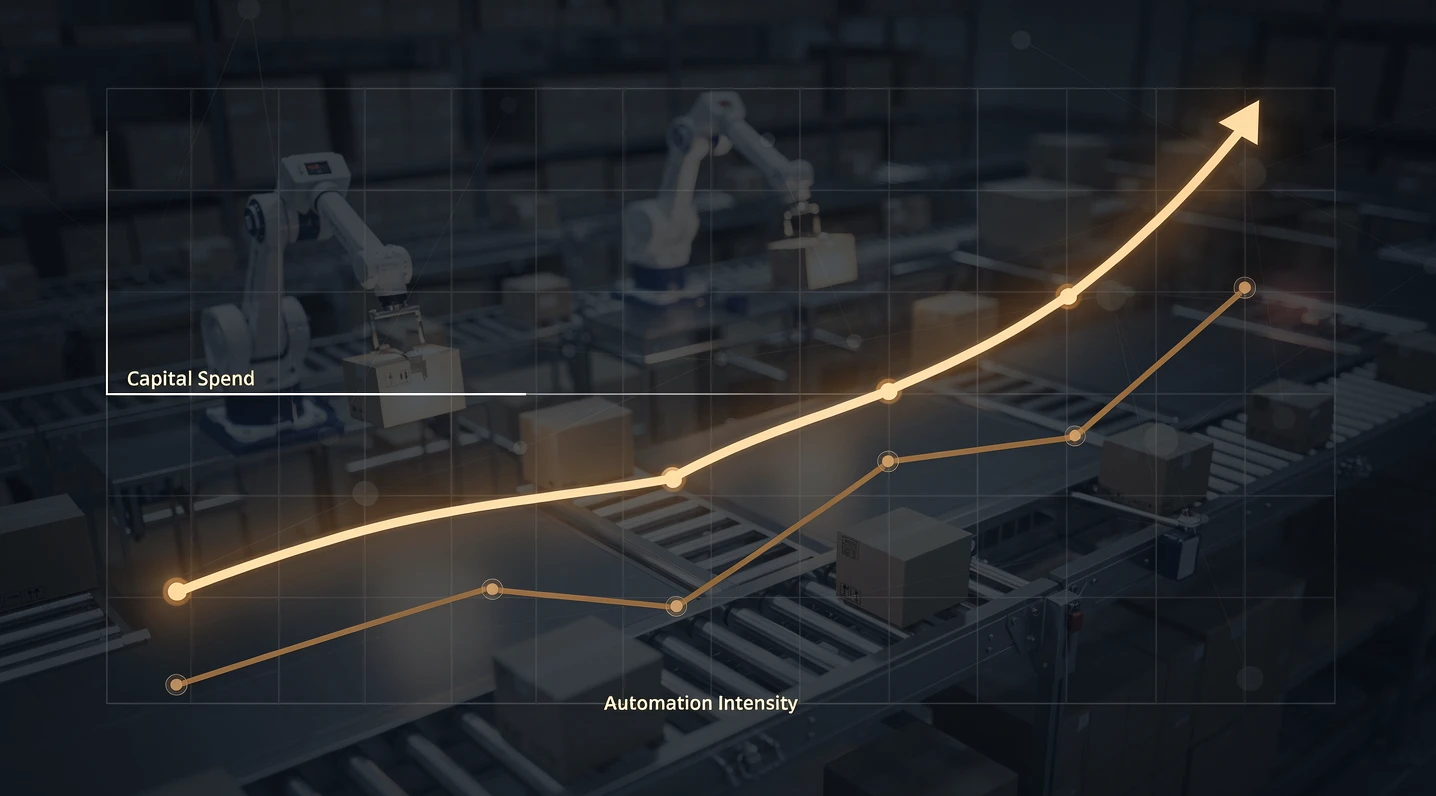
The clearest read on the late-July-to-August 2026 earnings season is not that retail and logistics operators are spending more on automation. It is that they are spending a rising share of a flat or shrinking capital budget on it. The pattern from the last four weeks of results points to a capex bifurcation: total dollars are plateauing while robotics, warehouse control systems, and network software climb as a proportion of the spend. The first live tests arrive fast, with UPS reporting on July 28 and Amazon on July 30, and the pattern is likely to hold across the peak-season commentary that follows.
This is a prediction about mix, not magnitude. If it is right, the headline capex numbers this season will look unremarkable or even soft, and the interesting movement will be inside the footnotes and the prepared remarks, where “facility modernization,” “automation,” and “density” replace “new buildings” and “square footage.” A future observer can check this in 90 days by reading the same calls: did the biggest names hold capex flat or trim it while explicitly reallocating toward automation before the holiday build? The recent signals suggest yes.
In short
- The prediction: across the late-July to mid-August 2026 earnings season, major retail and logistics operators are likely to keep total capex flat or lower year over year while raising the automation and robotics share of that spend, with the first confirmations landing at UPS (July 28) and Amazon (July 30).
- Signal 1: FedEx closed fiscal 2026 with capex at roughly 4% of revenue, its lowest ever and below depreciation, yet guided the next year’s spend “strictly” to facility modernization and automation.
- Signal 2: UPS guides full-year capex to about $3.0 billion while targeting roughly 30,000 fewer operational roles and 25 million fewer operational hours, a headcount-for-automation swap in plain sight.
- Signal 3: GXO’s sales pipeline hit an all-time high while Ocado’s build capex fell and its technology-solutions revenue guidance rose, both consistent with automation demand outrunning building spend.
- The main risk: Amazon is the giant exception, lifting 2026 capex toward $200 billion, and a fulfillment-heavy surprise on its July 30 call could blur the “flat dollars” read even though most of that money is AI and cloud.
Why this matters now
Capex mix is a leading indicator of where operating leverage shows up next. When a network operator shifts spend from new square footage to automation inside existing buildings, the productivity gains land within a few quarters, not a decade. That timing matters because the 2026 holiday build decisions are being locked now, and the language on these calls signals what the network will look like by November.
Demand for the underlying capability is not the question. E-commerce sales in the first quarter of 2026 rose about 9.7% year over year while total retail sales grew roughly 4.0%, per the U.S. Census Bureau’s quarterly retail e-commerce report. Online share keeps grinding higher, and each incremental point of online mix raises the fixed-cost burden of picking, packing, and last-mile handoff. That is precisely the cost base automation targets.
What has changed is the funding posture. Rates, tariff uncertainty, and a cautious consumer have pushed operators toward efficiency over expansion, and the cheapest way to add throughput without adding buildings is to automate the buildings you already run. This is the thesis we flagged earlier in our look at why warehouse automation was likely to headline retail’s Q2 2026 earnings, and the fresh results sharpen it from “automation will be a theme” to “automation share rises while dollars do not.”
There is a structural reason this posture is likely to persist rather than snap back. The 2021 to 2023 expansion cycle left many networks with more physical footprint than current volumes require, so the marginal return on a new building is lower than the marginal return on automating an existing one. That overhang favors density over footprint for at least the current planning cycle. It also means the mix shift is a rational response to prior over-building, not merely a defensive reflex, which makes it more durable.
The rest of this piece walks through the three signals, synthesizes the pattern, places it against the AI capex boom and the Amazon exception, and then sets out what could prove it wrong. The point is not to cheer automation. It is to read the mix shift early enough to act on it.
Signal 1: FedEx’s historic capex low with an automation carve-out
FedEx reported its fiscal fourth quarter on June 23, 2026, and the capital story was striking. Full-year capex came in around $3.8 billion, roughly 4% of revenue, described as the lowest level since the company was formed. It was only the third fiscal year in FedEx history where capex ran below depreciation and amortization, a textbook marker of a harvest posture rather than a build posture.
The forward guidance is where the mix shift shows. FedEx set calendar-2026 capital spending at about $3.9 billion, a marginal bump off a historic low, and framed the focus as “strictly” facility modernization and automation. That is not a company retreating from investment. It is a company redirecting a deliberately capped budget toward robotics and network intelligence rather than new hubs.
The operational scaffolding backs the language. FedEx has been co-locating its Express and Ground operations under Network 2.0, with roughly 45% of eligible daily volume now flowing through optimized joint sites, and it expects about $1.4 billion in incremental savings by the end of calendar 2026 from its DRIVE program. Consolidating physical nodes while automating the survivors is the clearest possible version of “fewer buildings, smarter buildings.”
Historically, capex below depreciation is a state a capital-intensive network can only sustain for a few years before assets age past the point of reliability. That FedEx is willing to run there, and to guide the next year barely above it, signals confidence that automation and consolidation can carry the productivity load that new assets used to. It is a bet that smarter beats bigger, at least until volumes force the next expansion wave.
The falsifiable read here is simple. If the “flat dollars, rising automation share” thesis is right, FedEx’s next update should keep capital intensity pinned near 4% of revenue while automation and modernization line items grow inside it. The June results already sit squarely on that line.
Signal 2: UPS guides capex down while automating headcount out
UPS is scheduled to report second-quarter 2026 results on July 28, 2026, and its full-year framework is the second data point. The company has guided capex to about $3.0 billion, a modest figure for a network of its scale, while pursuing roughly $3 billion of cost-out. The capital line is not where the ambition sits.
The ambition sits in the labor line, and that is the tell. UPS has targeted about 25 million fewer operational hours for 2026 and roughly 30,000 fewer operational positions, with nearly 25,000 already removed year over year, according to its own guidance. Taking that many hours out of a parcel network without collapsing service quality is not achievable by scheduling tweaks alone. It implies sustained automation of sortation, package handling, and facility flow.
Read together, the UPS numbers describe a headcount-for-automation swap funded by a restrained capital budget. The company is not building its way to lower cost. It is automating its way there, and it is doing so while holding capex to roughly $3.0 billion. That is the bifurcation in one operator: dollars disciplined, automation intensity up.
The July 28 call is the near-term test. Listen for whether management frames the operational-hour reductions as automation-enabled and whether it reaffirms the roughly $3.0 billion capex figure. If both hold, UPS confirms the pattern before Amazon even reports. This dynamic also feeds the consolidation pressure we traced in why another scaled delivery player is likely to exit independence before year-end, because automation-led cost curves widen the gap between the scaled and the sub-scale.
Signal 3: GXO’s record pipeline and Ocado’s build-to-monetize pivot
The third signal comes from the pure-play automation-adjacent names, where the same shift shows from a different angle. GXO, the contract-logistics operator, reported first-quarter 2026 revenue up about 10.8% to roughly $3.3 billion, with organic growth near 4.1%, and, more tellingly, a sales pipeline at an all-time high of about $2.7 billion. Its wins skewed toward higher-margin verticals such as aerospace and defense, technology, industrial, and life sciences.
That pipeline matters because GXO’s model is asset-light and automation-led. When retailers and manufacturers hand their fulfillment to a 3PL rather than build it themselves, they are converting their own capex into someone else’s opex, and they are buying automation as a service. A record GXO pipeline is a proxy for demand that is not showing up as building spend on the client’s balance sheet.
The vertical mix inside that pipeline reinforces the point. Aerospace and defense, life sciences, and industrial clients tend to demand complex, automation-heavy fulfillment rather than simple pick-and-pack, so a pipeline tilted toward them is a pipeline tilted toward robotics and control-software content. In other words, the demand GXO is winning is disproportionately the automation-intensive kind. That is exactly the flavor of activity the bifurcation thesis predicts should be growing fastest.
Ocado sharpens the point from the technology side. Around its first-half 2026 results, reported in July, the shares fell about 19% as investors digested softer near-term dynamics, yet the capital story fits the thesis cleanly. Ocado guided underlying capex to roughly GBP 250 million with technology spend declining in the first half, while pointing to technology-solutions revenue of around GBP 500 million at roughly 30% EBITDA margin looking into fiscal 2027.
That is a build-to-monetize pivot: fewer pounds into new customer fulfillment centers, more revenue extracted from the automation platform already deployed. It rhymes with the broader reset we described in Ocado’s H1 2026 revenue jump on the Kroger payout, where the underlying grocery volume told a more sober story than the headline. The direction of travel, less capex, more platform monetization, is the same mix shift the carriers are showing.
What the pattern suggests
Put the three signals in one frame and the shape is consistent. Carriers are capping capital at multi-year lows while explicitly routing it to automation. A leading 3PL is booking record demand for automation-as-a-service. A warehouse-tech platform is throttling build spend while scaling platform revenue. None of these is a spending boom. All of them are mix shifts toward automation.
| Signal | Capex direction | Automation-share tell | Freshness |
|---|---|---|---|
| FedEx FY2026 | ~4% of revenue, below D&A, historic low | Next-year spend guided “strictly” to modernization and automation; Network 2.0 co-location at ~45% of eligible volume | Reported June 23, 2026 |
| UPS FY2026 guide | ~$3.0bn, restrained | ~30,000 fewer roles and ~25m fewer operational hours, automation-enabled | Guide standing into July 28 report |
| GXO Q1 2026 | Asset-light, client capex avoided | Record ~$2.7bn pipeline for automation-led 3PL | Reported spring 2026 |
| Ocado H1 2026 | Underlying capex ~GBP 250m, tech spend down | Technology-solutions revenue guided ~GBP 500m at ~30% margin | Reported July 2026 |
The mechanism connecting them is the unit economics of online growth. With e-commerce compounding at more than double the pace of total retail, throughput demand keeps rising even as expansion budgets tighten. The only way to reconcile more volume with flat capital is to lift throughput per existing square foot, which is the definition of automation intensity. The pattern suggests operators have collectively chosen density over footprint for this cycle.
There is a second-order implication for how to read the season. If the thesis holds, the market may misprice these prints at first, reading flat capex as caution or weakness. The more accurate read is a deliberate reallocation whose payoff shows up in unit-cost curves over the following few quarters, not in the capex headline itself.
It helps to see this against prior mix shifts, because the pattern is not new even if the current instance is fresh. Networks have repeatedly moved from expansion to intensity when volumes outran the returns on new footprint, and the automation-heavy phase that followed tended to precede a margin inflection rather than a revenue one. The precedents below are illustrative rather than exhaustive, and they suggest the current setup rhymes with earlier density-over-footprint pivots.
| Prior precedent | Trigger | What followed | Relevance now |
|---|---|---|---|
| Post-2015 parcel sortation automation | E-commerce parcel volume outran manual capacity | Heavy automation capex, then multi-year cost-per-package declines | Same volume-versus-capacity squeeze, tighter budget |
| 2020 to 2021 fulfillment build-out | Pandemic demand shock | Rapid footprint expansion, later over-capacity | The overhang now favoring density over new buildings |
| 2023 to 2024 network rationalization | Demand normalized below built capacity | Facility consolidation, early automation focus | Directly continues into the 2026 bifurcation |
The through-line is that intensity phases are quieter than expansion phases and easier to underestimate. They do not produce ribbon-cutting headlines, and they show up as line-item language and productivity metrics rather than capex records. That is precisely why reading the mix early is worth the effort.
Wider context: the AI capex halo and the Amazon exception
None of this happens in a vacuum, and the loudest capex story of 2026 runs the other way. Amazon has guided 2026 capital spending toward roughly $200 billion, up about 50% from $131.8 billion in 2025. Taken at face value, that looks like the opposite of restraint, and it complicates any tidy “capex is flat” narrative.
The resolution is in the composition. The bulk of Amazon’s step-up is AWS, data centers, and generative AI capacity, not fulfillment square footage. On the retail side, the company has said its 2026 large-format US fulfillment launches use its latest-generation robotics, which is itself an automation-intensity story rather than a footprint-expansion one. Fulfillment expense rose about 9% and outbound shipping about 12% year over year in the first quarter, pressures that automation is meant to blunt over time.
So the AI capex boom sits alongside, not against, the logistics thesis. In cloud and compute, dollars are surging. In physical fulfillment and parcel, dollars are disciplined and the movement is in the mix. The risk is narrative contamination: because Amazon’s overall number is enormous, a fulfillment-heavy quarter could be read as building spend re-accelerating across the sector when it is really AI capex wearing a retail label.
There is a useful test buried in the Amazon comparison. If the sector were genuinely re-entering a footprint-expansion cycle, you would expect it to show first at the largest and best-capitalized operator, since scale players lead build waves. Instead, Amazon’s incremental dollars are flowing to compute while its fulfillment story is framed as robotics upgrades, which is the opposite of what a broad expansion cycle would look like. That absence is itself evidence for the bifurcation read.
The demand backdrop for automation vendors stays firm regardless. Industrial-automation suppliers have flagged broadening e-commerce and warehouse demand, with North America the strongest region, and the humanoid and robotics-as-a-service story keeps maturing, as we covered in why warehouse humanoids reach commercial scale before year-end 2026. A capped capex budget aimed at automation still funds a large and growing vendor pull.
Implications for retailers, 3PLs, and investors
For retailers, the read is to stop treating capex headlines as a proxy for ambition. A competitor holding capex flat while reallocating to automation may be widening its cost advantage faster than one splashing out on new distribution centers. The relevant metric this season is throughput per facility and cost per unit shipped, not gross capital outlay.
For 3PLs and automation vendors, the pattern is a tailwind dressed as caution. Every retailer that chooses not to build its own automated fulfillment is a candidate to outsource it, which is why GXO’s record pipeline is a leading indicator worth tracking. The names that sell automation as a service, rather than requiring clients to fund capex, are positioned to capture the reallocation directly.
The nuance for vendors is that a capped client budget rewards modular, retrofit-friendly automation over ground-up systems. Operators unwilling to fund new buildings are also less likely to fund rip-and-replace overhauls, so the winners are likely to be technologies that bolt into existing facilities and pay back inside a peak season or two. That favors robotics-as-a-service and control-software layers over the heaviest fixed-infrastructure plays. Vendors that price for opex budgets rather than capex budgets are aligned with where the money is actually moving.
| Scenario | What you would see this season | Signal strength | Rough odds |
|---|---|---|---|
| Base case: bifurcation holds | Capex flat or down, automation language and line items up; UPS reaffirms ~$3.0bn, Amazon fulfillment stays robotics-led | Strong | Likely |
| Reflation: expansion returns | One or more majors lift building capex on a strong holiday outlook | Moderate | Possible |
| Retrenchment: automation paused | Capex and automation both cut on a demand scare | Weak | Less likely |
For investors, the actionable nuance is timing. Automation reallocation compresses unit costs with a lag, so the operators showing this mix shift now are the ones whose margins are most likely to inflect two to four quarters out. Reading the prepared remarks for “density,” “modernization,” and “automation-enabled” is a cheaper edge than waiting for the margin line to move.
There is also a competitive-clustering effect worth watching. Once one scaled operator demonstrates that automation-led density lowers cost without new footprint, peers face pressure to match it or cede unit economics, which tends to synchronize the mix shift across a sector. That is part of why a signal visible at FedEx and UPS is unlikely to stay isolated to carriers. Grocers, big-box retailers, and pure-play e-commerce operators reading the same cost math are likely to echo the language in their own late-summer calls.
For grocery and perishable operators, the calculus is tighter still, because automated fulfillment economics have proven unforgiving, a reckoning we traced in why standalone automated grocery fulfillment is losing the US market. The mix shift toward automation does not guarantee returns; it raises the stakes on execution.
Caveats: what could go wrong
The most obvious way this prediction fails is Amazon. If the July 30 call reveals a meaningful re-acceleration of fulfillment building, and management frames it as footprint expansion rather than robotics upgrades, the “flat dollars” read weakens across the sector by association. Amazon’s scale means its choices set the tone even when the sector is doing something different.
A second risk is a strong holiday-demand signal. If early peak-season indicators run hot, operators could reverse course and greenlight expansion capital to avoid capacity shortfalls, converting a mix-shift season into a spending-up season. Capacity fear can override capital discipline quickly when volume surprises to the upside.
A third caveat is definitional. “Automation share” is not a standardized disclosure, so confirming the thesis relies on qualitative language and scattered line items rather than a clean reported ratio. Reasonable observers could read the same calls and disagree about whether the mix genuinely shifted or merely sounded like it did. That ambiguity is why the falsifiable version of this claim leans on the concrete anchors: UPS reaffirming roughly $3.0 billion capex, FedEx holding near 4% intensity, and Amazon’s fulfillment staying robotics-led.
Finally, macro could swamp the signal. A sharp consumer downturn would pull both capex and automation spend lower together, collapsing the bifurcation into plain retrenchment. That is the weak-probability scenario in the table, but it is not zero, and it would invalidate the “share rises” half of the prediction even as the “dollars flat or down” half held.
Frequently asked questions
What exactly is the prediction, and when can it be checked?
The prediction is that major retail and logistics operators will keep total capex flat or lower year over year while raising the automation and robotics share of that spend during the late-July to mid-August 2026 earnings season. It can be checked starting July 28 (UPS) and July 30 (Amazon), and fully within about 90 days as the season’s calls conclude.
Isn’t flat capex just a sign of weakness?
Not necessarily, and that is the core of the argument. FedEx’s sub-D&A capex paired with an automation-only forward focus, and UPS’s restrained capex paired with a 30,000-role reduction, both read as deliberate reallocation rather than retreat. The productivity payoff shows up in unit costs, not in the capex headline.
How does Amazon’s $200 billion capex fit a “flat dollars” thesis?
It mostly does not overlap with the logistics thesis, because the bulk of Amazon’s increase is AWS, data centers, and AI capacity rather than fulfillment. On the retail side, Amazon’s 2026 large-format launches lean on latest-generation robotics, which is an automation-intensity story. The risk is that Amazon’s sheer scale makes its number look like sector-wide building spend when it is not.
Why do GXO and Ocado belong in a capex story?
Because they show the same shift from the vendor side. GXO’s record pipeline captures demand for automation-as-a-service that never appears as building capex on the client’s books, while Ocado’s falling build capex and rising technology-solutions revenue is a build-to-monetize pivot. Both are consistent with automation demand outrunning footprint spend.
What is the single clearest tell to watch on the calls?
Watch whether operators reaffirm restrained capex figures while attributing productivity to automation. Concretely, UPS holding near $3.0 billion capex while crediting automation for operational-hour cuts, and FedEx keeping capital intensity near 4% of revenue, would be the cleanest confirmations. Language like “density,” “modernization,” and “automation-enabled” is the qualitative marker.
Could this reverse before the holidays?
Yes. A hot early read on peak-season demand could push operators to greenlight expansion capital to avoid capacity shortfalls, turning a mix-shift season into a spending-up one. Capacity fear tends to override capital discipline fast when volume surprises to the upside.
What does this mean for smaller retailers that cannot fund automation?
It raises the appeal of outsourcing fulfillment to automation-led 3PLs rather than building in-house, which is part of why the pipeline for those providers is expanding. The alternative, competing on manual fulfillment against automated rivals, likely means a widening cost disadvantage into 2027.
Does the automation mix shift guarantee better margins?
No. Automation reallocation raises the stakes on execution, and grocery fulfillment in particular has shown how unforgiving the economics can be. The prediction is about where spend is going, not a promise that every operator earns a return on it.
This analysis is grounded in company earnings disclosures and guidance from the past several weeks and in U.S. Census e-commerce data. For the primary demand backdrop, see the Census Bureau’s quarterly retail e-commerce report here. It is commentary, not investment advice, and the outcome remains uncertain until the season’s calls conclude.