
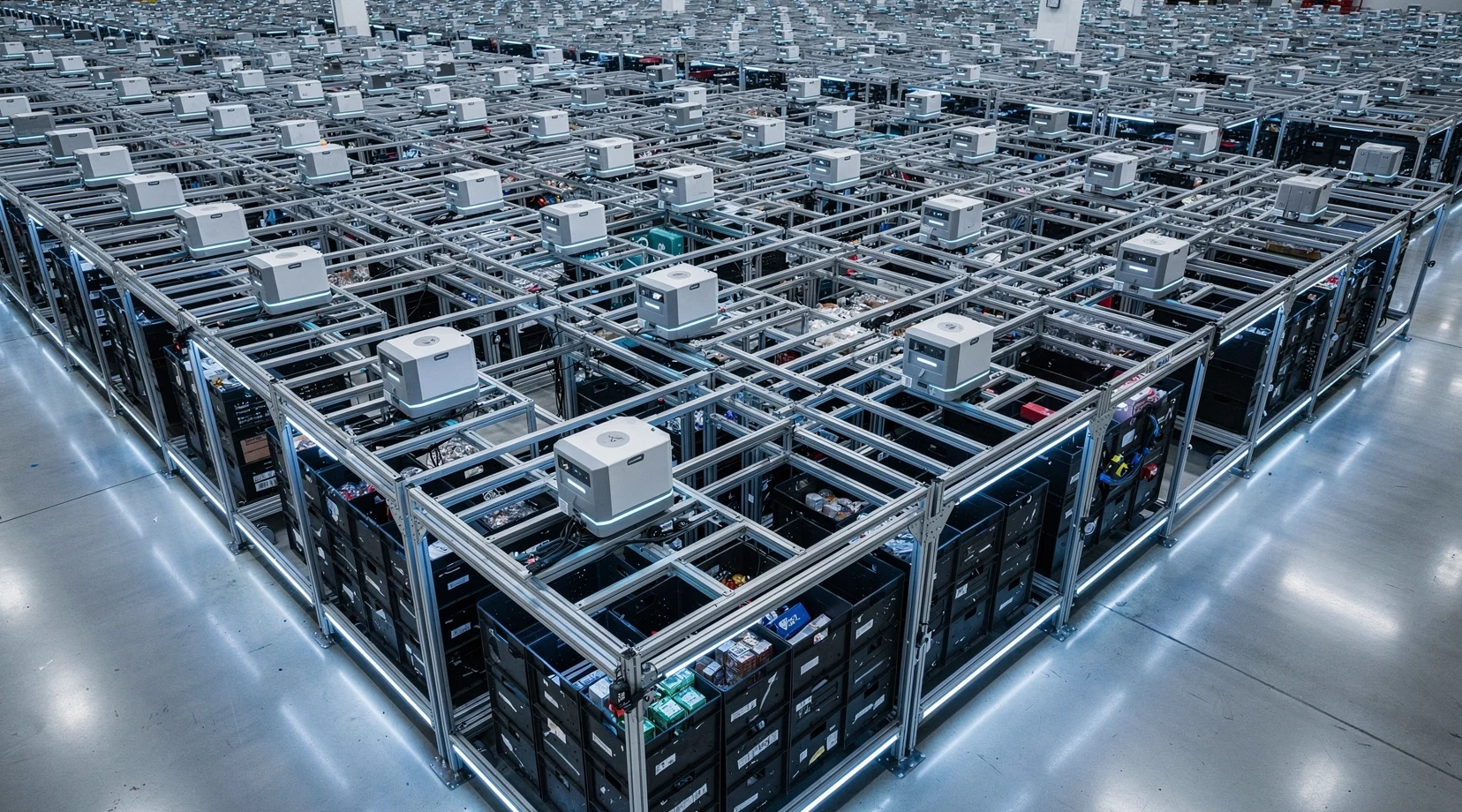
Ocado Group used its half-year results on 16 July 2026 to show a headline it has waited years to print: revenue up 54% and group adjusted core earnings of £432m, a swing from the deep losses that defined the company for most of the past decade. Read past the top line, though, and the picture is more sober. Almost all of that jump came from a one-off termination fee paid by Kroger, the US grocer that has been steadily unwinding its Ocado warehouse network. Strip the closure payments out and revenue grew just 1%, and adjusted earnings actually fell.
The British technology and logistics group, best known for the robotic grocery warehouses it licenses to retailers worldwide, framed the period as one of “accelerating commercial momentum.” It confirmed a new UK partnership with Asda, a return to profit at its Ocado Retail joint venture, and a pledge to turn cash flow positive in the second half of the year. The results, filed with the London Stock Exchange and detailed in the company’s own statement, also reopened the two questions that hang over Ocado: whether its capital-heavy automation model can win back big grocers, and who will run the company after founder Tim Steiner.
In short
- Revenue rose 54% to £1,037m (about USD 1.41bn) for the 26 weeks to 31 May 2026, but only because of one-off fees tied to Kroger and Sobeys warehouse closures. Excluding those, revenue grew 1% to £684m.
- Kroger paid a $350m termination fee (about £258m) to compensate Ocado for shutting three US fulfillment centers and canceling a fourth, the single biggest line item in the results.
- Ocado Retail returned to profit, posting a £12m pre-tax profit against a £17m loss a year earlier, as its share of the UK online grocery market rose to 13.7%.
- Asda joined as a new UK client, with a go-live planned for FY27, giving Ocado a fresh anchor customer as its US network shrinks.
- Ocado reaffirmed a turn to positive cash flow in the second half of FY26 and full-year cash generation in FY27, but flagged an underlying cash outflow of around £200m for the full year excluding closure fees.
What did Ocado actually report for the first half?
For the 26 weeks ended 31 May 2026, Ocado Group reported revenue of £1,037m, up 54% year on year, and group adjusted EBITDA of £432m against £92m in the same period of 2025. Those figures include £354m of non-recurring income from the closure of customer fulfillment centers, or CFCs, operated by Kroger in the United States and Sobeys in Canada. On a like-for-like basis, stripping the closure benefits out, the numbers are far more modest.
Excluding the closure impacts, revenue rose 1% to £684m and group adjusted EBITDA fell to £81m from £92m. In other words, the operating business went slightly backward on earnings while the accounting headline surged. Ocado was transparent about the split, presenting both an “including closure impacts” and an “excluding closure impacts” column in its income statement.
Statutory earnings before tax came in at £17m, which the company presented against a £173m loss in the prior period. Total net cash inflow was £25m, helped by £263m of net proceeds received in January 2026 from the Kroger and Sobeys settlements. On an underlying basis, which excludes those receipts, Ocado still burned £147m of cash, wider than the £108m outflow a year earlier.
| Metric (HY26, 26 weeks to 31 May 2026) | Including closure fees | Excluding closure fees | HY25 |
|---|---|---|---|
| Group revenue | £1,037m (+54%) | £684m (+1%) | £674m |
| Technology Solutions revenue | £609m | £256m | £277m |
| Ocado Logistics revenue | £428m (+8%) | £428m (+8%) | £397m |
| Group adjusted EBITDA | £432m | £81m | £92m |
| Technology Solutions adjusted EBITDA | £410m | £60m | £73m |
| Statutory profit before tax | £17m | £(173)m | |
| Underlying cash flow | £(147)m outflow | £(108)m | |
Currency conversions in this article use a rate of about £1 to USD 1.36, drawn from the same window in which the results were released. At that rate, the £1,037m headline is roughly USD 1.41bn, the £684m underlying figure about USD 930m, and the £765m cash balance around USD 1.04bn. Ocado reports in sterling and does not publish a fixed conversion, so dollar figures here are indicative.
How did the Kroger termination fee reshape the numbers?
The defining event of the half was not a new deal but the further retreat of Ocado’s largest customer. In November 2025, Kroger announced plans to optimize its automated network, and in January 2026 it closed three CFCs in Frederick, Maryland; Pleasant Prairie, Wisconsin; and Groveland, Florida. It also confirmed it would not proceed with a planned site in Charlotte, North Carolina.
What Kroger agreed to pay
To compensate Ocado for the lost capacity, the two companies agreed a one-off cash termination fee of $350m, of which Ocado recognized £260m as revenue in the period. A further £67m was booked from the accelerated recognition of advance receipts previously held as contract liabilities. Together with £27m tied to the closure of Sobeys’ Calgary CFC, the closures delivered £354m of non-recurring income, alongside £125m of related depreciation and impairment.
Kroger and Ocado said they continue to work together across five live CFCs in Monroe, Dallas, Atlanta, Denver, and Detroit. Ocado also disclosed that it sold the technology from one of the closed Kroger sites to a large US-based logistics company, retaining a maintenance role. The message the company wanted to land was that a painful reset had been monetized rather than simply written off.
Why analysts remain wary
Market coverage of the results was mixed. In reporting collated by Invezz, Ocado shares traded up sharply on the day, near 201 pence, as investors welcomed the cash injection and the reaffirmed guidance. Yet the same coverage noted that brokers stayed cautious: JPMorgan was reported to have trimmed its price target, and Bernstein analysts have suggested Kroger could close further sites.
Shore Capital’s Clive Black, one of the sharpest critics of the model, had earlier described the Kroger retreat as a blow to the credibility of the Ocado proposition in less densely populated markets. That critique cuts to the heart of the automated-grocery debate, a theme explored in our analysis of why standalone automated grocery fulfillment is losing the US market. The Kroger unwind is the clearest evidence yet that the giant, single-purpose warehouse is not the only path to profitable online grocery.
Why does the Asda partnership matter so much?
Against that backdrop, the Asda win is the most strategically important commercial news in the results. Asda, one of the UK’s largest grocers, agreed to adopt Ocado’s Smart Platform technology to overhaul its online business, with a go-live targeted for FY27. The deal was first announced in late May 2026 and was reaffirmed as a headline “new partner win” in the half-year statement.
Crucially, the Asda arrangement is not a bet on building expensive new robotic warehouses. It centers on Ocado’s front-end webshop, in-store fulfillment software, and last-mile routing tools, letting Asda pick from its existing stores and hubs while keeping control of pricing and its customer offer. Asda fulfills more than 700,000 online orders a week, so even a software-led relationship is meaningful volume for Ocado’s recurring fee base.
The Asda model mirrors the direction of travel for Ocado’s other UK partner, Morrisons, which has leaned on the platform for last-mile planning and aggregator fulfillment. Morrisons has been reshaping its own finances in parallel, including talks over a store-backed financing deal we covered when Morrisons weighed a £600m sale-and-leaseback with Realty Income. Taken together, the two UK relationships show Ocado pivoting from selling warehouses to selling software.
Is Technology Solutions still the growth engine?
Technology Solutions is the division that licenses Ocado’s platform and robotics to grocers, and it is where the exclusivity era is being tested. Recurring fees fell 3% to £231m as the closed Kroger and Sobeys sites dropped out of the base. Excluding those sites, recurring fees grew 5% to £222m, and international volumes across live partners rose 27% year on year.
The end of exclusivity
Ocado has spent the past year unwinding the exclusivity clauses that once tied it to a single grocer per market. Management argues this frees its commercial teams to prospect widely, and it merged Ocado Solutions and Ocado Intelligent Automation into one division to chase those leads. The company also opened a Product Hub in Dallas to showcase Store Based Automation and its new “Porter” pallet-moving robot to North American prospects.
Re:Imagined and robotic picking
The technology story leans heavily on the Re:Imagined program, Ocado’s suite of next-generation robotics. On-Grid Robotic Pick, or OGRP, is now live in 14 CFCs across eight partners and has completed more than 350m picks. At the mature Luton site, robotic picking now handles a large share of volume, and labor productivity across OSP-enabled centers rose to 268 units per hour.
These tools matter because they attack the cost that has always made robotic grocery warehouses hard to justify. Ocado’s pitch is increasingly that its software and picking robots can bolt onto a grocer’s existing stores, a lighter model we examined in our piece on why store-based grocery fulfillment is winning by 2027. Technology Solutions adjusted EBITDA, excluding closure fees, was £60m at a 23% margin, down from 26% a year earlier as revenue slipped.
What is driving Ocado Logistics?
Ocado Logistics, the third-party logistics arm that runs the automated warehouses and delivery fleets for Ocado Retail and Morrisons in the UK, was a quiet source of stability. Revenue rose 8% to £428m, driven largely by the recovery of costs through partner contracts, and adjusted EBITDA increased to £22m from £19m. It is the least glamorous division, but it converts operational discipline into reliable earnings.
Productivity did much of the work. Labor productivity across OSP-enabled centers rose 12% to 268 units per hour, while average delivery productivity for Ocado Retail improved 6% to 22.5 drops per standard eight-hour shift. Ocado credited better route planning, delivery density, and the rollout of Re:Imagined tools such as On-Grid Robotic Pick and Auto Frame Load.
The division also broadened what it can offer UK partners. The Swift Router solution, which enables shorter lead times and frees up delivery slots, is now available from all six OSP customer fulfillment centers in the UK. Ocado said it had extended aggregator fulfillment for Morrisons, helping the grocer reach more catchments through third-party delivery channels such as Just Eat, Uber Eats, and Deliveroo. For FY26, Ocado guided to high mid-single-digit revenue growth and EBITDA of £30m to £35m for the unit.
How did Ocado Retail perform?
Ocado Retail, the 50:50 joint venture with Marks & Spencer, was the clearest bright spot. Revenue rose 15.1% to £1.76bn (about USD 2.4bn), well ahead of the wider UK online grocery channel, and the business posted a £12m pre-tax profit before adjusting items against a £17m loss a year earlier. Since deconsolidation in April 2025, it is reported as an associate using the equity method.
Market share and customers
The joint venture said it remained the UK’s fastest-growing grocer over the preceding 12 months, lifting its share of the online grocery market to 13.7% in the four weeks to 16 May 2026, up 0.7 percentage points year on year. Average active customers grew 10.6%, and the number of customers placing five or more orders rose 10.2%. Average basket value edged up 1.9% to £126.55, with items per basket steady at 44.3.
Efficiency does the heavy lifting
Ocado Retail’s adjusted EBITDA reached £73m, or £89m excluding Hatfield capacity fees, up from £33m, lifting the margin to 4.2%. Management credited higher volumes and productivity, partly offset by higher employer National Insurance contributions and a rising National Living Wage. Network utilization hit 103% of original design capacity, which the company said gives it room to grow volumes with limited new capital. That is a pointed contrast with rivals still weighing costly new-build sites, and it underpins the joint venture’s claim to be gaining share while its margins expand.
Can Ocado really turn cash flow positive?
The cash question is the one that ultimately decides Ocado’s valuation. Management reaffirmed that the group will turn cash flow positive during the second half of FY26 and deliver full-year cash generation in FY27. That target sits alongside an expected underlying cash outflow of around £200m for the full year, excluding the closure receipts.
Ocado ended the half with cash and cash equivalents of £765m and an undrawn £300m revolving credit facility, giving liquidity above £1.0bn. It redeemed the remaining £56m of convertible bonds due December 2025 and said it has sufficient funds to address the £350m of convertible bonds maturing in January 2027. A £150m cost-reduction program, most of it actioned in the second quarter, is expected to feed benefits through the second half and into FY27.
Capital discipline is central to the promise. Group capital expenditure fell by £56m to £116m in the half as Ocado completed the research and development behind its Re:Imagined product suite and phased its warehouse spending. The company guided to full-year capital expenditure of around £250m, including the CFCs it is building for AEON in Hachioji and Lotte in Busan. In FY27, it plans to hold technology research and development capital expenditure at around 20% of recurring revenues as the current innovation cycle ends.
The credibility of the cash-flow pledge rests on three levers working at once: recurring fees stabilizing as new modules replace closed ones, the £150m of cost cuts landing on schedule, and capital spending staying disciplined. Each looks achievable on its own, but they must all hold for the group to exit FY26 in positive territory. Investors have heard cash-flow-positive targets from Ocado before, which is why management repeated the word “unchanged” so often in this update.
| FY26 guidance | Detail |
|---|---|
| Technology Solutions revenue | About £500m, excluding CFC closure fees |
| Technology Solutions EBITDA margin | About 30%, excluding closure impacts |
| Ocado Logistics revenue | High mid-single-digit % growth |
| Ocado Logistics adjusted EBITDA | About £30m to £35m |
| Group capital expenditure | Around £250m |
| Underlying cash flow | Positive in 2H FY26; full-year outflow about £200m; cash flow positive in FY27 |
What happens to leadership after Tim Steiner?
Buried in the chief executive’s statement was a line with outsized significance. Tim Steiner, who co-founded Ocado in 2000 and has led it ever since, said the company had “established a clear process for long-term succession planning.” He struck an upbeat tone on strategy, but the acknowledgment confirmed that the founder era is entering its final chapter.
That aligns with reporting we covered when Ocado signaled that Tim Steiner would step down as chief executive, closing a quarter-century at the helm. Succession is delicate at any company, but especially at one whose investment case has long been tied to its founder’s conviction in automation. How a new leader balances the capital-heavy warehouse model against the lighter software approach will shape the next decade.
The timing is also commercially sensitive. Ocado is mid-way through re-engaging retailers in mature markets, opening a US product hub, and courting prospects freed by the end of exclusivity. A leadership handover during that push risks unsettling clients who sign multi-year technology contracts and want continuity at the top. Management’s decision to formalize the process now, rather than announce a departure abruptly, appears designed to reassure both partners and shareholders that the transition will be orderly.
Where is Ocado’s global pipeline heading?
Beyond the UK and US, Ocado’s growth now depends on a pipeline of international launches, most of them in Asia and the Middle East. In the second half, Lotte is due to begin deliveries from its first CFC in Busan, South Korea, and AEON is set to launch a second Tokyo site. Panda in Saudi Arabia is expected to go live with Ocado’s full e-commerce platform after rolling out in-store fulfillment in 2025.
The Busan launch is notable for debuting Ocado’s Autofreezer solution and supporting “dawn delivery,” a feature specific to the Korean market, with Lotte planning a 100% electric delivery fleet. Ocado also flagged momentum among recent partners live in Spain, Poland, Japan, and Australia. In non-grocery automation, it signed new contracts for its “Chuck” autonomous mobile robot and expects to launch a McKesson site in Quebec.
| CFC / market | Partner | Expected go-live |
|---|---|---|
| Busan, South Korea | Lotte | FY26 |
| Tokyo (second site) | AEON | FY26 |
| Barcelona, Spain | Existing partner | FY27/FY28 |
| Tokyo (third site) | AEON | FY27/FY28 |
| Phoenix, US | Undisclosed | FY27/FY28 |
| Seoul, South Korea | Lotte | FY29 |
In total, Ocado expects six CFCs to go live over the next two to three years and around 10 new modules in each of FY26 and FY27. That module growth is designed to offset the 12 modules lost to the Kroger and Sobeys closures and the phased reduction in fees from the aging Hatfield site.
What does this mean for the automated-grocery model?
The larger story running through these results is a philosophical one about how online grocery should be fulfilled. For a decade, the bet was that giant, purpose-built robotic warehouses would beat picking from stores. Kroger’s retreat, and Ocado’s own pivot toward software and store-based tools, suggest the industry has not settled that argument in the warehouse’s favor.
Ocado’s own numbers illustrate the tension. The purpose-built model still delivers industry-leading throughput at mature sites such as Luton, yet it demands heavy upfront capital and long payback periods that make grocers hesitate when consumer demand is uncertain. The lighter, store-based approach that Asda has chosen trades some peak efficiency for speed of deployment and a far smaller balance-sheet commitment. Ocado’s task is to offer both, and to make the software layer valuable enough that grocers keep paying recurring fees whichever fulfillment method they pick.
US grocers in particular have grown cautious about the capital required, even as they keep consolidating at the store level. That consolidation continues apace, as seen when Kroger agreed to acquire Giant Eagle for $1.65bn, a deal that added stores rather than robots. Ocado’s challenge is to prove its technology can ride that store-centric wave rather than fight it.
For now, the company has bought itself time and cash. The Kroger fee shores up the balance sheet, Asda validates the software pivot, and Ocado Retail shows the model can be profitable at scale in the UK. Whether that is enough to convince a skeptical market, and a soon-to-be-appointed new chief executive, will be the test of the second half.
Frequently asked questions
How much did Ocado’s revenue actually grow in the first half of 2026?
Reported revenue rose 54% to £1,037m, but that figure is inflated by £354m of one-off fees tied to the Kroger and Sobeys warehouse closures. Excluding those fees, underlying revenue grew just 1% to £684m, a much slower rate that reflects the loss of the closed US sites from the base.
Why did Kroger pay Ocado a termination fee?
Kroger decided to optimize its automated network, closing three US customer fulfillment centers in January 2026 and canceling a planned site in Charlotte. To compensate Ocado for the lost capacity and contracted fees, the two companies agreed a one-off cash termination fee of $350m, of which Ocado recognized £260m as revenue in the period.
What is the Asda deal and when does it start?
Asda agreed to adopt Ocado’s Smart Platform technology to modernize its online grocery business, including the webshop, in-store fulfillment, and last-mile routing tools. The partnership was announced in May 2026 and is targeted to go live in FY27, with Asda retaining control of pricing and fulfilling from its existing stores and hubs.
Did Ocado Retail make a profit?
Yes. Ocado Retail, the joint venture with Marks & Spencer, reported a £12m pre-tax profit before adjusting items, reversing a £17m loss a year earlier. Revenue rose 15.1% to £1.76bn and its share of the UK online grocery market climbed to 13.7%.
When will Ocado turn cash flow positive?
Management reaffirmed guidance to turn cash flow positive during the second half of FY26 and to be full-year cash flow positive in FY27. For the full year FY26, however, it still expects an underlying cash outflow of around £200m, excluding the receipts from the Kroger and Sobeys closures.
Is Tim Steiner leaving Ocado?
The company said it has established a clear process for long-term succession planning, confirming that founder and chief executive Tim Steiner’s tenure is entering its final stage. No successor or timeline was named in the half-year statement, but the disclosure formalizes a leadership transition that had been widely expected.
How strong is Ocado’s balance sheet?
Ocado ended the half with £765m of cash and an undrawn £300m credit facility, for liquidity above £1.0bn. It said it has sufficient funds to address £350m of convertible bonds maturing in January 2027, and a £150m cost-reduction program is underway to improve the underlying cash position.
What is Ocado’s international expansion plan?
Ocado expects six new customer fulfillment centers to go live over the next two to three years, including Busan and a second Tokyo site in FY26, and Barcelona, a third Tokyo site, and Phoenix in FY27 and FY28, followed by Seoul in FY29. Second-half launches with Lotte in South Korea and Panda in Saudi Arabia are central to the near-term pipeline.
Why are analysts still cautious on Ocado?
The concern is that the one-off Kroger fee masks weak underlying growth and that the largest US customer is still shrinking its network. Some brokers have trimmed price targets and warned that further Kroger closures are possible, questioning whether the capital-intensive warehouse model can pay off in less dense markets.