
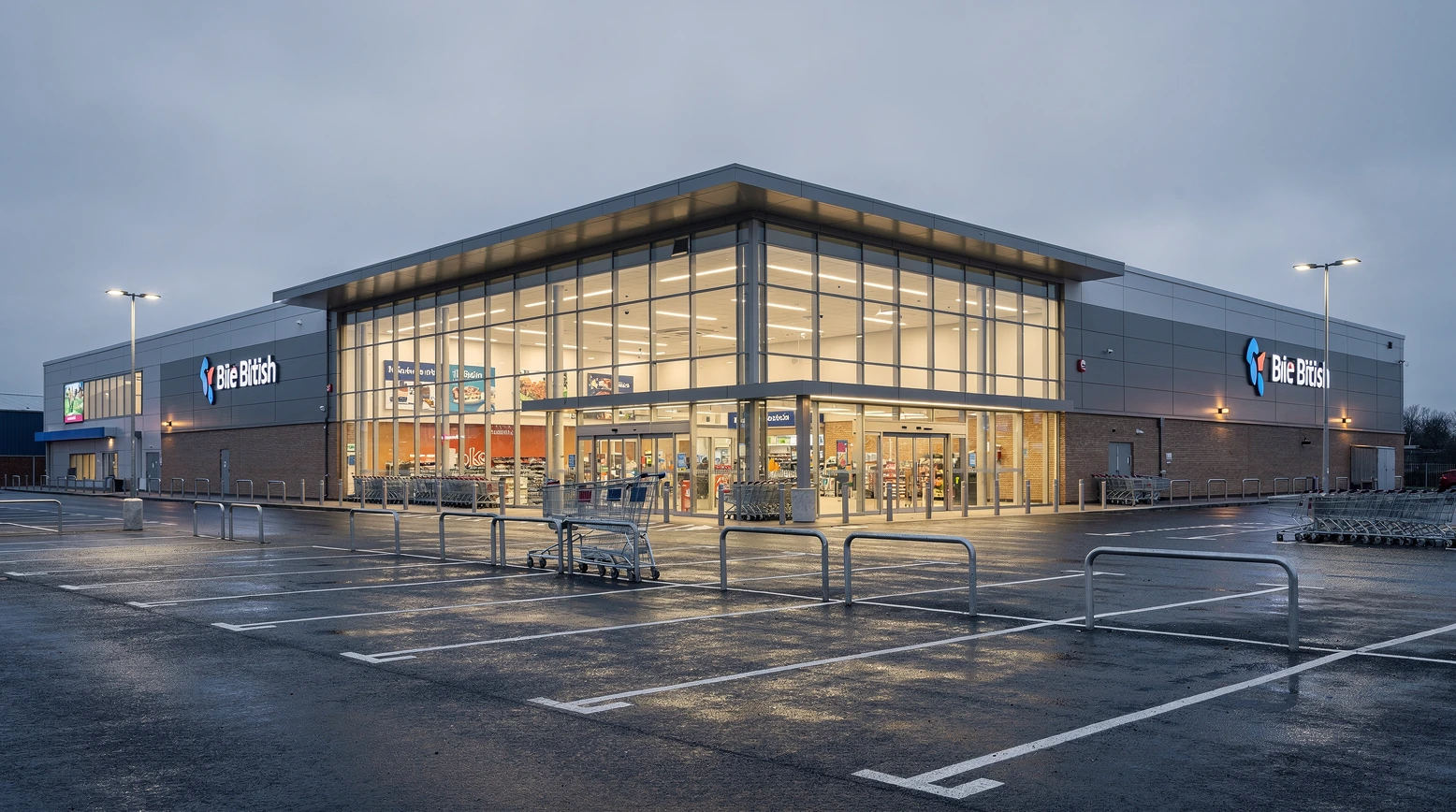
Morrisons, the UK’s fifth-largest supermarket chain, is in early talks with the American property giant Realty Income over a financing deal worth around GBP 600 million (about USD 803 million at current rates, roughly USD 1.34 to the pound), according to Sky News. The discussions center on money raised against a portfolio of the grocer’s freehold stores rather than an outright sale, and no agreement is understood to be close.
The report, published on Monday and subsequently carried by Reuters, positions Realty Income as one of a small number of parties in conversation with advisers to the Bradford-based retailer. It is the clearest sign yet that Morrisons intends to convert some of the value locked in its bricks and mortar into cash to support a turnaround that is still a work in progress under its private equity owner.
In short
- The talks: Morrisons is discussing a roughly GBP 600 million (about USD 803 million) financing arrangement secured against a group of its stores, per Sky News.
- The counterparty: Realty Income, a large US net-lease real estate investment trust, is one of a small number of parties reportedly in talks; no deal is close.
- The structure: The arrangement is unlikely to be a conventional sale-and-leaseback and may instead take the form of borrowing secured on a store portfolio.
- The motive: Morrisons owns the freehold on close to 80% of its estate, among the highest shares in UK grocery, giving it an unusually large pool of property to borrow against.
- The backdrop: Owner Clayton, Dubilier & Rice has cut Morrisons’ debt from about GBP 6.2 billion toward GBP 3.2 billion since 2021, and fresh property funding would extend that repair job.
What Morrisons and Realty Income are discussing
The core of the report is straightforward. Morrisons has been examining ways to raise money against its property estate, and Realty Income is among the investors it has been talking to. Sky News put the likely size of a transaction at around GBP 600 million, below the figures approaching GBP 1 billion that had circulated earlier in 2026.
Crucially, the parties are not described as negotiating a simple sale of stores. Instead, the arrangement is expected to be structured as financing secured against a defined group of supermarkets. That distinction matters because it changes how the deal would show up on Morrisons’ balance sheet and what control the grocer retains over the sites in question.
Morrisons brought in the real estate adviser CBRE around six months ago to examine its options, according to the report. The engagement of an external adviser signals that the company has been running a considered process rather than reacting to a single approach, even if the talks with Realty Income remain preliminary.
A Morrisons spokesperson was not quoted confirming specific terms, and neither company has announced a transaction. Readers should treat the GBP 600 million figure as a reported estimate of scale, not a signed number, until either side formalizes anything.
Why the amount landed below GBP 1 billion
Earlier speculation had pointed to a larger raise, closer to GBP 1 billion, tied to Morrisons’ property. The reported shift toward roughly GBP 600 million suggests a more targeted transaction covering a specific slice of the estate rather than a wholesale monetization.
A smaller deal is also easier to price and finance in a market where lenders and property investors remain selective. Keeping the raise proportionate limits how much rent Morrisons would commit to paying in future, and how much of its freehold advantage it gives up in one move.
Why the talks are only one of several conversations
Realty Income is described as one of a small number of parties in discussions, not the exclusive bidder. That framing is typical of an early-stage process where a company tests appetite across multiple counterparties before narrowing to a preferred partner.
For Morrisons, running parallel conversations preserves negotiating leverage on rate, tenor and the size of the store pool. For Realty Income, it means the deal is far from guaranteed even if the US group is a natural fit given its existing UK footprint.
Why Morrisons is raising money against its stores now
Morrisons sits in an unusual position among British grocers because it owns so much of its own property. The company holds the freehold on close to 80% of its estate, one of the highest ownership shares in the industry. That gives it a large, financeable asset base that rivals leaning on leased space simply do not have.
Property monetization is a familiar lever for retailers that want cash without issuing equity or taking on unsecured debt. By borrowing against or selling the income from stores it already operates, a grocer can free up capital while continuing to trade from the same sites.
The timing reflects where Morrisons is in its recovery. The chain has spent the past few years cutting debt and stabilizing sales, and additional low-cost, asset-backed funding would give management more room to invest in prices, stores and loyalty without stalling the deleveraging story.
There is also a competitive dimension. UK grocery remains a brutal margin business, a pressure visible across the sector and echoed in the way supermarket operators from Britain to India are being squeezed, as covered in our reporting on DMart’s cooling revenue growth and thin retail margins. Cheap capital secured on property can help fund the price investment needed to defend share.
How the deal differs from a classic sale-and-leaseback
The reported structure is what makes this transaction interesting to watch. A conventional sale-and-leaseback involves selling a store outright to an investor and then renting it back under a long lease, usually for 20 to 30 years with index-linked rent reviews. The retailer gets cash today and a rent bill for decades.
Sky News indicates the Morrisons arrangement is unlikely to follow that template. Financing secured against a group of stores can preserve more of the retailer’s ownership and optionality while still delivering upfront cash, depending on how the security and any income rights are drawn.
What financing-against-stores can look like
In practice, a property-backed financing can range from a secured loan to a structure where an investor buys a stream of store income for a set number of years. Morrisons has used the latter approach before, paying an investor for the right to receive future income on part of its estate.
The key variables are how much control Morrisons keeps, whether the stores leave its balance sheet, and what happens at the end of the term. A financing that keeps freeholds on the books but pledges them as security is very different from a sale that hands ownership to a landlord permanently.
Why the structure matters for Morrisons’ balance sheet
Accounting treatment drives a lot of these decisions. A sale-and-leaseback typically removes the asset but adds a long-term lease liability, while a secured financing keeps the asset and adds debt. Each has different consequences for reported leverage, covenants and future flexibility.
For a private equity owned business focused on cutting headline debt, the choice of structure is not cosmetic. It shapes how the market and lenders read the company’s balance sheet, and how much of the freehold advantage remains available for future use.
Who is Realty Income and why it wants UK supermarkets
Realty Income is one of the largest net-lease real estate investment trusts in the world, a member of the S&P 500 that markets itself to shareholders as a dependable monthly dividend payer. Its model is built on owning single-tenant commercial properties let on long leases to established operators, with grocery among its favored sectors for its defensive, non-discretionary demand.
The US group has expanded aggressively in the United Kingdom and Europe in recent years, drawn by long leases, inflation-linked rents and creditworthy tenants. According to Sky News, Realty Income has built a substantial UK retail-property presence through agreements covering sites operated by Asda, Tesco, Sainsbury’s and Waitrose.
Supermarkets appeal to a landlord like Realty Income precisely because they are hard to displace. A large grocery store anchored in a community, trading profitably, tends to renew its lease and keep paying rent through economic cycles, which is exactly the income profile a monthly-dividend REIT is built to deliver.
How a Morrisons deal fits Realty Income’s strategy
A financing or income deal tied to Morrisons freeholds would slot neatly into Realty Income’s UK grocery ambitions. It would add exposure to another of Britain’s national supermarket brands and deepen a portfolio already spread across the country’s biggest grocers.
The appeal runs both ways. Morrisons gets an experienced, well-capitalized counterparty that understands grocery property, and Realty Income gets scale with a tenant that operates the sites and has strong incentives to keep them trading.
Why the UK keeps drawing US property capital
American investors have poured capital into British commercial property in recent years, attracted by valuations that look cheap relative to the United States and by the sterling weakness that lowers the entry price for dollar buyers. Grocery real estate, with its long leases and inflation linkage, has been one of the most sought-after slices of that market.
Net-lease specialists in particular prize the predictability of supermarket income. Unlike shopping centers or offices, a well-located food store faces limited direct competition on its doorstep and serves demand that holds up in downturns, which supports the steady rent collection these landlords promise their own shareholders.
That structural demand explains why a chain like Morrisons can expect competitive terms even in a cautious lending environment. The scarcity is not of capital chasing prime grocery property but of operators willing to pledge or sell the freeholds that back it.
Morrisons’ debt and turnaround under CD&R
To understand why property funding is on the table, it helps to trace Morrisons’ recent history. The chain was taken private by the US buyout firm Clayton, Dubilier & Rice in 2021 in a deal worth around GBP 10 billion including debt, one of the largest UK leveraged buyouts of that period.
The acquisition loaded Morrisons with a heavy debt burden just as interest rates began to climb, which squeezed the business and made deleveraging the central task of the years that followed. Management has since made steady progress reducing what it owes.
Morrisons has cut its debt from about GBP 6.2 billion toward GBP 3.2 billion, repaying roughly GBP 2.4 billion and lowering the pile by close to 40% since the buyout, according to industry reporting. Fresh property financing would extend that trajectory by substituting cheaper, asset-backed money for more expensive debt.
What the turnaround looks like operationally
Chief executive Rami Baitieh, who joined from the French retailer Carrefour in 2023, has focused on value, availability and loyalty as the levers to win customers back. The company has reported a run of consecutive sales-growth periods as those measures took hold.
In its second quarter of 2026, Morrisons delivered like-for-like sales up 2.2% and total sales up 1.7% to GBP 4 billion in the 13 weeks to 26 April, extending a streak of consecutive growth periods. The direction of travel is positive even if the pace remains modest against faster-growing rivals.
Investment is the other side of deleveraging. Getting prices, ranges and store standards right requires capital, and the grocery sector’s costly experiments with automation, including the reset facing large automated fulfillment centers detailed in our analysis of automated grocery fulfillment and Ocado’s model, show how quickly capex can outrun returns. Low-cost property funding helps square that circle.
The precedent: paying for store income
Morrisons has monetized property income before. In 2024 the company completed a transaction with an investment partner under which it received upfront cash in exchange for the right to future income from a group of its supermarkets over a long period, a structure that raised money without a conventional sale.
That deal covered income rights on roughly 75 supermarkets across several decades, and demonstrates that Morrisons is comfortable using its freeholds creatively. The current talks with Realty Income look like a continuation of the same playbook rather than a departure from it.
| Morrisons milestone | Figure | Context |
|---|---|---|
| CD&R buyout (2021) | ~GBP 10bn | Take-private including debt |
| Debt at peak | ~GBP 6.2bn | Post-buyout leverage |
| Debt more recently | ~GBP 3.2bn | Down roughly 40% |
| Debt repaid | ~GBP 2.4bn | Cumulative reduction |
| Q2 2026 total sales | GBP 4.0bn | 13 weeks to 26 April, up 1.7% |
| Q2 2026 like-for-like | +2.2% | Consecutive growth streak |
| Freehold estate share | ~80% | Among highest in UK grocery |
| Reported financing talks | ~GBP 600m | With Realty Income, per Sky News |
Where Morrisons sits in the UK grocery market
Morrisons operates around 500 stores and employs roughly 95,000 people, making it a national player but a distant challenger to the market leaders. Its share of the UK grocery market has hovered in the mid-8% range in recent Kantar readings, stabilizing after years of slow decline.
The competitive backdrop is defined by two forces: the dominance of Tesco and Sainsbury’s at the top, and the relentless expansion of the German discounters Aldi and Lidl at the value end. Morrisons has been squeezed between them, which is why defending share is central to its strategy.
Peers are posting solid numbers of their own, with the strength of the traditional big-four grocers evident in Sainsbury’s run of grocery market-share gains. That makes Morrisons’ need to invest, and to fund that investment efficiently, all the more pressing.
The pressure is not unique to Britain. Grocers across developed markets are wrestling with price sensitivity, thin margins and the cost of technology, themes explored in our piece on the price-and-tech reset facing US grocery. Property-backed capital is one of the few low-cost funding routes available to a chain that owns its stores.
| UK grocer | Approx. grocery share | Ownership |
|---|---|---|
| Tesco | ~28% | Public (LSE) |
| Sainsbury’s | ~15% | Public (LSE) |
| Asda | ~12% | Private |
| Aldi | ~10% | Private (discounter) |
| Morrisons | ~8.5% | Private (CD&R) |
| Lidl | ~8% | Private (discounter) |
Share figures are approximate and move between Kantar reporting periods; they are shown to illustrate the competitive order rather than to fix a precise number for any single week.
What a freehold-backed raise means for the sector
Morrisons’ move is part of a broader pattern in which private capital is being deployed into the property beneath UK retailers. Investors want long, inflation-protected income streams, and grocers sitting on valuable freeholds are a natural source of them.
That flow of capital into UK operating assets has been a recurring theme, visible in transactions from grocery real estate to airline take-privates such as the deal covered in our report on easyJet backing Apollo’s GBP 5.7 billion takeover. Overseas funds continue to see British corporate and property assets as attractively valued.
For rivals, a successful Morrisons financing would reinforce sale-and-leaseback and property-backed lending as standard tools of the trade. Asda has already leaned on leaseback deals to manage its own balance sheet, and other owners may follow if the pricing on offer is attractive.
The trade-off every grocer weighs
Monetizing property is not free money. Whatever cash a retailer raises today is paid for through future rent or interest, and selling freeholds outright surrenders an asset that can appreciate and provides strategic flexibility.
The art is in doing enough to fund the business without hollowing out the balance sheet. Morrisons’ reported preference for financing over an outright sale suggests management is trying to keep that balance, drawing on its property strength without giving away the estate that underpins it.
What the talks signal for Morrisons’ strategy
Read in isolation, a GBP 600 million property raise is a financing detail. Read alongside the rest of Morrisons’ recent moves, it looks like the next step in a deliberate strategy of using the balance sheet to buy time and firepower for a turnaround that is finally showing results.
The company’s central problem since 2021 has been simple to state and hard to solve: it needed to service a large debt load while also investing enough to keep pace with sharper rivals. Every pound spent cutting prices or refreshing stores is a pound not available to pay down borrowings, and vice versa.
Property monetization is the lever that can ease that tension. If Morrisons can swap expensive debt for cheaper, asset-backed money, it lowers its interest bill and frees cash for the shop floor without diluting its owner or breaching covenants.
The customer and supplier angle
For shoppers, the immediate effect of a financing deal would be invisible, but the second-order effect matters. Funding that supports continued price investment helps Morrisons stay competitive on the shelf-edge prices that decide where households do their weekly shop.
Suppliers watch balance-sheet moves closely because a grocer’s financial health shapes payment terms and promotional budgets. A transaction that strengthens Morrisons’ liquidity is broadly reassuring for the thousands of producers and brands that depend on its shelves for volume.
How rivals and landlords will interpret it
Competitors will read the talks as confirmation that Morrisons intends to keep fighting on price rather than retrenching. That has implications for the whole market, because sustained price investment by one national chain pressures margins across the big grocers.
Property investors, meanwhile, will treat a completed deal as a fresh data point on the value of UK grocery real estate. Each transaction helps set the benchmark yields and rents that frame the next one, which is why landlords track these processes even when they are not directly involved.
How the 100 Morrisons Daily closures fit into this
Search results often bolt these two stories together, and it is worth separating them. In May 2026 Morrisons said it was looking at closing around 100 convenience shops. That programme is not the same thing as the freehold supermarkets being lined up for property financing.
The shops in question trade as Morrisons Daily. Most came into the business with the McColls acquisition in 2022, and Morrisons has said they had been loss making for years. The company pointed to rising costs from the higher national living wage and employer National Insurance, called the decision tough but necessary, and warned that hundreds of jobs were at risk. The first to close was the Morrisons Daily in Woodley, Reading, which shut on 12 July 2026.
The GBP 600 million talks sit at the other end of the estate. Realty Income wants large freehold supermarkets that produce predictable rent, not small leasehold convenience units. A shop on the closure list is therefore unlikely to be a store in the financing pool.
Read together they point the same way, even though they are separate transactions. Morrisons is trimming the parts of the estate that lose money and raising cheaper money against the parts that do not. It is worth noting that Morrisons still says it has a robust expansion plan for 2026 and room to open more franchise stores.
Risks, unknowns and what to watch next
The most important caveat is that this is a report of early talks, not a signed deal. Sky News is explicit that no transaction is close, and preliminary conversations of this kind can widen, shrink or collapse before anything is announced.
Key unknowns include the final size of any raise, which stores would be pledged or sold, the cost of the money, and whether Realty Income or another party ends up as the counterparty. The reported GBP 600 million is a scale estimate, and the eventual figure could differ.
There is also execution risk in the wider turnaround. Sales growth has resumed but remains modest, discounters keep expanding, and food inflation and cost pressures continue to test margins across the sector.
Investors and suppliers will watch for a formal statement from Morrisons or Realty Income, any change in the reported deal size, and how any proceeds are deployed, whether toward further debt reduction, price investment or store improvements. Until then, the story is a credible signal of intent rather than a completed transaction.
Frequently asked questions
What exactly are Morrisons and Realty Income discussing?
According to Sky News, Morrisons is in early talks with Realty Income and a small number of other parties over a financing deal worth around GBP 600 million (about USD 803 million) secured against a portfolio of its stores. No agreement is close, and neither company has announced a transaction.
Is this a sale-and-leaseback of Morrisons stores?
Reportedly not in the conventional sense. Sky News indicates the arrangement is unlikely to follow a typical sale-and-leaseback structure and may instead take the form of financing secured against a group of stores, which can preserve more of the retailer’s ownership than an outright sale.
Why does Morrisons own so much of its property?
Morrisons holds the freehold on close to 80% of its estate, one of the highest ownership shares in UK grocery. That large, financeable asset base is precisely what makes property-backed funding an option for the company.
Who owns Morrisons?
The US private equity firm Clayton, Dubilier & Rice took Morrisons private in 2021 in a deal worth around GBP 10 billion including debt. The company has since focused heavily on reducing the debt taken on in that buyout.
How much debt has Morrisons repaid?
Industry reporting indicates Morrisons has cut its debt from about GBP 6.2 billion toward GBP 3.2 billion, repaying roughly GBP 2.4 billion and lowering the total by close to 40% since the 2021 buyout. Fresh property financing would support further reduction.
Who is Realty Income?
Realty Income is one of the world’s largest net-lease real estate investment trusts, an S&P 500 member that markets itself as a monthly dividend payer. It owns single-tenant properties on long leases and has built a substantial UK presence, including grocery sites, per Sky News.
How is Morrisons performing right now?
In its second quarter of 2026, Morrisons reported like-for-like sales up 2.2% and total sales up 1.7% to GBP 4 billion in the 13 weeks to 26 April, extending a streak of consecutive growth periods under chief executive Rami Baitieh. Its grocery market share has stabilized in the mid-8% range.
Has Morrisons done a property deal like this before?
Yes. In 2024 Morrisons completed a transaction under which it received upfront cash in exchange for the right to future income from a group of roughly 75 supermarkets over several decades, showing it is willing to monetize property income without an outright sale.
When will we know if a deal happens?
There is no set timeline. The talks are described as preliminary and no deal is close, so a formal announcement would depend on Morrisons agreeing terms with Realty Income or another party. Until then, the reported GBP 600 million figure should be treated as an estimate of scale.