
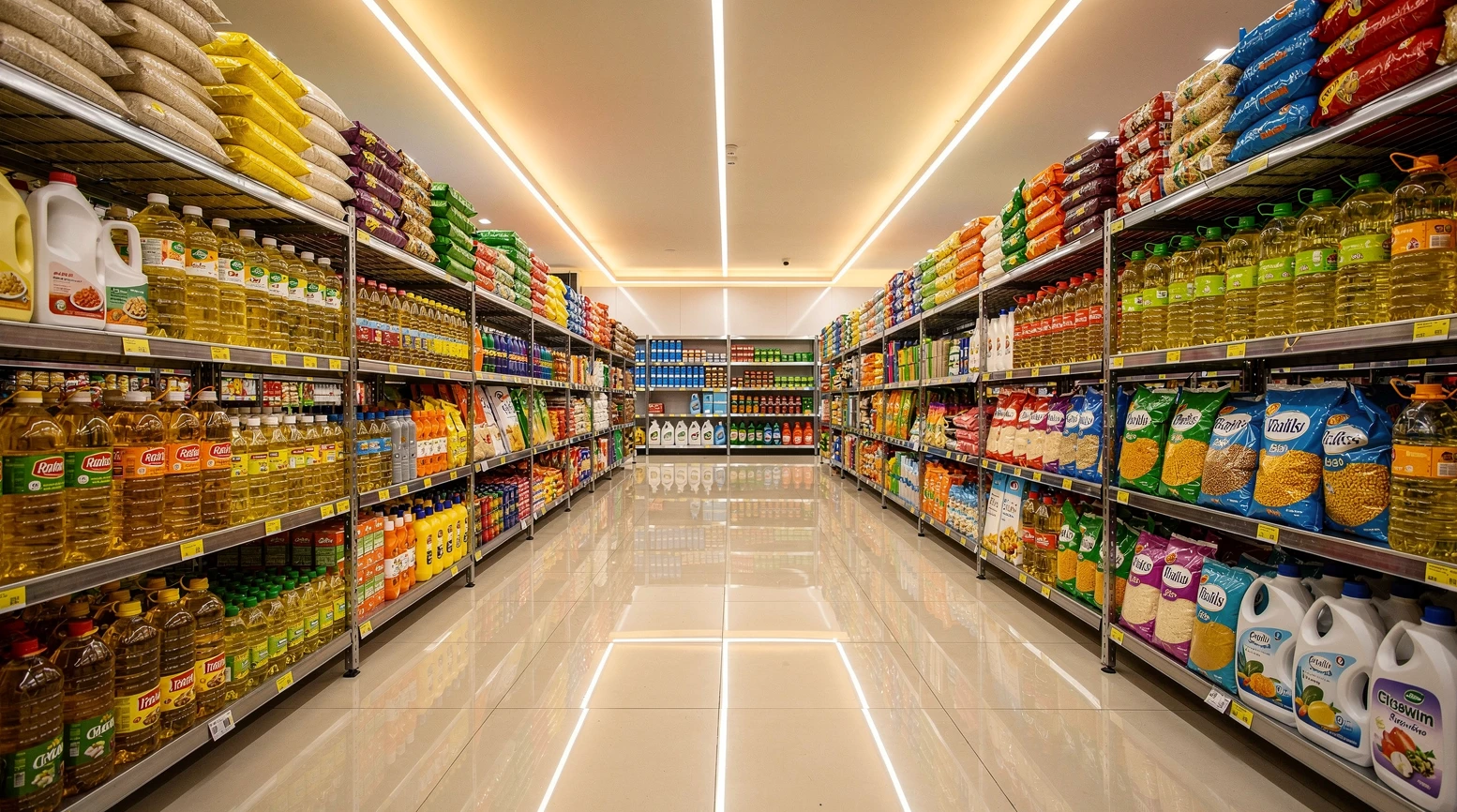
Avenue Supermarts, the company that operates India’s DMart value grocery chain, reported an 11 percent rise in first-quarter net profit on Saturday, a result that landed below what most brokerages had penciled in and underlined how the country’s most disciplined bricks-and-mortar retailer is now grinding rather than sprinting. The numbers, released after Indian markets closed for the week, covered the three months to June 30, 2026, the opening quarter of the company’s 2026-2027 financial year.
On the headline lines, DMart still looks like the steady compounder investors have prized for a decade. Standalone revenue from operations rose about 15 percent year on year to 18,343.49 crore rupees (roughly USD 1.92 billion at an exchange rate of about 95.5 rupees to the dollar), and the store count climbed to 503 outlets. Yet the pace of both sales and profit growth has cooled from the high-teens and low-twenties rhythm the chain posted in earlier years, and that deceleration, not the absolute figures, is what analysts seized on.
The quarter is the first full three-month period reported under the retailer’s new leadership. Anshul Asawa, who took over as managing director and chief executive after founder-era veteran Neville Noronha stepped down in January 2026, offered a measured commentary, pointing to a slight improvement in gross margin and costs that were broadly in line with business growth. The subtext, familiar to anyone tracking Indian retail this year, is a value chain defending its turf against quick-commerce apps, sticky food inflation, and a consumer who is trading carefully.
In short
- Profit up about 11 percent: DMart’s Q1 FY27 net profit rose roughly 11 percent year on year to a little over 900 crore rupees (about USD 96 million), according to initial results coverage, undershooting the 930 to 965 crore rupee range brokerages had forecast.
- Revenue growth cooled to 15 percent: Standalone revenue reached 18,343.49 crore rupees (about USD 1.92 billion), up 15.13 percent, one of the slower quarterly growth rates the chain has posted.
- Quick commerce is the pressure point: Rapid-delivery apps in India’s big cities are chipping at the metro shopper DMart relies on, weighing on same-store productivity.
- New CEO, same playbook: Anshul Asawa flagged a slight gross-margin improvement and disciplined costs, signaling continuity of the everyday-low-price model rather than a strategic reset.
- Fundraising on the agenda: The board also weighed raising money through debt securities on a private-placement basis, a rare move for a company that has historically funded growth from cash flow.
What DMart actually reported this quarter
The reported quarter tells a story of solid top-line expansion paired with profit that grew, but not as fast as the market wanted. Investors have grown used to DMart converting revenue growth into faster earnings growth through operating leverage. This quarter, that leverage looked thinner.
The revenue line
Standalone revenue from operations came in at 18,343.49 crore rupees, up 15.13 percent from 15,932.12 crore rupees in the same quarter a year earlier. In dollar terms that is a jump from roughly USD 1.67 billion to about USD 1.92 billion. The figure was consistent with the preliminary business update the company had put out in early July, so it did not surprise the market by itself.
What matters is the trajectory. DMart’s quarterly revenue growth has drifted down from the low-twenties percentages of a few years ago into the mid-teens. A 15 percent print is respectable for a retailer of this scale, but it is a clear step below the growth that supported DMart’s premium valuation.
The profit line
Net profit rose about 11 percent year on year, to a little over 900 crore rupees (about USD 96 million) on a standalone basis, according to initial results coverage, up from roughly 830 crore rupees a year earlier. That growth rate sat below the 12 to 16 percent range that brokerages such as Axis Securities, Antique Stock Broking, and Kotak had modeled, and below the 930 to 965 crore rupee profit band the Street had expected.
The gap between an 11 percent actual and a 12 to 16 percent forecast may look small, but for a stock priced for consistency, missing the low end of the consensus range is the kind of detail that moves sentiment. It reinforces a worry that has hung over the shares all year: that DMart’s growth engine is downshifting just as competition intensifies.
| Metric (standalone) | Q1 FY27 (Jun 2026) | Q1 FY26 (Jun 2025) | Change |
|---|---|---|---|
| Revenue from operations | 18,343.49 crore rupees (about USD 1.92bn) | 15,932.12 crore rupees (about USD 1.67bn) | +15.13% |
| Net profit | about 900 crore-plus rupees (about USD 96m) | about 830 crore rupees (about USD 87m) | about +11% |
| Store count | 503 | fewer than 420 (a year earlier) | net additions continue |
| Revenue growth pace | 15.13% | about 16% | decelerating |
Figures are drawn from the company’s business update and initial results coverage; the exact reported net profit should be read against the roughly 11 percent growth cited by early reports. Dollar conversions use an approximate rate of 95.5 rupees per US dollar from the same period.
Why the profit number missed the Street
Three forces sit behind the softer profit growth, and none of them are new. Together they explain why a 15 percent revenue rise did not drop through to a faster bottom line.
First, gross margins in Indian food and grocery retail have been squeezed by competitive intensity in fast-moving consumer goods. DMart’s edge has always been buying cheap and passing savings on, but when branded FMCG makers and rival retailers all chase the same value-conscious shopper, the room to expand percentage margins narrows.
Second, operating costs rise as DMart pushes into newer, smaller cities where store economics take longer to mature. A store in a fresh cluster does not throw off the same productivity as a decade-old outlet in a dense Mumbai suburb, so a growing share of newer stores can dilute the blended numbers.
Third, the mix of what shoppers buy matters. When households tighten, they lean toward staples and away from higher-margin general merchandise and apparel, a category where DMart earns better margins. A staples-heavy basket protects footfall but pressures profitability, a pattern that echoes the demand caution seen across global consumer names as US snacking demand cooled at PepsiCo earlier in the reporting season.
How quick commerce is reshaping DMart’s core market
The single biggest structural question hanging over DMart is quick commerce. India’s rapid-delivery apps have gone from a curiosity to a genuine channel shift in dense urban markets, exactly where DMart’s large-format value stores earn their keep.
The scale of the shift is hard to ignore. India’s quick-commerce sector has been expanding at breakneck speed, with the number of dark stores multiplying to serve ten-minute delivery promises. Coverage of that build-out shows how India’s quick-commerce order volumes grew around 40 percent as dark stores jumped 48 percent, a pace that dwarfs the growth of traditional store-based grocery.
Where the two models collide
DMart wins on price and basket size. A family stocking up for the month still finds a large DMart run cheaper than dozens of small quick-commerce orders. Quick commerce wins on convenience and the top-up trip, the small mid-week basket a shopper once might have driven to DMart to fill.
The risk for DMart is not that quick commerce steals the monthly stock-up. It is that convenience apps skim the incremental trips, the impulse buys, and the younger metro shopper who never builds the DMart habit in the first place. Over years, that erosion shows up as slower same-store growth, precisely the metric analysts flagged this quarter.
DMart’s answer
DMart’s response has been characteristically unflashy. It leans on DMart Ready, its online grocery arm, for scheduled and pickup orders rather than chasing ten-minute delivery economics that burn cash. Management has repeatedly signaled it will not sacrifice profitability to match quick-commerce delivery speeds, betting that value and reliability win over the long run.
| Dimension | DMart value model | Quick-commerce model |
|---|---|---|
| Core promise | Lowest price, large basket | Speed and convenience |
| Typical basket | Monthly stock-up, staples | Small top-up, impulse |
| Unit economics | Profitable, owned stores | Often loss-making, cash-hungry |
| Real estate | Large owned outlets | Small leased dark stores |
| Growth funding | Internal cash flow | External capital, subsidies |
| Margin profile | Thin but positive | Negative at delivery level |
What new CEO Anshul Asawa signaled
This was an important quarter for Anshul Asawa, running his first full three-month period as managing director and chief executive after Neville Noronha’s long tenure ended in January 2026. The market wanted to know whether the new leadership would tweak the model or hold the line.
Asawa’s commentary suggested continuity. He noted that gross margins saw a slight improvement over the prior period and that costs were largely in line with business growth, the sort of steady, understated language that has long defined DMart’s investor communication. There was no hint of a strategic pivot toward aggressive delivery spending or discount-led market-share grabs.
Continuity as a strategy
For a business built on operational discipline, continuity is arguably the right message. DMart’s founder, Radhakishan Damani, built the chain on a simple formula: own your stores, keep costs brutally low, buy in bulk, and pass the savings to shoppers. Changing that formula under competitive pressure would be a bigger risk than staying the course.
The bet Asawa is making is that quick commerce cannot indefinitely fund losses to win convenience trips, and that when the subsidies fade, DMart’s low-cost value proposition will still stand. Whether the market gives him the patience to prove that thesis is a separate question.
The margin story and the Indian consumer
Underneath the quick-commerce headlines sits a more basic issue: the health of the Indian mass-market consumer. DMart’s shopper is value-first, and value-first shoppers behave predictably when prices rise and incomes stay flat.
Food inflation has kept staples spending resilient, which supports revenue but does little for margins. Discretionary categories, the general merchandise and apparel that carry richer margins, have been the softer spot as households prioritize essentials. That mix effect is a recurring theme in DMart’s recent quarters and a big reason profit growth has trailed revenue growth.
Data and loyalty as the next lever
One area where store-based grocers globally are trying to claw back margin is first-party data and retail media, turning shopper information into advertising revenue. The playbook is well established in the West, where the grocery loyalty relaunch wave has become a retail-media data grab. DMart has historically been light on loyalty programs, a deliberate choice to keep costs down, but the monetization opportunity is one to watch as it scales its digital footprint.
How DMart compares with Indian retail peers
DMart’s quarter did not happen in isolation. India’s listed retailers have been reporting a mixed set of results, and the read-across matters for how investors judge the sector.
The most telling comparison came from Tata Group’s Trent, whose fashion-led model had been the market darling. When Trent’s shares crashed about 12 percent on a Q1 revenue miss as its Zudio engine cooled, it signaled that even the highest-flying Indian retail growth stories are hitting a demand ceiling. DMart’s steadier, value-led model looks defensive by comparison, but it is not immune to the same consumer caution.
The festive and price-war backdrop
Competition in Indian retail is not limited to quick commerce. The large online marketplaces run aggressive seasonal events that pull discretionary spending online. When Amazon and Flipkart reopened India’s price war with July mega-sales, they underscored how much of the discretionary basket now moves through digital channels during promotional peaks, another reason DMart leans on everyday staples rather than event-driven bursts.
| Retail model in India | Growth driver | Q1-season signal |
|---|---|---|
| DMart (value grocery) | Staples, price, store expansion | Steady 15% revenue, profit miss |
| Trent (value fashion) | Zudio store rollout | Revenue miss, shares fell sharply |
| Quick commerce (Blinkit, Zepto, Instamart) | Convenience, dark-store density | 40%-plus order growth, cash burn |
| Marketplaces (Amazon, Flipkart) | Discretionary, festive sales | Renewed discount war |
The debt fundraise and expansion plans
Alongside the results, the board evaluated a proposal to raise funds through the issuance of debt securities on a private-placement basis. For most large companies this would be routine. For DMart it is notable, because the chain has historically funded its owned-store expansion largely from internal accruals rather than borrowing.
A move toward debt, even a modest one, can be read two ways. Optimistically, it signals confidence to accelerate store additions and lock in real estate while rivals burn cash on delivery. Cautiously, it hints that self-funding may no longer keep pace with the capital intensity of expansion in a more competitive market.
Why owned stores still matter
DMart’s insistence on owning rather than leasing its stores is central to its cost advantage. Owned property removes rent inflation from the cost base and lets the chain price more aggressively than lease-heavy rivals. The trade-off is that ownership ties up capital, which is exactly the tension a debt raise would ease.
With 503 stores as of the end of June, DMart still has a long runway across India’s smaller cities. The question is whether it can keep opening owned outlets at a pace that reignites growth without eroding the balance-sheet discipline that underpins its premium rating.
The everyday-low-price engine, explained
To understand why an 11 percent profit rise counts as a disappointment, it helps to understand what makes DMart different from almost every other retailer in India. The chain is not built to grow fast in bursts. It is built to grind out low prices year after year, and that engine has a few distinct parts.
Procurement and scale
DMart buys in bulk and pays suppliers quickly, using prompt payment to negotiate deeper discounts than rivals who stretch their payables. Those savings flow into shelf prices, which drives volume, which in turn strengthens buying power. It is a virtuous loop that rewards scale and punishes anyone trying to undercut on price without the same volumes.
Owned stores and the rent advantage
Most Indian retailers lease their space, exposing them to years of rising rent. DMart, by contrast, owns the majority of its outlets. That decision consumes capital up front but removes a large, inflating cost from the model forever. In a quarter where rivals feel rent and wage pressure, DMart’s owned base is a quiet buffer that protects its ability to keep prices low.
A deliberately narrow range
DMart stocks a tighter assortment than a typical hypermarket, concentrating on fast-moving essentials that turn over quickly. Fewer slow-selling lines mean less capital tied up in inventory and higher sales per square foot. This discipline is exactly why the creeping loss of small top-up trips to quick commerce matters, because those trips are the high-frequency purchases the model is optimized to capture.
A decade of compounding meets a tougher market
For much of the past decade, DMart was the stock that seemed to defy gravity, compounding revenue and profit at rates that justified one of the richest valuations in global grocery retail. That history is precisely why the current deceleration attracts so much scrutiny.
When a company is priced for 20 percent-plus compounding and delivers mid-teens revenue growth with single-digit-to-low-double-digit profit growth, the math on the valuation gets harder. The business is still excellent by most standards, but excellence measured against its own history is a demanding yardstick.
The market is now asking a question it rarely posed before: is this a temporary air pocket driven by a cautious consumer and a food-inflation mix effect, or a structural step-down as the addressable metro shopper fragments across channels? This quarter did not answer it decisively, which is part of why the reaction has been wary rather than dramatic.
Global lessons: what happens when convenience scales
DMart’s predicament rhymes with battles fought in other markets, and those precedents offer both comfort and warning. In the United States and Europe, hard discounters built durable, profitable businesses on the same value-first logic DMart uses, and they survived waves of e-commerce and delivery disruption by refusing to abandon their cost discipline.
The warning is that convenience, once it scales and normalizes, rarely gives ground back. Shoppers who form a habit of instant delivery for top-up baskets seldom return to the car-and-trolley routine for those trips. Value retailers that weathered this shift did so by owning the stock-up mission so decisively that convenience players could only ever nibble the edges.
DMart’s challenge is to make sure the edges stay edges. If quick commerce remains a top-up channel funded by investor patience, DMart’s owned-store, low-cost fortress should hold. If rapid delivery ever cracks the economics of the larger grocery basket, the competitive picture changes. That is the long-run tension every number in this quarter ultimately points back to.
What the results mean for the stock
DMart shares have had a difficult year, having already slid after the early-July business update as investors digested the slower revenue pace. A profit number at the low end of, or just below, expectations does little to change the near-term narrative.
The bull case rests on longevity: a debt-light, cash-generative, owned-store model with decades of expansion ahead in an underpenetrated market. The bear case is simpler: growth is decelerating, quick commerce is structurally chipping at the metro shopper, and the valuation still assumes faster compounding than the business is currently delivering.
The truth, as often, sits between the two. DMart is not broken, but it is maturing, and a maturing growth stock has to earn its multiple with consistency rather than acceleration. This quarter delivered consistency without the acceleration the market craved.
For long-term holders, the reassuring detail is that the model still throws off cash and still expands its footprint, quarter after quarter, without the boom-and-bust swings that plague less disciplined chains. For traders, the frustration is that steadiness alone no longer surprises anyone, and surprise is what moves a premium stock. The two camps will keep talking past each other until the growth trend either stabilizes or turns.
What to watch next
Several signposts will tell investors whether this quarter marks a trough or a new, slower normal. Same-store sales growth is the first: if productivity at mature stores keeps sliding, the quick-commerce thesis gains weight. Gross margin trend is the second: a durable improvement would validate Asawa’s cost discipline.
The third is the pace and funding of new stores. A visible step-up in openings, financed partly by the mooted debt issue, would suggest management is playing offense. The fourth is any evolution in DMart’s digital and delivery stance, however incremental, as a tell on how seriously it now takes the convenience channel.
For now, DMart remains what it has always been: a disciplined, profitable, value-first retailer navigating a market that is getting harder, not easier. The 11 percent profit rise is neither a crisis nor a triumph. It is the sound of a compounder shifting into a lower, steadier gear.
Frequently asked questions
What did DMart report for Q1 FY27?
Avenue Supermarts, DMart’s parent, reported standalone revenue from operations of 18,343.49 crore rupees (about USD 1.92 billion), up about 15 percent year on year, and net profit growth of roughly 11 percent to a little over 900 crore rupees (about USD 96 million), according to initial results coverage. The quarter covered the three months to June 30, 2026.
Why did DMart’s profit miss expectations?
Brokerages had forecast net profit growth of 12 to 16 percent, roughly 930 to 965 crore rupees. The reported growth of about 11 percent came in below that range, reflecting margin pressure in FMCG, higher costs from newer stores, and a staples-heavy basket that carries thinner margins than discretionary goods.
How is quick commerce affecting DMart?
Rapid-delivery apps are winning the small, frequent top-up trips in dense Indian cities, exactly where DMart’s large-format value stores are concentrated. That erosion pressures same-store productivity over time, even though DMart still wins on price for larger monthly stock-up shopping.
Who is DMart’s CEO now?
Anshul Asawa is managing director and chief executive of Avenue Supermarts. He took over after Neville Noronha, who led the company through its listing and long growth run, stepped down in January 2026. This was Asawa’s first full quarter reporting results.
How many stores does DMart operate?
DMart operated 503 stores as of June 30, 2026, having added a small number of net new outlets during the quarter. The chain continues to expand, favoring owned rather than leased stores to keep its cost base low.
Why is DMart considering raising debt?
The board evaluated raising funds through debt securities on a private-placement basis. DMart has historically funded expansion from internal cash flow, so a move toward debt is notable. It could support faster owned-store expansion, though it also signals that self-funding alone may not match the capital needs of a more competitive market.
How does DMart compare with other Indian retailers this season?
DMart’s steady 15 percent revenue growth looks defensive next to peers such as Trent, whose shares fell sharply on a Q1 revenue miss as its Zudio fashion engine cooled. Across the sector, results point to a cautious Indian consumer and intensifying competition from both quick commerce and online marketplaces.
Is DMart stock a buy after these results?
This article does not offer investment advice. The debate centers on whether DMart’s decelerating growth justifies its premium valuation. Bulls point to a durable, cash-generative, owned-store model with a long expansion runway; bears highlight slowing same-store growth and structural pressure from quick commerce. Investors should weigh both against their own risk tolerance.