
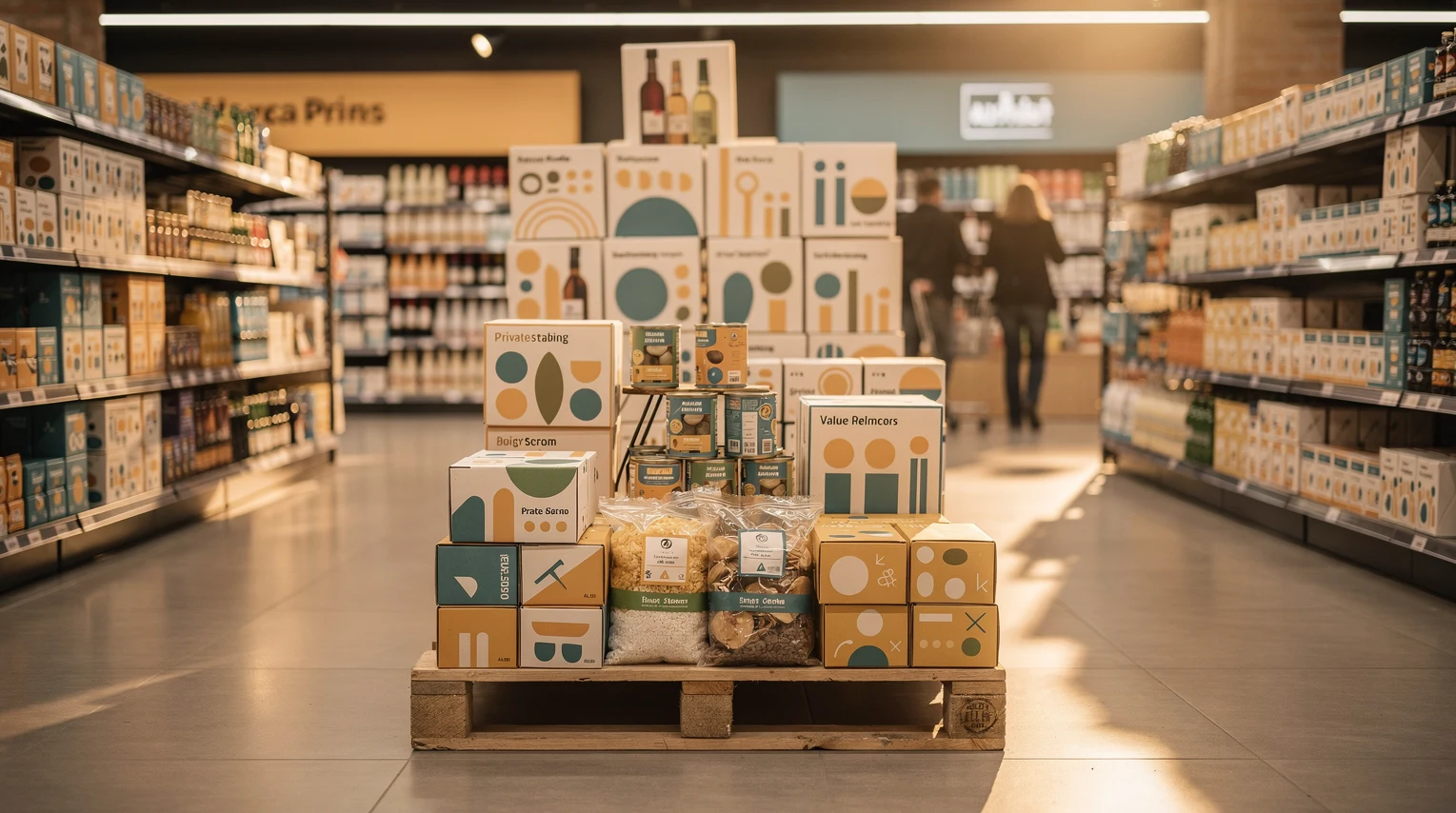
Aldi is the rare discounter that customers brag about. Shoppers who could afford full-price grocery runs choose the limited-assortment, bring-your-own-bag experience on purpose, then post their Aldi Finds hauls online. That loyalty is not an accident of low prices. It is the output of a tightly engineered operating model, and it is the most instructive case in any serious library of retail brand profiles.
Most write-ups credit Aldi’s success to cheapness and stop there. That misses the mechanism. The interesting question for an operator is not why is Aldi cheap but how does Aldi stay cheap and still feel like a treat. The answer lives in deliberate constraints: a short SKU count, near-total private label, hard-coded store labor, and a refusal to spend on the things customers do not see. This profile maps those constraints to numbers and to moves you can test in your own format. For the strategic frame behind it, see our modern brand playbook for retail and e-commerce, which treats positioning as an operating choice rather than a marketing slogan.
In short
- Constraint is the strategy. Aldi carries roughly 1,400-2,000 SKUs versus 30,000-plus at a conventional supermarket, which compresses cost at every step from buying to checkout.
- Private label is the product, not a hedge. Around 90% of what Aldi sells is its own brand, so margin and quality control sit inside the company instead of with national vendors.
- The cult is engineered through scarcity. Weekly Aldi Finds create a treasure-hunt loop that drives repeat visits without paid media.
- Store economics fund the prices. Pallet merchandising, shelf-ready cases, deposit carts, and paid bagging strip out labor that customers were never willing to pay for.
- The model travels. The same playbook scaled across Europe, the US, and Australia, and pieces of it port to non-grocery formats.
What is the Aldi brand actually selling?
Aldi sells trust in a short list. A conventional grocer competes on choice and asks the shopper to do the editing. Aldi does the editing first, stocks one or two strong options per need, and stakes its name on each one being good enough. The promise is simple: if it is on the shelf, it is worth buying, and it is cheaper than the branded equivalent you skipped.
That promise only works because the company controls the product. With private label at roughly 90% of the assortment, Aldi is not reselling someone else’s brand equity, it is building its own on every package. When a shopper likes the Specially Selected pasta sauce or the Simply Nature organics, that affection accrues to Aldi, not to a national CPG vendor who could pull the line tomorrow.
The Aldi origin story sharpens the point. Brothers Karl and Theo Albrecht took over their mother’s shop in postwar Germany and made a bet that ran against retail orthodoxy: cut range, cut frills, pass the savings forward, and let volume do the rest. The chain split in 1960 into Aldi Nord and Aldi Sud (the latter operates the US business and owns Trader Joe’s), but the discipline stayed identical. Decades of consistency, not a clever campaign, built the equity.
How does limited assortment lower cost at every step?
A short SKU count is not a merchandising preference, it is a cost engine that compounds. Each item Aldi chooses not to carry removes buying complexity, shelf space, replenishment labor, spoilage risk, and decision friction at the register. Fewer SKUs also mean larger orders per item, which earns deeper supplier pricing that a long-tail grocer cannot match.
The contrast is stark when you lay it out. The table below compares the operating shape of a hard discounter against a conventional full-range supermarket. The figures are representative industry ranges, not a single company’s audited numbers, and they show why the cost gap is structural rather than promotional.
| Dimension | Hard discounter (Aldi-style) | Conventional supermarket |
|---|---|---|
| Active SKUs | 1,400-2,000 | 25,000-40,000 |
| Private label share | ~90% | 15-25% |
| Average store size | 12,000-15,000 sq ft | 40,000-60,000 sq ft |
| Staff per shift | 3-5 | 15-40 |
| Items scanned per minute | High (shelf barcodes, pallet display) | Moderate |
| Gross margin posture | Low margin, high turn | Higher margin, lower turn |
Read that table as a system, not a list. A smaller box with fewer items needs fewer staff, turns inventory faster, and wastes less, and every one of those savings can be returned as a lower shelf price that pulls more volume, which earns better buying, which lowers price again. That loop is the whole game.
How does Aldi engineer the “cult” feeling?
Loyalty this loud usually costs money. Aldi generates it for nearly free through a single mechanism: manufactured scarcity in the middle of the store. The twice-weekly Aldi Finds aisle stocks rotating, limited-quantity nongrocery goods (cookware, garden tools, fitness gear, seasonal oddities) at sharp prices and never restocks once they sell out.
That creates a treasure-hunt psychology that converts a chore into entertainment. Shoppers visit more often because the assortment changes, they buy on impulse because when it is gone it is gone, and they share their hauls because the finds feel like wins worth posting. The economics are elegant: the finds carry healthy margin, require no long-term shelf commitment, and act as free, customer-generated advertising. If you are mapping which capabilities power this kind of rotating-assortment merchandising, our roundup of tools and vendors for brand profiles in 2026 covers the planning and forecasting stack that makes scarcity feel intentional rather than chaotic.
The cult is reinforced by a deliberately spartan core experience. Quarter-deposit carts, customer bagging, products sold in their shipping cartons, and a near-total absence of in-store theater all signal the same message: every penny not spent on frills is a penny taken off your bill. Customers read the austerity as honesty, and honesty is sticky.
What store economics make the prices possible?
Aldi’s prices are funded on the floor, not in a spreadsheet. The store is designed to remove labor and overhead that shoppers were never willing to subsidize. Walk one and you can read the cost decisions directly off the fixtures.
- Pallet and carton merchandising. Products arrive on pallets or in shelf-ready cases, so stockers drop a box rather than face individual units. This can cut restocking labor by a large margin versus hand-stacking.
- Multi-barcode packaging. Items carry oversized barcodes on several faces so cashiers scan without hunting, which lifts checkout throughput per labor hour.
- Deposit carts. The returnable-coin cart system means the store does not pay anyone to collect carts from the lot.
- Customer bagging. Bagging is offloaded to the shopper at a fast bag-and-go counter, removing a full labor function from the front end.
- Tight footprint. A smaller box costs less in rent, utilities, and cleaning per dollar of sales, and it keeps the assortment shoppable in one quick loop.
None of these are gimmicks. Each one converts a fixed cost into a lower shelf price, and together they let a three- to five-person crew run a store that a conventional grocer would staff with dozens. The real estate side matters too: discounters obsess over site cost because rent is one of the few line items that can quietly erase the margin a lean operation worked to protect. That tension between location quality and occupancy cost is the same one independents wrestle with, as our piece on rent, parking and zoning on main street retail lays out in detail.
How does private label become a moat instead of a cost?
For most grocers, private label is a hedge: a cheaper alternative parked next to the national brand to capture price-sensitive shoppers. For Aldi, private label is the store, and that inversion turns a tactic into a structural advantage.
When you own roughly 90% of your assortment, three things happen. First, you keep the margin that would otherwise route through a brand owner, because there is no brand premium to pay. Second, you control quality, packaging, and reformulation directly, so you can hit a target cost without begging a vendor for terms. Third, you build switching cost: a shopper loyal to Specially Selected or Simply Nature can only get it from you, which is the opposite of competing to sell the same Coca-Cola that the store across the street also stocks.
Aldi has also pushed quality up rather than letting own-brand mean second-rate. Many lines win independent taste and value awards, which dismantles the old assumption that private label is a compromise. That quality-credibility flywheel is the same one that powers ambitious own-brand challengers across categories, and you can see a vivid version of it in our case study on a small skincare brand that scaled to nine figures, where owning the product end to end was the lever for both margin and trust.
What does the model look like at scale?
The clearest proof that this is a system and not a national quirk is its portability. Aldi Sud entered the US in 1976 and has grown into thousands of stores, with aggressive expansion continuing through the mid-2020s as it converts acquired locations and opens new ones. The same lean box, short list, and private-label spine traveled across very different grocery cultures and still worked.
Australia is the textbook example. Aldi entered a market dominated by two entrenched incumbents and forced both to launch their own discount-tier private labels and trim prices, a competitive reset often called the Aldi effect. According to the OECD, grocery markets with strong discount entrants tend to show measurable price discipline across the whole category, which is exactly the pattern incumbents experienced after Aldi arrived. The lesson for operators is that a coherent low-cost model does not just win share, it changes the rules everyone else has to play by.
The scaling math is worth dwelling on because it explains why imitators stall. Aldi does not chase scale for vanity, it needs volume to keep the buying advantage that funds the prices. Every additional store deepens the order quantity behind each of those 1,400 to 2,000 SKUs, which improves cost of goods, which lets the company hold or cut shelf prices, which drives more traffic and justifies the next store. A late entrant cannot leap into the middle of that flywheel. It has to build the volume first, run thin or negative margins through the ramp, and stay disciplined while incumbents undercut it. Most boards lose their nerve before the loop closes, which is why the model is easy to admire and hard to copy.
How does Aldi build trust without a marketing budget?
Aldi inverts the usual demand equation. A conventional retailer buys attention through advertising, then hopes the in-store experience converts it. Aldi does the opposite: it engineers an experience and a price that are worth talking about, then lets customers do the broadcasting. The result is a brand built on earned attention rather than bought attention, which is both cheaper and more durable because trust transferred from a friend outperforms a paid impression.
Three mechanisms carry the load. The price guarantee mentality (consistently low everyday shelf prices rather than a few loss leaders) trains shoppers to stop comparison-checking, which itself is a loyalty behavior. The quality-award proof on own-brand lines gives skeptics permission to switch without feeling cheap. And the social haul culture around Aldi Finds turns the assortment into shareable content that competitors would have to pay influencers to manufacture. Notice that none of these require a media plan, they require operational excellence that happens to be photogenic.
This is the part operators most often get wrong, because it looks like luck. It is not. Aldi spends deliberately on the few signals customers actually evaluate (price, fill rate, own-brand quality) and starves everything else. A retailer that wants the same word-of-mouth lift has to ask a harder question than how much to spend on ads: what about the store is genuinely worth a customer’s recommendation, and is anything in the budget actively undermining it?
What metrics should you watch if you run a discount format?
If you are adapting any of this, vanity metrics will mislead you. Same-store sales and total revenue can both rise while the model quietly breaks. The discount engine lives or dies on a smaller set of operating ratios, and those are what a serious operator instruments first.
| Metric | Why it matters in a discount model | Healthy direction |
|---|---|---|
| SKU count per category | Guards the editing discipline that funds everything | Hold flat or shrink, resist creep |
| Inventory turns | Low margin only works at high velocity | Materially above category norm |
| Private-label penetration | Drives owned margin and switching cost | Steadily rising toward the assortment majority |
| Sales per labor hour | Confirms the labor-out store design is working | Well above conventional benchmark |
| Shrink and spoilage rate | A short list should waste less, not more | Falling, kept below category average |
| Repeat visit frequency | The cult behavior the model is supposed to create | Rising, ideally with no loyalty-card bribe |
Read these together and they tell you whether you are running a discounter or just a thin-margin grocer that happens to be small. The distinction is not academic: the first is defensible, the second gets crushed the moment a real discounter opens nearby. If your private-label penetration is flat, your SKU count is creeping up, and your repeat frequency only moves when you run coupons, you have the costs of a discounter without the moat.
Common mistakes when copying the Aldi model
Plenty of retailers admire Aldi and then import the wrong pieces. The failures tend to repeat.
Cutting frills without cutting SKUs. Removing baggers or shrinking the store while keeping a 30,000-item assortment just creates a cramped, understaffed full-range grocer. The SKU cut is the part that funds everything else, and it is the part most operators flinch on.
Treating private label as a discount line. If own-brand sits in the store as the cheap option next to the real brands, it never builds equity. Aldi works because private label is the default, not the fallback.
Faking scarcity badly. The Aldi Finds loop works because the deals are genuinely good and genuinely limited. Manufactured urgency on mediocre product trains customers to ignore you. Scarcity is a credibility instrument, and it breaks the moment shoppers sense the trick.
Underinvesting in product quality. Low price plus low quality is just a dollar store with extra steps. Aldi’s discipline is low price at trustworthy quality, which is far harder and far more durable.
Ignoring the demand-generation channels. Aldi spends little on traditional advertising, but it is not passive: word of mouth, social hauls, and a sharp value story do the work paid media usually buys. Operators who copy the cost cuts while neglecting how demand actually gets generated end up cheap and invisible, which is a quieter way to fail than a price war but no less fatal.
Frequently asked questions
Is Aldi actually cheaper than other supermarkets, or does it just feel that way?
Independent basket comparisons routinely place Aldi among the lowest-priced grocers in the markets where it operates, often well below conventional supermarkets on like-for-like staples. The savings are structural rather than promotional: they come from a short SKU list, heavy private label, small stores, and lean labor, so the low prices persist week to week instead of relying on rotating coupons or loyalty-card gymnastics that conventional grocers use to feel cheap on a few headline items.
Why does Aldi sell so much of its own brand instead of national brands?
Owning roughly 90% of the assortment lets Aldi capture margin that would otherwise go to a brand owner, control cost and quality directly, and build loyalty that no competitor can match because the products are exclusive. National brands carry an advertising premium baked into their wholesale price, and they can dictate terms. By developing private label as the default rather than a budget alternative, Aldi turns its assortment into proprietary equity instead of a commodity shelf anyone can replicate.
What are Aldi Finds and why do they matter so much?
Aldi Finds are rotating, limited-quantity nongrocery products (cookware, tools, seasonal goods, gadgets) sold at sharp prices and never restocked once they sell out. They matter because they convert a routine grocery trip into a treasure hunt, which lifts visit frequency and impulse purchasing. The scarcity also generates organic social sharing, effectively turning customers into a free marketing channel. Strategically, the finds carry healthy margin and require no permanent shelf commitment, so they boost both traffic and profit.
How does Aldi keep store labor costs so low?
Aldi engineers labor out of the store at the design stage. Products arrive on pallets or in shelf-ready cartons so restocking is fast, oversized multi-face barcodes speed up scanning, returnable-coin carts eliminate cart-collection labor, and customers bag their own groceries. A typical store runs on a crew of three to five rather than the dozens a conventional supermarket needs. Every labor function removed becomes a lower shelf price, which is the core of the discount model.
Can the Aldi model work outside groceries?
Pieces of it travel well. The core logic (edit the assortment for the customer, own the product, strip cost the customer does not value, and use scarcity to drive visits) applies to hardgoods, apparel, beauty, and even some services. What does not travel is cherry-picking: copying the frill cuts without the SKU discipline, or faking scarcity without genuine value, produces a worse store, not a discounter. The model is a coherent system, and partial imports usually fail.
Did Aldi really change how competitors price, or is that a myth?
It is well documented. In several markets, Aldi’s entry pushed entrenched incumbents to launch their own discount-tier private labels and lower prices on staples, a dynamic commonly called the Aldi effect. The pattern is consistent with broader findings that strong discount entrants impose price discipline across a whole category. So the influence is real and measurable: Aldi competes by changing the rules of the market it enters, not just by taking a slice of the existing one.
What’s next
If you are pressure-testing your own positioning, treat the Aldi profile as a checklist rather than a story: where are you carrying SKUs the customer never asked you to edit, and where could owning the product replace reselling someone else’s? The discipline is reproducible even at a fraction of Aldi’s scale. Start by mapping your assortment against your real cost-to-serve, then revisit the structural moves in our modern brand playbook to decide which constraints are worth adopting and which would just make your store cheaper without making it better.