
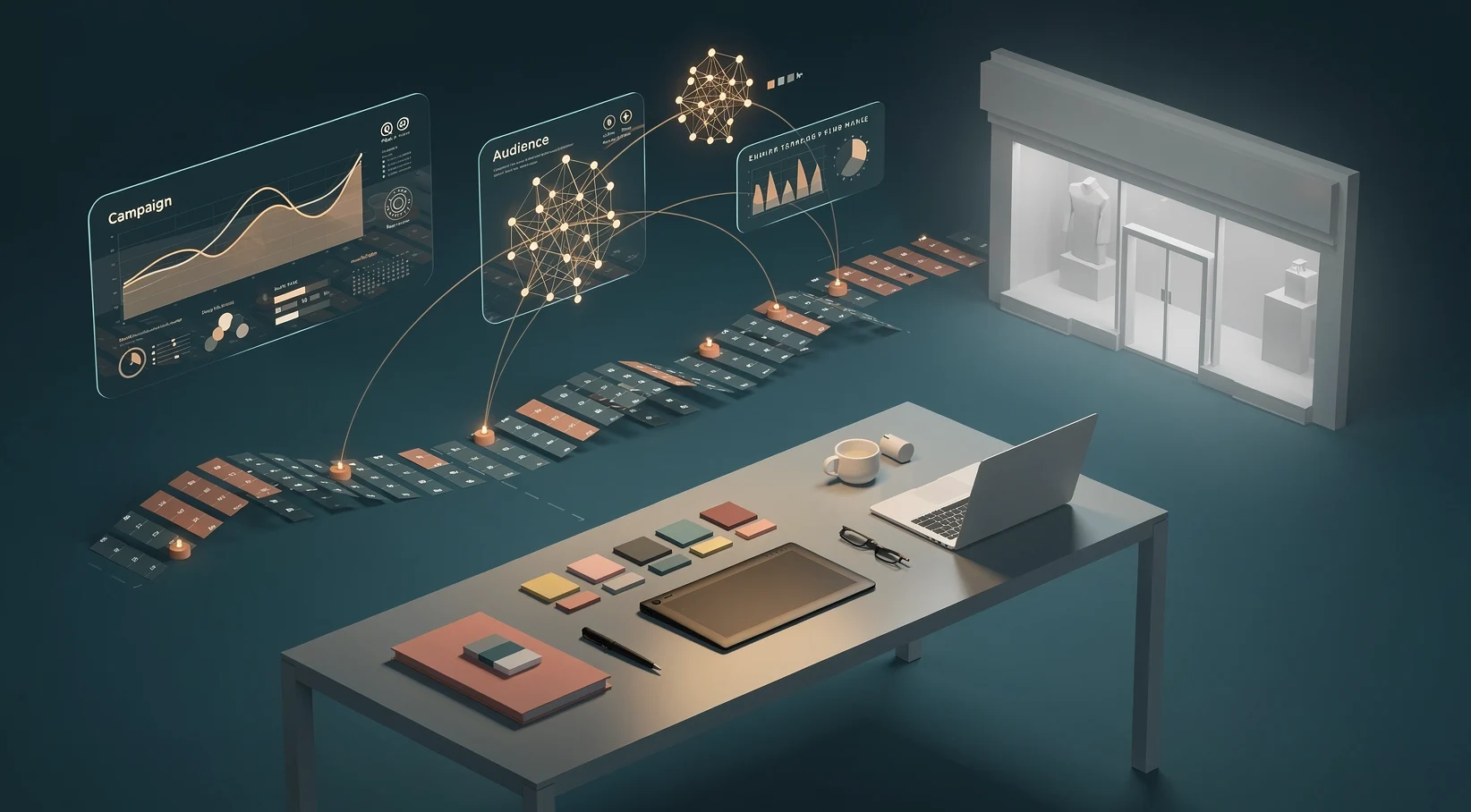
Marketing campaigns for retail teams entered 2026 looking less like a calendar of seasonal pushes and more like an always-on system that has to justify every dollar of spend. The combination of tighter budgets, signal loss from privacy changes, the arrival of generative tools inside everyday workflows, and the rapid scaling of retail media networks rewrote what a campaign even is. For brand managers, performance marketers and retail merchandising leads, the practical shift is that the old playbook of brief, big idea, flight dates and a post-campaign report no longer matches how money moves or how customers discover products. This guide breaks down what actually changed, why it changed, and how working retail teams are adapting without burning out their staff or their margins.
In short
- Retail media networks moved from a side channel to a core line item, and campaigns now have to plan for on-site, in-store and off-site retail media from the first brief rather than bolting it on at the end.
- Generative AI compressed production timelines so much that the bottleneck shifted from making assets to deciding which assets are worth making and measuring whether they work.
- Signal loss from cookie deprecation and platform privacy changes pushed teams toward first-party data, clean rooms and modeled measurement, which changed how campaigns are targeted and judged.
- Always-on structures replaced the burst-and-wait flight model for most categories, so teams now manage a continuous system with seasonal peaks rather than a sequence of discrete launches.
- Incrementality became the measurement standard that finance teams actually trust, displacing last-click attribution and forcing marketers to prove that spend created sales that would not have happened anyway.
Why did marketing campaigns change so much in 2026?
The change was not driven by one event. It was the result of several pressures arriving at the same time and compounding each other. Retail margins stayed thin through 2025 into 2026, which made finance teams scrutinize marketing spend with a sharper eye than in the growth-at-any-cost years. At the same time, the tools available to marketers changed faster than at any point in the previous decade.
Privacy changes were the first structural pressure. The long erosion of third-party cookies and mobile identifiers meant that the targeting and measurement methods retail teams had relied on for years stopped returning clean data. Campaigns that once ran on precise audience signals now run on a mix of first-party data, contextual signals and modeled estimates. This shift alone forced a rethink of how campaigns are planned and how success is proven.
The second pressure was the maturation of retail media. What started as sponsored product listings on a handful of large marketplaces became a full advertising ecosystem spanning on-site search, in-store screens and off-site programmatic inventory powered by retailer purchase data. For retail teams, this meant a new and growing share of budget had to be planned, bought and measured inside platforms that did not exist as serious channels five years earlier. The shift connects directly to the broader changes in how brands build presence, which we cover in our modern brand playbook for retail and e-commerce.
The third pressure was generative AI moving from novelty to daily tool. Copy, image variants, product descriptions and even media plans could be drafted in minutes rather than days. That collapsed the cost of producing campaign assets and changed the economics of testing, which in turn changed how teams structure their work.
Key terms and definitions for the 2026 landscape
Before going deeper, it helps to fix the vocabulary, because several terms shifted meaning over the past two years. The words sound familiar but the practical definitions retail teams use in 2026 are sharper and more operational than they were.
Retail media network
A retail media network is an advertising business run by a retailer that lets brands buy ad placements using the retailer’s first-party shopper data. The network spans the retailer’s own website and app, its physical store screens and checkout displays, and off-site inventory on the open web and social platforms. The defining feature is that targeting and measurement are tied to real purchase data rather than inferred audience signals, which is why these networks held value while other targeting methods lost it.
Incrementality
Incrementality is the measure of sales that a campaign caused that would not have happened without it. It is tested through controlled experiments such as holdout groups and geo tests, where one set of customers or regions sees the campaign and a matched set does not. The gap between the two is the incremental lift. This concept displaced last-click attribution as the measurement that retail finance teams trust, because it isolates the actual effect of spend.
Clean room
A data clean room is a secure environment where a brand and a platform or retailer can match and analyze customer data without either side exposing raw individual records. Clean rooms became central to campaign measurement in 2026 because they let teams connect exposure data to sales data in a privacy-safe way. They are the technical backbone behind much of the modeled measurement that replaced cookie-based tracking.
Always-on versus flighted
A flighted campaign runs in discrete bursts with defined start and end dates, going dark between flights. An always-on campaign runs continuously with budget and creative adjusted in response to performance and seasonality. Most retail categories moved toward always-on structures in 2026, reserving true flighting for genuine seasonal events such as holiday peaks and major sales periods.
How do retail marketing campaigns work in practice now?
The practical workflow of a 2026 campaign looks different from the linear brief-to-report cycle that defined the previous era. The work is more continuous, more data-led at the planning stage, and more tightly coupled to commerce systems. Understanding the new shape matters because teams that try to run new tools inside an old process tend to get the worst of both.
Planning now starts with first-party data and channel economics rather than with a creative idea. Teams look at which customer segments they can actually reach with owned data, what retail media inventory is available for their categories, and what incremental return each channel has shown historically. The creative brief follows that analysis instead of leading it, which is a reversal from how many teams worked before. For a detailed look at the brief stage itself, our guide on how retail marketing campaigns are built from brief to launch walks through the modern sequence.
Execution is split across more surfaces than before. A single product push might run simultaneously across a retailer’s on-site search, its in-store screens, the brand’s own email and app, paid social, and off-site programmatic bought through the retail media network. Coordinating these surfaces so they reinforce rather than duplicate each other is the core operational skill of the 2026 campaign manager.
Measurement runs in parallel with execution rather than waiting for a post-campaign report. Teams set up holdout groups or geo tests at launch, watch modeled incrementality through the flight, and reallocate budget toward the surfaces showing real lift. The campaign is treated as a live system to be steered, not a fixed plan to be executed and then reviewed.
The new campaign team shape
Team composition shifted to match the new workflow. The pure creative and the pure media buyer are increasingly joined by a hybrid role that sits between data and execution. This person reads measurement output, understands retail media platform mechanics, and translates findings into creative and budget decisions fast enough to matter during a live campaign.
Smaller retail teams often cannot staff every specialty, so they lean on generative tools and platform automation to cover gaps. A three-person team in 2026 can produce and manage a campaign volume that needed eight people in 2021, but only if they accept that the tools make the routine decisions and the humans focus on judgment, measurement design and brand consistency.
What changed in measurement and budgeting?
Measurement is where the 2026 change is most visible to anyone outside the marketing team, because it directly affects how budgets get approved. The move away from last-click attribution toward incrementality reshaped the conversation between marketing and finance. Finance teams stopped accepting attribution dashboards that credited channels for sales they did not cause, and marketers had to learn to speak in terms of tested lift.
Budgeting moved from fixed annual allocations to a more fluid model where a baseline is set annually but a meaningful reserve is reallocated quarterly or monthly based on measured performance. This gives teams the flexibility to move money toward channels that prove incremental value and away from those that do not. It also means budget conversations happen continuously rather than once a year.
The table below contrasts the measurement and budgeting approach that dominated through the early 2020s with the approach most retail teams use in 2026.
| Dimension | Early 2020s approach | 2026 approach |
|---|---|---|
| Primary metric | Last-click attribution and ROAS | Incremental lift from controlled tests |
| Targeting basis | Third-party cookies and device IDs | First-party data, clean rooms, modeling |
| Budget cadence | Fixed annual allocation by channel | Baseline plus continuous reallocation |
| Reporting rhythm | Post-campaign report after flight ends | Live measurement steered during flight |
| Finance relationship | Marketing reports results in its own terms | Shared incrementality language with finance |
The practical effect is that campaigns now have to be designed to be measured. A push that cannot be tested for incrementality is harder to fund, because the team cannot prove it worked. This has pushed measurement design to the front of the planning process, where it used to be an afterthought.
Common mistakes and how to avoid them
The speed of change in 2026 created a predictable set of errors as teams adopted new tools and structures faster than they adapted their thinking. Most of these mistakes come from applying old habits to new systems. Recognizing them early saves budget and prevents the kind of campaign post-mortem that blames the tool rather than the process.
Treating retail media as an afterthought
The most common mistake is planning a campaign around traditional channels and then adding retail media at the end with leftover budget. Because retail media now carries a large share of the path to purchase, this sequencing wastes the channel’s strength. Teams that win plan retail media placements alongside the creative concept, so the campaign is designed for the surfaces where shoppers actually decide. This is especially true for in-store retail media, which we examine in our piece on in-store retail media moving from pilot to scale.
Confusing AI output volume with quality
Generative tools make it trivial to produce hundreds of asset variants, and many teams mistook that volume for productivity. Producing more variants does not help if the team has no disciplined way to test which ones actually perform. The teams that benefit most use generation to expand the test pool deliberately and pair it with a measurement system that kills weak variants quickly rather than letting them run on equal footing.
Clinging to last-click attribution
Some teams kept reporting on last-click metrics because the dashboards were familiar and the numbers looked good. This created a slow-motion credibility problem with finance, which increasingly understood that those numbers overstated marketing’s contribution. The fix is to migrate reporting to incrementality before finance forces the issue, so marketing leads the measurement conversation rather than defending an outdated one.
Running paid channels in isolation
Paid social, search and retail media each have their own platforms and their own teams, and it is easy to run them as separate efforts that compete for credit. This duplicates spend and confuses measurement. The better pattern is to plan paid channels as one coordinated system, a discipline covered in depth in our analysis of paid ads for retailers in 2026.
Examples from US retail and e-commerce
Abstract principles are easier to apply when grounded in how US retail teams actually changed their work. The patterns below are composites drawn from how mid-sized and large retail marketing teams adapted, rather than named case studies, but they reflect the operational reality of 2026.
A national specialty retailer that previously ran four big seasonal campaigns a year moved to an always-on structure with two genuine seasonal peaks. The shift freed the team from the boom-and-bust cycle where they over-hired agencies before each flight and went quiet between them. Steady-state management with seasonal surges produced more consistent sales and lower production costs, because the creative system kept running instead of restarting each quarter.
A direct-to-consumer brand that grew on paid social through the late 2010s found its acquisition costs climbing as targeting signals degraded. It shifted budget toward retail media partnerships with the marketplaces where its products sold, using those platforms’ purchase data to reach buyers that social targeting could no longer find reliably. The brand also built out first-party data capture through its own app and loyalty program to reduce dependence on any single platform.
A grocery chain used its own retail media network to fund a larger share of its marketing, effectively turning its shopper data into a revenue stream that subsidized customer-facing campaigns. This reflects a broader 2026 pattern where large retailers run their media networks as profit centers while also using them to power their own promotional calendars. The holiday execution side of this is something we explore in detail in our look at holiday retail campaigns and what separates the good from the forgettable.
Across these examples the common thread is the same structural move. Teams shifted from discrete campaigns measured by attribution toward continuous systems measured by incrementality, with retail media and first-party data at the center. According to the US Census Bureau, e-commerce continued to take share of total retail sales through this period, which kept pressure on teams to make every channel measurable. You can review the underlying retail sales context at the US Census Bureau retail trade data.
Tools, partners and vendors worth knowing
The 2026 toolset reflects the structural changes described above. Teams no longer assemble a stack around third-party tracking and instead build around first-party data, clean rooms, retail media platforms and generative production tools. Knowing the categories matters more than any single vendor, because the category defines the capability the team needs.
On the measurement side, the important category is incrementality and marketing mix modeling tools that run controlled experiments and model channel contribution without relying on individual-level tracking. These tools are what let teams have the incrementality conversation with finance. They range from platform-native experiment tools to independent measurement vendors that work across channels.
On the retail media side, the relevant partners are the networks themselves and the platforms that help brands manage spend across many networks at once. As the number of retail media networks grew, a layer of management tools emerged to handle planning and reporting across them, because no team wants to log into a dozen separate dashboards. This connects to the broader presence strategy outlined in our modern brand playbook.
On the production side, generative tools for copy, image and video variants became standard, but the differentiator is integration with the team’s testing and asset management systems. A generation tool that produces variants the measurement system can immediately test is far more useful than a standalone tool that creates assets in isolation. The table below maps the main tool categories to the job they do in a 2026 campaign.
| Tool category | Job in the campaign | Why it matters in 2026 |
|---|---|---|
| First-party data platform | Collect and unify owned customer data | Foundation for targeting after signal loss |
| Clean room | Match exposure to sales privately | Enables measurement without raw data sharing |
| Incrementality and mix modeling | Prove what spend actually caused | Currency of the finance conversation |
| Retail media management | Plan and report across networks | Tames fragmentation as networks multiply |
| Generative production | Create and vary creative assets fast | Expands the test pool at low cost |
The selection principle that holds across categories is integration over individual feature strength. A 2026 campaign is a connected system, and a tool that does not connect to the team’s data and measurement layers creates more work than it saves regardless of how good its standalone features look.
What should retail teams prioritize for the rest of 2026?
For teams still catching up, the priority order matters because budget and attention are limited. The highest-leverage move is establishing reliable incrementality measurement, because it unlocks every other decision. Without it, teams cannot tell which of the new channels actually works, and they end up reallocating budget on guesswork.
The second priority is building first-party data capture, since it underpins both targeting and measurement in a privacy-constrained environment. Loyalty programs, owned apps and email capture are the practical mechanisms, and the value compounds over time as the data set grows. Teams that delay this find their reachable audience shrinking as third-party signals continue to degrade.
The third priority is integrating retail media into the core planning process rather than treating it as a separate buy. Because retail media now sits close to the point of purchase, planning it alongside creative and other channels produces compounding returns. Teams that get this sequencing right turn the channel’s purchase data into a planning advantage rather than just an ad placement.
The connecting thread across all three priorities is a shift in mindset from running campaigns to running a system. The teams adapting best in 2026 stopped thinking of marketing as a series of launches and started thinking of it as a continuously measured, continuously steered operation with seasonal intensity. That mental model, more than any single tool, is what separates the teams thriving in the new landscape from those still fighting the last era’s battles.
Frequently asked questions
What is the single biggest change in retail marketing campaigns in 2026?
The biggest change is the shift from discrete, attribution-measured campaigns to continuous, incrementality-measured systems. Retail teams now run always-on operations with seasonal peaks rather than a sequence of separate launches, and they judge success by tested lift rather than last-click credit.
Why did last-click attribution lose credibility?
Last-click attribution credits the final touchpoint before a sale, which overstates the contribution of channels that appear late in the path to purchase and ignores the channels that created demand earlier. Finance teams increasingly recognized this distortion and pushed marketers toward incrementality, which measures the sales a campaign actually caused.
How is generative AI actually used in campaigns now?
Generative AI is used to draft copy, produce image and video variants, and accelerate routine production work. The value comes not from raw output volume but from pairing fast generation with disciplined testing, so the team expands its test pool deliberately and kills weak variants quickly rather than shipping everything that gets made.
What is a retail media network and why does it matter?
A retail media network is an advertising business run by a retailer that lets brands buy placements using the retailer’s first-party shopper data across on-site, in-store and off-site inventory. It matters because it ties targeting and measurement to real purchase data, which held value while cookie-based methods lost it, making it a core part of the 2026 campaign rather than a side channel.
Do small retail teams need all of these tools?
No. Small teams should prioritize reliable incrementality measurement and first-party data capture first, then add retail media management and generative production as budget allows. The mindset of running a measured system matters more than owning every tool category, and platform automation can cover gaps that a small team cannot staff.
How did privacy changes affect campaign targeting?
The erosion of third-party cookies and mobile identifiers removed the precise individual-level signals that targeting relied on. Teams moved to first-party data, contextual signals and modeled estimates, and they use clean rooms to connect ad exposure to sales without sharing raw customer records. This made owned data and modeling central to how campaigns reach and measure audiences.
Is the flighted campaign model dead?
Not entirely. Most categories moved to always-on structures, but genuine seasonal events such as holiday peaks and major sales periods still justify true flighting. The 2026 norm is a continuous baseline with deliberate seasonal surges rather than a calendar of isolated bursts with dark periods between them.
What skill is most valuable on a 2026 campaign team?
The most valuable skill is the hybrid ability to read measurement output, understand retail media platform mechanics, and translate findings into creative and budget decisions fast enough to steer a live campaign. This bridges the old divide between data and execution, and it is what lets teams run campaigns as systems rather than fixed plans.
The retail teams that adapted fastest in 2026 share one trait: they stopped treating each of these shifts as a separate problem and recognized them as one connected change in how marketing works. Privacy, retail media, generative tools and incrementality measurement are facets of a single move from campaigns as events to marketing as a continuously measured system. Teams that internalize that framing, and build their structure and tooling around it, are the ones turning a disruptive year into a durable advantage.