
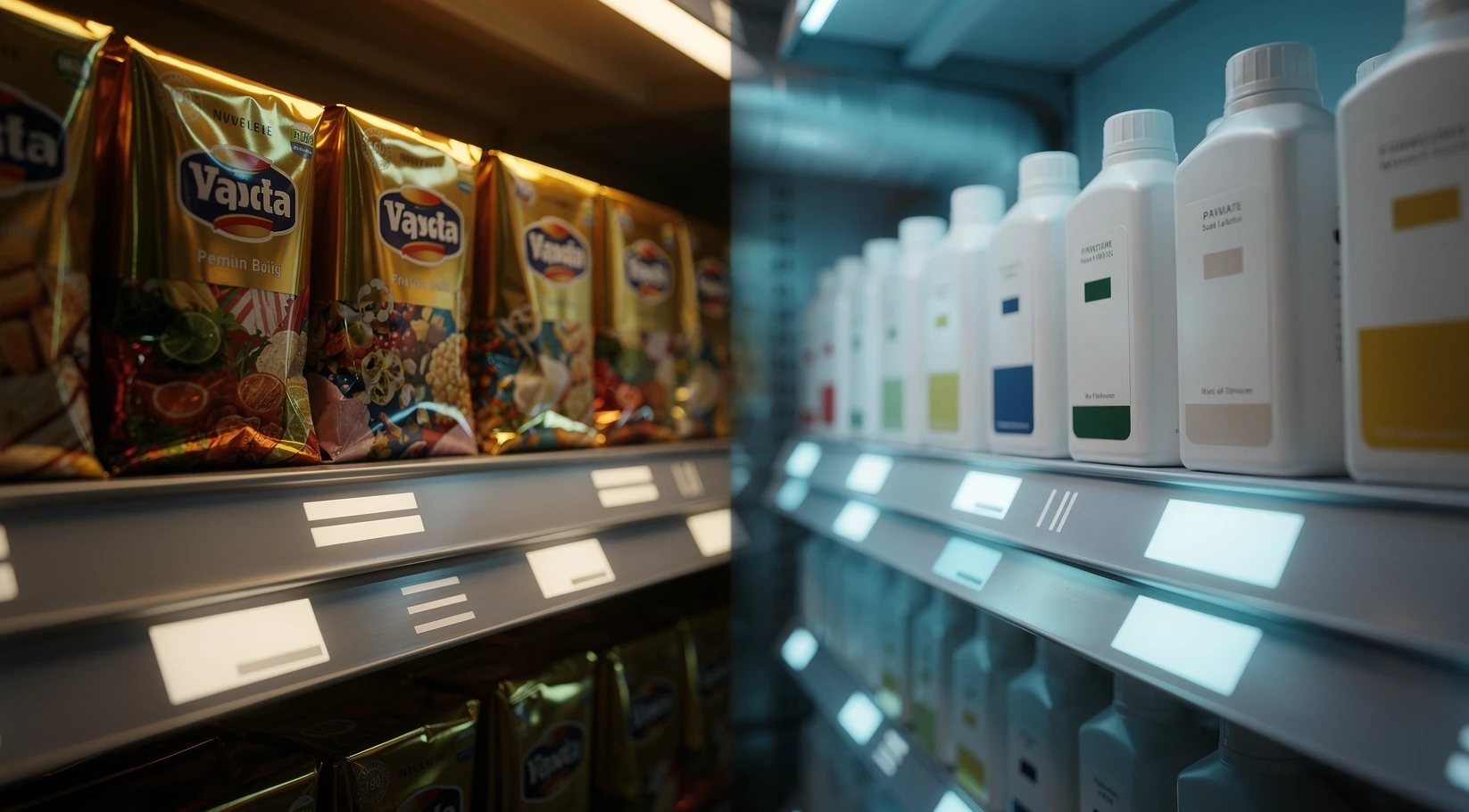
Private label used to be the shelf you reached for when money was tight and pride could wait. That framing is now out of date. In 2026, store brands are engineered products with their own design language, their own supply chains, and in many categories a quality bar that meets or beats the national name sitting next to them. The gap that shoppers once accepted between “the brand” and “the cheaper one” has narrowed to the point where, for a growing share of US households, the private label is simply the default choice.
This shift is not an accident of the post-inflation moment. Retailers have spent a decade building the sourcing muscle, the data, and the brand confidence to compete head-on with the companies whose products they stock. The result is a structural reordering of who captures margin in the aisle, and national brands are the ones absorbing the pressure.
In short
- Private label discount is no longer a value tier alone; it is a full brand strategy that lets retailers undercut national brands on price while protecting or improving their own margin.
- US store-brand penetration has climbed past a quarter of unit sales in many grocery categories, and the fastest growth is in premium and specialty ranges, not just the cheapest lines.
- Retailers win on vertical control: they own the shelf, the data, the placement, and increasingly the factory relationship, which lets them price a comparable product 15% to 30% below the branded equivalent.
- National brands lose twice, first on volume as trial shifts to store brands, then on pricing power as they cut promotions to defend share.
- The durable threat is not price, it is loyalty transfer: once a shopper trusts a store brand, that trust follows the retailer across categories and channels.
Why private label discount matters in 2026
The macro backdrop set the stage. Several years of elevated prices trained US shoppers to compare unit costs, read ingredient panels, and treat brand loyalty as negotiable. When households ran that experiment during the inflation spike, many discovered the store brand was fine, and they never switched back. That behavioral stickiness is the single most important fact in the category today, and it explains why the shift has outlasted the price shock that triggered it. We unpack the broader demand picture in our overview of the state of consumer behavior in retail and e-commerce.
The second driver is retailer capability. Grocers and general merchandisers now run private label like a product portfolio, with tiers, roadmaps, and dedicated development teams. They test formulations against the market leader, match or exceed it, then price below it. This is a different discipline from the generic “no-name” products of earlier decades.
The third driver is the economics of the shelf. A national brand pays for its own marketing, distribution, and trade spend, and those costs are baked into the wholesale price a retailer pays. A store brand strips out most of that layer, which means the retailer can offer a lower shelf price and still earn a fatter percentage margin. That structural advantage is why the trend compounds rather than fades, a dynamic we track in our analysis of why discount retailers are quietly winning the post-inflation era.
Who is exposed and who is insulated
Exposure is uneven. Categories where the product is functionally interchangeable, such as household paper, basic pantry staples, over-the-counter medicine, and commodity dairy, are the most vulnerable to store-brand substitution. Categories with strong emotional or performance differentiation, such as beauty, pet nutrition, and certain beverages, hold up better because the brand carries meaning the label cannot easily copy.
Even in defended categories, though, the moat is thinner than it was. Retailers now launch premium private label lines that borrow the codes of aspirational brands, from minimalist packaging to clean-label claims. The question for a national brand is no longer whether store brands compete, but how far up the value ladder they can climb.
Key terms and definitions
Before going deeper it helps to fix the vocabulary, because the category is full of overlapping terms that mean different things to merchants, suppliers, and shoppers.
- Private label: a product manufactured for and sold under a retailer’s own brand, whether by a third-party co-packer or an owned facility.
- Store brand: often used interchangeably with private label, though some merchants reserve it for the retailer-named tier specifically.
- National brand: a product marketed by a manufacturer across many retailers, carrying its own advertising and brand equity.
- Co-packer: a contract manufacturer that produces private label goods, sometimes in the same plant that makes the national brand.
- Good-better-best: a tiering strategy where a retailer offers an entry-price line, a mainstream line, and a premium line under distinct sub-brands.
The good-better-best framework is worth dwelling on, because it is the mechanism that turned private label from a single cheap tier into a portfolio. A modern grocer might run an opening-price-point brand for the most cost-sensitive shopper, a mainstream brand positioned directly against the category leader, and a premium brand that competes with specialty and natural products. Each tier targets a different shopper and a different competitor.
How private label discount works in practice
The mechanics start with sourcing. A retailer identifies a high-volume category where the national brand carries a visible price premium, then commissions a comparable product from a co-packer, frequently the same class of manufacturer that supplies branded players. Because the retailer controls demand through its own stores, it can guarantee volume that makes the factory economics work.
From there, the advantage is about control of the shelf and the data. The retailer decides where the store brand sits relative to the national brand, how the price gap is communicated, and which shopper data informs the next formulation. That feedback loop is faster and cheaper than anything a national brand can run through a retailer it does not own.
The margin math that makes it work
The core insight is that a lower shelf price and a higher margin are not contradictory in private label. Consider a simplified example for a common pantry item, with figures chosen only to illustrate the structure rather than any specific product.
| Line item | National brand | Private label |
|---|---|---|
| Shelf price to shopper | $4.99 | $3.79 |
| Cost of goods to retailer | $3.40 | $2.20 |
| Retailer gross margin (dollars) | $1.59 | $1.59 |
| Retailer gross margin (percent) | 32% | 42% |
| Marketing cost carried by product | High (brand funded) | Low (retailer funded) |
In this illustration the shopper saves more than a dollar, and the retailer earns the same gross dollars at a materially higher percentage margin. When the retailer sells more units because the price is lower, absolute profit rises even as the headline price falls. That is the flywheel national brands are fighting.
Placement, packaging, and the trust cue
Execution details decide whether the flywheel spins. Retailers place store brands at eye level or directly beside the leader, use a “compare and save” cue, and design packaging that signals quality rather than cheapness. The goal is to remove the psychological friction that once made shoppers hesitate.
Packaging has become a competitive weapon in its own right. Premium private label now uses restrained typography, matte finishes, and specific claims such as organic or single-origin, which borrow the visual grammar of challenger brands. When the label looks as considered as the national brand, the price gap does the rest.
Where discovery and search now decide the winner
The battleground has moved beyond the physical shelf. A growing share of category discovery happens through on-site search, marketplace rankings, and increasingly through AI assistants that summarize options for a shopper. In that environment, the product with the clearest, most structured description often wins the recommendation, regardless of whether it is a national brand or a store brand.
This is where retailers hold another quiet advantage: they control their own product data. A store brand can be described exactly the way the retailer wants, with the attributes that its shoppers search for surfaced first. National brands, by contrast, often depend on syndicated content that arrives inconsistently across retailers. For teams thinking about how machines read their listings, our guide to writing product descriptions LLMs actually want to cite covers the mechanics.
The strategic point is simple. As more purchase decisions route through search and assistants, the quality of structured product data becomes a pricing lever of its own. A well-described store brand at a lower price is exactly the combination that automated recommenders reward.
Common mistakes and how to avoid them
Both sides of the aisle make predictable errors. For retailers, the temptation is to treat private label as a margin grab and cut quality to widen the gap. That works until a shopper is disappointed once, at which point the trust that took years to build evaporates across the whole store brand. Quality parity is the price of entry, not an optional upgrade.
A second retailer mistake is over-tiering. Launching too many sub-brands confuses shoppers and fragments volume, which undermines the factory economics that make private label profitable in the first place. Discipline in the good-better-best structure matters more than breadth.
Mistakes national brands keep repeating
National brands often respond to store-brand pressure by deepening promotions, which trains shoppers to buy only on deal and erodes the everyday price the brand can command. Discounting into a structural threat rarely reverses it; it simply resets the reference price lower. The more durable response is genuine differentiation that a label cannot copy quickly.
Another frequent error is ceding the data layer. When a national brand lets its listings go stale or inconsistent across retailers, it hands the discovery advantage to the store brand that owns its own content. Investing in accurate, structured, and channel-specific product information is now a defensive necessity, not a nice-to-have.
- Do not compete on price alone against a retailer that controls the shelf; you will lose the margin war.
- Do invest in attributes a store brand cannot replicate at speed, such as proprietary formulation, brand-led experience, or verified performance.
- Do not let promotions become the only reason to buy; protect the everyday reference price.
- Do treat product data quality as a competitive asset across every retailer and search surface.
Examples from US retail and e-commerce
The clearest evidence is in grocery, where the largest US chains have made owned brands central to their identity rather than a discount afterthought. Premium private label lines now anchor the value proposition of several major grocers, and shoppers cite those brands as a reason to choose one retailer over another. That is loyalty transfer in action, and it is the outcome national brands fear most.
Off-price and value retail show a related pattern from a different angle. Chains built on a treasure-hunt model use a mix of branded closeouts and owned labels to keep prices low and margins healthy, a playbook we detail in our look at dollar stores, off-price chains, and the new value playbook. The lesson across formats is the same: control over assortment lets the retailer decide how much value to pass to the shopper and how much to keep.
Value-focused variety retailers illustrate how far the model travels internationally. When a specialty value chain such as MINISO signals confidence in its own position, as it did with its HK$2bn buyback, it underlines that owned-brand value retail is a global structural trend rather than a US-only story. The mechanics of vertical control and price leadership repeat across markets.
What the substitution looks like in the data
Zoom into a single household and the pattern is legible. A shopper trials a store brand in one low-risk category, has a good experience, and then extends that trust outward to adjacent categories over subsequent trips. Each successful trial lowers the barrier to the next, which is why private label share tends to rise in steps rather than all at once.
The table below sketches how that expansion typically unfolds across a shopping relationship, using representative category types rather than any single retailer’s numbers.
| Trust stage | Typical category | Shopper posture | Effect on national brand |
|---|---|---|---|
| First trial | Paper goods, water, foil | Low risk, price led | Minor volume loss |
| Early expansion | Pantry staples, dairy | Comparing quality | Promotion pressure rises |
| Deepening | Snacks, frozen, cleaning | Store brand as default | Share erosion accelerates |
| Premium crossover | Organic, specialty, beauty | Choosing the store’s premium tier | Pricing power under threat |
The final row is the one that keeps brand managers awake. Once a shopper is willing to buy the retailer’s premium tier, the national brand has lost not just the value shopper but the aspirational one too. At that point the price premium the brand relies on becomes very hard to defend.
Tools, partners, and vendors worth knowing
Building a competitive private label program, or defending against one, relies on a specific stack of capabilities. Sourcing and co-manufacturing partners sit at the base, and the quality of those relationships determines whether the store brand can hit parity. Retailers increasingly qualify multiple co-packers per category to protect supply and negotiate cost.
Above sourcing sits the data and product information layer. Product information management systems, retail media platforms, and search optimization tools all shape how a product is discovered and how its value is communicated. For store brands, owning this layer end-to-end is the advantage; for national brands, closing the gap here is the priority.
Capability checklist for retailers and brands
The following comparison lays out where each side tends to hold the advantage today, which is a useful map for deciding where to invest.
| Capability | Retailer / store brand edge | National brand edge |
|---|---|---|
| Shelf and placement control | Strong | Weak |
| First-party shopper data | Strong | Limited |
| Product information consistency | Strong on owned channels | Fragmented across retailers |
| Brand equity and emotional pull | Growing | Still strong |
| Innovation speed and R&D depth | Improving | Strong |
| Marketing reach beyond the store | Limited | Strong |
The pattern is clear. Retailers dominate the parts of the value chain closest to the purchase decision, while national brands still lead on innovation depth and reach beyond the store. The strategic contest of 2026 is whether brands can convert those remaining advantages into value shoppers will pay for, before retailers close the gap.
For merchants weighing where the wider consumer picture is heading, the connective tissue across all of this is demand behavior itself, which we map in our pillar on the state of consumer behavior in retail and e-commerce. Private label discount is best understood as one expression of a broader shift toward value-conscious, data-shaped shopping.
The macro numbers behind the shift
It helps to place the store-brand story inside the wider spending picture. US consumer spending on goods has stayed resilient even as households traded down within categories, which means the private label surge is a reallocation of the same dollars rather than a collapse in demand. Shoppers are still buying, they are just buying differently, and the retailer’s own brand is capturing a rising slice of each basket.
Longer-run measures of household expenditure show that grocery and everyday essentials command a stubbornly large share of the budget, which is exactly why substitution in those categories moves the needle so much. When a shopper switches even a handful of weekly staples to store brands, the cumulative effect over a year is large enough to reshape a category’s competitive map. For the official baseline on how US households allocate spending, the Bureau of Labor Statistics Consumer Expenditure Survey is the standard reference, available through the Bureau of Labor Statistics.
Why the trend is structural, not cyclical
A common assumption is that private label rises when times are hard and recedes when confidence returns. The data of the past few years complicates that story. Store-brand share held on and kept climbing even as sentiment recovered, because the switching was driven by a permanent upgrade in store-brand quality, not only by temporary budget stress.
Once quality parity is real and shoppers have experienced it, there is little reason to pay a premium out of habit. That is the difference between a cyclical dip in brand spending and a structural reset of the category, and it is why brand teams can no longer treat private label as a recession-only problem that fades with the cycle.
The retail media wrinkle
There is a second-order effect worth naming. As retailers grow their own brands, they also grow the advertising businesses that sit on top of their first-party data, and national brands increasingly pay those retail media networks to defend the very shelf space they are losing. The retailer therefore captures value on both sides, from the store-brand margin and from the ad spend national brands deploy to compete.
This creates an awkward dependency. A national brand fighting to hold share often funds that fight through the retailer’s own ad platform, which strengthens the retailer’s data and cash position further. Understanding that loop is essential for any brand budgeting its defense, because the money spent to compete can inadvertently sharpen the competitor.
A practical playbook for national brands
Defense is possible, but it has to be built on the dimensions where a brand still leads rather than the ones a retailer controls. The first move is to segment the portfolio honestly and identify which products are genuinely differentiated and which are commodities dressed in brand livery. The commodities will lose to private label eventually, so resources should flow to the products where a real, defensible difference exists.
The second move is to make that difference legible to shoppers and to machines. A superior formulation that no one can perceive at the shelf or find in search is worth little, so investment in demonstrable proof points and clean, structured product data pays for itself. The third move is to rethink the promotion strategy so that deals build the brand rather than simply renting volume from deal-seekers.
The brands that execute this well tend to accept a smaller but more loyal base at a defensible price, rather than chasing a large base that only buys on discount. That is a strategic choice about what kind of business to be, and it is a healthier position than a slow bleed of both share and pricing power.
What to do next
For retailers, the mandate is to keep quality at parity, hold discipline on tiering, and treat owned product data as a strategic asset rather than a back-office chore. The programs that win are the ones that earn trust in a first category and then extend it deliberately, not the ones that chase the widest possible price gap.
For national brands, the response is to stop fighting the price war on the retailer’s terms and instead double down on what a label cannot copy quickly: proprietary innovation, verified performance, brand experience, and rigorous product data across every channel. The brands that thrive will accept that the store brand is now a permanent competitor and compete on the dimensions where they still lead.
Frequently asked questions
What does private label discount actually mean?
It refers to store-brand products that a retailer sells under its own name at a lower shelf price than a comparable national brand, while typically earning a higher percentage margin. The discount to the shopper and the margin gain to the retailer come from stripping out the marketing and distribution costs baked into a national brand’s wholesale price.
How much cheaper are private label products than national brands?
The gap varies by category, but a comparable store brand commonly sits 15% to 30% below the national brand on the shelf. Premium private label tiers narrow that gap deliberately, competing on quality rather than only on price.
Are private label products lower quality than national brands?
Not reliably anymore. Many store brands are made by the same class of co-packer that supplies national brands, and retailers now test formulations to reach quality parity. Quality still varies by category and by retailer, but the old assumption that private label means inferior no longer holds broadly.
Why can retailers price store brands so much lower?
Because they control the shelf, the shopper data, and often the factory relationship, and because a store brand does not carry the national brand’s advertising and trade spend. That combination lets a retailer offer a lower price and still keep a healthier margin.
Which categories are most exposed to private label substitution?
Functionally interchangeable categories such as paper goods, pantry staples, commodity dairy, and over-the-counter basics are most exposed. Categories with strong emotional or performance differentiation, such as beauty and certain beverages, are more defended, though the moat is narrowing.
What is the biggest long-term risk to national brands?
Loyalty transfer. Once a shopper trusts a store brand in one category, that trust follows the retailer into adjacent categories and premium tiers, eroding the price premium the national brand depends on across the basket rather than in a single aisle.
How should a national brand respond to private label pressure?
By competing on what a label cannot copy quickly: proprietary formulation, verified performance, brand experience, and consistent, high-quality product data across every retailer and search surface. Deepening promotions usually backfires by resetting the reference price lower.
Does AI-driven search change the private label dynamic?
Yes. As more discovery routes through on-site search and AI assistants, the product with the clearest structured data often wins the recommendation. Retailers control their own store-brand data end-to-end, which gives well-described store brands an added edge at a lower price.