
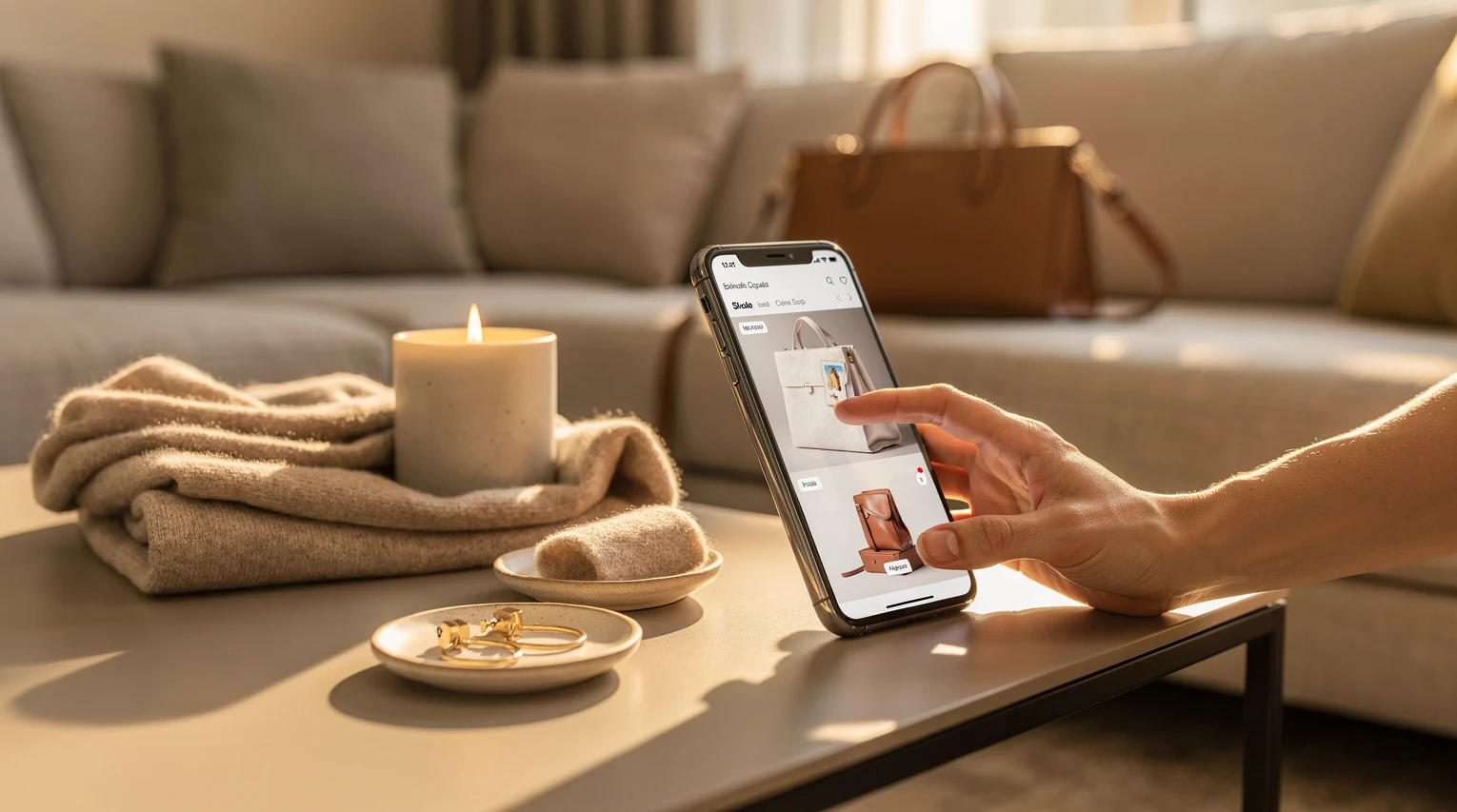
The mass middle of retail is collapsing, and the money is migrating in two directions: toward value and toward premium. For most operators the realistic prize is not true luxury but the band just below it, where a shopper who normally buys mid-market trades up for a single product that feels exceptional. That is the affordable luxury play, and in 2026 it is the cleanest margin lever a chain or independent still controls.
This guide treats premiumization as an operating discipline, not a marketing adjective. You will get the pricing architecture, the unit economics, the proof signals that justify a higher ask, and the merchandising sequence that moves a customer from the entry tier to the premium tier inside one visit.
Premiumization works because the spending base has split rather than shrunk: the same household that hunts discounts on staples will pay a 40 percent premium on the one category it cares about. Reading that split correctly is the whole game, and it starts with understanding the underlying demand shift documented across the wider market, which we mapped in the state of consumer behavior in retail and e-commerce.
In short
- Affordable luxury sits at roughly 1.5x to 3x your mainstream price, close enough to be reachable but distinct enough to feel like a deliberate upgrade.
- The margin case is decisive: a premium tier typically carries 8 to 15 points more gross margin, so even modest mix shift outperforms a sales push on core lines.
- You cannot charge a premium without earning it; proof signals (materials, provenance, craftsmanship, guarantees) carry the price, not the label.
- Merchandising sequence matters more than the products: anchor high, present the premium tier first, and let the entry product look like the compromise.
- The biggest failure mode is fake premium, where price rises but the experience, packaging, and service stay mid-market and shoppers punish the gap.
What affordable luxury actually means in 2026
Affordable luxury is a price-and-perception band, not a product category. It is the tier a shopper reaches by choosing the better option within a purchase they were already making, rather than aspiring to a separate luxury world they cannot normally enter. A 90 dollar everyday tote sitting beside a 30 dollar version is affordable luxury; a 4,000 dollar designer bag is not.
The defining feature is reachability under tension. The customer feels the stretch but completes it because the upgrade reads as justified rather than indulgent. That justification is what your assortment and storytelling have to manufacture, and it is why premiumization lives or dies on concrete attributes a buyer can verify.
In 2026 three forces make this band unusually attractive. First, value-tier competition has compressed margins on commodity goods to almost nothing, so volume without mix is a treadmill. Second, younger buyers reward authenticity and provenance over logos, a behavior we detail in how Gen Z really shops in 2026 and what retailers miss. Third, supply transparency has become a price-bearing feature in its own right, which we return to below.
| Tier | Price index (mainstream = 1.0) | Typical gross margin | Primary buyer motive |
|---|---|---|---|
| Value | 0.6 to 0.8 | 18 to 28 percent | Lowest acceptable cost |
| Mainstream | 1.0 | 35 to 45 percent | Reliable default |
| Affordable luxury | 1.5 to 3.0 | 50 to 62 percent | Reachable upgrade |
| True luxury | 5.0 and above | 65 percent and up | Status and scarcity |
Notice the margin step between mainstream and affordable luxury. A buyer who trades up adds revenue and, more importantly, adds margin points faster than revenue, because the cost to deliver the premium product rarely scales as fast as its price.
The band also behaves differently across the year. In recessionary or inflation-heavy stretches, the value and affordable luxury tiers both grow while the mainstream middle hollows out, a pattern sometimes called the lipstick effect: shoppers cut back on the big discretionary purchase but allow themselves one small, well-chosen indulgence. That dynamic is why a premium tier can be counter-cyclical when it is positioned as an affordable treat rather than a major outlay, and it is the single most underused defensive move in a soft market.
The margin math that justifies the play
The case for premiumization is arithmetic, and it is more forgiving than most operators assume. Mix shift, not full conversion, drives the result. Moving even one in eight customers from the mainstream tier to a tier carrying ten extra margin points can lift category gross profit more than a 15 percent volume increase on the core line, because the volume increase brings its own cost and promotional drag.
Work the numbers before you build the assortment. Use this sequence to size the opportunity for a single category:
- Take your current category units and average mainstream selling price, then compute baseline gross profit at the mainstream margin.
- Define the premium SKU at 1.5x to 3x price and estimate its delivered cost; confirm the resulting margin sits 8 points or more above mainstream.
- Model a conservative trade-up rate (start at 10 percent of mainstream units migrating, not new demand).
- Recompute total category gross profit with the migrated units priced and costed at the premium tier.
- Subtract incremental costs the premium tier actually requires: better packaging, added staff time, extended guarantee reserves.
- Compare the net gross profit delta against the cost of the merchandising and inventory changes needed to support the tier.
Run that model and you usually find the breakeven trade-up rate is low, often under 7 percent, which is why premiumization beats discount-driven volume on contribution. The risk is not the math; it is failing to deliver a product that earns the premium, which sends the trade-up rate to zero and strands premium inventory.
Work a concrete example. Suppose a category sells 1,000 units a month at a 40 dollar mainstream price and a 42 percent margin, so baseline monthly gross profit is 16,800 dollars. Introduce a premium SKU at 90 dollars with a 56 percent margin (a 14-point lift) and migrate just 10 percent of those units. The 100 migrated units now generate 5,040 dollars of gross profit instead of the 1,680 they produced at mainstream, a gain of 3,360 dollars from a single category with no new traffic. Net out, say, 600 dollars of incremental packaging and guarantee reserve, and you keep roughly 2,760 dollars of pure contribution per month, which annualizes past 33,000 dollars on one category and one tier.
Compare that to the discount alternative. To match 2,760 dollars of added monthly gross profit at the mainstream 42 percent margin, you would need to sell about 165 extra units, a 16.5 percent volume lift, and you would have to find and convert that incremental demand without cannibalizing existing sales or leaning on a promotion that erodes the very margin you are chasing. Mix shift is simply a more efficient path to the same profit, which is the structural reason premiumization keeps reappearing in the strategy of operators who have run the comparison honestly.
One platform note for smaller operators: the analytics to track tier mix and per-SKU margin do not require enterprise tooling. A well-configured store stack handles cohorting and margin reporting natively, as we cover in the rundown of WooCommerce in 2026 as a serious option for SMB stores.
Proof signals: how you earn the higher price
A premium price is a claim, and shoppers in 2026 demand evidence before they pay it. The single biggest mistake in premiumization is raising price without raising proof, which reads as a markup rather than an upgrade. The premium has to be legible in seconds, on the shelf and on the product page, through signals the buyer can verify rather than slogans they have to trust.
Proof signals fall into four families, and the strongest premium products stack several. Material and construction (full-grain leather, solid hardwood, higher thread density) give a tactile reason. Provenance (named maker, region, small-batch run) gives a story with a checkable source. Performance guarantees (lifetime warranty, free repair, generous returns) convert the price into a long-horizon value. And ethics give a moral premium that an increasingly large segment will pay for outright.
That last family is now a hard requirement in several categories. Verified sourcing and recognized certification have moved from nice-to-have to price-bearing, and buyers actively check the marks, a shift we break down in ethical supply chains and the certifications that matter to buyers. According to consumer research summarized by McKinsey’s retail practice, willingness to pay rises sharply when sustainability claims are specific and independently verified rather than vague.
Make the signals do the selling: put the warranty terms in the product title, photograph the material grain at macro scale, and name the maker. Each concrete proof point reduces the perceived risk of the higher price, and reduced risk is what closes a trade-up.
The hierarchy of signals matters as much as their presence. Tactile and visual proof outranks claimed proof, because a buyer trusts what they can see and feel over what they are told. A close-up photograph of stitching density does more work than a sentence asserting quality, and an in-store sample a customer can handle outperforms both. Rank your proof investment accordingly: spend first on the attributes a shopper can independently verify, then on the documentation that supports them, and last on the descriptive copy that frames them.
Guarantees deserve special attention because they shift the buyer’s mental math from price to lifetime cost. A 90 dollar item with a lifetime repair guarantee competes not against a 30 dollar disposable equivalent but against the three or four disposables the shopper would buy over the same period, which reframes the premium as a saving. Make that calculation explicit on the page. Stated plainly, a durable guarantee converts the headline price from a hurdle into the rational choice, and durability claims that survive scrutiny are themselves an ethical proof point in a market increasingly hostile to throwaway goods.
Merchandising the trade-up
The products do not sell the tier; the sequence does. Affordable luxury converts when the premium option is the first thing the customer evaluates and the entry option appears as a step down from it, rather than the reverse. Anchoring high resets the buyer’s reference price, so the premium tier no longer looks expensive, it looks complete.
Build the journey deliberately. Lead with the premium SKU in the hero slot, both in-store and on the category page, with the proof signals stacked in the first viewport. Place the mainstream option adjacent and clearly labeled as the standard, so the gap between them is visible and the upgrade reads as small relative to the benefit. Reserve the value option for shoppers who self-select into it, never in the lead position.
Bundling and financing widen the band. A small premium accessory bundled with a premium core product raises basket value while reinforcing the tier’s identity. Where regulation allows, simple installment options collapse the psychological barrier of the headline price by reframing the stretch as a manageable per-period figure. The mechanics of how these moves ripple through the wider market are worth tracking, and we contextualize them in coverage of how retail news shapes the global e-commerce industry today.
Staff are part of the merchandising system, not separate from it. A premium tier presented by an associate who cannot articulate why it costs more collapses the proof you built into the assortment. Equip floor staff and chat agents with the same two or three proof signals you put on the page, and give them permission to demonstrate rather than just describe. The marginal cost of one well-trained interaction is trivial against the margin it protects, and trade-up rates in assisted categories routinely run double those in pure self-service when the assistance is genuinely informed.
Building the premium tier online
The product detail page is where most digital trade-ups are won or lost, and it has to carry the proof a physical shelf delivers through touch. Lead the gallery with macro photography that shows material and construction, not lifestyle shots, because the buyer is interrogating whether the upgrade is real. Place the proof signals (materials, provenance, guarantee terms) above the fold and in the buy box, not buried in a tab the shopper never opens.
Use comparison framing rather than isolated listings. A side-by-side that shows the premium SKU against the mainstream version, with the differentiating attributes marked, lets the visitor justify the price to themselves in seconds. This is the digital equivalent of anchoring high on the shelf, and it consistently lifts the premium share of mix when the comparison is honest and specific.
Measurement closes the loop. Track tier mix, premium attach rate, and per-SKU contribution margin as primary metrics, and treat average order value as secondary, because AOV can rise on bundling while the premium tier itself underperforms. Cohort your data so you can see whether trade-up buyers return at higher rates and lifetime value, which they typically do, since the premium product sets a quality expectation that makes the cheaper option feel like a downgrade on the next visit. The tooling to run this analysis sits inside most modern store platforms without custom development.
Common mistakes
Fake premium. Price climbs but packaging, photography, and service stay mid-market. Shoppers feel the mismatch instantly and the trade-up rate craters, leaving you with marked-up inventory nobody wants.
Too wide a gap. A premium tier set at 5x mainstream stops being affordable and becomes aspirational, which removes the reachability that makes the band work. Keep the multiple in the 1.5x to 3x window unless the proof is overwhelming.
Proof-free pricing. Charging more without legible, verifiable reasons. The premium has to be visible on the shelf and on the page in seconds, or the buyer defaults to the cheaper option.
Promoting the premium tier into the ground. Discounting the affordable luxury SKU teaches shoppers it was never worth the price, permanently anchoring it lower and destroying the margin you built it for.
Ignoring the entry product. A weak value or mainstream option makes the premium look isolated and risky; the tiers need a coherent ladder so the upgrade feels like a natural next rung.
Premiumizing the whole catalog at once. Spreading the play across every category dilutes attention and capital, and most categories will not support it. Concentrate on the two or three categories where the quality gap is visible and the buyer already cares, prove the model there, and only then extend it. A focused premium tier that wins beats a broad one that confuses the assortment and trains shoppers to ignore the upgrade.
Frequently asked questions
What price multiple defines affordable luxury?
As a working rule, affordable luxury sits at roughly 1.5x to 3x your mainstream price. Below 1.5x the upgrade does not feel meaningfully different, so it fails to register as a premium; above 3x it stops being reachable for the mid-market shopper and slides toward aspirational luxury, where conversion depends on status rather than reachable value. The right multiple inside that window depends on how strong and verifiable your proof signals are: more proof supports a higher multiple. Test it empirically by introducing one SKU at the lower end of the range, measuring the trade-up rate, then nudging the multiple up only if the proof and demand justify it rather than guessing the ceiling in advance.
How is affordable luxury different from true luxury?
True luxury sells scarcity, status, and brand mythology, usually at 5x mainstream or higher, and the buyer enters a separate world deliberately. Affordable luxury sells a reachable upgrade within a purchase the customer was already making, justified by concrete attributes rather than logo or exclusivity. The affordable tier converts mid-market shoppers who trade up on one category they care about, while true luxury targets a distinct, smaller buyer whose motive is signaling rather than value per dollar.
Which categories suit premiumization best?
Categories where quality differences are tangible and verifiable perform best: leather goods, footwear, kitchenware, skincare, coffee, and home textiles all let a buyer feel or check the upgrade. Categories dominated by undifferentiated commodities resist premiumization because shoppers cannot perceive a reason to pay more. The test is simple: if you can photograph or demonstrate a concrete difference in seconds, the category supports a premium tier; if the difference is invisible or unprovable, it does not.
How much trade-up do I need to make it worthwhile?
Less than most operators expect. Because the affordable luxury tier carries 8 to 15 more margin points than mainstream, the breakeven trade-up rate is frequently under 7 percent of mainstream units. Model it for your own numbers using the six-step sequence above, starting with a conservative 10 percent migration of existing mainstream demand rather than assuming new customers. The key is that you are shifting mix, not chasing incremental volume, so even a single-digit migration rate can lift category gross profit materially.
Do sustainability claims really justify a higher price?
Yes, but only when they are specific and independently verified. Vague green language adds no willingness to pay and now risks a credibility penalty. A named certification, a traceable supply chain, or a documented repair-and-reuse program does carry a measurable premium, especially with younger buyers who check the marks before purchase. Treat ethics as a proof signal subject to the same evidence standard as materials or craftsmanship: the buyer must be able to verify the claim, not just read it.
Should I run promotions on my premium tier?
Avoid it. Discounting the affordable luxury SKU teaches shoppers it was overpriced and permanently anchors its perceived value lower, which erodes the margin the tier exists to create. If you need to move premium inventory, prefer bundling, added-value services, or a small accessory gift over a headline price cut. Promote the value and mainstream tiers to drive traffic, then use merchandising sequence to walk those visitors up to the premium option at full price.
What’s next
Start by picking one category where the quality difference is visible and modeling the trade-up math before you touch the assortment. Build the premium SKU around two or three verifiable proof signals, anchor it in the hero slot, and resist the urge to discount it. As you scale the tier, keep reading the broader demand shift in the state of consumer behavior in retail and e-commerce so your premiumization moves track where the market is actually heading rather than where it was. Review the tier quarterly: prune any premium SKU whose trade-up rate stalls below breakeven, and reinvest the freed shelf and working capital into the proof signals that the data shows are actually moving buyers up the ladder.