
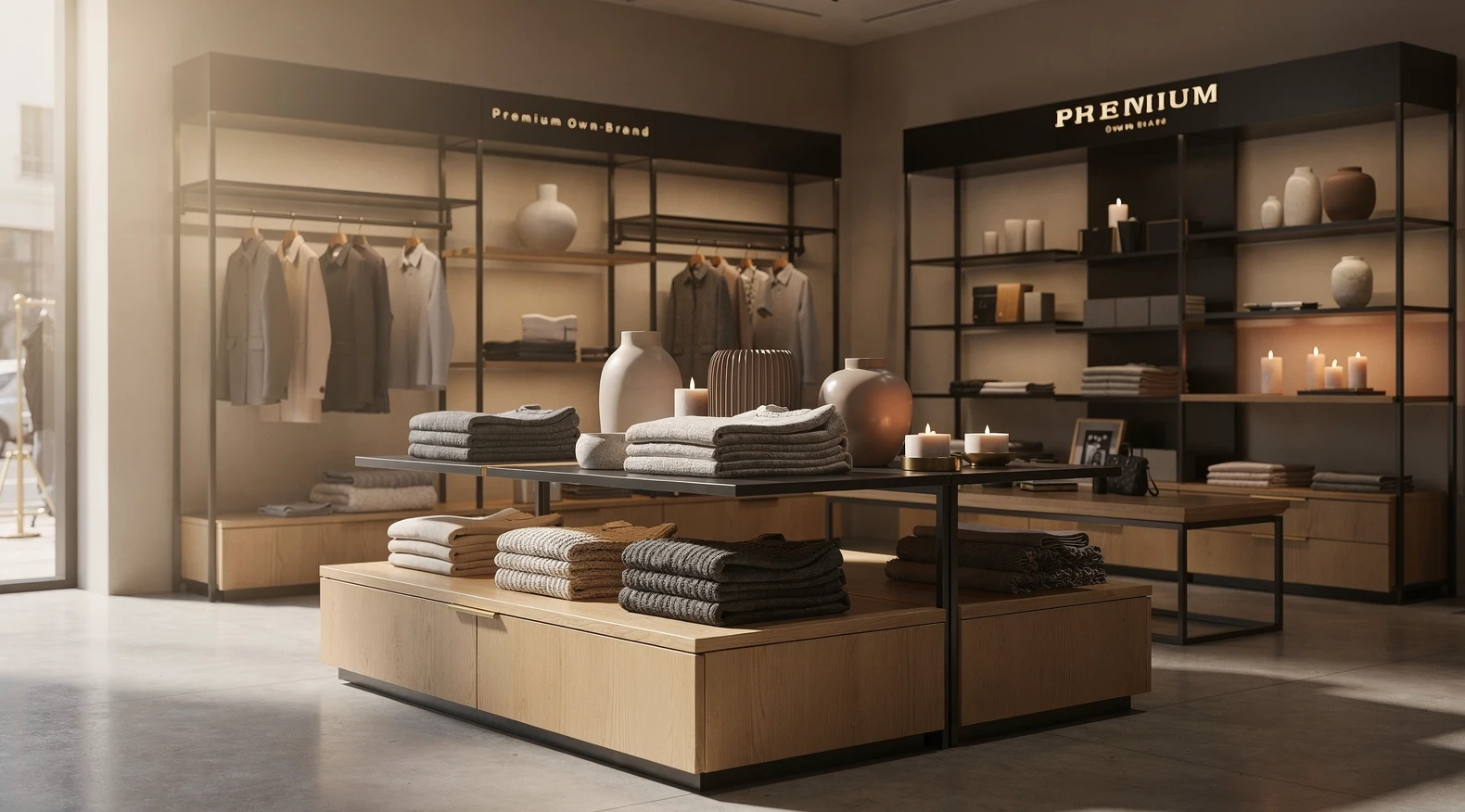
Premium private label has moved from the clearance rack to the center of the department store strategy deck. Once a synonym for cheaper substitutes stacked beside the national brands, store-owned labels are now being built as design-led, full-price propositions that anchor entire floors and shape how shoppers perceive a retailer. In 2026, with margins squeezed by tariffs, promotional fatigue and the steady drift of branded assortments toward Amazon and direct-to-consumer channels, premium private label has become one of the few levers a department store can pull to defend both profit and identity at the same time. This guide explains what changed, how the model works in practice, and what retail and e-commerce teams should do about it.
In short
- Premium private label is a retailer-owned brand built to compete on design and quality rather than price, carrying margins roughly 10 to 20 points higher than comparable national brands.
- Department stores are leaning in because exclusive product cannot be price-matched on Amazon, protects against brand defections to direct-to-consumer, and gives shoppers a reason to choose one chain over another.
- The economics are the draw: own brands typically deliver gross margins of 50 to 65 percent versus 30 to 40 percent on wholesale national brands, while also reducing markdown exposure.
- US examples span Macy’s On 38th and store brand reset, Nordstrom’s owned labels, Target’s Good & Gather and apparel lines, and Kohl’s Sonoma and FLX, each positioned above old store-brand quality.
- The risk is that premium private label demands the same investment as a real brand: design talent, supply chain control, marketing and patience, and retailers that treat it as a margin trick rather than a brand fail within two seasons.
Why premium private label matters for department stores in 2026
Department stores spent two decades losing the middle of the market. Off-price chains pulled value shoppers down, luxury houses and direct-to-consumer brands pulled aspirational shoppers up, and the open-sell national brands that once filled the floor became available everywhere, often cheaper, on Amazon and brand-owned sites. The result was a format defined by what it carried rather than what it was, and a customer who had little reason to walk into one chain over another.
Premium private label is the structural answer to that problem. When a retailer designs, sources and brands its own product, that product exists nowhere else. It cannot be price-matched on a marketplace, it cannot defect to a wholesale partner, and it carries a margin profile that wholesale national brands structurally cannot match. For a format under permanent margin pressure, exclusivity plus margin is a rare combination, and it explains why almost every major US department store has reset its own-brand strategy since 2023.
The timing in 2026 is not accidental. Tariff volatility has raised the cost of imported branded goods and made vertically controlled sourcing more attractive. Promotional fatigue has made shoppers numb to the constant sale signage that defined the category. And the broader shift in how consumers discover and trust products, covered in depth in our pillar on the state of consumer behavior in retail and e-commerce, rewards retailers that can tell a coherent brand story rather than act as a neutral shelf. Premium private label is where those pressures meet.
What premium private label actually means
The phrase gets used loosely, so precise definitions matter before any strategy discussion. Private label, store brand and own brand are interchangeable terms for a product sold under a name the retailer controls (see the general definition of private label for the broad category). The premium qualifier is what separates the modern version from the generic store brand of the past, and it changes almost every operating decision.
It helps to remember how the category was once perceived. For most of the late twentieth century, store brands were the bottom shelf: plain packaging, lower price, lower expectations, a hedge for budget-conscious shoppers rather than a destination. That perception lingered long after the products improved, which is part of why the premium reset took so long and why retailers now invest so heavily in naming, packaging and storytelling. The job is not only to make a better product but to overwrite a decades-old mental model that equates own brand with compromise.
Private label versus national brand versus premium private label
A national brand is manufactured and marketed by a third party such as Levi’s, KitchenAid or Clinique, and sold across many retailers. A traditional private label is a retailer-owned product positioned mainly on price, designed to undercut the national brand on the same shelf. A premium private label is a retailer-owned product positioned on design, quality and identity, often priced at or above the national brand it sits beside. The table below makes the contrast concrete.
| Attribute | National brand | Traditional private label | Premium private label |
|---|---|---|---|
| Owner | Third-party manufacturer | Retailer | Retailer |
| Primary appeal | Recognition and trust | Lower price | Design and exclusivity |
| Typical price | Reference point | 15 to 30 percent below | At or above national brand |
| Retailer gross margin | 30 to 40 percent | 40 to 50 percent | 50 to 65 percent |
| Marketing investment | Funded by the brand | Minimal | Funded by the retailer |
| Availability | Many retailers and online | One retailer | One retailer, exclusive |
Why the premium label is a brand, not a price tier
The defining shift is that a premium private label is managed as a brand with its own identity, design language and customer promise. It has a name that means something, a consistent visual system, and a quality bar that has to survive direct comparison with the national brands around it. That is a different discipline from sourcing a cheaper alternative and applying a house name to it. Retailers that understand the difference invest in design teams, materials and storytelling. Those that do not end up with a more expensive generic, which is the worst position in the category.
How premium private label works inside a department store
Behind a single own-brand sweater sits a supply chain and merchandising operation that looks more like a brand company than a buying office. Understanding the mechanics explains both the margin upside and the execution risk.
Sourcing and supply chain control
National brands are bought wholesale: the retailer pays a wholesale cost, marks it up, and absorbs markdown risk on whatever does not sell. Premium private label is developed directly with manufacturers, often the same factories that produce national brands, but specified, designed and quality-controlled by the retailer. That direct relationship removes the brand’s margin from the equation and hands the retailer control over materials, fit and cost. It also hands the retailer responsibility for forecasting, minimum order quantities and inventory risk, which is where inexperienced programs get into trouble.
Sourcing strategy has also become a tariff story in 2026. Because the retailer now owns the supply chain directly, it also owns the exposure to import duties and freight swings, which has pushed several programs toward diversified and nearshored production across Mexico, Central America and parts of South Asia rather than a single-country dependency. That control is a double-edged feature: it lets a retailer move production to manage cost and risk, but it also means a tariff shock lands on the retailer’s own income statement instead of a supplier’s. The retailers winning at premium private label treat sourcing flexibility as a core competence, not a procurement afterthought.
Margin structure and markdown discipline
The margin gap is the headline. A national brand bought at wholesale might yield a 35 percent gross margin after typical markdowns. The same garment developed as premium private label can yield 55 to 60 percent because the wholesale layer disappears. Crucially, because the product is exclusive, it is not subject to the price transparency that forces markdowns on national brands available elsewhere. A well-run premium private label program therefore improves margin twice: a higher starting margin and lower markdown leakage.
A simplified worked example shows why finance teams care so much. Take a sweater that retails for 80 dollars in both scenarios. The table below traces the economics from cost to retained gross profit, holding the shelf price constant so the only variable is the sourcing model.
| Line item | National brand (wholesale) | Premium private label |
|---|---|---|
| Retail price | $80 | $80 |
| Cost to retailer | $48 (wholesale) | $30 (factory direct) |
| Starting gross margin | 40 percent | 62.5 percent |
| Typical markdown exposure | Higher (price-matched elsewhere) | Lower (exclusive) |
| Realized gross margin | ~35 percent | ~58 percent |
| Who funds marketing | The brand | The retailer |
The catch sits in that last row. The roughly 20-point margin advantage is not free profit, because the retailer now funds the design, marketing and inventory risk that a national brand would otherwise carry. Premium private label only pays off when the program runs at enough scale to absorb those fixed costs, which is why retailers concentrate on a few well-resourced brands rather than dozens of thin ones.
Merchandising, placement and the role of exclusivity
Exclusive product changes how a floor is merchandised. Instead of arranging shelves by national brand, a retailer can build a destination around its own label, with dedicated fixtures, lookbooks and in-store storytelling. This is where premium private label connects to the wider repositioning that luxury and premium retail is undergoing, a shift we explore in our analysis of how luxury retail is repositioning for the next decade. The own brand becomes a reason to visit, not a discount alternative encountered by accident.
Why department stores are leaning into premium own brands now
The strategic logic rests on four pressures that have all intensified at once, turning premium private label from a margin tactic into a survival strategy for the format.
The first is disintermediation. As national brands built their own direct-to-consumer channels and leaned into Amazon, the department store lost its role as the primary place to discover and buy those brands. Owning product is the only durable answer to a wholesale partner that increasingly competes with you for the same customer.
The second is price transparency. Any branded product with a universal identifier can be price-compared in seconds, which collapses the retailer’s pricing power and forces a race to the bottom. Exclusive product breaks the comparison, restoring some control over price and promotion.
The third is margin pressure from every other line of the income statement: labor, rent, shipping and tariffs. With cost lines hard to cut further, gross margin mix becomes the most controllable lever, and shifting penetration toward higher-margin own brands moves the whole business.
The fourth is identity. A department store that carries the same brands as everyone else has no answer to the question of why a shopper should choose it. A distinctive, well-made own brand is an answer, and increasingly the main one.
The numbers behind these pressures are not small. US retail and food services sales run well above 7 trillion dollars a year, and apparel and general-merchandise spending make up a large share of it, as tracked in the monthly retail data published by the US Census Bureau. Even a few points of margin-mix shift across a category that large moves real profit, which is why own-brand penetration has become a headline metric in department store earnings calls rather than an operational footnote.
Examples from US retail and e-commerce
The strategy is easiest to understand through the chains executing it, each with a different starting point and level of ambition. The table below maps several prominent US programs before the detail.
| Retailer | Premium own brand examples | Primary category | Positioning |
|---|---|---|---|
| Macy’s | On 38th, And Now This, store-brand reset | Apparel and accessories | Modern, design-led private brands |
| Nordstrom | Nordstrom-owned labels, Open Edit, Zella | Apparel and activewear | Quality at accessible premium price |
| Target | Good & Gather, A New Day, All in Motion | Food, apparel, activewear | Design-forward mass premium |
| Kohl’s | Sonoma Goods for Life, FLX | Apparel and home | Value-led with premium upgrades |
| Saks and luxury floors | Curated exclusive capsules | Designer and contemporary | Exclusivity at the top end |
Macy’s and the department store reset
Macy’s has been the most visible example of a legacy department store rebuilding its own-brand portfolio. The company retired tired store labels and launched modern private brands designed to compete on style rather than price, while pruning underperforming national assortments. The strategy is tied directly to its broader turnaround, where own brands and a healthier promotional posture are meant to lift margin. The momentum in adjacent premium formats, visible in results such as the lift that Bloomingdale’s surge gave to the 2026 outlook, shows how much the premium end now carries the group.
Target and the mass-premium playbook
Target is the clearest proof that premium private label is not limited to apparel or to traditional department stores. Good & Gather in food and a stable of design-forward apparel and home brands turned own-brand product into a primary reason shoppers choose Target over a grocer or a mass competitor. The brands are designed, named and marketed as real propositions, and several individually generate billions in annual sales, which is the scale that justifies the investment.
Nordstrom and the accessible-premium model
Nordstrom occupies a different position from Macy’s or Target, building owned labels that sit just below designer price points while delivering a clear quality step up from mass private label. Lines such as Zella in activewear and Open Edit in contemporary apparel give the retailer exclusive product that reinforces its service-led, fashion-forward identity rather than undercutting it. The lesson is that premium private label works best when it extends the retailer’s existing positioning instead of fighting it, which is why a value chain and a service chain end up with very different own-brand strategies even when the mechanics are identical.
The discount-to-premium lesson from grocery
The grocery channel previewed this shift years earlier, and the clearest case study is the way value chains turned own label into a brand in its own right. Our brand profile on how Aldi became a cult value retailer shows the endpoint: a retailer where the private label is the destination and national brands are the exception. Department stores are now applying the same logic at a higher price point, betting that design and exclusivity can do for apparel and home what quality-at-value did for groceries.
Common mistakes and how to avoid them
Premium private label fails far more often than the success stories suggest, almost always for the same reasons. Each mistake has a clear preventive.
Treating it as a margin trick rather than a brand
The most common failure is launching an own brand to capture margin without investing in design, quality or marketing. Shoppers notice immediately, and a thin product at a premium price erodes trust in the whole store. The fix is to staff and fund the program like a real brand, with dedicated design and merchandising talent and a multi-season commitment before judging results.
Underinvesting in discovery and search
An exclusive product has no national-brand search demand to coast on, so it has to be made discoverable. Many retailers bury own brands in poorly structured navigation and thin product pages, then conclude the brand failed when shoppers simply never found it. Getting this right depends on disciplined site architecture, the kind covered in our guide to how retailers should handle faceted navigation without killing SEO, so that own-brand collections are crawlable, filterable and easy to land on.
Cannibalizing national brands without a plan
Aggressively pushing own brands can hollow out the national-brand assortment that still draws certain shoppers, leaving the floor weaker overall. The fix is to manage penetration deliberately, growing own-brand share where it adds distinctiveness and protecting national brands where they remain the reason customers visit.
Inconsistent quality across the line
A premium label lives or dies on consistency. One disappointing garment teaches a shopper to distrust the whole brand, which is the opposite of how national-brand trust accumulates across retailers. The preventive is rigorous quality control and a narrower, deeper assortment rather than a sprawling line that the team cannot police.
Tools, partners and vendors worth knowing
Running premium private label well requires a stack of capabilities that most buying-led retailers historically lacked, and a network of partners that has grown up to fill the gap.
On the development side, design and sourcing agencies and product-development houses help retailers specify, prototype and quality-control product without building the entire capability in house. Full-package manufacturing partners in apparel and home, many of them the same factories that produce national brands, handle production against the retailer’s specifications and minimums.
On the operations side, product lifecycle management and product information management platforms keep specifications, materials, costs and compliance organized across a growing own-brand catalog. Demand-forecasting and allocation tools matter more for private label than for wholesale, because the retailer now owns the inventory risk that a national brand would otherwise absorb.
On the demand side, the toolkit is the same one any direct brand uses: content production for product pages and lookbooks, retail media and social to build awareness for a name with no prior recognition, and analytics to track own-brand penetration, margin contribution and repeat purchase. The common thread is that premium private label borrows the full operating model of a brand company, so the relevant vendors are brand-building vendors, not just sourcing ones.
What premium private label means for brands, suppliers and shoppers
The rise of premium own brands reshapes the position of everyone else in the value chain. For national brands, it is a competitive threat from a former wholesale partner, and the strategic response is usually to deepen direct-to-consumer relationships and reserve their strongest, most differentiated product for channels they control. Brands that compete mainly on being widely available are the most exposed.
For suppliers and manufacturers, the shift is an opportunity. The same factories that produce national brands can produce premium private label, and retailers building these programs need development and production partners who can deliver brand-grade quality at the specified cost. Manufacturers that can offer design support, speed and reliability move up the value chain from anonymous supplier to strategic partner.
For shoppers, the effect is mixed but mostly positive. Premium private label expands the choice of design-led product at a range of price points and gives stores a distinct identity again. The trade-off is less price transparency, because exclusive product cannot be comparison-shopped, which places more weight on trust in the retailer. That dynamic, where the relationship with the store rather than the brand drives the purchase, is exactly the behavioral shift mapped in our pillar on the state of consumer behavior in retail and e-commerce, and premium private label is one of its clearest commercial expressions.
The net picture for 2026 is a category that has graduated from defensive discounting to offensive brand-building. Premium private label is no longer the cheap option beside the real thing. For a growing number of department stores, it is the real thing, and the national brands are the supporting cast.
Frequently asked questions
What is the difference between private label and premium private label?
Private label is any product sold under a retailer-owned name. Premium private label is the design-led version positioned on quality and exclusivity rather than price, often priced at or above the national brands beside it, and managed as a brand with its own identity rather than as a cheaper substitute.
Why are department stores investing in own brands now?
Four pressures converged: national brands going direct and selling on Amazon, price transparency that erodes margin on comparable products, broad cost inflation that makes margin mix the most controllable lever, and the need for a distinct identity. Exclusive own brands address all four at once because they cannot be price-matched or defect to a competitor.
How much higher are margins on premium private label?
Premium private label typically delivers gross margins of 50 to 65 percent compared with 30 to 40 percent on wholesale national brands, because the brand’s wholesale margin is removed. Exclusivity also reduces markdown pressure, so the program improves both starting margin and markdown discipline.
Does premium private label hurt the national brands a store carries?
It can if managed carelessly. Pushing own brands too aggressively can hollow out the national assortment that still draws certain shoppers. The discipline is to grow own-brand penetration where it adds distinctiveness while protecting national brands where they remain the reason customers visit.
Which US retailers run the strongest premium private label programs?
Notable examples include Macy’s modern private brands and store-brand reset, Nordstrom’s owned labels and activewear, Target’s Good & Gather and design-forward apparel and home lines, and Kohl’s Sonoma and FLX. Each positions the own brand well above old store-brand quality and markets it as a real proposition.
What does it take to launch a premium private label successfully?
It requires the operating model of a brand company: dedicated design and merchandising talent, direct manufacturer relationships with quality control, demand forecasting because the retailer now owns inventory risk, discoverable site architecture and product pages, and marketing to build awareness for a name with no prior recognition. A multi-season commitment is essential before judging results.
How does premium private label affect online shoppers and SEO?
Exclusive products carry no national-brand search demand, so they have to be made discoverable through clean navigation, filterable collections and rich product pages. Retailers that bury own brands in poor site structure often conclude the brand failed when shoppers simply never found it, which makes search and navigation a core part of the strategy rather than an afterthought.
Is premium private label a threat to national brands long term?
It is a real competitive threat, especially for brands that compete mainly on wide availability. The strongest national brands respond by deepening direct-to-consumer relationships and reserving their most differentiated product for channels they control, while manufacturers that can produce brand-grade private label gain a new growth avenue.