
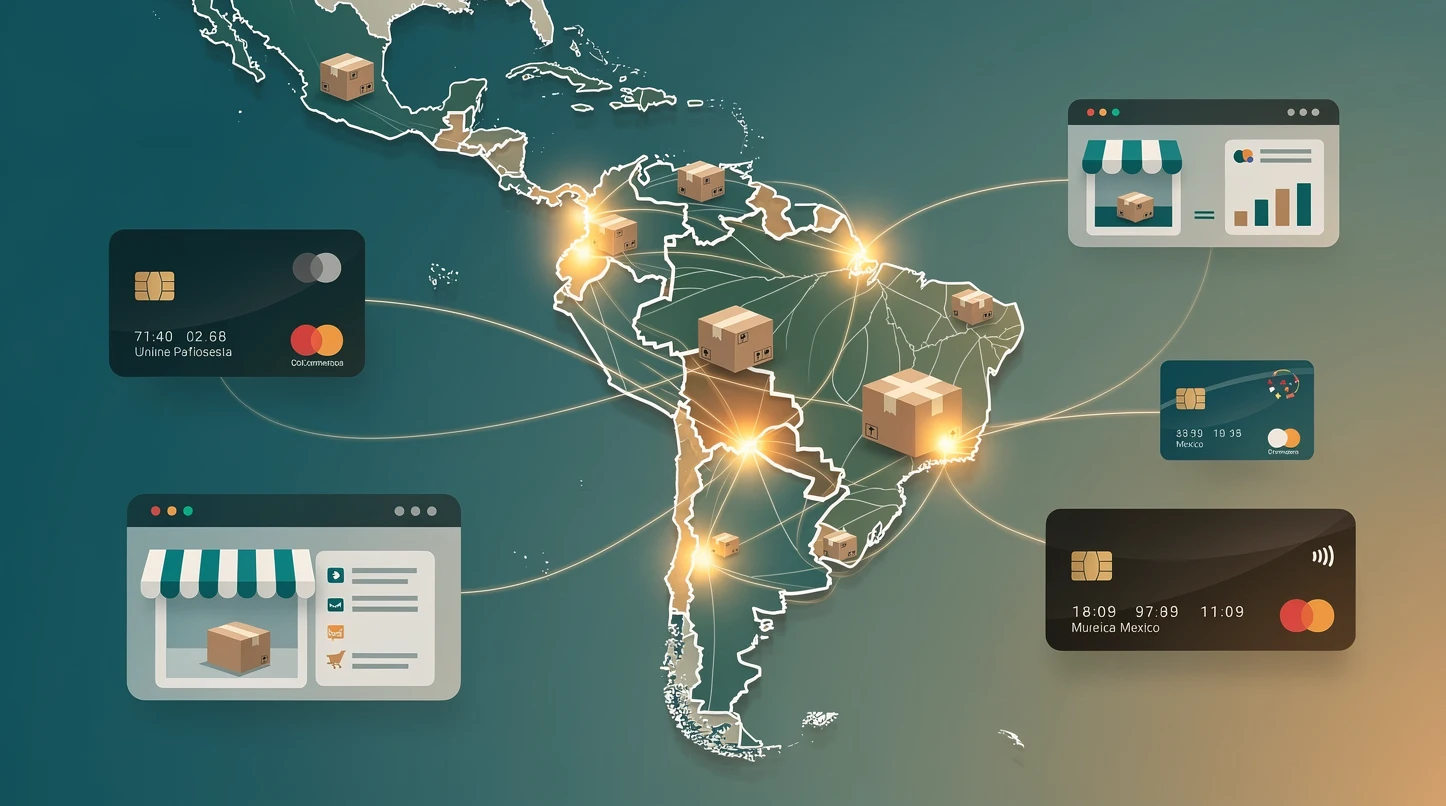
Mercado Libre is the largest e-commerce and fintech platform in Latin America, and for US sellers weighing where to expand next it has become the single most important gateway into the region. The company operates marketplaces across 18 countries, anchored by its three biggest markets of Brazil, Mexico and Argentina, and it pairs that reach with its own payments arm (Mercado Pago), logistics network (Mercado Envios), advertising suite and credit business. For a seller used to Amazon and Walmart Marketplace in the United States, the platform looks familiar on the surface and behaves very differently underneath.
This guide explains how Mercado Libre works for sellers, what it costs, how fulfillment and payments actually function on the ground, and how a US brand should sequence a launch into Latin America without burning cash on the wrong market first. The short version: the opportunity is real and still under-served by North American brands, but reputation mechanics, currency exposure and category fit decide who succeeds. If you are mapping this alongside other regions, it sits inside the broader discipline of selling on global e-commerce marketplaces, where the same brand runs very different playbooks per platform.
In short
- Mercado Libre is the Amazon of Latin America, operating in 18 countries with roughly 100 million-plus active buyers and a fully integrated stack of marketplace, payments (Mercado Pago), logistics (Mercado Envios), ads and credit.
- Three markets carry the economics: Brazil is the largest by gross merchandise volume, Mexico is the fastest-growing and the easiest cross-border entry for US sellers, and Argentina is high-volume but currency-volatile.
- Reputation is the ranking currency, not just reviews. On-time shipping, low cancellation and low claims decide search visibility and eligibility for the coveted MercadoLider seller tiers.
- Fulfillment through Mercado Envios Full (the platform’s equivalent of Amazon FBA) is close to mandatory for competitive delivery promises and Buy Box-style placement in the major markets.
- Cross-border into Mexico is the standard first step for US brands, because it avoids local incorporation at the start while still reaching the region’s most receptive online buyers.
Why Mercado Libre matters for US sellers in 2026
Latin America is one of the last large e-commerce regions where online penetration is still climbing quickly rather than plateauing. Retail e-commerce continues to grow at double-digit rates across the major economies, driven by smartphone adoption, expanding logistics coverage and a rapidly banking population that was largely cash-based a decade ago. Mercado Libre captures a disproportionate share of that growth because it built the payments and delivery rails the rest of the market depends on.
For US sellers the strategic point is simple. Amazon competes in the region but does not dominate it the way it dominates North America, and in several countries Mercado Libre is clearly the default destination for online shopping. That means a US brand can reach tens of millions of buyers through one platform relationship rather than stitching together a dozen local retailers. The catch is that the platform rewards operational discipline more heavily than most sellers expect coming from the US environment.
There is also a timing argument specific to 2026. Mercado Libre has spent years building fulfillment centers and last-mile capacity that now let it promise same-day and next-day delivery in major metros, closing the one gap that historically pushed shoppers toward local retail. As those delivery promises harden into buyer expectations, the sellers already inside the Full network capture the demand, and late entrants find the ranking positions and reputation ladders already occupied. Entering now means climbing a shorter ladder than entering in two years.
The scale of the opportunity
The company reports well over 100 million active users and continues to add buyers each quarter, with fintech users on Mercado Pago now exceeding the marketplace buyer base. Gross merchandise volume runs in the tens of billions of dollars annually, and items sold are measured in the billions. For a US category leader that has saturated domestic growth, a market this large with comparatively thin competition from other North American brands is difficult to ignore.
The competitive window also matters. Chinese cross-border players have targeted the region aggressively, and the way that contest resolves shapes fees and buyer expectations for everyone. Our analysis of how Shein and Temu’s Latin America pivot stacks up against MercadoLibre lays out why the incumbent’s logistics moat is harder to dislodge than the newcomers assumed. US sellers benefit from entering while the platform still actively courts quality international brands to differentiate from ultra-low-cost imports.
Key terms and definitions
Mercado Libre uses its own vocabulary, and several terms map only loosely onto Amazon or Walmart equivalents. Getting these straight before launch prevents expensive misreadings of the seller dashboard.
- Mercado Libre (Meli): the marketplace itself, branded locally as Mercado Livre in Brazil.
- Mercado Pago: the payments and fintech arm that processes checkout, holds seller balances, offers buyer installments and runs a growing consumer credit book. It is not optional; it is the payment layer.
- Mercado Envios: the shipping and logistics network, including the Full fulfillment program where the platform stores and ships your inventory.
- MercadoLider: the seller reputation tier system (Gold, Platinum) that unlocks visibility, badges and buyer trust once you meet volume and performance thresholds.
- Reputation thermometer: the color-coded seller health score (red through green) driven by claims, cancellations and delivery delays.
- Publication types: Classic and Premium listing formats that trade a higher commission for installment eligibility and better exposure.
The most important conceptual shift is that Mercado Pago and Mercado Envios are not add-ons you can bypass. They are the connective tissue of the platform, and opting out of them (where even possible) puts a listing at a structural disadvantage that no amount of pricing can overcome.
How selling on Mercado Libre works in practice
A live listing on Mercado Libre passes through the same four operational layers every time: catalog and listing setup, pricing and publication type, payment settlement through Mercado Pago, and fulfillment through Mercado Envios. Each layer has rules that differ enough from US marketplaces to trip up an unprepared team.
Listings and the catalog
Mercado Libre has moved steadily toward a catalog model similar to Amazon, where multiple sellers compete on a single product page and the platform awards a Buy Box-style winning offer. In categories with a mature catalog, you list against an existing product identity and compete on price, reputation and shipping speed. In less developed categories you still create standalone listings with your own titles and images, which gives more control but less built-in traffic.
Titles, images and attributes carry heavy ranking weight. The search algorithm favors complete technical specifications, high-quality images on white backgrounds, and titles that match how local buyers actually search, which is rarely a direct translation of your US title. Machine translation is a common and costly mistake because Portuguese for Brazil and Spanish for Mexico or Argentina differ in product terminology, not just language.
Publication types and pricing
Sellers choose between Classic and Premium publication types on most listings. Classic carries a lower commission but does not offer buyers interest-free installments. Premium carries a higher commission and unlocks installments, which materially lifts conversion on higher-ticket items because installment culture is deeply embedded in Latin American retail. Choosing the wrong publication type quietly suppresses conversion on exactly the products where margin should support the Premium fee.
Pricing must also absorb the platform’s fee stack and, critically, currency risk. A price set in Brazilian reais or Mexican pesos can swing in dollar terms between the moment of sale and the moment you repatriate funds. Sellers who price purely off a fixed dollar cost without a currency buffer routinely watch margin evaporate on Argentine sales in particular.
Payments through Mercado Pago
Every marketplace transaction settles through Mercado Pago. Buyer funds, installment financing, chargebacks and your payout balance all live inside that system. Payouts follow a release schedule tied to delivery confirmation and your reputation tier, so newer sellers wait longer to access cash than established ones. Planning working capital around that release lag is essential, because a fast-growing new seller can be starved of cash even while sales look healthy on the dashboard.
Why installments change the math
Interest-free installments, known locally as cuotas sin interes in Spanish-speaking markets and parcelamento in Brazil, are not a nice-to-have. They are how a large share of Latin American consumers finance any purchase above roughly one week of disposable income. A buyer who would never pay a single 3,000 peso charge will readily accept twelve monthly payments of 250, and conversion on higher-ticket listings can more than double once installments are enabled.
This is the core reason the Premium publication type earns its higher commission on the right products. Mercado Pago absorbs the financing and pays the seller up front in most configurations, so the merchant captures the conversion lift without carrying the consumer credit risk directly. US sellers who reflexively pick the cheaper Classic listing to protect margin frequently leave far more revenue on the table than the commission difference, especially in electronics, appliances and premium apparel where the ticket clears the installment threshold.
Fulfillment: how Mercado Envios and Full decide who wins
Fulfillment is where Mercado Libre most resembles Amazon and where US sellers most often underestimate the operational lift. Mercado Envios offers several modes, but the one that matters competitively is Full, the platform-operated fulfillment program equivalent to Fulfillment by Amazon.
With Full, you send inventory to a Mercado Libre fulfillment center and the platform handles storage, pick, pack, shipping and much of the customer service. Listings fulfilled through Full earn faster delivery promises, better search placement and the delivery badges that buyers now expect. In the major markets, competing against Full sellers while self-shipping cross-border is close to impossible on delivery time, which is the single biggest driver of conversion after price.
Cross-border versus local fulfillment
US sellers typically start with a cross-border program that ships from the United States into a market like Mexico, which avoids local incorporation and inventory commitment up front. Cross-border is the correct way to test demand, but it carries longer delivery times and customs exposure that cap how competitive a listing can be against local Full inventory. The pattern that works is to validate demand cross-border, then move winning SKUs into local Full stock once volume justifies the logistics investment.
The delivery-promise flywheel
Delivery speed feeds reputation, reputation feeds visibility, and visibility feeds volume that in turn justifies deeper local inventory. This flywheel is why sellers who commit to Full early in a single market usually outperform those who spread thin cross-border inventory across three countries. Concentration beats breadth in the first year, and the platform’s ranking mechanics actively reward it.
| Market | Position for US sellers | Typical entry mode | Key risk | Currency exposure |
|---|---|---|---|---|
| Mexico | Easiest cross-border entry, fastest US shipping lane | Cross-border, then local Full | Rising local competition | Moderate (peso) |
| Brazil | Largest market by volume, most demanding operationally | Local entity plus Full | Tax and import complexity | Moderate (real) |
| Argentina | High volume, high inflation and FX friction | Local operation required | Currency and capital controls | High (peso) |
| Chile, Colombia | Smaller but stable secondary markets | Cross-border | Thinner demand pool | Moderate |
Reputation: the ranking currency you cannot buy
The most important thing a US seller can internalize is that reputation on Mercado Libre is an operational score, not a marketing one. It is driven by objective delivery and dispute metrics, and it directly gates search placement, buyer trust and eligibility for the MercadoLider tiers that unlock the biggest visibility gains.
The reputation thermometer runs from red to green, and it reacts to claims, cancellations and shipping delays across a rolling window. A single operational stumble, such as a stockout that forces cancellations, can drag a seller from green into yellow and visibly cut traffic within days. Recovery takes sustained clean performance, not a quick fix, which is why the platform punishes overextension so effectively.
How MercadoLider tiers work
Once a seller crosses volume and performance thresholds while maintaining a green reputation, they qualify for MercadoLider Gold and then Platinum status. These tiers add badges that buyers recognize, improve ranking, and in practice compound into a self-reinforcing advantage. New sellers should treat the first 90 days as a reputation-building phase where flawless fulfillment matters more than aggressive scaling.
Because reputation is earned through delivery performance, Full fulfillment is effectively a reputation-protection tool as well as a logistics one. Handing storage and shipping to the platform removes the most common sources of delay and cancellation, which is why high-performing sellers concentrate their best SKUs in Full rather than risk self-shipping errors against their score.
Common mistakes and how to avoid them
Most failed Mercado Libre launches by US sellers repeat a small set of avoidable errors. Recognizing them in advance is the cheapest form of insurance.
Treating it like Amazon US
The interface invites the assumption that Amazon tactics transfer directly. They do not. Installment eligibility, Mercado Pago settlement timing, reputation mechanics and local-language listing quality all behave differently, and a lift-and-shift of US listings usually underperforms badly. Rebuild listings for the local market rather than porting them.
Spreading across too many countries at once
Launching in Brazil, Mexico and Argentina simultaneously divides inventory, attention and cash across three very different operating environments. The reputation flywheel rewards concentration, and cash tied up in slow-moving cross-border stock in a weak market starves the market that is actually converting. Pick one lead market, usually Mexico, and win it before expanding.
Ignoring currency and repatriation
Selling in a currency that can move sharply against the dollar, then repatriating funds through a settlement and payout lag, creates real margin risk that a US-only seller has never priced. Argentina is the extreme case, with inflation and capital controls that can trap or erode funds. Price with a currency buffer and plan repatriation deliberately rather than assuming dollar-equivalent margins.
Underinvesting in fulfillment and customer service
Delivery delays and unanswered buyer questions punish reputation immediately, and reputation gates everything else. Sellers who try to run Latin American operations as a low-priority side channel, with slow cross-border shipping and English-only support, see their reputation score cap their visibility no matter how good the product is. Local-language service and Full fulfillment are not optional for serious volume.
Examples from US retail and e-commerce
The sellers who succeed on Mercado Libre tend to share a profile: a differentiated product, patience for a single-market build, and a willingness to run local logistics properly. The category winners are instructive.
Branded consumer electronics accessories, beauty and personal care, home and kitchen goods, and specialty apparel travel well because they carry recognizable quality signals against a marketplace still crowded with generic imports. A US brand with genuine differentiation can command a trust premium precisely because Latin American buyers are increasingly wary of the ultra-cheap cross-border flood. The strategic read on that flood, and why platform loyalty is shifting, mirrors the dynamics we traced in how TikTok Shop is consolidating a pan-regional marketplace, where trust and delivery reliability, not just price, decide who keeps the buyer.
The single-market build in practice
A common successful sequence looks like this. A US brand launches a focused SKU set into Mexico cross-border, learns the local search vocabulary and pricing tolerance, then moves its best sellers into Mexican Full inventory once weekly volume stabilizes. Only after reaching a green reputation and MercadoLider status in Mexico does it open Brazil, this time with local fulfillment from day one because the lessons and cash flow now support it.
The role of platform infrastructure decisions
Sellers running their own storefront alongside marketplace channels often revisit their tech stack when Latin American volume grows, because latency and payment localization start to matter. Teams weighing that build sometimes reference infrastructure guides such as hosting Magento on AWS without a six-figure surprise, since a regional marketplace push frequently exposes the limits of a US-centric hosting setup. The marketplace remains the demand engine, but the owned channel has to keep up as the brand scales across borders.
Tools, partners and vendors worth knowing
Mercado Libre’s own stack covers most operational needs, but the ecosystem around it fills important gaps for cross-border US sellers.
- Mercado Pago and Mercado Envios: the non-negotiable core. Master the payout schedule, Full onboarding and reputation dashboards before layering anything on top.
- Mercado Ads: the platform’s advertising suite for sponsored placement, which becomes worthwhile only once reputation and fulfillment are solid, since ads amplify a listing’s underlying conversion rather than fixing a weak one.
- Multichannel listing tools: integrations that sync catalog and inventory between Amazon, Shopify and Mercado Libre reduce the operational overhead of running the platform as one channel among several.
- Cross-border logistics partners: specialists in US-to-Mexico and US-to-Brazil freight, customs and returns who shorten the learning curve on the hardest part of entry.
- Local tax and compliance advisers: essential before establishing a Brazilian or Argentine entity, where tax complexity is genuinely high and mistakes are expensive.
The sequencing that works is to lean entirely on Mercado Libre’s own infrastructure at first, add advertising once the fundamentals are green, and bring in cross-border logistics and local compliance partners only as volume in a specific market justifies the fixed cost. This ties back to the broader discipline of running one brand across global marketplaces, where each platform demands its own local stack rather than a single templated approach. You can also review Mercado Libre’s own corporate and seller resources and the platform’s company background for context on its market position.
A practical 90-day launch playbook
For a US seller committing to Latin America, a disciplined first quarter beats an ambitious multi-country sprint. The following sequence reflects how the successful entrants tend to move.
| Phase | Focus | Key actions | Success signal |
|---|---|---|---|
| Days 1-30 | Single-market setup (Mexico) | Localize listings, choose publication types, launch cross-border, seed reviews | First sales with zero cancellations |
| Days 31-60 | Reputation build | Flawless fulfillment, fast local-language support, tune pricing for FX | Green reputation thermometer |
| Days 61-90 | Consolidate and scale | Move top SKUs to local Full, begin Mercado Ads, target MercadoLider tier | Rising organic visibility and repeat buyers |
The discipline this playbook enforces is concentration. One market, clean operations, reputation first, scale second. Sellers who follow it reach sustainable volume faster than those who chase three markets at once, because the platform’s own ranking logic pays out for exactly this behavior.
Treat the 90 days as an investment in a compounding asset rather than a demand test with a pass or fail grade. Reputation, MercadoLider status and the delivery data that feeds the algorithm all accrue over time and cannot be bought back quickly once lost. The brands that dominate a Latin American category three years from now are, in most cases, the ones that entered patiently, protected their reputation obsessively, and let the flywheel do the compounding.
Frequently asked questions
Do I need a local legal entity to sell on Mercado Libre?
Not to start. US sellers can enter markets like Mexico through cross-border programs without local incorporation, which is the standard first step. A local entity becomes necessary for full local fulfillment at scale and is effectively required for serious operations in Brazil and Argentina, where tax and import rules are complex.
Which country should a US seller launch in first?
Mexico is the usual answer. It offers the shortest shipping lane from the United States, a large and receptive online buyer base, and the simplest cross-border entry. Winning Mexico first builds the reputation, cash flow and local knowledge that make a later Brazil launch far less risky.
How do Mercado Libre fees compare to Amazon?
The structure is broadly similar, with category-based commissions plus fulfillment fees, but the details differ by country and publication type. Premium listings that enable buyer installments carry higher commissions than Classic listings. Always model the full stack of commission, fulfillment and payment costs per market rather than assuming Amazon-equivalent economics.
Is Mercado Envios Full really necessary?
In competitive categories in the major markets, effectively yes. Full unlocks faster delivery promises, better search placement and the delivery badges buyers expect, and it protects your reputation score by removing common shipping errors. Cross-border self-shipping is fine for testing demand but rarely competitive against local Full inventory at scale.
What is the reputation thermometer and why does it matter so much?
It is a color-coded seller health score driven by claims, cancellations and delivery delays. It matters because it directly gates search visibility, buyer trust and eligibility for MercadoLider tiers. A drop from green to yellow can visibly cut traffic within days, and recovery requires sustained clean performance rather than a quick fix.
How does currency risk affect my margins?
You sell in local currency and repatriate dollars after a settlement and payout lag, so exchange-rate movement between sale and repatriation directly hits margin. Mexico and Brazil carry moderate exposure; Argentina is the extreme case with high inflation and capital controls. Price with a currency buffer and plan repatriation deliberately.
Can I run Mercado Libre alongside Amazon and my own store?
Yes, and most successful sellers do. Multichannel listing tools sync catalog and inventory across Amazon, Shopify and Mercado Libre. The key is to localize listings for each Mercado Libre market rather than porting US content, and to keep enough inventory dedicated to the market that is actually converting.
How long until Mercado Libre becomes profitable for a new US seller?
Plan for a reputation-building first quarter where flawless operations matter more than scale, followed by profitable volume as green reputation and MercadoLider status lift organic visibility. Sellers who concentrate on one market and invest in local fulfillment typically reach sustainable profitability faster than those who spread across several countries at once.