Chemist Warehouse, the Australian discount pharmacy chain that opened its first British shop in Harrow earlier this month, has said it intends to open “many, many, many more” UK stores. Its second London branch, in Hoxton, is planned for the new year. The comments came at the formal launch event for the Harrow store on 20 November, Chemist+Druggist reports, and the Australian Financial Review has since described the London opening as a “modest test” of the UK market by the chain’s ASX-listed parent, Sigma Healthcare.
For UK shoppers the arrival matters because it puts a new price-led competitor into a health and beauty market dominated by Boots and Superdrug, at a moment when Boots itself is changing hands. This article sets out what has been confirmed, what has not, how the format compares with the incumbents, and what shoppers should check before they cross London for a cheaper bottle of vitamins.
In short
- Harrow first: Chemist Warehouse opened its first UK store at 38–44 St Anns Road, Harrow, on 4 November 2026, and says more than 1,000 customers a day have visited since.
- Hoxton next: a second London branch in Hoxton is planned for the new year, according to its joint venture partner Green Light, with no further sites named yet.
- “Many, many, many more”: Sigma Healthcare chief executive Vikesh Ramsunder told the launch event the chain plans many more UK stores and 36 international openings this year.
- Joint venture model: Sigma takes a 75% stake in converted stores run with Green Light Pharmacy, an employee-owned London group of 22 pharmacies; the first phase covers up to five stores.
- No UK online shop yet: the UK website lists one store and opening hours but does not sell online, and only NHS pharmacy services are offered for now.
What did Chemist Warehouse announce at the Harrow launch?
The Harrow store began trading on 4 November, but the formal launch event took place on 20 November. Speaking there, Sigma Healthcare’s chief executive Vikesh Ramsunder said the chain plans to open “many, many, many more” stores in the UK, according to Chemist+Druggist. He also said the group would open 36 stores internationally this year to “continue growing the brand moving forward”.
The more concrete detail came from Paras Shah, professional services lead at Green Light, the London pharmacy group that is Chemist Warehouse’s UK partner. He told Chemist+Druggist that the next UK branch will be in Hoxton, in east London, with plans to open “in the new year”. No exact date, address or store size has been published.
James Kocharunchitt, Chemist Warehouse’s head of UK business and managing partner, said the local response since opening had been “exceptional, with more than 1,000 customers every day”. That figure is the company’s own claim and has not been independently verified. On opening day, he had told trade titles including Pharmacy Business that more than 700 customers visited the store.
The opening itself was covered by trade titles and LBC in the first week of November. What is new is the stated ambition and the second site. A single store in Harrow could be read as a trial; a named second store and a public commitment to “many more” turn it into a rollout, even if the pace remains undefined.
The Australian Financial Review, in a 22 November feature from its Europe correspondent, framed the venture as a test of whether the chain can “be better than the British pharmacy giant”, Boots, and avoid the fate of Bunnings, the Australian DIY chain whose UK expansion through the Homebase acquisition ended in heavy losses.
Where is the UK store and when is it open?
According to the Chemist Warehouse UK website, the store is at 38–44 St Anns Road, Harrow, Middlesex, HA1 1LA. Trading hours are 8am to 9pm Monday to Saturday and 9am to 7pm on Sunday. That makes it one of the longer-opening health and beauty shops in north-west London, and Green Light’s Paras Shah has pointed to people “who traditionally may not be able to pop to the pharmacy” because of usual closing times.
The Sunday hours are worth a note. Under the Sunday Trading Act 1994, shops in England and Wales with more than 280 square metres of sales floor are limited to six continuous hours on a Sunday. A 10-hour Sunday therefore suggests the Harrow sales area sits below that threshold, which fits Pharmacy Business’s description of the first stores as converted or relocated Green Light sites rather than the very large warehouse units seen in Australia. Chemist Warehouse has not published the store’s floor area.
Hoxton: what is and is not known
Only the area has been named. Green Light already operates pharmacies in and around London, and Sigma has said that both parties plan to “identify existing GreenLight pharmacies” and, “where appropriate, develop or relocate these into Chemist Warehouse stores”, as Chemist+Druggist reported in May. Whether Hoxton is a converted Green Light branch or a new unit has not been confirmed.
Shoppers in east London should treat “new year” as a target rather than a date. Store fit-outs, pharmacy registration changes and staffing can all move timetables, and the company has not given a month.
How does the Green Light joint venture work?
Chemist Warehouse is not entering Britain alone. The UK business is a joint venture with Green Light Pharmacy, which Pharmacy Business describes as an employee-owned group founded in London in 1999 and operating 22 pharmacies in and around the capital. Under the agreement announced in May 2026, Sigma acquires a 75% interest in a number of stores and Green Light retains the other 25%.
The division of labour is clear in the published terms. Sigma provides the Chemist Warehouse brand and intellectual property and retail support covering ranging, store layout, inventory management and marketing. Green Light continues to provide dispensing, professional pharmacy services and back-office support.
The first phase is expected to focus on rebranding and developing up to five stores, with the option to add more if it proves successful, Pharmacy Business reports. That matters for expectations: Green Light’s 22-branch network is not a confirmed list of 22 future Chemist Warehouse shops. LBC’s early report that the deal would bring the brand to “22 locations” overstated what has been agreed.
Why a partner rather than a standalone entry?
Running a pharmacy in England requires premises registered with the General Pharmaceutical Council, a responsible pharmacist on site, and, for NHS dispensing, inclusion on the local pharmaceutical list. Buying into an established operator gives an overseas retailer an existing licence base, clinical staff and NHS relationships. It also limits the capital at risk while the format is tested, which is consistent with the AFR’s description of a “modest test”.
| Item | What has been reported | Source |
|---|---|---|
| First UK store | 38–44 St Anns Road, Harrow, opened 4 November 2026 | Company website; Chemist+Druggist |
| Opening hours | Mon–Sat 8am–9pm, Sun 9am–7pm | Company website |
| Footfall claim | 700+ on day one; 1,000+ a day since | Company statements via trade press |
| Next store | Hoxton, east London, “in the new year” | Green Light, via Chemist+Druggist |
| Ownership | Sigma 75%, Green Light 25% of converted stores | Pharmacy Business |
| First phase | Up to five stores | Pharmacy Business |
| Pharmacy services | NHS services only; private services planned later | Chemist+Druggist |
| Online shop | None on the UK website | Company website |
Is Chemist Warehouse really the UK’s cheapest chemist?
That is the question the chain itself poses. The sign above the Harrow store asks, “Is this the UK’s cheapest chemist”, the AFR reports, borrowing a device the company has used for years in Australia, where the words “is this” often appear in smaller print than the rest of the line. Pharmacy Business notes that the retailer has promoted itself as the UK’s cheapest chemist, while observing that its pricing claims will face competition from established high street and online retailers.
No independent basket comparison between Chemist Warehouse Harrow and Boots, Superdrug or the supermarkets has been published. Shoppers should therefore treat the claim as marketing rather than a verified finding. On specific items, prices can be checked in store against the Boots and Superdrug websites, which both publish live online prices.
What UK advertising rules say about “cheapest” claims
The Committee of Advertising Practice’s code requires marketers to hold evidence for objective claims, and comparative price claims must compare like with like. The Advertising Standards Authority judges an advert on the overall impression it gives the average consumer, so phrasing a claim as a question does not automatically take it outside the rules if shoppers would read it as a statement. Separately, since April 2025 the Digital Markets, Competition and Consumers Act 2024 has allowed the Competition and Markets Authority to fine businesses directly for misleading consumer practices.
None of this means the Harrow claim is misleading; there has been no complaint or ruling reported. It does mean the chain will need evidence behind its value messaging if a rival or a shopper challenges it, in a market where Boots and Superdrug have run their own price-matching and loyalty pricing for years.
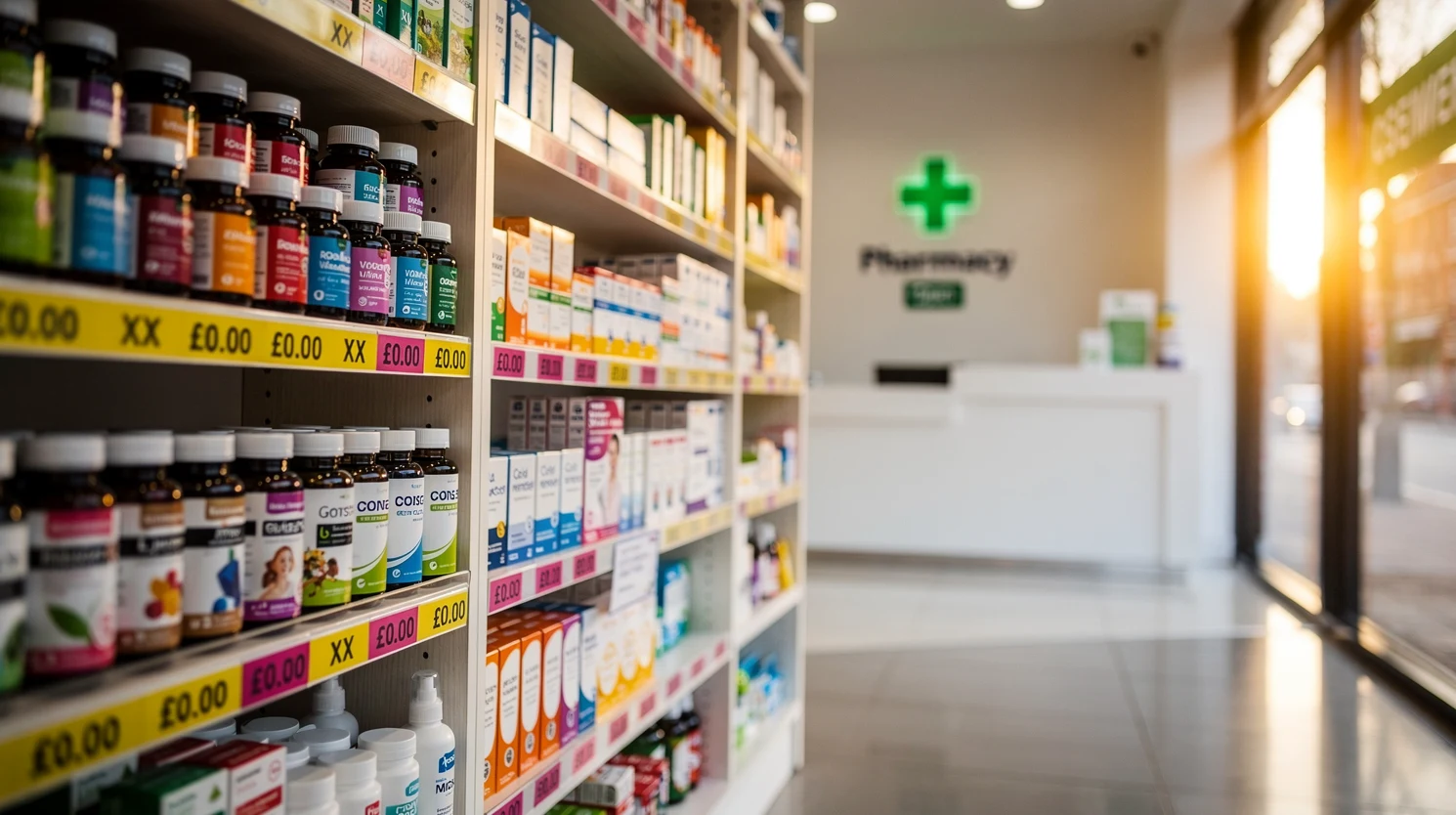
IGD, which visited the Harrow store, described value as “clearly at the core of the proposition”, with bright yellow and pink labels, bold pricing claims and promotional signage dominating the shopping experience. It said the chain introduces “a competitor willing to operate on lower margins to drive scale and market share”.
What does the store actually sell?
The UK website lists skincare and beauty, fragrances and cosmetics, haircare and personal care, vitamins and wellbeing products, baby care and family essentials, dental and oral care, and everyday health products. It notes that ranges vary by store and that medicines and regulated pharmacy services are subject to UK regulatory requirements.
IGD’s store visit found the supplements category “particularly impressive”, with extensive choice across brands, formats and health needs. It also found parts of the range more premium than shoppers might expect from a discounter, citing Marvis toothpaste and Manuka honey from New Zealand. Brands including CeraVe and Vichy have dedicated fixtures and branded displays.
That mix, value lines alongside “masstige” and premium brands, is the same territory in which Boots and Superdrug compete, and in which newer entrants have been pushing. Sephora, for example, is preparing a wider UK store rollout, as covered in our report on Sephora’s plan for 10 new UK stores, which targets the prestige end of the same beauty spend.
IGD also highlighted retail media: digital screens and branded aisle ends that suppliers pay for. For shoppers this is mostly invisible, but it explains part of how a discounter can fund low shelf prices. Supplier-funded promotions, display fees and screen advertising subsidise margins, which is why prominent end-of-aisle placements are not necessarily the cheapest option in a category.
LBC reported a polarised reaction from Australians online when the opening was announced, with some warning British shoppers of an “overstimulating” experience. IGD made a similar point more diplomatically, saying the volume of messages competes for shoppers’ attention and “may feel unconventional and overwhelming to UK shoppers”. It added that operational standards were strong, with high availability and well-stocked shelves during its visit.
How does it compare with Boots and Superdrug?
The scale gap is enormous. Boots says it operates more than 1,800 stores, a figure it gives as at 28 February 2026, and Superdrug has around 800. Chemist Warehouse UK has one, with a second planned. The incumbents also have mature online shops, loyalty schemes and, in Boots’ case, a growing private clinical services business.
Boots has been widening its paid services this autumn, including the medical cannabis service covered in our report on what Boots’ SureLeaf service costs. Chemist Warehouse, by contrast, currently offers only NHS services in Harrow, with private services planned once it has “the governance in place”, according to Green Light’s Paras Shah.
| Chemist Warehouse UK | Boots | Superdrug | |
|---|---|---|---|
| UK stores | 1 (Harrow); Hoxton planned | 1,800+ (company, Feb 2026) | About 800 |
| Ownership | Sigma Healthcare (ASX) 75%, Green Light 25% | Being sold by Sycamore Partners to the Weston family (agreed October 2026) | A.S. Watson (CK Hutchison) |
| Price positioning | Discount-led, heavy promotional signage | Mid-market with loyalty pricing | Value-leaning beauty and health |
| Online shop | No | Yes | Yes |
| Pharmacy services | NHS services only for now | NHS plus private clinics | NHS plus online doctor |
| Sunday hours (Harrow) | 9am–7pm | Varies by store | Varies by store |
The table shows why the immediate effect on most shoppers will be small. One shop in Harrow cannot move national prices. The effect, if any, will be local at first: rival pharmacies and beauty shops near St Anns Road and, from next year, Hoxton.
Sigma’s interest in the UK went well beyond Harrow earlier this year. In June 2026 it confirmed early-stage talks about buying Boots from Sycamore Partners, the US private equity firm that took control through its takeover of Walgreens Boots Alliance, Retail Gazette reported. On 15 June it withdrew, saying an acquisition would not currently meet its strategic and capital investment objectives, The Grocer and others reported.
On 7 October, the BBC, Sky News and the FT reported that the Weston family had agreed to buy Boots in a deal valued at about GBP 6.7 billion (USD 8.9 billion). So the chain that once looked at buying the market leader is now competing with it from a single shop, while Boots adjusts to new owners.
What will it mean for UK shoppers?
In the short term, the main practical effect is for people within reach of Harrow, and from next year Hoxton. They gain another late-opening pharmacy and a large range of vitamins, skincare and everyday health products sold on a promotional model. Everyone else sees no change yet.
The longer-term question is whether a discounter can push down prices in categories such as supplements, over-the-counter medicines and personal care. IGD expects the arrival to “increase competitive pressure across the sector” in exactly those categories, and named Boots, Superdrug, Savers and the major grocers as the players facing it. Supermarkets already sell many of the same everyday health lines, often at sharp prices, so the discounter’s advantage will be range and pharmacy services rather than price alone.
Things shoppers should check
- Unit prices: compare price per tablet, per 100ml or per day’s dose, not pack prices, especially on multi-buy offers.
- Pack limits: UK rules cap paracetamol at 32 tablets in pharmacies (16 outside them) per pack, so cheaper large packs seen abroad will not appear here.
- Returns policy: for non-faulty items bought in store, returns are at the retailer’s discretion; ask before buying gifts.
- Faulty goods: under the Consumer Rights Act 2015 you have a 30-day right to reject faulty items for a full refund, wherever you bought them.
- Prescriptions: NHS prescription charges in England are set nationally, so a discount chain cannot undercut them; savings apply to retail products.
Prescription pricing is a point often missed. In England, the NHS charge per item is the same in any pharmacy, and prescriptions are free in Scotland, Wales and Northern Ireland. A discount pharmacy competes on the shopping basket around the prescription, not on the prescription itself.
Why is a new chain opening when pharmacies are closing?
The timing looks counter-intuitive. Community pharmacy in England has been shrinking for several years under funding pressure, and Chemist+Druggist reported last month that Morrisons had sold around 10 of its pharmacies with more going through a sale process. Boots itself has closed hundreds of branches since 2023.
The Chemist Warehouse model answers that pressure by leaning on retail footfall rather than dispensing fees. Green Light’s Paras Shah described a “symbiosis” between footfall and services, arguing that “delivering those services is going to be enhanced in the setting we’re in, because we’ve got access to more people”. The bet is that cheap health and beauty brings people in, and pharmacy services and prescriptions keep them coming back.
Shah also argued that this model “can play an important role in revitalising local British high streets by attracting increased foot traffic”. That claim will be tested against a tough backdrop. Footfall has been weak this autumn, as our analysis of UK footfall in October 2026 showed, and occupancy costs remain a pressure point for new stores.
The rates picture is changing too. The Budget’s changes to retail property bills, explained in our piece on business rates relief for high street shops, are weighted towards smaller high street units, the kind of premises Green Light conversions are likely to use, rather than large out-of-town sheds.
Can the Australian model work in Britain?
Chemist Warehouse says it began in Australia more than 20 years ago and now trades in Australia, New Zealand, Ireland and the United Arab Emirates. After its merger with Sigma Healthcare in 2025, the combined group runs around 1,000 shops in Australia, LBC reported. Britain is its largest new market by population.
There are reasons for caution. UK shoppers already have a dense network of pharmacies, discounters such as Savers and B&M, and supermarkets selling health and beauty at keen prices. The AFR’s reference to Bunnings is pointed: an Australian retailer with a strong home format found that Britain’s property costs, shopper habits and competition did not match its assumptions.
There are also reasons the format could travel. IGD found availability high and standards well maintained, and judged that the chain “has the potential to bring meaningful disruption to the channel”. It described the store as a destination for health, beauty and wellness across price points, rather than a limited-range discounter.
Scaling beyond London would mean either a national partner, more acquisitions of independent pharmacies, or a standalone retail-first model with pharmacies added store by store. None has been announced. The first-phase cap of five stores suggests Sigma wants trading data from Harrow and Hoxton before committing serious capital, and the chain has not said whether it plans an online shop for UK customers.
| Date | Event |
|---|---|
| May 2026 | Sigma announces UK entry through Green Light joint venture |
| June 2026 | Sigma confirms early-stage Boots talks, then withdraws on 15 June |
| 7 October 2026 | Weston family agrees to buy Boots for about GBP 6.7 billion |
| 4 November 2026 | First UK store opens in Harrow |
| 20 November 2026 | Launch event: “many, many, many more” UK stores; Hoxton named next |
| New year 2027 | Planned Hoxton opening (no date given) |
What does it mean for suppliers and independent pharmacies?
For brands, Chemist Warehouse is a new route to market with heavy in-store visibility, IGD noted, but its model “relies on sharp pricing, promotional activity and supplier support”. In practice that means suppliers will be asked to fund promotions and pay for screen and fixture space, the same trade-off they face with the big grocers.
For independent pharmacies near the new stores, the competition is mainly on the retail side of the shop. A discount chain with long opening hours and a big vitamins range takes the impulse and top-up spend that helps many independents subsidise dispensing. Independents tend to compete back on service, delivery of prescriptions, and clinical services such as Pharmacy First consultations.
The wider health and beauty market is in flux. Apart from the Boots sale and Sephora’s expansion, Mothercare’s exclusive UK distribution deal with Boots ended at the close of 2025, and the brand is still looking for a new UK partner, as covered in our report on Mothercare’s year-end rescue deadline. Shelf space in baby care and family essentials, categories Chemist Warehouse also stocks, is being reshuffled across the high street.
What to watch next
- A confirmed Hoxton address and opening date.
- Any named sites for stores three to five in the first phase.
- The launch of private pharmacy services, such as travel vaccinations or weight management.
- Any independent price comparison against Boots, Superdrug and the supermarkets.
- Whether Chemist Warehouse launches a UK online shop or click-and-collect.
- Sigma’s next results, which may give the first figures for UK trading.
Frequently asked questions
Where is the Chemist Warehouse store in the UK?
The only UK store is at 38–44 St Anns Road, Harrow, Middlesex, HA1 1LA, according to the company’s UK website. It opened on 4 November 2026.
What are the Chemist Warehouse Harrow opening hours?
The store opens 8am to 9pm Monday to Saturday and 9am to 7pm on Sunday, per the UK website. Hours over Christmas have not been published.
When will Chemist Warehouse open in Hoxton?
Green Light Pharmacy, the chain’s UK partner, told Chemist+Druggist the Hoxton branch is planned for “the new year”. No date or address has been announced.
Can I shop at Chemist Warehouse online in the UK?
Not at present. The UK website lists the Harrow store, its hours and job opportunities but does not offer online ordering or delivery.
Is Chemist Warehouse cheaper than Boots?
The chain promotes itself with the question “Is this the UK’s cheapest chemist”, but no independent price comparison has been published. Compare unit prices on the items you buy most often.
Can I get my NHS prescription at Chemist Warehouse?
The Harrow store currently offers NHS services, Chemist+Druggist reports, with private services planned later. NHS prescription charges are the same in every pharmacy in England.
Who owns Chemist Warehouse UK?
The UK stores are a joint venture in which ASX-listed Sigma Healthcare holds 75% and London’s employee-owned Green Light Pharmacy holds 25%.
Did Chemist Warehouse try to buy Boots?
Its parent Sigma confirmed early talks in June 2026 but withdrew on 15 June. Boots is being bought by the Weston family in a deal agreed in October.
How many UK stores will Chemist Warehouse open?
No number has been given. The first phase covers up to five stores, and Sigma’s chief executive has said “many, many, many more” will follow.