
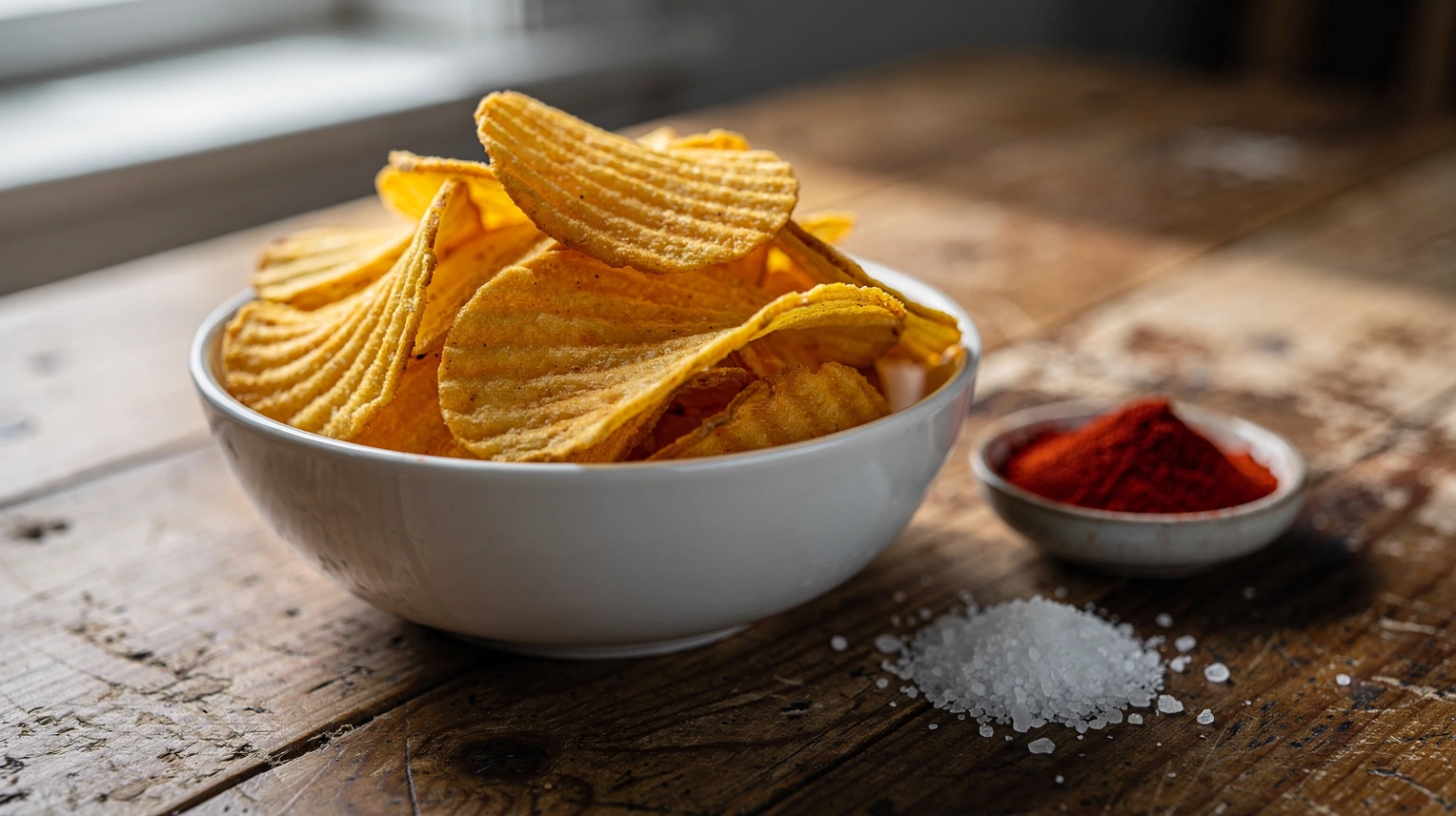
Smoky bacon crisps are not being banned, and no packet in a British shop has to change this year. What has changed is that the government now expects a new EU rule reserving the word “bacon” for meat products to fall within the food deal Prime Minister Andy Burnham is due to sign in Brussels on 20 November.
The BBC reported on Friday evening that the rule could force crisps called smoky bacon or roast chicken to be relabelled for sale in British shops, while stressing that much remains unclear. We read the regulation itself, the Defra guidance and the ingredient lists to separate what is settled from what is still an argument.
In short
- No ban yet: the EU rule does not apply until 19 August 2029, and the UK has not said whether its version would start then.
- The risk is the name, not the crisp: “bacon”, “chicken”, “beef” and “steak” are among 31 reserved terms, and Walkers Smoky Bacon lists no meat ingredient.
- The government’s position: it told the BBC it expects the rules to be in scope of the deal, although the Environment Secretary told a radio host to “get a life” over the question.
- An exit exists: the Commission can exempt names with an established long-term use, but it has not said whether crisp flavours qualify.
- Bigger label changes come first: Defra’s guidance already lists marmalade, jam, honey and fruit and vegetable labels, with the deal intended to take effect in mid-2027.
Are smoky bacon crisps actually being banned in the UK?
No, not on what has been published so far. The Telegraph reported on 4 November that the flavour faces being banned from supermarket shelves, and the Standard and Metro carried similar warnings. The BBC’s account is more cautious: it says crisps with such names “could have to be relabelled”, and adds that much is unclear about how the rules would work in practice.
The distinction matters to anyone with a multipack in the cupboard. The rule at the centre of the row restricts what a product may be called. It says nothing about whether a potato crisp may taste of smoke and paprika.
So the realistic question is not whether the flavour disappears. It is whether a packet could still say “bacon” on the front if there is no bacon in the bag, and that question has three separate answers still outstanding: one from the European Commission, one from MEPs and one from the UK government.
The issue is not new. The i Paper and The Sun ran warnings about Bacon Fries, Monster Munch and Pot Noodle in March, and FoodNavigator reported on 27 October that crisps could be caught. It became a national story when the Telegraph tied it to the summit, and then on Thursday 5 November when Times Radio presenter Stig Abell put it to Environment Secretary Dame Angela Eagle.
Her reply, as reported by HuffPost UK and others, was: “Oh, Stig. I mean, really, we’ve had EU straight bananas, and now we’re talking about banning smoky bacon crisps, I think you should get a life.” She went on to say the deal was about being able to “do business with our closest neighbours”, and added: “If you want to obsess about smoky bacon crisps, I suppose that’s your choice.”
The minister’s answer did not address whether the labelling would change. A day later the BBC reported that the government expects the regulations to be in scope of the deal, and that Defra stands ready to help snack businesses prepare.
What does the EU rule actually say?
The measure is Regulation (EU) 2026/1739, adopted on 8 July 2026 and published in the Official Journal on 29 July. It is mainly a law about strengthening farmers’ position in the food supply chain, and the meat names section is one part of it.
It reserves the word “meat” and a list of 31 terms for meat products, “at all stages of marketing”. The list covers animals and cuts, and applies to food generally, not just to plant-based burgers and mince. That wording is why crisps have been drawn in: the text contains no specific exception for flavour descriptions.
| Group | Terms reserved in the published regulation |
|---|---|
| Animals and meats | beef, veal, pork, poultry, chicken, turkey, duck, goose, lamb, mutton, ovine, goat |
| Cuts | drumstick, tenderloin, sirloin, flank, loin, ribs, shoulder, shank, chop, wing, breast, thigh, brisket, ribeye, T-bone, rump |
| Other | bacon, steak, liver |
| Not on the list | burger, sausage, ham, fillet, nuggets, prawn, cheese, onion, vinegar, salt |
Several British reports this week, including the Standard and Metro, have listed “fillet” among the banned words. It does not appear in the list of terms as published in the Official Journal. “Burger” and “sausage” were also dropped from the list during negotiations.
That may not be the final word. FoodNavigator reports that separate proposals now in the European Parliament would extend the list to include burger and sausage, and would limit the terms to products made exclusively from meat. Those proposals have not been agreed.
The clause that could save the crisp
The regulation gives the Commission power to grant exceptions for products “the exact nature of which is clear due to an established long-term use and does not cause any possible confusion to the consumer”. The recitals say this should take the form of a list of names, reflecting how terms are used in different languages.
On its face, that test looks friendly to a flavour that British shoppers have bought for decades. But the BBC notes that Brussels has yet to set out how it plans to use the power or what it means for snacks. A British crisp name would also need to be argued for inside an EU process, which is exactly the point British trade bodies are now raising.
Which crisps and snacks are exposed?
The products most exposed are those that carry a reserved word and contain no meat. Plain flavours are untouched. Ready salted, salt and vinegar, cheese and onion and prawn cocktail use no reserved term at all, and fish and seafood fall outside the scheme.
The table below is based on current ingredient lists and retailer listings where we could check them. It shows exposure to the naming question and is not a forecast of what any manufacturer will do; none of these brands has announced a change.
| Product | Reserved word | Meat in the recipe? | What we checked |
|---|---|---|---|
| Walkers Smoky Bacon | bacon | None listed | Walkers’ own ingredient list: flavourings, yeast extract, salt, yeast powder, potassium chloride, acids, paprika extract |
| Walkers Monster Munch Roast Beef | beef | None listed | Walkers’ ingredient list; Sainsbury’s lists it as suitable for vegetarians |
| Smiths Frazzles Crispy Bacon | bacon | Listed as vegetarian by One Stop | Retailer listing; check the pack for the current recipe |
| Smiths Bacon Fries | bacon | Not verified | Named in press reports in March; check the pack |
| Pot Noodle meat-named varieties | chicken, pork | Not verified | Named by the Telegraph and Metro; check the pack |
| Roast chicken and flame-grilled steak crisps | chicken, steak | Varies by brand | Named as a category by the Telegraph and the BBC |
There is a twist in the wording too. “Smoky” is not a reserved term. On our reading of the list, a packet could say “smoky” with no difficulty; the exposed word is “bacon”. That would be a matter for each brand, and no company has said it plans a rename.
Could manufacturers just add meat?
The Telegraph raised that alternative: firms could change recipes so the name stays accurate. It reported that adding beef extract would raise costs, shorten shelf life and mean the product was no longer suitable for vegetarians. That would be a far larger change for shoppers than a new word on the bag.
The bigger shift could be the one shoppers rarely notice. Recipes change without much fuss, as the recipe change to Kellogg’s Rice Krispies showed this autumn, and buyers with allergies or dietary needs should read the ingredient panel rather than rely on a familiar pack.
Is this the same as the smoke flavouring ban?
No, and the two are easy to confuse. The earlier smoky bacon scare in 2024 concerned safety and ingredients, not names. The new one concerns words. The table sets them side by side.
| Question | Smoke flavourings rule | Meat names rule |
|---|---|---|
| EU law | Implementing Regulation (EU) 2024/2067 | Regulation (EU) 2026/1739 |
| What it targets | Specific smoke flavouring primary products | Words used to name products |
| Why | Safety concerns raised during reauthorisation | Stated aim of protecting farmers’ position and avoiding consumer confusion |
| Crisps deadline in the EU | 1 July 2026 for most foods; 1 July 2029 for cheese, meat and processed fish | 19 August 2029 |
| Route into Britain | EU authorisations replace GB ones under the deal, according to Defra | Government expects it to be in scope, according to the BBC |
| Effect on Walkers | PepsiCo said in 2024 it had already reformulated | Unresolved |
PepsiCo told The Grocer in June 2024 that it had reformulated its snacks “across the board” in the previous year, so its UK and European products “no longer contain the smoke flavourings”. Walkers’ current ingredient list for Smoky Bacon shows “flavourings” and no smoke flavouring. Older retailer listings still mentioning smoke flavouring may be out of date, so the pack is the reference.
Smaller brands may not be as far along. Defra’s guidance names smoke flavourings among the regulated products where GB authorisations “will cease to apply” and EU authorisations take over, and says businesses should check if they need to reformulate. Food Manufacture reported in 2025 that flavour houses had been building smoke-free ranges for this change.
How does this get from Brussels into a British shop?
Through what is known as dynamic alignment. Defra’s guidance says Great Britain and Northern Ireland will apply certain rules in line with the EU, and that “as EU rules change in the future, rules in Great Britain will update too”. It also says the arrangements apply “whether or not you trade directly with the EU”, so a crisp sold only in Bolton is in principle covered in the same way as one exported to Belgium.
The UK would not have a vote on those rules. Defra describes a “decision-shaping process”, meaning the UK would contribute to future rules that then apply here. The meat names regulation was finished before any such arrangement existed, a point the Food and Drink Federation has now made in public.
“Meat protections are an example of a new EU rule that UK businesses will need to comply with, but which the UK was not involved in developing,” Kate Halliwell, the federation’s chief scientific officer, told the BBC.
Defra’s food standards guidance page for businesses, part of a publication last updated on 30 July, does not mention the reserved meat names at all. It predates the row and sets out a timetable under which details of exceptions and transition periods were expected in summer 2026, with checklists in the autumn.
The BBC says it is not yet clear what a British version of the rules would look like, or whether it would need to apply from 2029. Those are the two facts that would turn this from a political argument into something a buyer or brand manager could plan around.
Northern Ireland sits in a different position. A report carried by Yahoo News in October 2025 said the EU ban would apply there through the Windsor Framework, while goods made in Britain and moved via the green lane could keep their UK names. How that works once the wider agreement takes effect has not been spelled out in the material we have seen.
Who wants what in the crisp row?
The arguments do not split neatly between Brexit supporters and opponents. The Telegraph says the EU list was drawn up under pressure from the agricultural lobby. Vegan campaigners oppose it, crisp makers want clarity, and the government wants the wider deal.
| Group | Position | Source |
|---|---|---|
| Environment Secretary, Dame Angela Eagle | Dismissed the question; stressed exports and growth | Times Radio, 5 November |
| Food and Drink Federation | Backs the deal, wants ministers and industry to ensure UK interests are reflected in EU decisions | BBC |
| Potato Processors’ Association | Monitoring closely; wants to avoid “unintended consequences” for names understood as flavours | BBC |
| European Snacks Association | Warned flavour names may be inadvertently covered | Politico, via FoodNavigator |
| Stefan Köhler MEP and three EPP colleagues | Tabled an amendment to exempt snacks, sauces, seasonings and condiments | FoodNavigator, BBC |
| The Vegan Society | Calls the ban “pointless and ridiculous” | Metro |
| Mark Francois MP, European Research Group | Says voters did not leave the EU for it to decide what goes in “a Walkers crisp packet” | Telegraph |
Vanessa Richardson, deputy director general of the Potato Processors’ Association, told the BBC that the deal needs to be implemented in a way that “avoids unintended consequences for established product descriptions which consumers clearly understand as referring to a flavour”. That sentence is close to the legal test in the EU text, and looks like the likely argument for an exemption.
The amendment from the German MEP group would go further, stating that such products are “clearly understood as distinct from meat or meat substitutes”. It is a proposal in separate legislation, not law. If it passes, the UK may inherit the benefit without having argued for it; if it fails, the Commission’s list becomes the main route.
The evidence cited in this week’s coverage is limited. Metro cites a 2025 survey of 20,000 people by Radar, in which 96% of respondents said they could clearly tell vegan and meat sausages apart and 75% reported no confusion over plant-based labelling. Those figures are about plant-based products, not crisps, and we have not seen the underlying survey.
When could packets actually change?
Not soon. Even on the fastest reading, the name rule itself does not begin until August 2029, with old stock allowed to run out after that. The Telegraph said three years from now, and Metro’s “2030” is a rounder estimate of the same thing.
| Date | Event | Status |
|---|---|---|
| 18 August 2026 | EU regulation enters into force | Done |
| 20 November 2026 | UK-EU summit in Brussels, where the food deal is expected to be signed | Scheduled |
| Mid-2027 | SPS agreement takes effect, on Defra’s stated timetable | Subject to negotiations |
| November 2027 or Q1 2028 | Rollout date as reported by Food Manufacture, which understands the later date to be more likely | Trade press report |
| 19 August 2029 | Meat name rules apply in the EU | In law |
| 19 August 2032 | Final backstop for non-compliant products made or imported into the EU before the start date | In law |
The 2032 date applies to goods “produced in or imported into the Union”. Whether Britain would adopt the same run-off, in the same form, is unconfirmed. Still, it gives a sense of how long old names could remain on shelves in the EU itself, although crisps have far shorter shelf lives than that backstop implies.
Separately, farmers have asked for a 24-month transition on the wider deal. Dame Angela told BBC Radio 4’s Today programme that the transition was “a balance between getting and accessing those benefits as quickly as possible, but dealing with some of the transitional issues”. A report carried by AOL says the government has rejected the 24-month request.
Will the food deal make your shopping cheaper or dearer?
The crisp argument is a small part of a much larger trade-off. Both sides of that trade-off are about the weekly shop, and the size of each is disputed. Food prices are already a sensitive issue, with UK shop price inflation at 2.1% in October.
| Case for | Case against |
|---|---|
| Government says the deal puts “downward pressure on food price inflation” | Fresh Produce Consortium estimates up to £300m a year in added costs to the food sector |
| Export health certificates, which can cost up to £200 per consignment, would go | Defra has acknowledged increased checks on some rest-of-world imports |
| Routine border checks removed on dairy, fish, eggs and red meat imports | Association of Port Health Authorities warns “removing a check does not remove the risk” |
| Up to £5.1bn a year to the economy by 2040, on the government’s figures; Mr Burnham says the summit deals could raise GDP by 0.4% | Port health chair Anthony Baldock wants proof these are net savings, not costs moved elsewhere |
| Fresh sausages, burgers and some shellfish could be traded with the EU again | Firms must meet EU rules even if they never export |
The Fresh Produce Consortium’s chief executive, Nigel Jenney, told The Grocer in September that “UK fresh produce consumers will pay a hefty price” as EU-style controls extend to imports from outside the bloc. The consortium says around half of the UK’s fresh produce demand comes through those routes. Defra told its members the change “will lead to increased checks on imports for certain rest of world goods”.
None of these estimates is a shelf price forecast, and neither side has published a figure per basket. The Vegan Society warns that relabelling costs could be passed on to shoppers. Packaging changes are a normal cost of business, though, and shoppers have seen how brands deal with cost pressures through shrinkflation and quiet pack changes.
What else will change on UK food labels?
This is the part that has had far less attention than crisps, and it is already in Defra’s guidance. Some of these changes affect everyday products and, unlike the meat names rule, they are expected to come with the agreement itself. The list below comes from Defra’s business guidance, and details could still change before the deal takes effect.
| Product | Expected change | What shoppers may see |
|---|---|---|
| Marmalade | Citrus spreads must be labelled “citrus marmalade” or name the fruit | “Orange marmalade” rather than just “marmalade” |
| Jam and jelly | Higher minimum fruit content per 1,000g, varying by fruit and category | Possible recipe changes to keep the name |
| Reduced sugar jam | Must contain at least 30% less sugar than the standard product | Some lines may need reformulating |
| Blended honey | Countries of origin listed in descending order with percentages | More detail on the jar |
| Prepacked fruit and vegetables | Net weight required; limits on quality descriptors beyond the EU marketing standards | Fewer quality claims on packs |
| Mince, blended olive oil, mixed fruit and veg | “Non-UK” origin wording replaced by “EU” and “non-EU” options | Different origin wording |
| Fruit juice | Optional statement that juices “contain only naturally occurring sugars” | A new claim on some cartons |
| Additives | EU authorisations replace GB ones; titanium dioxide is not authorised in the EU, and permitted nitrite and nitrate levels are lower | Possible changes to sweets, cured meats and other foods |
Additives are already a live issue for supermarkets acting on their own, as Tesco’s ban on 114 additives in own-brand food showed. Many of the other changes are simply new wording. Defra says the basic rule stays the same: food information must not be misleading.
Why own-label lines may move first
Supermarkets control their own recipes and packaging, and they refresh both regularly. Own-label ranges also make up a large share of the grocery aisle, as the growth of grocery private label shows. A retailer could fold label changes into a routine redesign rather than a special reprint, though none has yet published a plan, so this is our reasoning and not an announcement.
What should shops and online sellers do now?
Very little for now, and nothing urgent on crisps. Defra’s guidance states that at this stage businesses are not expected to make detailed changes, though they should think about how the rules could affect them. Nothing published this week requires a label printed today to change.
Independent shops, wholesalers and marketplace sellers should keep these points in mind:
- Do not stockpile on the headlines. Crisps are a short-dated product, and the EU’s rule is almost three years from applying.
- Be careful with listing copy. Calling a product “soon to be banned” or “last chance” is not supported by anything published, and misleading sales claims carry risks under consumer law.
- Track names across every channel. The EU text applies “at all stages of marketing”. If a UK version follows it, product titles on a website, Amazon or eBay would be as relevant as the packet.
- Importers should check both rulebooks. Defra’s move from GB to EU authorisations covers flavourings and additives, which is a more immediate issue than names for small brands.
- Sign up for Defra’s alerts. The SPS readiness mailing list is the official route for checklists and exceptions.
What shoppers can do
Shoppers do not need to do anything. There is no refund or consumer rights issue here, because nothing about the product has changed, and no retailer has announced a withdrawal. If a name does change in future, the ingredient and allergen panel remains the reliable guide to what is in the bag, especially for vegetarians who may assume a renamed or reformulated flavour stays meat-free.
What happens next?
The next firm date is 20 November, when Mr Burnham is due to meet António Costa and Ursula von der Leyen in Brussels. The food agreement is one of three deals he is expected to sign, alongside emissions trading and a youth mobility scheme. Further details are expected there, according to Food Manufacture, and the text, once published, will be the first real test of how exceptions work.
Four things will settle whether “smoky bacon” survives on the front of the pack:
- The agreement text: whether the meat names regulation is formally listed in scope, and whether the UK secured an exception. The BBC says the government expects it to be in scope.
- The UK start date: whether a British rule would apply from August 2029 or at another time.
- The Commission’s delegated act: whether long-established flavour names make the exemption list.
- The European Parliament: whether the Köhler amendment on snacks and sauces passes, and whether burger and sausage are added to the list.
Until then, a packet of smoky bacon crisps bought this weekend is what it was last week: potato, oil and seasoning, with a name that may or may not outlast the decade.
Frequently asked questions
Are smoky bacon crisps being banned in the UK?
No ban has been announced. The concern is that the name could need to change if a UK version of an EU rule reserving the word “bacon” for meat products applies to flavour names. The BBC reports that much about this remains unclear.
When would the rule start?
The EU rule applies from 19 August 2029, with a final date of 19 August 2032 for older stock made or imported into the EU before then. The government has not confirmed when or how a British version would apply.
Do Walkers Smoky Bacon crisps contain bacon?
Walkers’ published ingredient list shows potatoes, vegetable oils and a seasoning of flavourings, yeast extract, salt, yeast powder, potassium chloride, acids and paprika extract, with no meat ingredient listed. It also carries a “may contain” warning for milk, soya, mustard and wheat and other cereals containing gluten.
Which other flavours could be affected?
Any name using a reserved word, such as roast chicken, flame-grilled steak or roast beef, is in the same position if the product has no meat. Ready salted, cheese and onion, salt and vinegar and prawn cocktail use no reserved term.
Is “burger” or “sausage” banned as a name?
Not under the regulation as published. Burger and sausage were left off the final list, as was fillet, despite some reports. Proposals to add burger and sausage are being discussed in the European Parliament but have not been agreed.
Could the crisps get an exemption?
Possibly. The Commission can exempt names whose meaning is clear through established long-term use and which do not confuse consumers, and a group of MEPs has proposed exempting snacks and sauces. Neither has been decided.
What is the SPS deal?
A sanitary and phytosanitary agreement between the UK and the EU that would remove most routine checks and health certificates on food trade. In return, Great Britain would follow EU rules on food safety, labelling and standards, updating them as EU law changes.
Will this make food more expensive?
The evidence points both ways. The government says the deal will put downward pressure on food price inflation, while the Fresh Produce Consortium estimates up to £300m a year in added costs from new checks on non-EU produce. No basket-level figure has been published.
Does this affect Northern Ireland differently?
Northern Ireland already follows some EU food rules under the Windsor Framework, and a report carried by Yahoo News in October 2025 said the meat names rule would apply there, with goods from Britain moved on the green lane able to keep their UK names. How that changes under the new agreement has not been fully set out.