
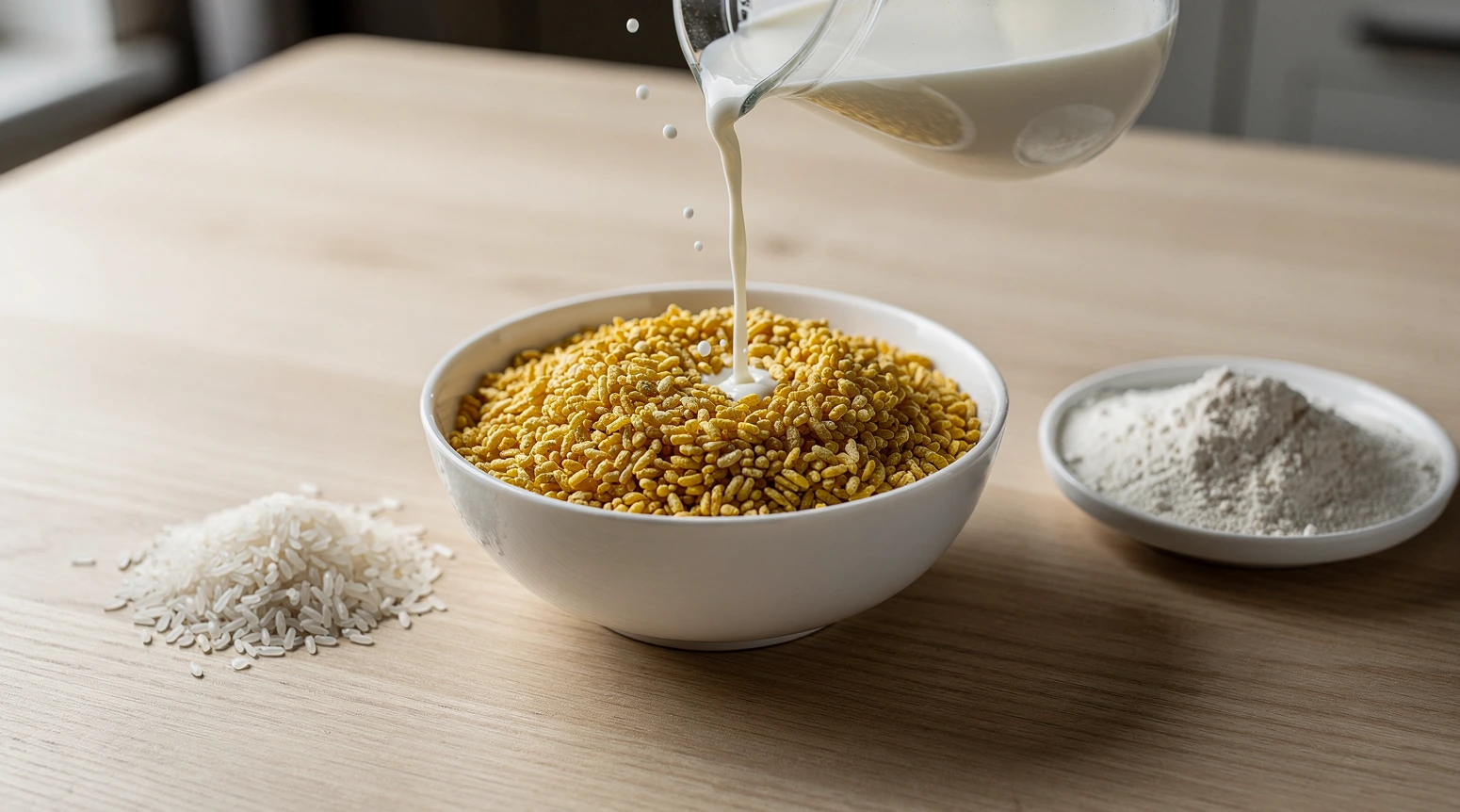
Kellogg’s has told the BBC that the “snap, crackle and pop” of Rice Krispies may now be quieter, after shoppers complained about a recipe change that has removed whole rice grains from the cereal and from Coco Pops. The firm blames “changing weather conditions” for hitting the quality and availability of rice and other grains.
The sound has made the headlines, but the label is the bigger change for many UK households. Both cereals now contain wheat gluten as an ingredient, so they are no longer suitable for people with a wheat allergy or coeliac disease. Kellogg’s says packs are clearly labelled; older boxes in the cupboard will carry different wording.
In short
- The recipe: Rice Krispies now use rice flour and Coco Pops a blend of rice flour and corn flour, rather than whole rice grains.
- The allergen change: wheat gluten is now an ingredient, replacing the old “may contain gluten” wording. UK retailer listings also add a “may contain soy” warning.
- The reason given: Kellogg’s cites weather disruption to grain supplies, and told the BBC that extreme weather in Spain in 2022 and 2023 cut availability of the rice it uses.
- The sound: Kellogg’s says the snap, crackle and pop is “still there” but “may be quieter and not as instant as before”.
- The alternatives: own-brand rice cereals cost about a third as much per kilo but still list barley malt extract, so they are not an answer for coeliac shoppers. Check for a “gluten free” label instead.
What has Kellogg’s changed in Rice Krispies and Coco Pops?
For nearly a century, Rice Krispies have been made from puffed rice grains. STV reports that the UK product is now made from a rice flour dough, and The Grocer, which reported the change on 3 November, says Coco Pops have moved to a blend of rice flour and corn flour.
Kellogg’s statement, carried by the BBC, STV, the Mirror and others, reads: “We have updated the Rice Krispies and Coco Pops recipes, which are now made using corn flour and rice flour. This recent change helps us maintain consistent quality at a time when changing weather conditions are affecting the quality and availability of some of the rice and grains used in our cereals.”
The company added that the new recipes had been “carefully assessed for taste, appearance and texture” and that it was “continuing to listen closely to consumer feedback”. It told The Grocer that no other cereal in its range has been reformulated.
What the ingredient lists now say
We checked the listings on Sainsbury’s, Ocado and Morrisons on 4 November 2026. The comparison below sets those lists against the earlier recipe as described in press reports and older retailer data. Product information can change, so the pack in your hand always takes priority.
| Product | Earlier recipe | New recipe, as listed by UK retailers | Allergen wording now listed |
|---|---|---|---|
| Rice Krispies | Rice, sugar, salt, barley malt extract, added vitamins and iron; “may contain gluten” | Rice flour, sugar, barley malt extract, wheat gluten, salt, added vitamins and iron | Contains barley and wheat; may contain gluten from other cereals and soy |
| Coco Pops | Rice-based; “may contain gluten” (full earlier list not verified) | Corn flour, rice flour, sugar, glucose syrup, fat-reduced cocoa powder (4.5%), wheat gluten, cocoa mass, barley malt extract, salt, flavourings, added vitamins and iron | Contains barley and wheat; may contain gluten from other cereals and soy |
Two details most reports skipped
First, the wording on corn differs by product. Kellogg’s statement and much of the coverage refer to “corn flour and rice flour” for both cereals, but the Rice Krispies listings we checked show rice flour with no corn flour. Corn flour appears only in the Coco Pops list, where it is the first ingredient, in line with The Grocer’s account.
Second, listings at Sainsbury’s, Morrisons and Ocado display an allergen update stating that the cereals now contain wheat gluten “and may contain soy”. Soy has had little attention in the coverage so far, but it matters to anyone managing a soya allergy. Wheat gluten is the deliberate ingredient; soy is a precautionary warning.
Why did Kellogg’s say it removed the rice grains?
Kellogg’s explanation is about supply and consistency. It told the BBC the change would help “maintain consistent quality” as extreme weather affects crops and pushes up ingredient prices. It has not said what the change means for its costs or for what shoppers pay, and no price change has been reported.
Spain, El Niño and the rice price
The BBC reports that Kellogg’s pointed specifically to extreme weather in Spain in 2022 and 2023, which it said reduced availability of the types of rice it uses in breakfast cereals. Other coverage has leaned more heavily on Asian harvests and the current El Niño. The BBC also notes that the World Meteorological Organization expects this record-breaking El Niño to last until at least 2027, with South East Asia, which produces more than a quarter of the world’s rice, expected to be hit hard.
The two explanations are not the same thing, and readers should keep them apart. Spain is the sourcing problem Kellogg’s named, while El Niño is the wider backdrop that reporters have added to explain pressure on the rice market. Whichever carries more weight, rice is becoming dearer: Just Food reports that the UN Food and Agriculture Organization’s All Rice Price Index rose 9.5% in September from a year earlier, reaching 110.5 against an average of 103.5 for all of last year.
The timing also sits within a wider squeeze on packaged food. The BRC’s latest figures showed ambient food inflation rising to 3.2% in October, with long-life goods such as cereals feeding into that category. The Food and Drink Federation had earlier warned in its forecast for 3.9% food inflation by December that manufacturers could not hold back rising costs indefinitely.
Is the change only happening in the UK?
It is not happening in North America. The original Kellogg company split in 2023. Kellanova, now owned by Mars, holds the cereal brands outside North America, while WK Kellogg, now owned by Italy’s Ferrero, holds them in the US and Canada.
A WK Kellogg spokesperson told Just Food that its Rice Krispies in the US and Canada “are made with real rice and will continue to be”. Just Food also says it has asked Kellanova and Mars whether the change reaches beyond the UK into other international markets, so the full geographic scope remains unclear. British holidaymakers and shoppers buying imported boxes should not assume that one country’s recipe matches another’s.
Who can no longer eat them, and were they gluten free before?
The Grocer reports that the reformulated cereals are no longer suitable for people with a wheat allergy or coeliac disease, and STV says Kellogg’s has confirmed this. Cereals containing gluten, including wheat and barley, are among the 14 allergens that UK food law requires to be declared. That is why wheat must now appear on the pack and be emphasised in the ingredients list, where retailers show it in bold.
Nadim and Tanya Ednan-Laperouse, the founders of Natasha’s Foundation, told The Grocer it was a “shame that these popular cereals will no longer be a safe breakfast option for people with a wheat allergy or coeliac disease”. They said the change “shines a spotlight on the challenges families with food allergies face” when shopping for basic food.
Some headlines have said the cereals are “no longer gluten free”, but that needs care. Reports say both cereals were previously labelled “may contain gluten” because of the factory they were made in, and older data for Rice Krispies also lists barley malt extract, which comes from a gluten-containing cereal. Coeliac UK explains that only foods with 20 parts per million of gluten or less can legally be labelled gluten free, and we found no evidence that these UK packs carried that claim.
The practical shift is from a precautionary warning to a deliberate ingredient. For someone with a wheat allergy, that is a clear line: the old pack warned of a possible trace of gluten, while the new one contains wheat gluten by design. Coeliac UK says about 1 in 100 people in the UK have coeliac disease, of whom only 36% are diagnosed. We found no statement from the charity on this change at the time of publication.
What to do with the packs in your cupboard
Old and new boxes may be in circulation at the same time, and Kellogg’s has not published a date on which the switch was completed. If anyone in your household avoids wheat, soya or gluten, read the ingredients on every box rather than relying on memory or on an online product photo.
- Look for the prominent allergen labelling that Kellogg’s says now appears on new packs.
- Read the ingredients: bold wheat and the words “wheat gluten” identify the new version.
- Check any homemade treats, especially Rice Krispie cakes for parties, school bake sales and Christmas fairs.
- Tell anyone who regularly feeds your child, including grandparents, childminders and breakfast clubs, that the familiar box has changed.
Why do the snap, crackle and pop sound different?
The sound comes from what happens when milk meets the cereal, and it has been central to the brand’s marketing since the 1950s. A Kellogg’s spokesperson told the BBC that retaining it had been a “huge focus” in designing the new recipe, while conceding that customers “might notice that the sound may be quieter and not as instant as before”. The company insists it is “still there”.
Shoppers have been less generous. The Sun quoted one Coco Pops buyer in October who said the cereal “tastes so artificial and floury”, and the BBC quotes a parent named Dani saying on TikTok: “There’s no snap, crackle and pop in these. My toddler won’t eat them.” Another TikTok user, Lauren, said she could “immediately tell the difference” after years of eating the cereal daily, while a third described the new version as “weird and stale”.
The criticism did not begin this week. A Morrisons customer review of Coco Pops dated 17 October says the recipe has changed and that corn flour has been added, and national and regional titles were carrying complaints within days. Kellogg’s gave The Sun its weather explanation on 21 October, but the statement as quoted in that report did not mention wheat. The allergen change reached national headlines around 3 November.
| Date (2026) | What happened | Where it appeared |
|---|---|---|
| 17 October | Customer review says Coco Pops recipe has changed and names corn flour | Morrisons product page |
| 21 October | Coco Pops complaints reach the national press; Kellogg’s confirms the change and cites the weather | The Sun, Metro |
| 23 October | Headlines report shoppers calling the new cereals “terrible” | Newsquest regional titles |
| 27 October | Complaints spread to Rice Krispies | Metro, The Sun |
| 3 November | Rice Krispies change and the wheat gluten warning become national news | The Grocer, PA, The Guardian, The Times |
| 4 November | Kellogg’s says the sound may be quieter | BBC, Mirror |
Reaction is not one-way. Reviews on the Morrisons Rice Krispies page through October remain largely favourable, including one dated 26 October, although a reviewer may have been eating an older box. Online comments also show who is angry, not how many are: nobody outside the company has published data on how many shoppers have noticed, or what share have stopped buying.
Why does a cereal recipe change cause so much anger?
Recipe changes are notoriously difficult for big brands, as the BBC notes. It points to the accusations levelled at chocolate makers over cocoa content, online debates about ketchup, and the crates of old-recipe Irn Bru that fans stockpiled when the sugar content was cut in 2018. Rice Krispies themselves have changed before, with salt reduced in the 1990s and sugar lowered in 2018.
This case has two features that make it especially sharp. The name promises rice, and the sound is the product’s selling point: a shopper can test the claim at the breakfast table without reading anything. That is how consumer backlashes tend to start, with shoppers noticing a change through routine rather than through the small print.
No report suggests that the packs have shrunk, and Kellogg’s has framed this mainly as a supply and quality issue. Even so, many shoppers will file this alongside skimpflation, in which a product keeps its size and price but its contents change. Kellogg’s says its fibre, vitamin D and iron levels are unchanged, and that the recipes contain no artificial colours, flavours or sweeteners.
How a company discloses a change often matters as much as the change itself. Grocery data on how shoppers respond to shrinkflation suggests they resent feeling deceived more than they resent the underlying cost pressure. Kellogg’s has on-pack callouts and gave a reason when first asked, which helps. The weak point is reach: the wheat warning became national news about two weeks after the first taste complaints were reported.
What are the alternatives, and what do they cost?
The price gap between Kellogg’s and supermarket own brands was already wide, and it is now harder for some households to justify. We checked the prices below on retailer sites on 4 November 2026. The Tesco product was showing as out of stock when we checked, and prices and offers change often.
| Product | Pack and price | Per kg | Cost of a 30g bowl | Main ingredient listed | Labelled gluten free? |
|---|---|---|---|---|---|
| Kellogg’s Rice Krispies (Sainsbury’s, Ocado) | 430g, £3.50 | £8.14 | about 24p | Rice flour, plus wheat gluten | No; contains wheat |
| Kellogg’s Coco Pops (Sainsbury’s) | 420g, £3.50 | £8.33 | about 25p | Corn flour, rice flour, plus wheat gluten | No |
| Kellogg’s Coco Pops (Ocado) | 650g, £4.35 | £6.69 | about 20p | Corn flour, rice flour, plus wheat gluten | No |
| Sainsbury’s Rice Pops | 375g, 95p | £2.53 | about 8p | Rice (94%), with barley malt extract | No; contains barley |
| Tesco Rice Snaps | 375g, 89p | £2.37 | about 7p | Rice, with barley malt extract | No; contains barley |
| M&S Made Without Wheat Rice Pops (Ocado) | 300g, £2.10 | £7.00 | about 21p | Brown rice flour (87%) | Yes, per listing |
Cheapest is not the same as safest
For shoppers whose only complaint is taste or value, the own-brand comparison is striking. A daily 30g bowl of Sainsbury’s Rice Pops instead of Kellogg’s Rice Krispies would save about 17p a day, or roughly £61 over a year, at these shelf prices. Sainsbury’s and Tesco both still list rice as the lead ingredient, although any recipe can change if rice supply tightens further.
For coeliac shoppers and many people avoiding gluten, those cheaper products do not solve the problem, because both list barley malt extract with barley in bold. The M&S Made Without Wheat version listed on Ocado is described as gluten free, and is made with brown rice flour rather than whole grains. It is the only one in this table carrying that label.
The gluten-free aisle has also lost an obvious substitute this year. Coeliac Sanctuary, a specialist site, reported in April that Nestlé had discontinued its Go Free Rice Pops because of “low demand”. Anyone with an allergy should treat this table as a starting point and read the pack, including its “may contain” wording, before buying.
Can you get a refund for a box you do not like?
Usually not as of right, though it can be worth asking. Under the Consumer Rights Act 2015, goods must be of satisfactory quality, fit for purpose and as described. A correctly labelled cereal made to a new recipe is unlikely to count as faulty simply because you preferred the old one.
Some supermarkets may refund as a gesture of goodwill, particularly with a receipt, but that is a matter of store policy and not a legal entitlement. You can also raise a complaint directly with Kellogg’s, whose customer line is given as 0800 626 066 on retailer listings. The company says it will “continue to look at ways to make [its] products even better in the future”.
The position differs if a product is wrongly labelled, stale, damaged or unsafe. If you buy a box whose label does not match its contents, keep the packaging, tell the retailer, and report it to your local trading standards or food safety team. If anyone has a suspected severe allergic reaction, call 999 first.
What does it mean for supermarkets, online grocers and small shops?
The change creates practical work well beyond Kellogg’s. UK food information rules require allergen details to be available before an online purchase is completed as well as at delivery, which puts the onus on grocery sites to keep their listings accurate. Sainsbury’s, Ocado and Morrisons listings we read on 4 November had been updated, and Morrisons also warns customers to check the labels supplied in each delivery.
Substitutions and stock are the awkward part for online orders. A shopper who ordered a familiar product could receive either recipe during a changeover, and may not reread a box they have bought for years. Anyone with an allergy in the household may want to check the delivered pack each time, whichever retailer they use.
Cafés, bakeries, market stalls and independent shops have a more direct duty. Under Natasha’s Law, explained by the Food Standards Agency, food that is prepacked for direct sale must carry a full ingredient list with allergens emphasised. A business that makes and wraps its own Rice Krispie cakes or Coco Pops bars on site therefore needs to review its recipes and labels, and should tell staff that an old allergen sheet may now be wrong.
Kellogg’s has been keen to stress that both cereals remain “non-HFSS”, meaning they are not classed as high in fat, salt or sugar. That has commercial weight, because products classed as less healthy face limits on prominent store placement in England and on TV and paid online advertising across the UK. Keeping that status protects a cereal’s ability to be promoted, which may be one reason the recipe was designed to hold its nutrition profile.
The wider trade is also paying closer attention to what is in processed food. The BBC notes that cereals have been under the spotlight from healthy eating advocates, and retailers are making their own moves, such as when Tesco banned 114 additives from its own-brand food. A switch from a whole grain to a flour-based dough will draw questions in that climate, even with no artificial colours, flavours or sweeteners added.
What happens next for Rice Krispies?
The next hard evidence should come from The Grocer’s Top Products Survey 2026, due next month. The magazine says the survey will show Rice Krispies sales falling in both value and volume. Because the survey is an annual ranking, that decline is likely to reflect a period largely before the recipe row. Measuring the impact of the change itself will take later data.
Three things are worth watching over the coming weeks:
- Whether Kellogg’s adjusts the recipe: it says it is listening to feedback and will keep looking at improvements, but it has not said it will restore rice grains.
- Whether other brands follow: with the FAO rice index up 9.5% on the year, other makers of rice-based products face the same market, though none has announced a similar change in the coverage we reviewed.
- Whether own brands gain share: shoppers who dislike the new taste can move to a cheaper rice-based alternative on the same shelf, and that is the commercial risk for Kellogg’s.
What will not change soon is the need to read the label. Shoppers who ate these cereals safely for years can no longer assume the familiar box is the same product. For a household managing an allergy, that matters more than how loudly the cereal pops.
Frequently asked questions
Do Rice Krispies still contain rice?
Yes, but not as whole grains. UK listings show rice flour as the first ingredient in Rice Krispies. Coco Pops now list corn flour first, followed by rice flour.
Why did Kellogg’s change the Rice Krispies recipe?
Kellogg’s says changing weather conditions have affected the quality and availability of some rice and grains. It told the BBC that extreme weather in Spain in 2022 and 2023 reduced availability of the rice types it uses.
Are Rice Krispies and Coco Pops gluten free?
No. Both now contain wheat gluten and barley malt extract, and Kellogg’s says they are not suitable for people with a wheat allergy or coeliac disease. Previously they were reported to carry a “may contain gluten” warning.
How can I tell if I have the new recipe?
Check the ingredients for wheat gluten, with wheat in bold, and look for the allergen labelling that Kellogg’s says appears on new packs. If in doubt, contact the Kellogg’s customer line or do not serve the cereal to anyone with an allergy.
Is the US or Canadian recipe changing?
No. WK Kellogg, a separate company owned by Ferrero, told Just Food that its US and Canadian Rice Krispies are made with real rice and will continue to be. It is not yet clear whether other international markets are affected.
Have any other Kellogg’s cereals changed?
Kellogg’s told The Grocer and the BBC that it has not changed the recipe of its other cereals. Recipes can still change over time, so anyone with an allergy should read the label on each purchase.
What are the cheapest alternatives to Rice Krispies in the UK?
On 4 November, Sainsbury’s Rice Pops cost 95p for 375g and Tesco Rice Snaps were listed at 89p for 375g, though Tesco’s product was showing as out of stock. Both list rice first but contain barley malt extract, so they are not labelled gluten free.
Can I get my money back if I dislike the new taste?
There is generally no legal right to a refund for a correctly labelled product you simply dislike. Some retailers may offer one as a goodwill gesture, and you can complain to Kellogg’s directly.