
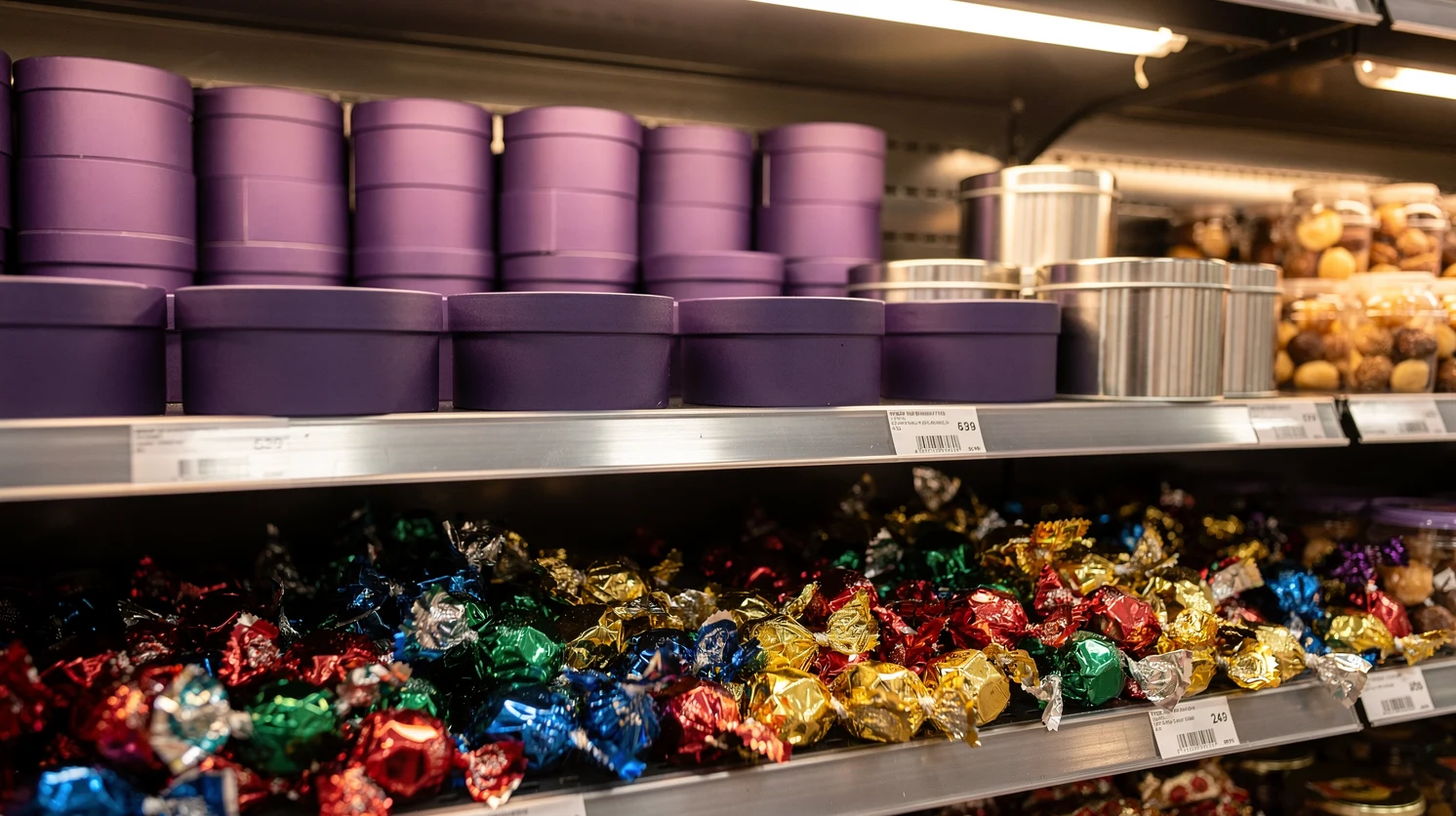
Quality Street’s paper tub will not be on sale at Tesco this Christmas. Nestlé told the Manchester Evening News, in a report published on Saturday 7 November 2026, that it “won’t be trialling” the recyclable tub this year, after two festive seasons in selected Tesco stores, and Tesco confirmed the tub is not part of its Christmas range. Nestlé has not given a specific reason, and it says it hopes to bring the format back “on a bigger scale in the future”. For shoppers, the plastic tub remains the main purchase, and the price per 100g can more than double depending on where and how you buy.
In short
- Paper tub is off for 2026: Nestlé says it will not run the Tesco trial this year and is using what it learned in 2024 and 2025 to make “further developments”.
- Not a final goodbye: the company’s stated ambition is a return “on a bigger scale”, though it has given no date, no reason for the pause and no sales results.
- Weight holds at 550g: the standard Quality Street tub is unchanged from 2025, while Cadbury Roses and Heroes have dropped to 475g, according to The Grocer and supermarket price checks.
- Monopoly tubs replace the novelty: promotional tubs on sale since 1 November carry a Chance Card, with 5,000 limited-edition boards and cash prizes up to £20,580.
- Unit price is what counts: by our calculation, September’s loyalty price worked out at about 72p per 100g, against 96p for Costco’s giant tin and £1.86 for a 700g tin at Morrisons.
What has Nestlé actually said about the paper tub?
The new information comes from two short statements given to the Manchester Evening News, whose report has since run across other Reach titles, including the Newcastle Chronicle, the Liverpool Echo and the Daily Record. A Nestlé spokesperson said: “We won’t be trialling our Quality Street paper tub this year. We’re using our experience from 2024 and 2025 to make further developments. Watch this space as we continue to explore its role with the ambition to bring it back on a bigger scale in the future.”
A Tesco spokesperson separately confirmed that the cardboard tubs are not in the supermarket’s Christmas range this year. Tesco was the only retailer in the trial, so that closes off the one place British shoppers could reliably have looked for the tub. We have not seen any statement on whether unsold tubs from 2025 remain in the supply chain.
Several headlines say that Quality Street has “axed” or “scrapped” the product. The wording from Nestlé is softer than that: it describes a year off the shelf and continued development, not an end to the idea. A third year could have been used to widen the test, so the pause is notable, but on its own it cannot show why the tub is being held back.
What Nestlé has not said
Nestlé has not published sales data, shopper survey results or the feedback gathered from Tesco’s staff and supply chain teams. The Manchester Evening News reports that the company did not give specific details about why the tub will not return. Any claim that the tub failed on sales, cost or practicality is therefore speculation for now.
That matters because the trial was set up to answer precisely those questions. When it launched, Nestlé said that it would evaluate the tub’s popularity with shoppers and take feedback from supply chain and in-store teams at Tesco. The results of that exercise are the next piece of real information, and they have not been shared.
How did the Tesco trial work over two Christmases?
The trial began in October 2024. The Guardian reported at the time that about 200,000 paper tubs would go on sale in selected Tesco stores, and the Manchester Evening News puts the number of stores at 60. Nestlé said the design was “the first of its kind” and that it was proud to be the first major manufacturer to test a paper tub at Christmas.
The tub came in Quality Street’s signature purple, with gold foil and what the company called an integrated re-close feature. Packaging Europe reported that Nestlé had tested it for food quality and freshness in transport and storage before it reached shops. Once empty, the whole container could go into household recycling, which was the main selling point.
Price was deliberately not a barrier. The Guardian reported in 2024 that the product had the same weight and the same recommended price, £5.50, as the year before, and the Manchester Evening News says the paper tubs cost the same as the plastic ones. A second run followed in selected stores for Christmas 2025, which Nestlé described as “another step on Nestlé’s journey to reduce virgin plastic use”. The number of tubs and stores in that second year has not been widely reported.
| Date | What changed | Scale or detail | Reported by |
|---|---|---|---|
| October 2022 | Plastic and foil wrappers begin moving to paper | Nine of 11 sweets; green triangle and orange crunch stay in foil; aim of 2bn fewer wrappers a year in landfill | The Guardian |
| October 2024 | First paper tub trial | About 200,000 tubs, selected Tesco stores (60, according to the MEN) | The Guardian, Packaging Europe, MEN |
| Christmas 2025 | Second paper tub trial | Selected Tesco stores; standard tub separately reduced from 600g to 550g | MEN, The Sun |
| Late October 2026 | John Lewis stops selling Quality Street | All products, including pick and mix stations, in stores and online | MEN, Brit Brief |
| 1 November 2026 | Monopoly promotion arrives in stores | Chance Card in each promotional tub; 5,000 boards and cash prizes | The Sun, FoodNavigator |
| 7 November 2026 | Paper tub confirmed absent | No trial this year; Nestlé cites future development | MEN |
Why some shoppers objected in the first place
The paper tub arrived on top of an existing grievance. In October 2022 Nestlé said it would move nine of the 11 Quality Street sweets out of their shiny wrappers and into recyclable paper, ending 86 years of rustling, according to the Guardian. That report noted the company’s aim of keeping 2bn wrappers a year out of landfill.
The change landed badly with a vocal group of customers. Metro reported in 2024 that some fans said it had “ruined Christmas”, while the Guardian cited a viral TikTok video calling it a “travesty”. Nestlé held its position on wrappers, and it remains the standard format today.
There was also a practical complaint. As the Guardian put it in 2024, the plastic tub often gets a second life for years as a cake tin or a box for Lego. Metro quoted one sceptic on X who asked: “How is my Grandma going to store her sewing kit in there for the next thirty years?”
Reaction was not uniformly negative. The Manchester Evening News recalls that a post on a money-saving Facebook page drew hundreds of comments: one person wrote “Go back to tin and squeaky wrappers”, while another called the move “about time” and hoped others would follow. These are social media comments, not a measure of public opinion, and they tell us little about what people did at the till.
What is on the shelves instead this Christmas?
The absence of the paper tub is one of three changes to Quality Street’s festive presence in 2026. The main tub stays at 550g, a new promotion has taken over the front of the pack, and one of the brand’s best-known Christmas experiences has gone. Taken together, the changes shift the brand’s seasonal message from sustainability and personalisation to prizes and value.
Monopoly tubs and Chance Cards
Promotional tubs with a Monopoly design reached shops nationwide on 1 November, The Sun reported. Each contains a Chance Card, with 5,000 limited-edition Monopoly: Quality Street Edition boards available as prizes. Thousands of further winners can collect between £5 and £500, and one top prize is worth £20,580.
The board swaps Mayfair and Marylebone for names such as Caramel Swirl Way and Green Triangle Gardens, according to FoodNavigator, and Newsquest titles report an octagonal shape, with a space in the centre for a tub. Stations are replaced by places linked to the brand, including Halifax, where the sweets are still made. Beth Lucas, marketing director for Nestlé Confectionery UK and Ireland, said partnering with Monopoly “felt like a natural fit”. Read the full terms on the pack or the promotion site before relying on a prize, as closing dates and eligibility were not set out in the coverage we reviewed.
John Lewis pick and mix has gone
For anyone who likes to choose their own mix, the larger loss is at John Lewis. The Manchester Evening News and Brit Brief reported in late October that the retailer has dropped all Quality Street products for 2026, in stores and online, including the personalised tins and pick and mix stations that had run for eight years in selected branches such as the Trafford Centre and Cheadle Royal. The John Lewis website says: “Quality Street will not be available in John Lewis this year, but we have lots of gifting options for you to explore.”
A John Lewis spokesperson said it was focusing on a “fresh line-up of exclusive festive treats and unforgettable gifts”, a message that sits alongside John Lewis’s 2026 Christmas advert, its main seasonal campaign. Nestlé’s reply was that shoppers enjoyed the tins and that it was “doing things a little differently” this year with Monopoly. In the coverage we reviewed, neither side says who made the decision.
Where is the cheapest Quality Street tub right now?
Supermarket prices for Christmas tubs change often, and most of the headline deals depend on a loyalty card. The figures below are the most recent we could trace to a named retailer and date, with the unit price worked out by us. Treat the September loyalty prices as a guide to what is possible, not a promise of today’s shelf price, because The Sun reported that Tesco’s offer ran until 29 September and Sainsbury’s until 6 October.
| Retailer and pack | Size | Price | Per 100g (our calculation) | Date and source |
|---|---|---|---|---|
| Tesco tub, Clubcard | 550g | £3.95 | 72p | 8 Sep, Liverpool Echo |
| Sainsbury’s tub, Nectar | 550g | £3.95 | 72p | 8 Sep, Liverpool Echo |
| Aldi tub | 500g, as reported | £3.89 | 78p | 25 Sep, The Argus |
| Morrisons tub, More card | 550g | £4.95 | 90p | 8 Sep, Liverpool Echo |
| Costco giant tin | Almost 2kg | Just over £19 | About 96p | 7 Nov, MEN |
| Asda tub | 550g | £5.72 | £1.04 | 8 Sep, Liverpool Echo |
| Sainsbury’s tub, standard | 550g | £6.50 | £1.18 | 8 Sep, Liverpool Echo |
| Tesco or Morrisons tub, standard | 550g | £7.00 | £1.27 | 8 Sep, Liverpool Echo |
| Morrisons Festival Tin | 700g | £13.00 | £1.86 | 7 Nov, MEN |
| Amazon giant tin | 2kg | £39.99 | £2.00 | 7 Nov, MEN |
What the table tells a shopper
The most useful comparison is between formats. Costco’s giant tin looks like a bargain, and at about 96p per 100g it is well under the £1.86 charged for a 700g tin at Morrisons and roughly half the Amazon price, as the Manchester Evening News points out. But a 550g tub on a loyalty deal has been cheaper still per 100g, and Costco also requires a paid membership.
A live listing on Trolley, the price comparison site, showed a Quality Street tub at £3.95 when we checked on 7 November, along with a 685g refill bag at £7.50 (about £1.09 per 100g) and 700g tins from £12 to £13. The site warns that its prices are available online and may not reflect those in store, and it does not always show the pack size. Check the label when you buy, and compare the price you will actually pay, with or without a loyalty card.
Which? published its latest supermarket comparison on 5 November, with Aldi keeping the cheapest title and Tesco and Sainsbury’s loyalty prices beating Asda. Our table shows a similar loyalty effect on this one product, with a twist. Aldi’s Quality Street price looks cheapest at the till, but The Argus reports a 500g pack, so Sainsbury’s and Tesco’s 550g deals worked out lower per 100g in September, and the gap was just 6p on the shelf price.
A rough cost per chocolate adds another angle. The Sun reported that the 550g tub holds about 57 chocolates, and the Manchester Evening News counted 211 in a giant tin last Christmas. On those counts, a £7 tub works out at about 12p a sweet and a £3.95 tub at about 7p, against about 9p from a giant tin at just over £19. Counts vary by pack and year, so this is a guide only.
Has the tub shrunk, and how do its rivals compare?
The Quality Street tub has kept the same weight this year. Nestlé told The Sun in September that “our Christmas 2026 range includes a 550g Quality Street sharing tub, the same weight as it was in 2025”. That follows a cut from 600g to 550g in 2025, which The Sun said reduced the contents from around 63 chocolates to 57.
Other brands have moved more recently. The Grocer’s analysis found Cadbury Roses and Heroes fell 13.6% from 550g to 475g while pre-promotional prices at Tesco and Morrisons stayed at £7, meaning shoppers pay up to 15.8% more per kilo. We looked at a similar pack-size dispute this week, when Yorkshire Tea halved its Bedtime Brew box and raised the price.
| Tub | 2025 size | 2026 size | Tesco standard price | Per 100g at £7 (our calculation) | Tesco Clubcard, 8 Sep | Per 100g on Clubcard |
|---|---|---|---|---|---|---|
| Quality Street | 550g | 550g | £7.00 | £1.27 | £3.95 | 72p |
| Celebrations | 500g, per most retailers | 500g | £7.00 | £1.40 | £3.95 | 79p |
| Cadbury Heroes | 550g | 475g | £7.00 | £1.47 | £5.25 | £1.11 |
| Cadbury Roses | 550g | 475g | £7.00 | £1.47 | £5.25 | £1.11 |
The Liverpool Echo’s price check from 8 September is the source for the sizes and Clubcard prices, and it says Tesco sold all four at 550g in 2025, though it reports Celebrations at 500g elsewhere that year. Longer term, analysis by the Energy and Climate Intelligence Unit published in December 2025 found that the price per 100g had risen since 2021 by 95% for Roses, 88% for Celebrations, 71% for Heroes and 59% for Quality Street. That makes Quality Street the smallest riser of the four, though the same report said tub prices rose 23–47% over two years, when general inflation was 6%.
Manufacturers have blamed input costs. Responding to that analysis, Mars Wrigley UK pointed to cocoa, and Mondelēz said any size change was “a last resort”. Sources describe cocoa differently depending on the period: the Liverpool Echo noted in September that this year’s shrink came despite a fall in cocoa prices, while the Food and Drink Federation’s Christmas food inflation forecast of 3.9% listed cocoa among commodities that have more than doubled.
Could packaging fees and plastic targets have a bearing?
Nestlé has not linked its decision to packaging fees, so what follows is context rather than an explanation. Since 2025, large UK producers have paid Extended Producer Responsibility (pEPR) fees based on the weight and type of packaging they put on the market. Those costs reach shelf prices: the British Retail Consortium has named packaging taxes among the costs behind UK shop price inflation reaching 2.1% in October.
Year 2 of the scheme brings in fees that vary by recyclability rating. On illustrative figures from PackUK and Defra, as reported by Food Manufacture, Let’s Recycle and other trade sources, plastic costs roughly twice as much per tonne as paper and card, which on the face of it favours paper. We could not find a confirmed Year 2 fee table on GOV.UK when we checked, and a third-party review reported on 5 October that none had been published, so these numbers may change.
| Material | Year 1 base fee, 2025–26 (per tonne) | Year 2 illustrative green | Year 2 illustrative amber | Year 2 illustrative red |
|---|---|---|---|---|
| Paper and card | £196 | £190 | £210 | £250 |
| Plastic | £423 | £415 | £455 | £545 |
A fee comparison per tonne does not settle the matter, because weight matters as much as rate. Nestlé has not published the weight of either tub, and a fibre container built to protect 550g of chocolate through a Christmas supply chain could be heavier than a thin plastic one. Fibre-based composites, which include paper combined with other materials, also sit in a different and more expensive fee band, and we do not know how the tub would be classified.
The sums can be large for retailers. John Lewis Partnership said its results for the 53 weeks to 31 January 2026 included £13m from the packaging levy, part of £53m in new tax costs. For a confectionery brand, fees would be one factor among many, including production capacity, machinery, damage rates in transit and shopper preference, and none of them has been ruled in or out by Nestlé.
What the pause means for plastic reduction
The trial was presented as part of Nestlé’s effort to reduce virgin plastic. A year’s break does not reverse the 2022 wrapper switch, which remains in place, and Nestlé says it is still exploring the tub. It does mean, however, that the mainstream Quality Street tub in British supermarkets this Christmas remains a plastic one.
The scale of the trial was always modest. About 200,000 tubs across 60 stores is a test rather than a national range, which is why the “bigger scale” wording matters: moving beyond Tesco would probably change the supply, production and costs involved. Nothing Nestlé has said so far indicates when that could happen.
For shoppers who want less plastic, the practical choices this year are narrower but not absent. Metal tins remain widely available, although they cost more per 100g, and the Guardian noted in 2022 that most local authorities collect the paper-based wrappers. The orange crunch and green triangle stayed in foil. Check what your council accepts, as collections differ from area to area.
What should shoppers do before buying?
The best approach is the same as for any promotional grocery line, and it is especially relevant in the run-up to Black Friday and the early sales. Do not assume that a large tin, a brand-new design or a higher “was” price signals value. Five quick checks are enough.
- Compare per 100g, not per pack. Tubs of similar appearance now run from 475g to 550g, and a 500g tub can look cheaper than a 550g one without being so.
- Price it without the card. If you do not hold a Clubcard, Nectar or More card, the relevant figure is the standard price, which was up to £7 in September.
- Look at the alternatives. At £7.50, the 685g refill bag listed on Trolley works out cheaper per 100g than a standard-price tub, if you already have a tin at home.
- Factor in membership and delivery. Costco’s tin needs a membership, and a minimum basket or delivery charge can change the total on an apparently cheap online price.
- Do not buy just for the prize. The Monopoly promotion adds excitement, but most buyers will not win a major prize, so the chocolate should be worth the price by itself.
Timing is the other variable. The Sun noted in September that supermarkets tend to run offers on chocolate and sweets in the run-up to Christmas, and this year’s price war was already under way in the first days of that month. If you need several tubs, buying when a loyalty price appears is usually sensible, while watching the best-before date.
What happens next?
Three things would change this story. The first is a statement from Nestlé about why the tub is on hold, including whether the problem was sales, supply or the design. The second is any announcement of a wider launch: “watch this space” is not a date, but a Christmas 2027 return would need planning well ahead of the shelves.
The third is the confirmed Year 2 packaging fee table from PackUK, which will show how much recyclability ratings really cost producers. We will update this page if Nestlé or Tesco give further detail. Until then, the accurate summary is that the paper tub is off the shelves for 2026, with its future officially open and its results unpublished.
Frequently asked questions
Has Quality Street got rid of the paper tub for good?
No, not on the evidence so far. Nestlé says it will not run the trial in 2026, is working on “further developments” and has an ambition to bring the tub back on a bigger scale. It has not given a date, so a return is not guaranteed.
Why is the Quality Street paper tub not at Tesco this year?
Nestlé has not given a specific reason. The company said only that it is using its experience from 2024 and 2025 to develop the idea, and Tesco confirmed that the tub is not in its Christmas range. Explanations involving sales or costs are unconfirmed.
Are Quality Street wrappers still made of paper?
Yes. Nestlé began moving nine of the 11 sweets to paper wrappers in 2022, with the orange crunch and green triangle staying in foil. The pause concerns only the outer tub, not the wrappers.
How much does a tub of Quality Street weigh in 2026?
The standard sharing tub is 550g, the same as in 2025, according to Nestlé. It was cut from 600g to 550g last year. Aldi’s tub has been reported at 500g, so check the label when comparing prices.
Where can I buy Quality Street cheapest this Christmas?
In September the lowest unit prices we could trace were the 550g tubs at Tesco with Clubcard and Sainsbury’s with Nectar, both £3.95 or about 72p per 100g. Those offers have ended, so check current prices. Costco’s giant tin was recently about 96p per 100g, with a membership required.
Can I still get a pick and mix Quality Street tin at John Lewis?
No. John Lewis says Quality Street will not be available this year, in stores or online, which ends the personalised tins and pick and mix stations reported to have run for eight years. Nestlé has not announced another retailer for the service.
What can you win with the Quality Street Monopoly tub?
Promotional tubs contain a Chance Card, with 5,000 limited-edition Monopoly: Quality Street Edition boards, thousands of cash prizes between £5 and £500, and a top prize of £20,580, The Sun reports. Check the terms on the pack for closing dates and eligibility.
Are Quality Street, Roses, Heroes and Celebrations all the same size now?
No. Supermarket checks in September showed Quality Street at 550g, Celebrations at 500g, and Roses and Heroes at 475g. That leaves a gap of up to 75g between tubs that can carry the same £7 standard price, so the unit price is the fairest comparison.