
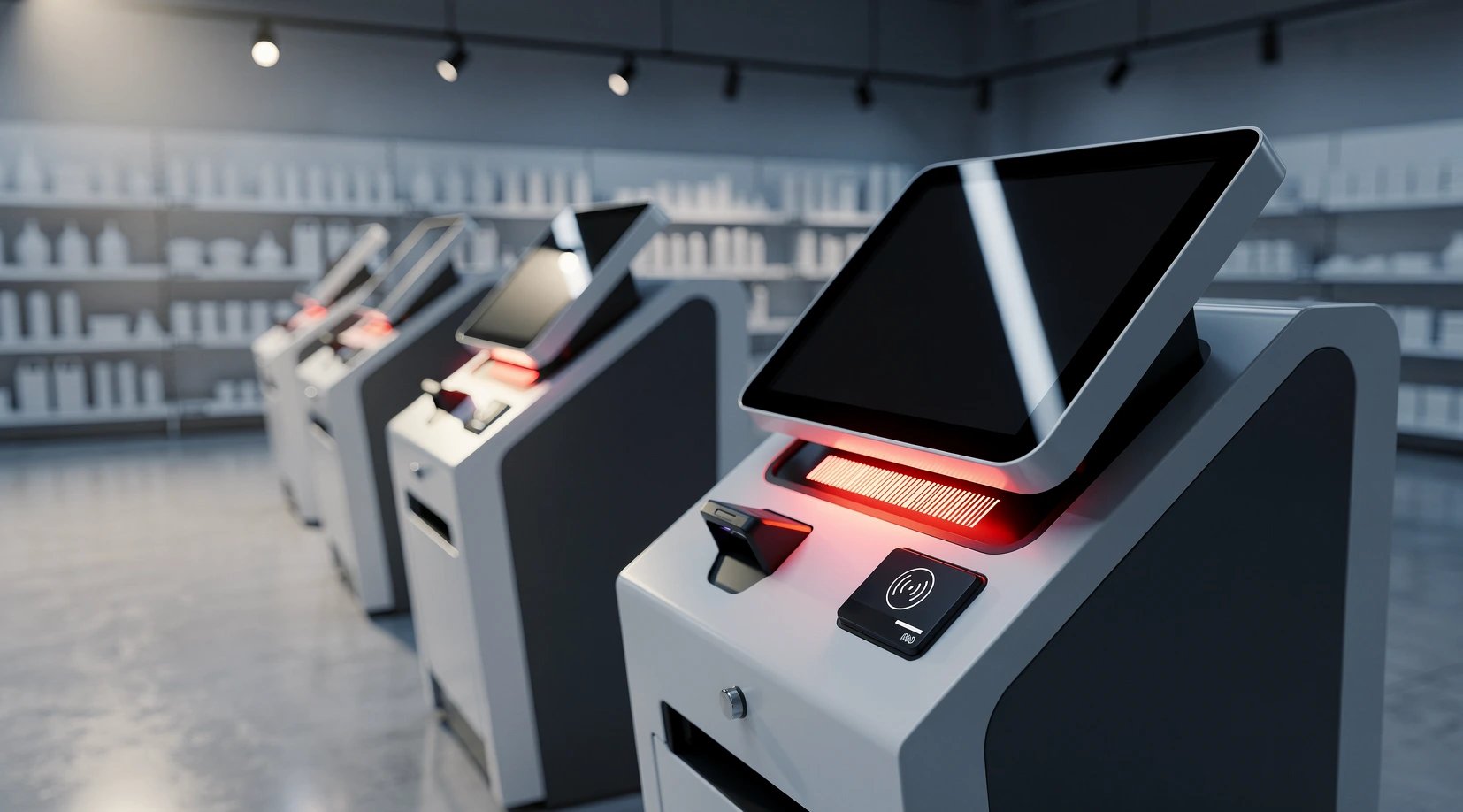
Self-checkout was supposed to be the great equalizer of the store floor: faster lines for shoppers, lower labor costs for retailers, and a tidy way to absorb the wage pressure that has squeezed margins since 2021. The reality in 2026 is messier. Some chains have doubled down and report cleaner throughput and happier staff. Others have quietly ripped machines out, citing theft, broken trust, and a checkout experience that customers describe as a part-time job they did not apply for.
This guide cuts through the marketing and looks at the operating math. It explains where self-checkout genuinely pays, where it quietly destroys morale and margin, and how to tell the difference before you sign a hardware contract. The focus is US grocery, mass, convenience, and specialty retail, with notes for e-commerce teams running buy-online-pickup-in-store flows that now lean on the same terminals.
In short
- Self-checkout retail works when basket sizes are small, item counts are low, and labor is reallocated to assistance rather than eliminated outright.
- Shrinkage is the swing factor: unmanaged self-checkout zones can push loss rates several times above staffed lanes, erasing the labor savings on paper.
- Morale collapses when one attendant babysits six to eight machines, fields theft alerts, and absorbs customer frustration with no extra pay or authority.
- The winning model is hybrid: a curated mix of staffed lanes, assisted self-checkout, and mobile or scan-as-you-go options matched to trip type.
- The decision is operational, not technological: the hardware is commoditized, so the payoff lives in layout, staffing policy, and loss controls.
Why self-checkout matters in 2026
Self-checkout stopped being a novelty a decade ago, but the economics shifted hard in the past three years. US retail wages rose sharply after 2021, and entry-level cashier roles became some of the hardest to fill and retain. Automation that once paid back over five years started penciling out in two. That math pulled millions of terminals into stores that had resisted them.
At the same time, the backlash matured from anecdote into balance-sheet reality. Several large chains publicly walked back aggressive self-checkout rollouts, and a few removed machines entirely from formats where theft and friction outran the savings. The lesson was not that the technology failed. It was that retailers had treated a staffing decision as a hardware purchase.
For US operators, three pressures now collide. Labor remains expensive and scarce, a strain visible in the official Bureau of Labor Statistics data on retail employment. Shrink has climbed to levels that retailers describe in earnings calls as a structural threat rather than a rounding error. And shoppers, trained by frictionless apps, expect checkout to feel instant. Self-checkout sits at the heart of how retail payments are changing across cards, BNPL and crypto, which is exactly why it rewards careful operators and punishes careless ones.
The labor-versus-loss tradeoff
Every self-checkout business case reduces to one tension. You save labor at the lane, but you spend it back on attendants, audits, and loss. If the resaved labor and the recovered shrink are smaller than the gross labor saving, you win. If they are larger, you have spent capital to make your store worse. Most failed rollouts never modeled the second half of that equation.
Key terms and definitions
The category is full of overlapping jargon, and vendors blur the lines on purpose. These are the distinctions that change how a deployment behaves on the floor.
- Fixed self-checkout (SCO): the standard kiosk with a scanner, bagging scale, and card reader. Highest theft exposure because the weight-based controls frustrate honest shoppers and rarely stop determined ones.
- Assisted self-checkout: the same kiosks, but staffed at a ratio designed for help rather than surveillance, often one attendant per three or four machines instead of one per eight.
- Scan-as-you-go: shoppers scan items with a handheld unit or their phone while filling the cart, then pay at a station or in-app. Throughput is excellent, loss control depends on audit rates.
- Mobile checkout: a phone-only version of scan-as-you-go, usually tied to a loyalty app, common in convenience and club formats.
- Computer-vision checkout: ceiling cameras and shelf sensors that track items automatically, the grab-and-go model. High capital cost, narrow set of formats where it pays.
Two metrics matter more than any feature list. The first is interventions per transaction, the rate at which a machine flags an attendant. The second is known shrink delta, the measured loss difference between self-checkout and staffed lanes for comparable baskets. A vendor that cannot help you instrument both is selling hardware, not outcomes.
How self-checkout works in practice
On paper the flow is simple: scan, bag, pay, leave. In practice each step hides a failure mode that determines whether the lane helps or hurts. Understanding the mechanics is the only way to judge a vendor pitch.
The scan step is where most friction lives. Produce without barcodes forces shoppers into lookup menus that are slow and error-prone, which is why grocery sees the highest intervention rates. Bottles of wine, age-restricted items, and high-theft categories trigger holds that pull an attendant over, and each hold is a small tax on both throughput and goodwill.
The bagging scale is the most contested piece of hardware in the store. Weight verification is supposed to confirm that what was scanned matches what went in the bag. In reality it generates a flood of false positives, the dreaded unexpected item in the bagging area, that train shoppers to wait for an override rather than trust the system. Many retailers now disable strict weight checks to cut friction, accepting higher loss as the price of speed.
What the attendant actually does
The attendant role is the hinge on which the whole model turns. In a healthy deployment, the attendant greets, troubleshoots scanners, approves age-restricted items, and recovers abandoned baskets. In an unhealthy one, the same person is a de facto loss-prevention officer, a customer-service desk, and a tech-support line, all at once, for a wall of machines that beep constantly.
The difference is almost entirely a staffing ratio and a policy choice. When one attendant covers four machines and has authority to clear holds instantly, interventions resolve in seconds and shoppers stay happy. When one attendant covers eight and must call a manager for overrides, queues form behind the very lanes that were supposed to eliminate them.
When self-checkout pays
Self-checkout earns its place under a specific set of conditions. The clearer the match, the larger the payoff, and the closer the deployment gets to the textbook savings vendors love to quote.
The strongest case is small-basket, high-frequency retail: convenience, pharmacy front-of-store, quick grocery runs, and specialty formats where most trips are five items or fewer. Short baskets mean fewer scans, fewer produce lookups, and far fewer interventions per transaction. Throughput rises, queues shrink, and the labor reallocation is real because demand is spiky and hard to staff by the hour.
The second strong case is throughput relief at peak. A bank of self-checkout lanes can absorb lunch rushes and post-work surges that would otherwise need cashiers who sit idle the rest of the day. Here self-checkout is a buffer, not a replacement, and the business case is about flexing capacity rather than cutting heads. Pairing those lanes with modern POS systems for retail that share inventory and loyalty data is what keeps the buffer from becoming a data silo.
The table below maps formats to expected outcomes based on basket profile and shrink exposure. Treat it as a starting hypothesis to test with your own data, not a guarantee.
| Retail format | Typical basket | Self-checkout fit | Primary risk |
|---|---|---|---|
| Convenience and forecourt | 1–4 items | Strong | Age-restricted holds |
| Pharmacy front-of-store | 2–6 items | Strong | Restricted product approvals |
| Grocery, full basket | 20–40 items | Weak to moderate | Produce friction and shrink |
| Mass and discount | 10–25 items | Moderate | High-value theft |
| Apparel and specialty | 1–5 items | Moderate to strong | Security tags and fit returns |
| Club and warehouse | 15–50 items | Scan-as-you-go only | Exit audit throughput |
The hybrid lane mix
The operators who win rarely go all-in on any single mode. They run a deliberate mix: a few staffed lanes for big baskets and shoppers who want service, a bank of assisted self-checkout for the middle, and scan-as-you-go or mobile for loyal regulars who value speed. The mix is tuned by daypart, so the same floor space serves a lunch rush and a quiet Tuesday afternoon differently.
This is also where payment strategy matters. Self-checkout terminals are now a primary surface for contactless, mobile wallets, and increasingly account-to-account methods, so the lane mix decision is inseparable from the broader question of how a retailer accepts money at every touchpoint.
When self-checkout kills morale
The failure cases are as predictable as the wins, and they almost always trace back to treating headcount reduction as the goal rather than service improvement. When the only metric that moves is cashier hours cut, the store pays for it in three currencies: morale, shrink, and customer trust.
Morale erodes first. A cashier who once owned a lane and built rapport with regulars becomes a rover who chases error beeps and confronts suspected theft with no training and no backup. The job loses its dignity and its rhythm, turnover climbs, and the remaining staff absorb more machines per person, which makes the problem worse in a loop that ends in chronic understaffing.
Shrink follows. Self-checkout removes the single most effective deterrent in retail, a human watching the transaction. Some loss is honest error, a missed scan or a mis-keyed produce code. Much of it is not. Retailers consistently report that self-checkout shrink runs well above staffed-lane shrink for similar baskets, and the gap widens as attendant ratios stretch.
The trust spiral
The most corrosive failure is the trust spiral. To fight loss, retailers add receipt checks, exit gates, weight controls, and on-screen camera feeds that show shoppers their own faces. Honest customers, who are the overwhelming majority, experience these as accusations. They feel watched and slowed, satisfaction scores drop, and the friendliest shoppers defect to competitors or to delivery, taking their margin with them.
Once a store enters this spiral it is hard to exit, because each new control adds friction that depresses sales while only partially recovering loss. The retailers who removed machines were usually not rejecting the technology. They were escaping a spiral they had engineered by under-staffing and over-policing.
A worked example: does the math actually close?
Abstract arguments about labor and loss only become real when you put numbers on them. Consider a mid-size supermarket replacing four staffed lanes with twelve self-checkout kiosks supervised by attendants. The vendor slide shows four cashiers removed and a tidy annual saving. The operating reality has more lines on the ledger.
Start with the gross labor saving from removing four full-time-equivalent cashiers. Then subtract the attendant coverage the kiosks actually require. At a healthy ratio of one attendant per four machines across trading hours, twelve kiosks need roughly three attendants, so the net labor reduction is closer to one position than four. That single fact reframes most business cases before loss even enters the picture.
Now add the loss line. If self-checkout shrink runs materially above the staffed-lane baseline, the incremental loss on the sales volume flowing through those kiosks can consume the remaining labor saving entirely. Layer in audit labor, occasional refunds for false weight alerts, and the soft cost of shoppers who switch to a competitor after a bad receipt-check experience, and a deployment that looked like a clear win on the slide can land at break-even or worse.
The point is not that the numbers never close. They often do, especially in small-basket formats. The point is that the answer is decided by the second half of the equation, the part vendors do not put on the slide, and that you can only know it by instrumenting your own pilot rather than trusting a generic payback estimate.
Where the saving is real
Flip the same model to a convenience format with one-to-four-item baskets and the arithmetic changes character. Interventions per transaction fall sharply, so a single attendant can genuinely supervise more machines without triggering queues, and the labor reallocation sticks. Shrink exposure is lower because baskets are small and dwell time is short. In that setting the textbook saving is achievable, which is precisely why convenience and forecourt operators have expanded self-checkout while some full-basket grocers have pulled back.
The lesson generalizes. The further a format sits from short baskets, low intervention rates, and a credible exit or audit control, the more of the headline saving leaks away. Treat the worked example as a template: build the same ledger for your own format, populate it with pilot data, and only then decide how many lanes to convert.
Common mistakes and how to avoid them
Most self-checkout disappointments come from a short list of avoidable errors. None of them are technical. All of them are decisions made before the first machine was switched on.
- Modeling only the labor saving. The business case must net out attendant hours, incremental shrink, audit labor, and lost sales from friction. A model that shows only cashier hours removed is not a model, it is a sales slide.
- Stretching attendant ratios. Going from one attendant per four machines to one per eight does not double savings, it doubles interventions per person and triggers the morale and shrink spiral.
- Deploying in the wrong format. Full-basket grocery without scan-as-you-go is the classic mismatch. Long baskets plus produce plus weight checks equals a friction machine.
- Over-policing honest shoppers. Aggressive receipt checks and exit gates punish the 95% to catch the few, and the reputational cost outruns the recovered loss.
- Skipping the staff transition plan. Cashiers reassigned to attendant roles need new training, clear authority to clear holds, and ideally a pay structure that reflects the broader responsibility.
The avoidance playbook is straightforward. Pilot in one format, instrument interventions and shrink from day one, hold attendant ratios tight, and refuse to expand until the pilot shows a net gain after loss. Retailers who follow that discipline rarely make headlines for ripping machines out two years later.
Examples from US retail and e-commerce
The public record over the past two years offers a clear pattern. Operators that paired self-checkout with service and tight loss controls expanded. Operators that chased pure labor cuts retreated, often loudly.
In grocery, the most cited reversals came from chains that had pushed fixed self-checkout into full-basket formats. Several reduced the number of self-checkout lanes, reintroduced staffed lanes, or capped self-checkout to baskets under a set item count, a quiet admission that the format mismatch was real. Others moved decisively toward scan-as-you-go apps tied to loyalty, which kept the labor savings while restoring a sense of trust because the shopper opted in.
In mass and club retail, exit verification became the battleground. Membership clubs that already audited receipts at the door folded self-checkout in smoothly, because the exit check was an existing norm rather than a new accusation. The handheld scan-as-you-go model thrived there for the same reason, and it pairs naturally with the operational discipline that lets brands scale, a theme explored in our guide to scaling D2C from one million to ten million revenue.
The e-commerce and BOPIS overlap
Self-checkout hardware now does double duty for online orders. Buy-online-pickup-in-store and curbside flows route through the same terminals and the same staff, which means the attendant who clears a self-checkout hold may also be staging a digital order. This convergence is why the POS decision has become a whole-store decision rather than a front-end one, and it is worth comparing the major platforms before committing, as we do in our breakdown of Square versus Shopify POS versus Clover for SMB retail.
Grocery delivery and rapid fulfillment add another wrinkle. As stores become micro-fulfillment hubs, the front-end labor freed by self-checkout is increasingly redeployed to picking and staging rather than removed, a shift visible in the move toward store-based grocery fulfillment. The labor does not vanish, it migrates, and the smartest operators plan that migration deliberately.
Tools, partners and vendors worth knowing
The hardware layer is largely commoditized, which is good news for buyers. The differentiation has moved to software: loss analytics, intervention reduction, and integration with loyalty and inventory. When evaluating partners, weight the analytics and integration story far more heavily than the bezel and the touchscreen.
The comparison below groups the main approaches by what they optimize for, so you can match a vendor type to your dominant trip profile rather than to a feature checklist.
| Approach | Best for | Capital cost | Loss control method | Watch out for |
|---|---|---|---|---|
| Fixed SCO kiosks | Convenience, pharmacy, small baskets | Low to moderate | Weight scale, camera prompts | False positives, friction |
| Assisted SCO | Mass, mid-basket grocery | Moderate | Tight attendant ratio | Labor cost if ratio slips |
| Scan-as-you-go (handheld) | Club, large grocery | Moderate | Randomized audits | Audit throughput at exit |
| Mobile scan (app) | Loyal regulars, convenience | Low | Account identity, audits | App adoption rates |
| Computer-vision | High-traffic urban micro-formats | High | Automatic item tracking | Payback only at high volume |
Three questions separate a useful vendor conversation from a sales pitch. Ask how the system measures interventions per transaction and whether you get that data in real time. Ask what the measured shrink delta has been at comparable accounts, in numbers, not adjectives. And ask how the platform integrates with your loyalty program, because identity at the lane is the single best lever for both personalization and loss control.
Build the operating model before the buy
Whatever vendor you choose, the spreadsheet that matters is the operating model: lanes by type, attendant hours by daypart, projected interventions, modeled shrink delta, and the net labor position after all of it. If that model shows a gain only when attendant ratios are unrealistically thin, the deployment will fail on the floor regardless of how good the hardware looks in the showroom. The technology is rarely the constraint. The staffing policy almost always is.
Frequently asked questions
Does self-checkout actually save money?
It can, but only after netting out attendant labor, incremental shrink, audit costs, and lost sales from friction. In small-basket formats with disciplined staffing the net saving is real. In full-basket grocery with stretched attendant ratios, the recovered costs often exceed the labor saved, which is why some chains removed machines.
Why do shoppers dislike self-checkout?
The common complaints are false weight-check errors, slow produce lookups, age-restriction holds that require an attendant, and surveillance features such as receipt checks and on-screen camera feeds that feel like accusations. Honest shoppers experience friction and distrust, which depresses satisfaction even when the lane is faster on average.
How much higher is shrink at self-checkout?
Retailers consistently report self-checkout shrink running well above staffed-lane shrink for comparable baskets, and the gap widens as attendant coverage thins. The exact multiple varies by format and controls, so the practical answer is to measure your own known shrink delta rather than rely on an industry average.
What is the ideal attendant-to-machine ratio?
For assisted self-checkout, roughly one attendant per three to four machines keeps interventions resolving in seconds and protects both morale and shrink. Ratios of one per eight or more are where the trust spiral and staff burnout typically begin. The right number depends on basket size and intervention rate, so tune it with live data.
Is scan-as-you-go better than fixed kiosks?
For large baskets and loyal customers, often yes. Scanning while shopping removes the bottleneck of scanning everything at the end, and tying it to a loyalty account adds identity that aids both personalization and loss control. The tradeoff is exit-audit throughput and app adoption, so it suits club and large-grocery formats more than walk-in convenience.
Which retail formats should avoid self-checkout?
Full-basket grocery without a scan-as-you-go option is the classic mismatch, because long baskets, produce, and weight checks generate constant friction. High-value specialty retail with significant theft exposure and no exit verification is another poor fit unless paired with strong loss controls.
How does self-checkout affect store jobs?
It rarely eliminates jobs outright in well-run stores. It shifts cashier hours toward attendant, fulfillment, and service roles, especially as stores take on buy-online-pickup-in-store and delivery picking. Morale problems arise when the transition is unplanned, training is skipped, and one attendant is left to police a wall of machines.
What should I measure during a self-checkout pilot?
Track interventions per transaction, known shrink delta versus staffed lanes, attendant hours by daypart, queue times at peak, and customer satisfaction for self-checkout users specifically. Refuse to expand the rollout until the pilot shows a net gain after loss and friction, not just a reduction in cashier hours.
Self-checkout is neither the labor-saving miracle vendors promised nor the theft-magnet critics warned about. It is a tool that amplifies your operating discipline in whichever direction you point it. Match it to the right format, staff it for service rather than surveillance, instrument loss from day one, and it pays. Treat it as a way to cut heads and police shoppers, and it will cost you morale, margin, and the customers you most want to keep. For the wider strategic frame, our overview of how retail payments are changing across cards, BNPL and crypto puts these front-end decisions in context.