
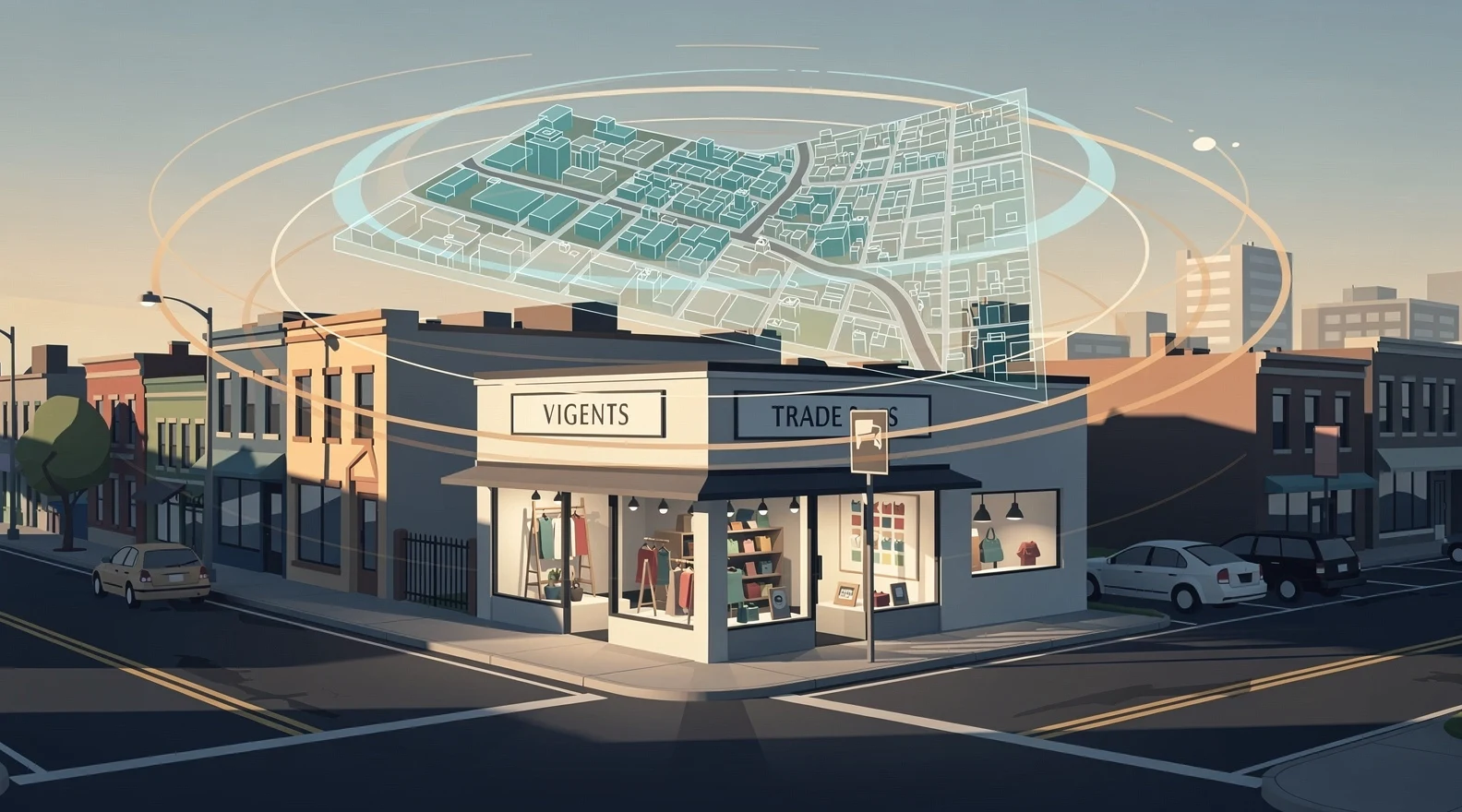
Choosing where to open a store is the single most expensive decision a small retailer makes, and it is the hardest one to reverse. A lease locks up capital, labor and management attention for years, long after the excitement of a signed contract fades. Get it right and foot traffic does half of your marketing for free. Get it wrong and no amount of clever merchandising or discounting will rescue the numbers.
This guide breaks down how independent and small-chain retailers in the United States should approach location choice in 2026. It covers the data that actually predicts performance, the trade-offs between high-rent and low-rent corridors, and the negotiation levers that small operators routinely leave on the table. The goal is a repeatable method, not a lucky guess.
In short
- Location is a revenue decision, not a cost decision. Cheap rent in the wrong trade area destroys more value than expensive rent in the right one.
- Trade area data beats intuition. Daytime population, household income, drive-time isochrones and competitor density predict sales better than a landlord’s pitch.
- The four-wall test is the gate. If projected sales cannot cover rent, labor, inventory and a target margin with room to spare, the site fails regardless of how it feels.
- Co-tenancy is leverage. The anchors and neighbors around you shape your customer flow as much as your own storefront does.
- Negotiate the deal, not just the rent. Tenant improvement allowances, free-rent periods, kick-out clauses and percentage-rent caps often matter more than the headline rate per square foot.
Small-format physical retail is far from finished. As we argued in our look at how brick and mortar retail in 2026 is not dead, just different, the winners are operators who treat the store as a deliberate part of an omnichannel system rather than a default. Location choice is where that discipline starts. It is also where the broader state of retail shows up first, because rent corridors react to demand long before headlines do.
Why location choice matters more than ever in 2026
The economics of small retail have tightened on both ends. Commercial rents in prime corridors have not fully unwound from their post-pandemic peaks, while consumer patience for a mediocre in-person trip keeps shrinking. A shopper who can buy almost anything from a phone will only leave the house for convenience, experience or immediacy. Your location either supplies those things or it does not.
At the same time, the cost of a wrong choice has gone up. Build-out costs, fixtures and signage are more expensive than they were five years ago, and labor markets in many metros remain tight. A relocation two years into a five-year lease can wipe out a small retailer’s entire reserve. The margin for error is thinner than the spreadsheets usually assume.
There is also a structural shift worth naming. As consolidation continues and a US retail restructuring wave reshapes anchor tenants, the neighbors around any given storefront are less stable than they used to be. The department store that drove your mall traffic in 2022 may be gone by 2027. Smart location work now treats co-tenancy as a moving target, not a fixed asset.
The store is now a node, not the whole business
For most small retailers the store no longer stands alone. It supports pickup, returns, local delivery, social content and brand discovery that later converts online. That changes what a good location looks like. A site that is weak for walk-in impulse sales can still be excellent as a fulfillment and experience hub if it sits close to your existing customer base.
The practical implication is that you should evaluate a location against your whole model, not just over-the-counter sales. A second-tier corridor with cheap rent and easy parking may beat a marquee street if most of your revenue is pickup and appointment-based. Define the job the store is doing before you judge the address.
Key terms and definitions
Location analysis has its own vocabulary, and small retailers who skip it tend to overpay. The terms below come up in every broker conversation and every site model. Knowing them shifts the balance of information back toward the tenant.
| Term | What it means | Why it matters to a small retailer |
|---|---|---|
| Trade area | The geographic zone from which a store draws the bulk of its customers, often 60% to 80%. | Defines the population and income base you can realistically sell to. |
| Daytime population | The number of workers and visitors present during business hours, distinct from residents. | Critical for lunch, convenience and service retail in business districts. |
| Drive-time isochrone | The area reachable within a set number of minutes by car, such as a 10-minute ring. | A more honest catchment measure than a simple radius, because it follows real roads. |
| Co-tenancy | The mix of other tenants in a center, including anchors and neighbors. | Drives shared traffic and signals whether your customer already shops here. |
| Tenant improvement (TI) allowance | Money the landlord contributes toward build-out, quoted per square foot. | Directly lowers your upfront capital and changes the true cost of the deal. |
| Percentage rent | Extra rent paid once sales pass a set breakpoint, common in malls. | Can quietly tax your best years if the breakpoint is set too low. |
| NNN (triple net) | A lease where the tenant pays taxes, insurance and common-area maintenance on top of base rent. | The headline rate hides the real monthly number; always ask for the all-in figure. |
Two of these deserve a flag. Daytime population is routinely ignored by retailers who only look at residents, yet a downtown lunch concept lives or dies on it. And the difference between a gross lease and an NNN lease can swing your true occupancy cost by 30% or more, so never compare two sites on base rent alone.
How location choice works in practice
A disciplined site search moves through stages, from wide to narrow. Each stage is designed to kill bad options cheaply before you spend money on lawyers and engineers. The discipline is in walking away early, not in falling for the first space that feels right.
Step one: define the customer and the trade area
Start with who you sell to and how far they will travel. A specialty coffee bar pulls from a 5-minute walk, while a destination outdoor-gear shop can pull from a 30-minute drive. Write down the realistic trade area before you look at any listings, because the address has to serve that geography rather than the other way around.
Then pull the numbers for candidate areas. Household income, age mix, daytime population and household count are all available from public data, and the US Census Bureau publishes most of it for free at the tract level through data.census.gov. Match those figures against your target customer profile. If the fit is poor, no storefront within that area will save you.
Step two: score the trade area against demand
With a trade area defined, estimate demand. Take the relevant population, apply a realistic capture rate based on your category and competition, and multiply by an average transaction value. This gives a rough ceiling for annual sales that you can sanity-check against comparable stores you already know.
This is also where competitor mapping happens. Plot every direct and near-direct competitor inside the trade area. Density is not automatically bad, because clusters of similar stores can grow the overall pie, but you need a clear reason why a shopper would pick you over an incumbent who is already convenient to them.
Step three: shortlist sites and run the four-wall model
Only now do you look at specific spaces. For each shortlisted site, build a four-wall profit-and-loss model: projected sales minus rent, labor, inventory cost, utilities and a maintenance reserve. The site has to clear your target store-level margin with a cushion, not just break even on paper.
Visit each finalist at three different times: a weekday morning, a Friday evening and a weekend afternoon. Counts of cars and pedestrians at those moments will tell you more than any broker flyer. Walk the parking flow, check the signage sightlines and note how easy it is to actually pull in.
Step four: negotiate and stress-test the lease
The final stage is the deal itself, which is where small retailers most often lose money they did not need to lose. Treat the lease as a negotiation across many levers, not a single rent number. The section on negotiation below covers the specific clauses that matter.
| Stage | Primary question | Kill criterion |
|---|---|---|
| 1. Trade area | Does this area contain my customer? | Income or demographic profile is wrong. |
| 2. Demand scoring | Is there enough realistic sales volume? | Modeled demand cannot support the format. |
| 3. Four-wall model | Does this specific site clear my margin? | Rent plus costs erase store-level profit. |
| 4. Lease terms | Is the deal structured to protect me? | No kick-out, runaway percentage rent, thin TI. |
The metrics that actually predict store performance
Retailers love a few vanity numbers, but only a handful of metrics consistently track with sales. Anchoring your decision to the right ones keeps you from being seduced by a pretty facade on a quiet street. The list below is the short version that holds up across categories.
- Sales per square foot in comparable stores. The cleanest benchmark for whether a format can pay for a given rent level.
- Occupancy cost ratio. Total rent plus NNN charges as a share of sales; many small retailers aim to stay under 10% to 12%.
- Daytime and resident population within the drive-time ring. The raw pool of potential customers, weighted by how they actually arrive.
- Visibility and access score. Signage sightlines, ease of entry, and parking or transit convenience, rated honestly during real visits.
- Co-tenancy quality. Whether neighboring tenants attract your customer, with a hard look at anchor stability.
The occupancy cost ratio is the one number to internalize. If rent and related charges eat more than roughly an eighth of your sales, the site has to be extraordinary on every other dimension to survive a soft year. When you compare two sites, compare them on projected occupancy cost ratio, not on rent per square foot, because a higher-rent site with much higher sales can easily be the cheaper choice in practice.
Why a radius lies and a drive time tells the truth
A three-mile radius drawn on a map ignores rivers, highways and the simple fact that nobody crosses town for a convenience purchase. A drive-time isochrone follows the road network and reflects how customers really move. Two sites with identical three-mile populations can have wildly different 10-minute catchments once you account for a freeway or a lake in the way.
Free and low-cost mapping tools now generate isochrones in seconds, so there is no excuse for relying on a circle. Build the realistic catchment, then pull demographics for that exact shape. This single habit separates serious site work from guesswork.
Common mistakes and how to avoid them
Most location failures are not exotic. They repeat across categories and decades, and they are all avoidable with a checklist. The pattern is almost always the same: a retailer falls for one attractive feature and stops scrutinizing the rest.
Chasing prestige rent you cannot support
A marquee address feels like a marketing win, but prestige corridors carry prestige rents. If your margins cannot absorb the occupancy cost, the address becomes a slow leak that no amount of traffic fixes. Many promising independents have signed a famous street and quietly closed within 18 months because the four-wall math never worked.
The fix is to let the occupancy cost ratio veto the address. Calculate what rent your realistic sales can support, then only look at spaces inside that ceiling. Glamour is not a line item on the profit-and-loss statement.
Ignoring the build-out and the all-in cost
The base rent is the beginning of the cost, not the end. NNN charges, utilities, signage, permits and build-out can add 20% to 50% to the first-year burden. Retailers who anchor on the per-square-foot rate get a nasty surprise when the all-in number lands.
Always ask for the fully loaded monthly cost, including estimated NNN, before you fall for a space. Then secure a tenant improvement allowance in writing to offset build-out. A strong TI package can be worth more than several months of free rent.
Misreading co-tenancy and anchor risk
Neighbors drive traffic, so a center anchored by a store your customer already visits is a gift. The mistake is treating the current tenant mix as permanent. Anchors close, and when they do the foot traffic you paid for can evaporate overnight.
Protect yourself with a co-tenancy clause that lets you reduce rent or exit if a named anchor goes dark. This is standard in larger deals and increasingly available to small tenants who ask. The fact that nobody offered it does not mean you cannot request it.
Treating the store as a standalone instead of a system
A storefront that underperforms on walk-in sales might still be the right node in an omnichannel network, and the reverse is also true. Retailers who judge a site only on impulse sales miss its fulfillment and experience value, while those who ignore the daily P&L talk themselves into money-losing trophies. The discipline is to weigh both jobs at once. Strong physical execution still matters here, which is why store design that drives conversion belongs in the same conversation as the address itself.
Examples from US retail and e-commerce
Abstract rules land better against real patterns. The cases below are composites drawn from common situations across US small retail, chosen to show how the method plays out rather than to single out any one business.
The specialty grocer that won on a second-tier street
An independent specialty grocer skipped the high-rent main drag and signed a space one block off it, at roughly 40% lower rent. The trade area data showed the same household income within the 8-minute drive ring, and the cheaper site offered a dedicated parking lot that the main street lacked. Two years on, the store clears a healthy occupancy cost ratio precisely because it refused the prestige corridor.
The lesson is that adjacency to demand beats being on the demand. A block of separation costs almost nothing in customer convenience when parking and access are better, yet it can cut rent dramatically.
The digitally native brand that opened a fulfillment-first store
A direct-to-consumer apparel brand opened its first physical location not to chase walk-in shoppers but to serve the dense cluster of online customers it already had in one metro. The store doubles as a pickup point, a returns desk and a content set. Walk-in sales are modest, but the location pays for itself by cutting shipping costs and lifting local online conversion.
This is the omnichannel logic in action. The right address for a digitally native brand is often defined by where its existing customers live, not by retail foot traffic at all. Understanding how a larger operator structures these decisions can help; our look inside the org chart of a large retail company shows where real estate and e-commerce teams sit and why they increasingly plan together.
The service-led concept that lived on daytime population
A small repair-and-customization shop chose a site in a business district with a thin resident population but a heavy daytime workforce. Competitors had dismissed the area because the after-hours numbers looked weak. The shop built its hours and marketing around the lunch and after-work windows and turned the overlooked daytime population into its core customer.
The takeaway is that the right metric depends on the model. A resident-population purist would have walked away from a site that turned out to be ideal once daytime workers were counted.
Tools, partners and vendors worth knowing
Small retailers do not need an enterprise site-selection budget to do this well. A short stack of mostly free or affordable tools and the right human partners cover the essentials. The point is to get honest data and an experienced advocate, not to buy the most expensive software.
| Category | What it does | Notes for small retailers |
|---|---|---|
| Public demographic data | Income, population and household data by tract or block group. | Free from the US Census Bureau; the backbone of any trade-area model. |
| Mapping and isochrone tools | Generate drive-time rings and plot competitors. | Many consumer mapping apps and low-cost GIS tools handle this. |
| Mobile-location analytics | Estimate real foot traffic and visit patterns. | Paid, but useful for high-stakes sites; some offer per-report pricing. |
| Tenant-rep broker | Represents you, not the landlord, in the search and deal. | Usually paid by the landlord; align incentives and confirm exclusivity. |
| Real estate attorney | Reviews and negotiates lease language. | A few hours of fees can save years of exposure on a bad clause. |
One partner is non-negotiable for a serious lease: a tenant-representation broker who works for you rather than the landlord. A good tenant rep knows local comps, spots inflated asking rates and negotiates terms a first-time tenant would never think to request. Pair that broker with a real estate attorney for the lease review, and the combined fee is trivial against the cost of a bad multiyear commitment.
How to read the data without overpaying for it
You can build a credible trade-area model from free public sources alone for most categories. Paid foot-traffic data earns its keep only on borderline, high-rent sites where a small error is expensive. Start free, add paid analytics selectively, and never let a vendor’s report substitute for your own three timed visits to the space.
Negotiating the lease: where small retailers leave money behind
The deal is the last gate and the one most often fumbled. A few clauses shift far more value than a small change in base rent, yet first-time tenants rarely ask for them. Going in knowing the levers turns the conversation from take-it-or-leave-it into a real negotiation.
- Free-rent (abatement) period. Several months of reduced or zero rent during build-out and ramp-up protects early cash flow.
- Tenant improvement allowance. Landlord money toward build-out, ideally documented per square foot and tied to milestones.
- Kick-out clause. The right to exit if sales fail to hit a defined threshold by a set date, a lifeline for an unproven site.
- Co-tenancy protection. Rent relief or exit rights if a named anchor or a share of the center goes dark.
- Percentage-rent breakpoint. Set the breakpoint high enough that you are not punished for a strong year.
- Assignment and sublease rights. Flexibility to transfer the lease protects you if you need to move or sell the business.
The kick-out clause deserves special attention for any unproven location. It caps your downside by giving you a defined, contractual exit if the sales just are not there. Landlords resist it, but on a softer space or in a slower leasing market it is winnable, and it can be the difference between a recoverable mistake and a ruinous one.
A practical checklist before you sign
Pull the whole method together into a short pre-signature checklist. If you cannot answer yes to each item with evidence, you are not ready to commit. The discipline of the list is what keeps emotion out of a six-figure decision.
- Is the trade-area demographic a clear match for my target customer, backed by Census data?
- Does the 10-minute drive-time catchment, not a radius, contain enough realistic demand?
- Does my four-wall model clear my target store-level margin with a cushion?
- Is my projected occupancy cost ratio inside my category’s safe band?
- Have I visited the site at three different times and counted real traffic?
- Is the all-in monthly cost, including NNN, in writing?
- Did I secure TI, free rent, a kick-out and co-tenancy protection where relevant?
- Has an attorney reviewed the lease language line by line?
None of this guarantees success, because retail always carries execution risk. But it stacks the odds heavily in your favor and turns a gut call into a defensible decision. That shift is the entire point, and it is why location work pays for itself many times over across the life of a lease. For the wider context on where physical retail is heading and which formats are gaining ground, our overview of the state of retail is a useful companion read.
Frequently asked questions
How much should rent be as a percentage of sales for a small retailer?
Most small retailers aim to keep total occupancy cost, meaning base rent plus NNN charges, under roughly 10% to 12% of sales. The exact safe band varies by category, with high-margin specialty retail tolerating more than thin-margin grocery. The key is to compare sites on this ratio rather than on rent per square foot.
Is a high-traffic, high-rent location always better than a cheaper side street?
No. A cheaper site one block off the main corridor can outperform if it shares the same trade-area demographics and offers better parking or access. What matters is whether the four-wall model clears your margin, not the prestige of the address.
What data do I actually need to evaluate a trade area?
At minimum you need household income, population, household count and daytime population for the realistic drive-time catchment. Most of this is free from the US Census Bureau. Layer competitor locations on top to judge density and capture.
Should I use a radius or a drive time to define my trade area?
Use a drive-time isochrone, not a radius. A circle ignores roads, rivers and highways, while a drive-time ring reflects how customers really reach you. Two sites with identical radius populations can have very different real catchments.
Do I need a real estate broker if I am a small independent?
Yes, a tenant-representation broker is worth it for any multiyear lease. They work for you rather than the landlord, know local comps and negotiate terms first-time tenants miss. In most US markets the landlord pays the broker fee, so confirm that and align incentives up front.
What is a kick-out clause and can a small tenant get one?
A kick-out clause lets you exit the lease if sales miss a defined threshold by a set date. It caps your downside on an unproven site. Landlords resist it, but in softer leasing markets or on harder-to-fill spaces, small tenants can and do win it by asking.
How does location choice change if most of my sales are online?
If you are primarily a digitally native brand, the best location is often defined by where your existing online customers cluster, not by retail foot traffic. The store then serves as a pickup, returns and experience node that lifts local online conversion and cuts shipping costs.
How long should it take to choose a location?
Plan for a few months from defining the trade area to signing, not a few weeks. The stages of demand scoring, four-wall modeling, timed visits and lease negotiation each take time, and rushing any of them is how expensive mistakes get made. Walking away early and often is part of a healthy process.
What is the single most common location mistake?
Chasing a prestige address whose rent the realistic sales cannot support. The marquee street feels like marketing, but if the occupancy cost ratio is too high it becomes a slow drain that traffic alone never fixes. Let the four-wall math veto the glamour.