
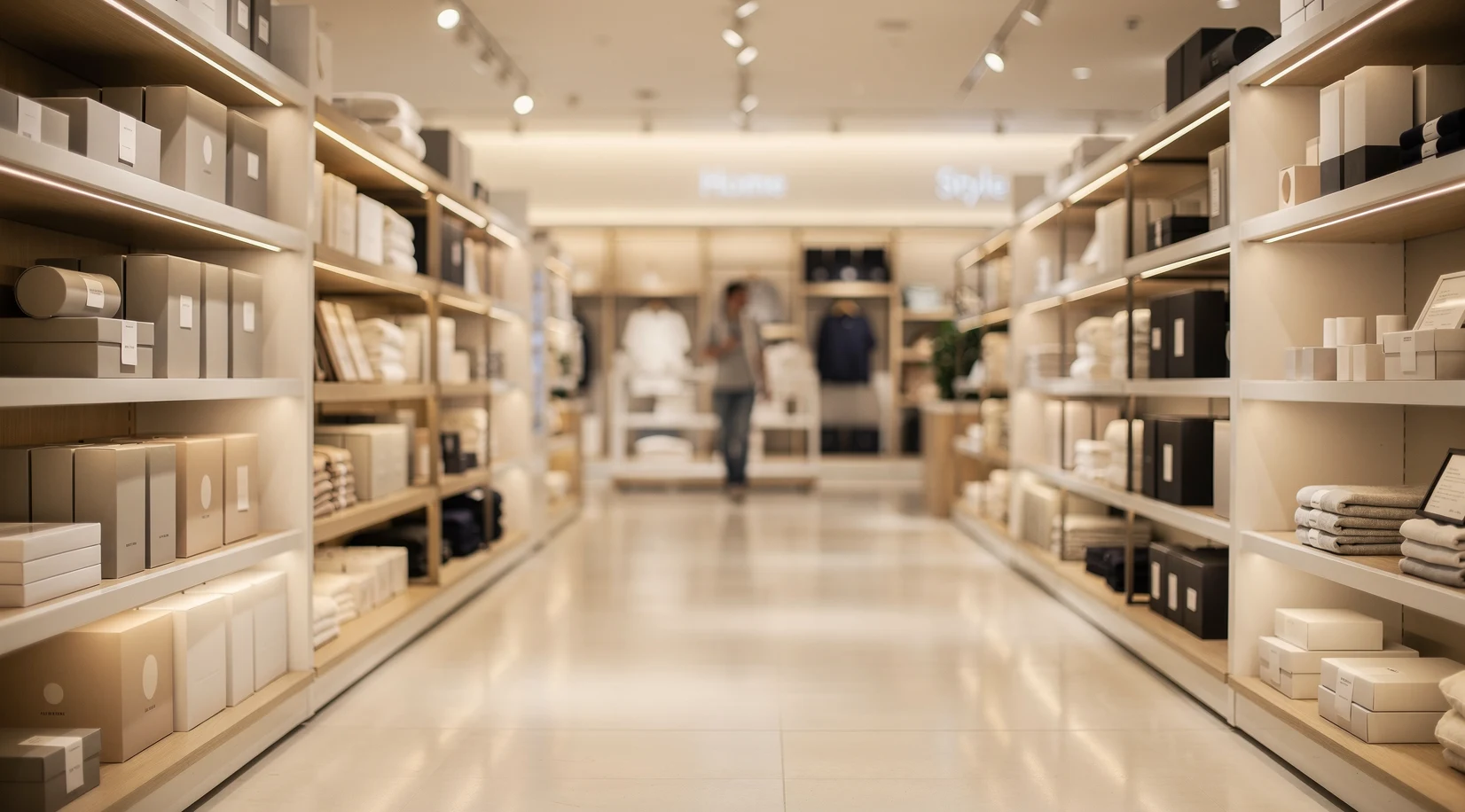
The American department store has been written off so many times that its obituary has become a genre. Yet the chains that are still standing in 2026 share one strategic move above all others, and it is not a flashy app launch or a metaverse pop-up. It is the patient, profitable, occasionally boring expansion of private label, the in-house brands that customers can only buy on a specific retailer’s floor or website.
Macy’s keeps adding to its INC and Alfani lines. Kohl’s leans on Sonoma Goods for Life. Target has turned Good & Gather, Cat & Jack and All in Motion into multibillion-dollar properties. Even Saks, fighting a different fight at the luxury end, has rebuilt around its own house labels. The pattern is too consistent to be coincidence. When traffic gets thin and national brands get squeezed by Amazon, Walmart and TikTok Shop, the path back to a healthy operating margin runs through the goods only you can sell.
In short
- Private label is the margin engine keeping US department stores solvent while national brands shift to direct-to-consumer and marketplaces.
- House brands earn 8 to 15 points more gross margin than equivalent national-brand goods, depending on category and sourcing model.
- The strategy only works with brand discipline, real design investment and a clean separation between value tiers and aspirational tiers.
- Apparel, home and food are the highest-leverage categories; consumer electronics and licensed beauty are the hardest to crack.
- The biggest risk is store credibility, not sourcing. Shoppers forgive a thin national-brand assortment far faster than they forgive a bad house brand.
Why private label became survival, not just strategy
For most of the post-war era, the US department store sold a curated mix of national brands at full markup, supported by occasional sales and a tightly managed credit program. The model worked because the store controlled access. Levi’s, Estée Lauder and Calphalon needed a Macy’s or a Dillard’s to reach affluent suburban shoppers, and those brands accepted retail’s margin terms because no alternative existed at scale.
That arrangement broke. Direct-to-consumer websites, Amazon’s apparel ramp-up and the rise of TikTok Shop have given heritage brands a route to the customer that bypasses the department store entirely. The remaining wholesale relationships are tougher, with brands demanding co-op spending, exclusive SKUs and faster sell-through reporting in exchange for shelf space. Markdowns, which used to be a controllable lever, are now a tax department stores pay just to keep traffic moving.
Private label is the response. When a chain owns the brand, it owns the entire margin stack, from cut-and-sew specs to the hangtag. There is no co-op spend to negotiate, no minimum advertised price to police, and no risk that the same dress shows up on Amazon Prime for fifteen percent less. As our pillar on the state of US retail argues, the chains that survived the last decade did so by treating their own labels as the strategic asset and national brands as the traffic-generating supporting cast.
How private label math actually works
The headline number that retail finance teams obsess over is gross margin percentage. A typical national-brand women’s blouse sells through to the store at roughly 50 to 55 percent off the retail tag. After markdowns, allowances and freight, the realized gross margin lands somewhere in the high thirties on a good day. A comparable private-label blouse, sourced through Asia with a longer lead time and a fixed cost per unit, can deliver realized gross margin in the high forties to low fifties, even after the higher markdown risk that comes with the absence of national-brand demand.
That spread, called the house-brand premium, is what funds the rest of the department store P&L. It pays for store labor, rent on aging mall boxes, the loyalty program and the digital build-out. Without it, most chains would be running unprofitably on a four-wall basis. The cluster piece on department store closures shows that the locations shutting down are almost always the ones where house-brand penetration never crossed 25 percent of mix.
A simple worked example
| Line item | National brand blouse | Private label blouse |
|---|---|---|
| Retail ticket price | $79.00 | $59.00 |
| Average selling price after promos | $54.00 | $44.00 |
| Landed cost | $34.00 | $17.00 |
| Realized gross margin % | 37% | 61% |
| Co-op spend received | $2.00 | $0.00 |
| Markdown risk | Shared | Retailer owns 100% |
| Net contribution per unit | $22.00 | $27.00 |
The unit math favors the house brand even though its retail price is lower, the customer pays less, and the retailer takes on full markdown risk. Multiplied across millions of units a year, the premium funds the entire turnaround playbook.
The category playbook: where house brands win and where they stall
Not every aisle responds to a private-label strategy the same way. After watching twenty years of US department store launches, a consistent ranking emerges.
- Basic apparel (tees, denim, sleepwear, intimates). The easiest category to crack. Customers care about fit, fabric and price, not the label inside the collar. Macy’s INC, JCPenney’s Stafford and Kohl’s Sonoma Goods for Life all started here.
- Home textiles and kitchenware. Pillows, sheets, casual dinnerware and small electrics behave like apparel. Target’s Threshold is the template. Margins north of 55 percent are routine.
- Children’s apparel. Cat & Jack at Target rewrote what private label could be: trusted, design-led, defended by a guarantee. Department stores have struggled to match it.
- Active and athleisure. Harder, because performance claims demand real R&D and the customer is loyal to Nike, Lululemon and Vuori. Successes (All in Motion, Aerie’s OFFLINE in specialty) require multi-year commitment.
- Beauty and color cosmetics. Very hard. Beauty is a brand-driven, social-media-driven category. House lines work as a value flanker (Target’s Up & Up bath) but rarely replace the prestige aisle.
- Consumer electronics and major appliances. Almost impossible. Reliability expectations and warranty exposure punish weak brands. Even Best Buy’s Insignia stays in a narrow lane.
The lesson is that private label is not a single strategy but a portfolio of moves. The chains that have rebuilt around their own labels did so unevenly, doubling down where the math worked and conceding ground where it did not. Compare this with how the same chains are handling mall anchor tenancy in the post-mall era: the categories with the strongest house brands are the ones still warranting a 200,000-square-foot footprint.
Brand architecture: the part most chains get wrong
The single most common failure mode in department store private label is brand sprawl. A merchandiser who likes the margin signs off on another house brand, then another, until the customer cannot keep them straight and the floor looks like a flea market with better lighting. Macy’s at its low point in 2017 carried more than 50 active private-label trademarks across apparel and home. Most of them were doing under $20 million a year, well below the threshold at which a brand can justify its own marketing investment.
The chains that have rationalized their portfolios into a small number of strong house brands, each with a clear customer and a clear price tier, are the ones now generating real growth. The architecture usually looks like this.
- An opening-price-point brand that competes head-on with mass channel and TikTok Shop. Margin is moderate but unit velocity is high.
- A core lifestyle brand that anchors the floor, runs in stores and online, gets real photography and a real social presence.
- One or two specialty brands that signal aspiration: a contemporary line, a wellness line, an own-brand collaboration with a designer.
- A handful of category-specific labels for home, kids and bedding that operate like sub-brands of the core.
That is roughly the shape of Target’s house-brand portfolio, and it is what Macy’s has been migrating toward under its current merchant team. It is also the architecture Kohl’s used to anchor Sonoma Goods for Life as its workhorse brand while keeping a small set of premium and athletic flankers.
Sourcing, design and the operational reality
Most coverage of private label focuses on the brand layer, because that is what shoppers see. The harder work happens upstream. Running a credible house brand requires a design studio with real apparel talent (no longer a given inside US chains after years of layoffs), a sourcing organization that can negotiate factory capacity in Vietnam, Bangladesh and Central America without the leverage of a Walmart-scale order, and a quality control function that can spot a bad cut before 30,000 units land in a Memphis distribution center.
The chains that do this well have invested heavily and quietly in technical design and product development over the last five years. Target spent more than a decade rebuilding its in-house design bench, hiring away from Gap, J.Crew and the contemporary brands. Macy’s restructured its merchant organization around brand teams rather than category buyers, so that the people responsible for INC own the full P&L the way an external brand would. JCPenney rebuilt sourcing under new ownership specifically to support faster turns on Stafford and Worthington.
The chains that have not done this work are visibly losing. A house brand without real design becomes a margin-padding exercise that customers feel. The product looks generic, the fit is approximate, the photography is flat, and the brand becomes the floor’s last-resort markdown rack within two seasons.
The risks most boards underweight
Private label is not a free lunch. The category-by-category math is real, but so are the strategic risks, and they tend to show up only after the chain has reorganized around house brands and lost the optionality to reverse course.
Brand credibility cliff
A national brand that ships a bad season takes the reputational hit. A house brand that ships a bad season takes the retailer down with it. Sears’s collapse was many things, but the perceived erosion of Kenmore, Craftsman and DieHard quality in the 2000s removed the chain’s reason for existing. The same dynamic now hovers over Macy’s, Nordstrom and Kohl’s. A two-year run of weak product on INC or Sonoma would do more damage than a national-brand exit.
Markdown exposure
Because the retailer owns 100 percent of the markdown on private label, a missed forecast hits gross margin twice as hard as a national-brand miss. Discipline on initial buy quantities is essential and rare. The chains that nail it run with leaner inventory and more frequent reorders, the chains that miss end up clearing months-old house-brand goods at 70 percent off on the second floor.
Concentration in a few factories
When private label penetration crosses 30 percent of mix, a chain’s supply chain looks more like a brand’s than a retailer’s. That means tariff exposure, factory labor exposure and freight exposure are all concentrated on the retailer’s balance sheet. The 2025 tariff cycle was a stress test that several chains failed quietly.
Customer-data feedback loops
This one cuts the other way. Retailers with strong house brands and strong loyalty programs get faster, cleaner customer feedback than any national brand can buy. Target uses Circle data to inform Cat & Jack and Good & Gather assortment decisions before competitors can react. That advantage compounds.
Case studies: three chains, three trajectories
To make this concrete, consider how three US department store chains have actually used private label over the last five years. The differences in execution explain more about their current standing than any macro retail narrative.
Target. The most refined private-label operator in US retail. Target spent most of the 2010s consolidating dozens of legacy house brands into roughly 50 named labels organized in tight tiers: Up & Up at opening price, Threshold and Project 62 in home, Cat & Jack and All in Motion in apparel, Good & Gather in grocery. Each one was given a real design and marketing budget, a clear customer, and a multi-year time horizon. The result is that more than a third of Target’s revenue now flows through goods customers cannot buy anywhere else. That is the structural reason Target’s gross margin has held up through the post-pandemic markdown cycles that flattened weaker competitors.
Macy’s. The most visible mid-cycle pivot. As of 2019 Macy’s was carrying too many private labels, too thinly funded, and could not articulate which ones were its anchors. The current leadership took the portfolio down, killed weak lines, and reorganized buyers into brand teams with end-to-end ownership of P&L. INC and Alfani got real campaign dollars and new product-development talent. The chain also leaned harder on Brooks Brothers after acquiring its license, treating it as a contemporary flanker rather than a marked-down basement brand. The results are still uneven, but the direction is right and the private-label penetration trend is upward.
Kohl’s. The cautionary tale. Kohl’s has had a credible workhorse brand in Sonoma Goods for Life for nearly two decades, but it never assembled the surrounding architecture. The athletic flanker stayed under-resourced, the contemporary line cycled through reinventions, and store traffic kept softening. Kohl’s also leaned on Sephora-at-Kohl’s as the traffic engine, which is a sound move but does not solve the apparel margin problem. The chain is now in a position where private label is necessary but not sufficient, and a deeper structural redesign is on the table.
What the next three years probably look like
Three patterns will define the next phase of US department store private label.
First, consolidation of brand portfolios will continue. Expect another wave of retired sub-labels and a sharper focus on a handful of brands per chain that can carry meaningful marketing budgets. The end state is a department store floor where the house brands feel like real consumer brands with their own equity, not back-of-house margin tactics.
Second, more chains will license or acquire heritage names rather than build new private labels from scratch. The Authentic Brands Group playbook (acquiring Reebok, Nautica, Aéropostale, Forever 21) showed that licensed equity can be plugged into a department store with less risk than launching from nothing. Saks’s structural moves in 2025 hinted at this direction.
Third, the line between private label and national brand will keep blurring online. Department store house brands are increasingly available on Amazon, Walmart Marketplace and through their own DTC sites. That distribution is margin-dilutive in the short run but builds brand equity that protects the parent retailer’s pricing power on its own floor. As the state-of-retail pillar outlines, the chains that figure out this dual-channel posture will be the ones with the best chance of holding their physical footprint into the 2030s.
How to read a department store’s private label trajectory
If you want to tell whether a chain is actually executing on private label, ignore the press releases and look at four signals.
- House-brand penetration. Disclosed or estimated as a percent of total apparel and home sales. Healthy chains are pushing past 35 percent. Anything under 20 percent is a yellow flag.
- Number of active private-label trademarks. Down year over year is good. Up is usually a sign of merchandising churn rather than discipline.
- Marketing investment per brand. If a house brand is not getting real campaign dollars, it is not a brand, it is an SKU set.
- Average selling price stability. Strong house brands hold ASP within a tight band. Constant markdown promotion on a private label signals weak product or weak buy discipline.
This is also the framework reporters use when they cover quarterly results in the sector. As the cluster piece on how reporters verify retail scoops describes, the sourcing patterns and credit terms that show up in supply chain databases often telegraph private-label health long before the chain announces it.
Frequently asked questions
What counts as a private label brand at a US department store?
Any brand owned, controlled or exclusively licensed by the retailer and sold only through that retailer’s channels. INC at Macy’s, Sonoma Goods for Life at Kohl’s, Stafford at JCPenney and Brooks Brothers (post-acquisition) at Macy’s all qualify. Exclusive collaborations with a national brand, where the SKU is unique but the brand is not owned, are usually treated as separate from true private label.
How much more margin does private label really deliver?
Industry benchmarks put the gross margin spread between national brand and comparable private label at 8 to 15 percentage points, depending on category. Apparel and home textiles sit at the high end, electronics at the low end. The spread is bigger than it looks because it stacks on top of co-op savings and reduced markdown sharing.
Is private label hurting national brand relationships?
Yes, and the tension is intentional on both sides. National brands have responded by pulling allocation, opening DTC stores and seeding wholesale on Amazon. Department stores have responded by giving their house brands the best floor positions and the heaviest marketing. The relationship is now competitive in a way it was not before 2018, and that is the new normal.
Can private label work for a luxury department store?
It is much harder. Luxury customers buy the label as much as the product. Saks, Neiman Marcus and Nordstrom have all tried, with limited success outside of contemporary categories. The most viable model is exclusive capsules with established designers rather than a fully owned house brand, plus selective acquisition of small heritage labels.
How long does it take to build a credible house brand?
From a standing start, three to five years of consistent investment. The first two years are about product quality and customer trust. The next two add the loyalty layer and the marketing equity. Year five is when the brand starts to behave like a real consumer franchise. Target’s Cat & Jack hit this maturity around year four, which is faster than the norm.
What is the right private label mix for a midsize chain?
Most successful US chains target 35 to 45 percent house brand penetration on apparel and home, with the remainder split between national brands that drive traffic and exclusive collaborations. Going much higher concentrates risk on the retailer’s design and sourcing capability. Going much lower forfeits the margin engine that funds the rest of the business.
Where can I see official US retail data on department store sales?
The US Census Bureau Monthly Retail Trade Survey publishes department store sales as a separate line item every month, with revisions and historical context. It is the cleanest single source for tracking the segment.
How does ShopAppy cover private label going forward?
We track it through the Retail cluster, with cluster pieces on mall anchor tenancy, closure signals and the overarching state of retail pillar. We focus on operating reality rather than press releases: who is funding design, who is rationalizing brand portfolios and who is using house brands to defend store footprint.