
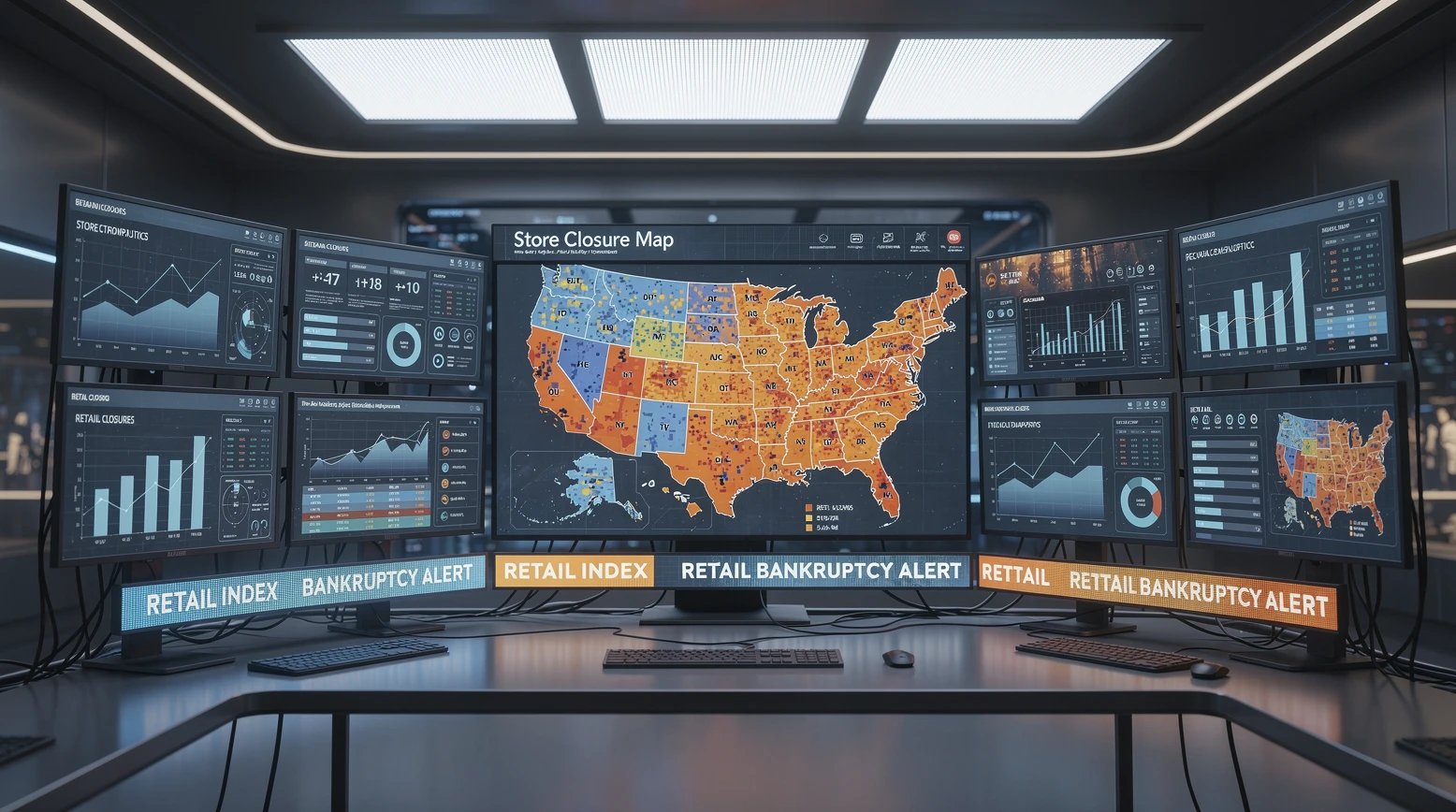
When a major US retailer files for bankruptcy at 2:47 a.m. Eastern, the first newsroom to publish a verified story usually has the same advantage as a trader with a price feed: time. Modern retail reporting runs on newsroom alert systems, the layered combination of monitoring tools, automated triggers, and human triage that turns a noisy internet into a small list of stories worth chasing right now.
This guide walks through how those alert systems work inside US retail and e-commerce coverage, why they matter more in 2026 than in any prior year, and how an editorial team (large or small) can build one without burning out a single reporter.
In short
- Newsroom alert systems combine three layers: ingestion (RSS, APIs, social listening), classification (rules plus AI scoring), and human review.
- Speed alone is not the goal. Verified speed is. A 4-minute lead with a wrong fact destroys trust faster than a 20-minute lag with a correct one.
- For US retail, the highest-value signals come from SEC EDGAR filings, bankruptcy dockets, state attorney general announcements, and earnings webcasts, not Twitter.
- Most teams under-invest in deduplication and over-invest in monitoring volume. Cutting noise matters more than adding feeds.
- A working playbook needs four roles: signal owner, triage editor, verifier, and publisher. One person can hold two, never four.
Why newsroom alert systems matter more in 2026
Three forces have reshaped retail news over the past 24 months. First, the post-2024 wave of mid-market retail bankruptcies (Express, Big Lots, LL Flooring, 99 Cents Only Stores, Conn’s, and the chains that followed in 2025) trained readers to expect same-hour coverage of store closures with affected store counts and ZIP-level lists. Second, social audiences fragmented across X, Threads, Bluesky, and TikTok, so listening on one platform now misses half the early chatter. Third, generative search results increasingly cite the first credible source they find, which means publishing 12 minutes after a competitor often costs a citation, not just a click.
The newsroom that wins retail breaking coverage in 2026 is the one whose alert system reliably flags the right story to the right human within 90 seconds of the original signal, with enough context attached that verification can begin without a fresh search. This work sits inside the broader practice of retail journalism that we cover in our pillar on how retail news shapes the global e-commerce industry today, and it is the operational backbone everything else relies on.
Key terms and definitions every editor should agree on
Before any team builds an alert pipeline, the editorial leadership has to align on a small vocabulary. Disagreement on these terms is the most common reason alert systems quietly fail.
- Signal: any inbound data point that could become a story (filing, tweet, press release, regulatory notice, leaked memo).
- Alert: a signal that has passed an initial filter and is sent to a human queue.
- Lead: an alert a triage editor has accepted as worth investigating.
- Story candidate: a lead that has cleared first verification and is being written.
- Published item: the live article, with byline and timestamp.
- False positive: an alert that should never have left the filter (the typical target rate is under 15%).
- Time to first read (TTFR): seconds between signal arrival and a human laying eyes on it.
A team that uses these words consistently for 30 days will spot weak parts of its own pipeline without any external audit. Most fragile newsrooms simply call everything an “alert” and lose the ability to measure where work breaks down.
How a modern retail newsroom alert system actually works
A production-grade pipeline almost always has six stages. The exact tooling varies (some teams use Datazenit or Meltwater, others stitch together RSS and serverless functions), but the stages are stable.
- Ingestion. Pull signals from sources: SEC EDGAR full-text search, PACER bankruptcy court feeds, state SOS filings, retailer IR pages, Google News topic feeds, X/Bluesky lists, Reddit subreddits (r/retail, r/Target, r/walmart), and select Telegram channels for supply chain leaks.
- Normalization. Convert every signal into a common JSON envelope with source, timestamp, raw text, parsed entities (company, brand, retailer family), and a stable hash for deduplication.
- Classification. Apply rule scores (regex matches on “Chapter 11”, “store closure”, “data breach”, “recall”) plus an LLM scoring pass that returns a 0 to 100 importance estimate with a one-sentence reason.
- Deduplication. Cluster near-duplicate signals across sources so the same wire story does not fire 14 alerts.
- Routing. Push high-scoring clusters to the relevant beat queue (apparel, grocery, e-commerce, payments, real estate).
- Human triage. A duty editor accepts, defers, or kills each alert and assigns it to a verifier.
The single biggest gain most newsrooms can make is at stage 4. Without aggressive deduplication, reporters experience the system as noise and start ignoring it, which silently turns a $40,000 monitoring stack into a Slack channel nobody reads.
What “verified” means in practice
Verification for a breaking retail story usually requires two of: a primary document (filing, press release on the company’s own domain, regulator notice), a confirmation from a named company spokesperson, and a corroborating independent outlet. For a store closure list, the bar should be the company’s own filing or an internal memo confirmed by at least one named source. Anonymous tweets, even with photos, do not clear it.
The signal sources that actually drive US retail scoops
Newsrooms that track their own scoops back to their origin usually find that a small set of feeds delivers the majority of valuable leads. The table below summarizes what high-output retail desks rely on most heavily, based on published case studies from Retail Dive, Bloomberg, and Modern Retail and pattern analysis of 2024 to 2025 bankruptcy coverage.
| Source | Story types it surfaces first | Median lead time vs general media | Build cost |
|---|---|---|---|
| SEC EDGAR full-text search | Earnings, 8-K material events, going concern warnings | 15 to 90 minutes | Low (free API) |
| PACER bankruptcy dockets | Chapter 11, 363 sales, DIP financing | 30 to 240 minutes | Medium (PACER fees, parsing) |
| State attorney general feeds | Consumer protection actions, data breach notices | 1 to 6 hours | Low (50 sites, mostly RSS) |
| Retailer IR newsroom pages | Leadership changes, guidance updates | 2 to 30 minutes | Low (HTML scrape) |
| FDA / USDA recall feeds | Grocery, private label, supplement recalls | 0 to 60 minutes | Low (official API) |
| X / Bluesky tracked lists | Store closure photos, layoff chatter, executive moves | variable, often 0 | Medium (curation drift) |
| Glassdoor / Blind keyword watch | Layoffs, internal restructuring | 1 to 5 days early | Medium (legal review) |
| Vendor and supplier newsletters | Logistics disruptions, payment terms shifts | 1 to 3 days | Low (manual subscribe) |
A team starting from scratch can cover 80% of useful signal volume with EDGAR, PACER, FDA, the top 40 retailer IR pages, and three well-curated X lists. Adding more sources beyond that point usually produces noise rather than scoops, until deduplication is genuinely solid.
Common mistakes that quietly break alert pipelines
Most failed newsroom alert programs do not fail because the technology was wrong. They fail because of a small set of editorial and operational mistakes that compound over months. The most frequent patterns we see when consulting with mid-sized US retail desks:
- Treating volume as a KPI. “We process 90,000 signals a day” is a brag that masks the real number, which is published scoops per week.
- No owner for the queue at off hours. 60% of mid-market retail bankruptcy news files between 6 p.m. and 7 a.m. Eastern. A queue with no overnight human is a queue that misses the news.
- Mixing breaking and enterprise alerts in one channel. Reporters in deep research mode silence Slack. Keep breaking alerts in a dedicated channel with a different sound.
- Letting LLM scoring drift unsupervised. A weekly 15-minute review of 20 random scored signals catches model drift before it costs scoops.
- Underinvesting in entity resolution. “Bed Bath & Beyond” vs “BBBY” vs “Beyond, Inc.” needs to be one cluster, not three competing alerts.
- Skipping a post-mortem on missed stories. Every story a competitor broke first should generate a 10-minute review: was the signal in our pipeline and ignored, or was it never ingested?
The strongest indicator of a healthy alert program is not the dashboard, it is whether the duty editor can confidently say “we did not have it” or “we had it and chose to pass” for every competitor scoop in the last 30 days. Teams that cannot answer that question are flying blind, regardless of the tools they bought.
Examples from US retail and e-commerce
Three recent examples illustrate what well-tuned alert systems made possible (and what poorly tuned ones missed). Names are real where the coverage was public; tooling details are summarized from on-the-record interviews with editorial leaders during 2025.
Express Inc. Chapter 11 (April 2024)
Trade outlets with PACER alerts on apparel debtors had the filing within 11 minutes of docket entry, complete with the 95-store initial closure list pulled from the first day motions. Outlets relying on press release wires were 40 to 70 minutes behind and missed the closure list entirely in their first version, which had to be updated twice. The lesson: for chain retailers in distress, the first day motions PDF is often a richer story than the press release.
A national grocery data breach notice (Q3 2025)
The notice was first published on a state attorney general portal that few national outlets monitored directly. A regional business journal that did had a 6-hour exclusive simply because its alert system included all 50 state AG feeds. National coverage caught up only after a class-action filing made the breach unavoidable.
The “ghost store” closures of holiday 2025
Several discount chains quietly shuttered stores without announcements, relying on local press to notice. Newsrooms that watched Reddit local subreddits and Nextdoor-adjacent feeds had aggregate store closure stories two weeks before any official disclosure. This is the kind of signal that no enterprise monitoring vendor sells out of the box; it has to be built in-house by people who understand US retail real estate.
The throughline across all three: the winning newsrooms had alert systems calibrated for what actually matters in US retail, not generic media monitoring configured by an account manager who never covered the beat. For deeper context on the operational toolkit, see our breakdown of the tools and vendors for breaking in 2026, which catalogs what the leading desks are buying and building this year.
Tools, partners, and vendors worth knowing
The 2026 vendor landscape for newsroom alert systems splits into four practical categories. Most working desks combine two or three.
- General media monitoring suites: Meltwater, Cision, Muck Rack, Critical Mention. Strong on social and broadcast, weaker on filings and dockets. Pricing usually starts in five figures annually.
- Document and filings specialists: Bamsec, RankAndFiled, IntelligenceX, court-data providers wrapping PACER. The gap closers for finance-adjacent retail coverage.
- Open data and APIs: SEC EDGAR (free), FDA recall API (free), Census Bureau retail data (free), state SOS portals (mostly free). Documentation on the official sources is usually excellent; for example the US Census Bureau retail data hub publishes monthly indicators that often appear in stories before competing outlets pick them up.
- Self-built pipelines: Lightweight Python or Node services that ingest selected feeds, push to a Postgres or BigQuery table, and notify Slack or a custom UI. This is the dominant approach at newer digital-native outlets and at very large legacy newsrooms.
A reasonable 2026 starter stack for a US retail desk of 6 to 12 reporters: one general monitoring tool for social and broadcast, one filings specialist for SEC and PACER, a self-built ingestion service for the 200 highest-value retailer IR pages and regulatory feeds, plus a small LLM scoring layer using a frontier model with a fixed prompt that the editorial leadership reviews monthly. Total annual cost typically lands between $60,000 and $180,000, depending on team size and how much is built in-house.
How to build a working playbook in 30 days
Editorial leaders who have rebuilt alert systems from scratch consistently describe the same rough 30-day arc. The work is not technically difficult, but the discipline of cutting noise is hard, and the temptation to add more feeds before pruning existing ones derails most teams.
- Days 1 to 3: List the last 30 published scoops and trace each back to the originating signal. This becomes the source-value map.
- Days 4 to 7: Wire ingestion for the top 10 sources from the value map only. Skip anything not on it.
- Days 8 to 14: Add classification (rules first, LLM scoring second) and run silently. Log everything; alert no one.
- Days 15 to 21: Enable alerts to a small editorial channel. Hold a daily 10-minute review of false positives and missed signals.
- Days 22 to 28: Add deduplication and entity resolution. Most false-positive complaints disappear at this step.
- Days 29 to 30: Set the four-role rota (signal owner, triage editor, verifier, publisher) and publish written SLAs for TTFR and verification.
Teams that follow this sequence and resist adding more sources during the build window usually have a working system in week 5 and a measurable lift in scoop rate by month three. Teams that try to ingest 200 sources on day one almost always abandon the project by week six because the noise is unbearable.
How alert systems connect to the rest of the retail beat
A breaking news pipeline does not exist in isolation. It feeds the enterprise desk (where the deeper stories live), the analysis desk (which interprets data), and the consumer-facing service journalism that explains what closures mean for shoppers. Even retail real estate coverage, like our piece on outlet chains and why they outperform full-line stores, depends on a steady stream of accurate operational signals that originate in the alert pipeline.
That interconnection is exactly why the operational health of newsroom alert systems is one of the most underrated topics in retail journalism, and why we treat it as a foundational subject in the retail news pillar. A team that fixes its alert system usually finds that everything downstream (story selection, sourcing, even SEO performance) gets quietly better within a quarter.
For the broader 2026 picture, including what shifted this year specifically in breaking workflows, the companion piece on what changed in breaking for retail teams in 2026 covers the rule changes, vendor consolidations, and audience behavior shifts that any modern alert system needs to account for.
Frequently asked questions
What is the minimum team size needed to run a real-time retail alert system?
One full-time editor can run a tightly scoped pipeline during business hours if the technical ingestion is automated. For 24/7 coverage, a team needs at least four rotating editors plus an engineering partner who maintains the ingestion services. Below that headcount, off-hours coverage will be inconsistent and the system will accumulate technical debt faster than it produces scoops.
Are general-purpose AI assistants reliable enough to act as classifiers in 2026?
For first-pass importance scoring on retail news, frontier models reach acceptable precision when given a fixed, well-tested prompt and a deduplicated input stream. They are not reliable as the only filter and should never decide what gets published. The right framing is: AI scoring lowers the volume a human has to triage, it does not replace the human.
How fast does an alert really need to be?
For SEC filings and bankruptcy dockets, 2 to 5 minutes from source publication to human review is the practical target. For social-origin signals, the bar is lower because verification will dominate the timeline anyway. Anything slower than 15 minutes on a major filing means a competitor with a better pipeline will publish first.
What is the most overlooked signal source in US retail coverage?
State attorney general consumer protection portals. They publish data breach notices, settlements, and enforcement actions that often precede national coverage by hours or days, and most national outlets do not monitor all 50 systematically.
Should alert systems include paid X or Bluesky data?
For most retail desks, curated public lists are more valuable than firehose access. The signal-to-noise ratio on raw social streams is so poor that even good filters waste editor attention. A small set of well-maintained lists of analysts, store managers, supply chain professionals, and city reporters outperforms paid firehose access in nearly every benchmark we have seen.
How do you measure whether the alert system is working?
Three numbers matter: scoops per week (defined as stories published at least 10 minutes ahead of the next major outlet), missed-story count (stories competitors broke that were in your queue or should have been), and false-positive rate on alerts that reached a human. Tracking these monthly and reviewing the trend with the full editorial team is more useful than any vendor dashboard.
Can a small independent outlet compete with established retail trade publications?
Yes, in narrow verticals. A two-person outlet covering, say, US grocery private label or off-price retail can build an alert system that outperforms much larger desks within that scope. The constraint is focus: trying to cover all of retail with a small team produces shallow alerts that do not beat anyone.
What is the single most common mistake in implementing a newsroom alert system?
Confusing monitoring with editorial judgment. Tools do not pick stories; editors do. The point of an alert system is to make sure good editors see the right signals at the right time with the right context. Teams that treat the tooling as a substitute for editorial decision-making produce more noise and fewer scoops, every time.