
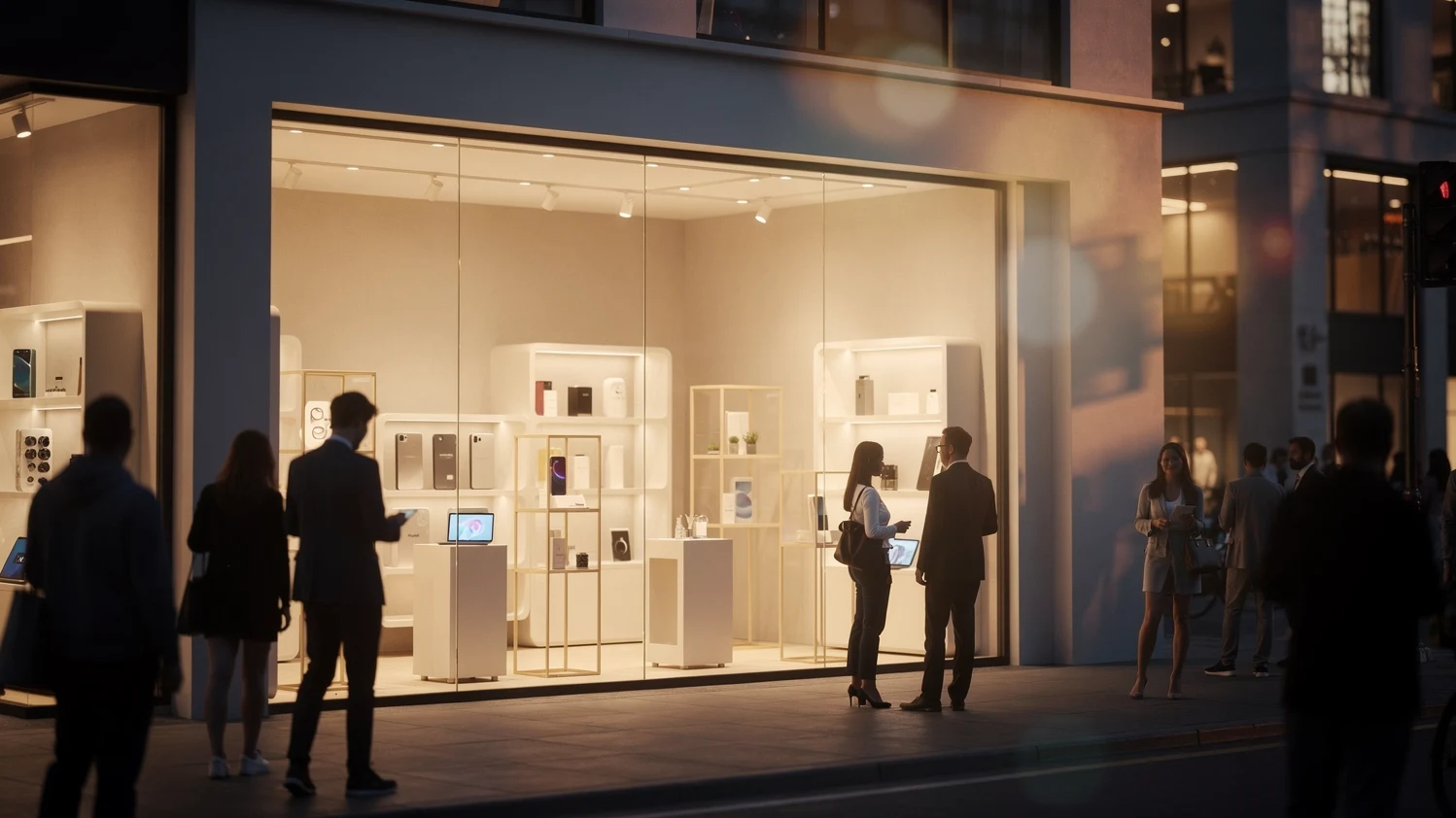
A 30-day pop-up looks deceptively simple from the outside: rent a space, fill it with product, run a launch event, and tally the receipts at the end of the month. The reality is a tightly compressed retail business that has to recover its entire cost base in four weeks rather than four years. Costs land before a single sale clears, footfall is concentrated into a handful of high-traffic days, and the margin math leaves almost no room for the slow learning curve that a permanent store enjoys. Understanding realistic popup costs revenue benchmarks before signing a lease is the difference between a profitable brand activation and an expensive marketing lesson.
This guide breaks down what a 30-day pop-up actually costs in the United States in 2026, what revenue and conversion benchmarks separate a strong activation from a weak one, and how to build a working financial model before you commit. The numbers here reflect short-term retail leasing, experiential builds and D2C brand activations in mid-tier US cities and major metro neighborhoods, not flagship Manhattan windows that operate on entirely different economics.
In short
- A typical 30-day US pop-up in a mid-tier location runs $15,000 to $60,000 all-in, with rent, fit-out and staffing as the three largest line items in nearly every budget.
- Revenue benchmarks vary by goal: a sales-driven pop-up should target 2.5x to 4x its total cost in gross revenue, while a brand-awareness activation is measured on impressions, email capture and earned media rather than same-month sales.
- Conversion rate is the single most predictive metric: well-run pop-ups convert 20% to 35% of visitors versus 1% to 3% for the same brand online, because foot traffic is pre-qualified by location and intent.
- Break-even usually lands between day 12 and day 20 for a sales-focused pop-up, which means the first two weeks fund the space and the back half generates profit, if it generates any at all.
- The most common failure is treating a pop-up like a permanent store: over-investing in fixtures that get scrapped, under-investing in launch-day traffic, and ignoring the fixed-cost clock that never stops ticking.
Why pop-up benchmarks matter more in 2026
Short-term retail has moved from a novelty to a standard channel in the D2C and emerging-brand playbook. Vacancy in secondary retail corridors remains elevated enough that landlords are far more willing to do 30-day and 60-day deals than they were before 2020, which has pushed short-term rent into a negotiable range rather than a fixed premium. That flexibility is exactly why benchmarks matter: when the deal terms are negotiable, the brand that walks in with a clear cost-to-revenue model negotiates from strength.
The second driver is that online customer acquisition cost has stayed stubbornly high. Paid social and search now cost enough per acquired customer that a physical activation, which captures email addresses, generates content and produces first-party data, can compete on blended acquisition economics. A pop-up is no longer just a sales channel. It is an acquisition and content engine, and the benchmarks you measure against depend on which of those jobs you are actually hiring it to do.
Third, the experiential dimension has matured. Customers increasingly expect a physical brand moment to be photogenic, interactive and worth the trip, which is its own cost line. Brands weighing whether the experience investment pays back can study how experiential retail drives sales rather than just footfall, because spend on the experience only counts if it converts to revenue, data or reach.
Key terms and cost categories you need to define first
Before any number means anything, the budget has to be organized into categories that map to how short-term retail actually bills. Mixing one-time and recurring costs is the fastest way to misjudge break-even, so separate them from the start.
Fixed versus variable costs
Fixed costs are everything you owe regardless of how many people walk in: rent, insurance, the fit-out build, permits and base staffing. Variable costs scale with sales: payment processing fees, packaging, replenishment shipping and any commission-based labor. In a 30-day window the fixed-cost share is unusually high, often 70% to 85% of the total, which is why low-traffic days are so punishing. The clock charges you whether or not the door opens.
One-time versus recurring
One-time costs hit once: design, build-out, signage fabrication, initial inventory and launch marketing. Recurring costs repeat across the 30 days: daily staffing, utilities if not included, cleaning and any weekly restock logistics. The trap is amortizing a one-time fit-out cost as if the space will run for a year. In a pop-up, that fixture spend is fully absorbed by a single month, so a $12,000 build on a 30-day run is a $400-per-day fixed charge, not a rounding error.
All-in cost versus occupancy cost
Occupancy cost is rent plus utilities plus insurance, the cost of simply holding the space. All-in cost adds product, people, build and marketing. Landlords and brokers quote occupancy. Founders need all-in. Many first-time operators benchmark against the rent figure a broker quoted and are blindsided when the all-in number lands at three to five times that rent. The detailed teardown in pop-up retail economics: what a 30-day space really costs walks through where that multiple comes from line by line.
What a 30-day pop-up actually costs
The single most useful thing you can do before signing anything is build the full budget bottom-up, not top-down from a rent quote. The table below shows a realistic all-in range for a 30-day pop-up in a mid-tier US market, the kind of secondary metro neighborhood or suburban lifestyle center where most emerging brands actually activate.
| Cost category | Lean (small kiosk or shop-in-shop) | Standard (400 to 800 sq ft storefront) | Premium (1,000+ sq ft experiential) |
|---|---|---|---|
| Rent (30 days) | $3,000 to $6,000 | $6,000 to $18,000 | $18,000 to $40,000 |
| Fit-out and fixtures | $1,000 to $3,000 | $4,000 to $12,000 | $15,000 to $50,000 |
| Staffing (30 days) | $2,500 to $5,000 | $6,000 to $12,000 | $12,000 to $25,000 |
| Initial inventory | $3,000 to $6,000 | $8,000 to $20,000 | $20,000 to $60,000 |
| Insurance and permits | $300 to $800 | $500 to $1,500 | $1,500 to $4,000 |
| Launch and local marketing | $1,000 to $3,000 | $3,000 to $8,000 | $8,000 to $25,000 |
| POS, payments and tech | $200 to $600 | $500 to $1,500 | $1,500 to $5,000 |
| Typical all-in total | $11,000 to $24,000 | $28,000 to $73,000 | $76,000 to $209,000 |
Rent and the short-term premium
Short-term leases carry a premium over long-term rates because the landlord absorbs turnover risk and lost time between tenants. Expect to pay a 20% to 50% premium on a monthly-equivalent basis versus a 12-month lease in the same space. The premium is negotiable in soft corridors, and many landlords prefer a paying 30-day tenant to an empty unit, so revenue-share or stepped deals are increasingly common. Always ask whether utilities, cleaning and basic insurance are bundled, because an unbundled quote can understate true occupancy by 15% to 25%.
Fit-out: where budgets quietly explode
Fit-out is the line that ruins more pop-up budgets than any other, because founders carry permanent-store instincts into a temporary space. Custom millwork, painted walls and built-in displays get demolished in four weeks. The disciplined approach is modular and rentable: freestanding fixtures, tension-fabric walls, rented furniture and lighting that travels to the next activation. A premium experiential build can absorb $50,000 in fabrication, but a standard pop-up that spends more than 20% of its all-in budget on fixtures is usually over-building.
Staffing the 30 days
Staffing is the largest controllable recurring cost. A standard storefront open seven days a week needs two staff during peak hours and one during off-peak, which at US retail wage rates plus payroll taxes lands around $6,000 to $12,000 for the month. Founders often staff it themselves for week one to save cash and learn the floor, then bring in part-time help for the back half. Under-staffing launch weekend, when traffic and conversion peak, is a false economy that costs far more in lost sales than the saved wages.
Revenue benchmarks: what good actually looks like
Cost is only half the equation. The revenue side is where pop-ups are won or lost, and the benchmarks depend entirely on the activation’s primary goal. A sales-driven pop-up and a brand-awareness pop-up are measured on completely different scorecards, and confusing the two is how brands declare a success that lost money or kill an activation that actually worked.
| Metric | Weak activation | Solid benchmark | Strong activation |
|---|---|---|---|
| Visitor-to-buyer conversion | Under 10% | 20% to 25% | 30% to 35%+ |
| Average transaction value | Below online AOV | Matches online AOV | 1.3x to 1.8x online AOV |
| Revenue vs total cost | Under 1.5x | 2.5x to 3x | 4x+ |
| Email or SMS capture rate | Under 5% of visitors | 15% to 25% | 35%+ |
| Cost per acquired customer | Above paid-social CAC | At or near paid-social CAC | Below paid-social CAC |
| Earned media and content | Minimal | Steady UGC, some local press | Viral moment or major press hit |
Conversion rate is the headline number
The defining advantage of physical retail is that foot traffic is pre-qualified. Someone who walks into a pop-up has already spent the effort to be there, so conversion rates of 20% to 35% are normal where the same brand converts 1% to 3% online. If a pop-up is converting below 10%, the problem is almost always location, merchandising or staffing rather than product. Track conversion daily, because it is the earliest signal that something on the floor needs fixing while there is still time to fix it.
Revenue-to-cost ratio for sales-driven pop-ups
For a pop-up whose job is to sell, the cleanest benchmark is gross revenue against total all-in cost. A ratio under 1.5x means the activation lost money once cost of goods is netted out. A healthy sales pop-up lands at 2.5x to 3x, and a strong one clears 4x. Note this is gross revenue, not profit. After cost of goods at typical D2C margins, a 3x revenue-to-cost ratio roughly translates to breaking even or a modest profit, with the real return often sitting in the captured customer list rather than the till.
Benchmarks for brand and acquisition pop-ups
When the goal is awareness or data capture, same-month sales are the wrong scorecard. Measure cost per email or SMS subscriber against your paid-acquisition CAC, total qualified impressions, content volume produced, and earned media value. A pop-up that captures 1,500 emails at a blended cost below your paid CAC is a winning acquisition channel even if in-store sales barely covered the rent. Many brands use a pop-up to test demand in a new city before committing, an approach detailed in how D2C brands use pop-ups to test new cities.
How to model break-even and ROI before you sign
A working financial model takes an afternoon and prevents five-figure mistakes. The goal is a single spreadsheet that answers one question: how many transactions per day, at your real average order value, are needed to cover the fixed-cost clock and reach break-even.
The break-even calculation
Start with total fixed cost, then divide by contribution margin per order (average order value minus cost of goods minus per-order variable cost). That gives the number of orders to break even across the whole run. Divide by 30 for the daily order target, then sanity-check that target against realistic footfall and your conversion benchmark. If you need 40 orders a day but the location and conversion math only support 20, the model has told you the deal does not work before you signed it.
Front-loading the timeline
Pop-up revenue is rarely linear. Launch weekend and the first week typically deliver 35% to 50% of total revenue, the middle sags, and a closing-week push can recover some volume. Model the curve, not a flat daily average, because a flat assumption hides the cash-flow reality that fixed costs are due on day one while revenue arrives unevenly. Break-even on a sales-driven pop-up usually lands between day 12 and day 20 under this front-loaded pattern.
Counting the after-sale value
The honest ROI model includes value that lands after the doors close: the captured email and SMS list, the content library produced, the press and social proof, and the lift in online sales in that geography during and after the activation. A pop-up that broke even on in-store sales but captured 2,000 subscribers and lifted regional online revenue for the following quarter can be the most profitable channel the brand ran all year. Brands deciding whether the activation justifies a permanent footprint should work through the decision framework in turning a pop-up into a permanent store.
Common mistakes and how to avoid them
Most pop-up losses trace back to a small set of repeatable errors. Knowing them in advance is cheaper than learning them on the floor.
Treating a temporary space like a permanent one
The signature mistake is over-building. Custom fixtures, heavy millwork and permanent-grade finishes get torn out in four weeks and deliver almost no return. Rent, borrow or build modular, and route the saved capital into launch-day traffic and staffing where it actually converts. The brand-building logic for why the activation itself matters more than the fixtures is covered in pop-up retail explained as a brand growth lever.
Underspending on launch traffic
A pop-up with no opening-weekend traffic plan is a store nobody knows exists. Local paid social, influencer seeding, an email blast to any existing customers in the metro, and a genuine reason to show up on day one are not optional. The fixed-cost clock is running regardless, so empty early days are pure loss. Concentrate marketing spend in the week before opening and the opening weekend itself.
Ignoring the data-capture opportunity
Every visitor who leaves without joining the list is a paid acquisition that walked out the door. Build email and SMS capture into checkout, the experience and any giveaway, and treat capture rate as a primary KPI alongside sales. A 25% capture rate on 3,000 visitors is 750 owned contacts, frequently the most durable asset the pop-up produces.
Skipping permits and insurance
Temporary does not mean exempt. Most US municipalities require a temporary business or seller’s permit, sales tax registration, and the landlord will almost always require a certificate of insurance. Skipping these to save a few hundred dollars risks a shutdown mid-run that wipes out the entire investment. Build permits and insurance into the budget from the first draft.
Examples from US retail and e-commerce
Concrete patterns make the benchmarks tangible. The following composite examples reflect how the numbers play out across common US pop-up archetypes in 2026.
The lean D2C test market
A digitally native apparel brand activates a 500-square-foot space in a secondary metro neighborhood for 30 days at roughly $32,000 all-in. With strong launch marketing it draws about 3,200 visitors, converts at 24%, and runs an average transaction value slightly above its online AOV. Gross revenue lands near $95,000, a 3x revenue-to-cost ratio, plus 800 captured subscribers. The in-store profit is modest after cost of goods, but the subscriber list and the validated demand justify a second city.
The brand-awareness experiential build
A beauty brand runs a premium 1,200-square-foot experiential pop-up at roughly $140,000 all-in, designed for content and reach rather than direct sales. In-store revenue covers only about 60% of cost, which would read as a failure on a sales scorecard. But the activation generates a viral social moment, two national press hits and 4,000 subscribers, putting blended customer acquisition cost well below the brand’s paid-social CAC. On the correct scorecard, it was the most efficient acquisition the brand ran that quarter.
The local main-street activation
A regional home-goods maker takes a small main-street unit for 30 days at roughly $18,000 all-in, leaning on community ties and local press rather than paid media. Conversion runs high at 31% because foot traffic is highly local and intent-driven, and revenue reaches about $58,000. Local activations like this often benefit from district-level support, including the funding mechanisms covered in BID levies and grants for funding main street retail in 2026.
Tools, partners and vendors worth knowing
The pop-up vendor ecosystem has matured enough that most of the operational load can be outsourced. Knowing the categories keeps you from reinventing each piece.
Space and leasing
Short-term retail marketplaces and specialist brokers now aggregate pop-up-ready inventory with transparent 30-day and 60-day pricing, which compresses the search from weeks to days. For soft corridors, approaching property managers directly about vacant units often beats marketplace pricing, especially when you can offer a clean, low-risk 30-day tenancy.
POS, payments and analytics
Mobile-first POS systems handle in-store checkout, inventory sync and customer capture on a month-to-month basis, which suits a temporary run. The non-negotiable feature is clean reporting on conversion, transaction value and capture rate, because the benchmarks in this guide are only actionable if the system measures them in real time. Integrate the POS with your existing e-commerce stack so the captured customers flow into the same marketing database.
Fixtures, build and staffing
Rental-fixture vendors, modular display suppliers and short-term retail staffing agencies let you stand up a professional floor without permanent capital outlay. For the experience layer, lighting, signage and any interactive element are increasingly available as rentals. A current view of the broader category, including how vendor needs shift with retail trends, is tracked in what changed in company structure for retail teams in 2026. For national context on retail employment and wage rates that drive staffing budgets, the US Bureau of Labor Statistics retail trade data is the authoritative reference.
FAQ
How much does a 30-day pop-up cost in the US?
A realistic all-in range for a mid-tier US market is $15,000 to $60,000, with a lean kiosk starting near $11,000 and a premium experiential build exceeding $150,000. Rent, fit-out, staffing and initial inventory are the four largest line items in nearly every budget. Always budget all-in cost rather than the rent figure a broker quotes, because all-in typically runs three to five times the rent.
What is a good conversion rate for a pop-up?
A solid benchmark is 20% to 25% visitor-to-buyer conversion, with strong activations reaching 30% to 35% or higher. This is far above the 1% to 3% typical online because foot traffic is pre-qualified by location and intent. If your pop-up converts below 10%, look first at location, merchandising and staffing rather than the product itself.
How do I know if my pop-up was profitable?
For a sales-driven pop-up, compare gross revenue to total all-in cost. A ratio of 2.5x to 3x usually means breaking even or a modest profit after cost of goods, and 4x or more is a strong result. For a brand or acquisition pop-up, measure cost per captured subscriber against your paid-acquisition CAC, plus impressions and earned media, rather than same-month sales.
When does a 30-day pop-up break even?
Break-even on a sales-driven pop-up typically lands between day 12 and day 20. Revenue is front-loaded, so launch weekend and the first week often deliver 35% to 50% of total revenue while fixed costs are due from day one. Model the revenue curve rather than a flat daily average to see the real cash-flow timing.
What is the biggest mistake brands make with pop-ups?
Treating a temporary space like a permanent store by over-investing in custom fixtures that get scrapped in four weeks. Build modular and rentable instead, and route the saved capital into launch-day traffic and staffing where it converts. The second most common mistake is underspending on opening-weekend marketing, which leaves the fixed-cost clock running against an empty store.
Do I need permits and insurance for a temporary pop-up?
Yes. Most US municipalities require a temporary business or seller’s permit and sales tax registration, and landlords almost always require a certificate of insurance. These typically cost a few hundred to a few thousand dollars depending on the market. Skipping them risks a mid-run shutdown that can wipe out the entire investment, so build them into the budget from the first draft.
How much should I spend on fit-out for a pop-up?
Keep fit-out under roughly 20% of your all-in budget for a standard activation. Use modular, freestanding and rented fixtures that travel to the next pop-up rather than custom millwork that gets demolished. A premium experiential build can justify higher fabrication spend, but only when the experience itself is the product and is measured on reach and content, not just sales.
Is a pop-up cheaper than paid online advertising for acquiring customers?
It can be, on a blended basis. A pop-up that captures email and SMS subscribers, produces content and generates earned media can deliver a cost per acquired customer at or below paid-social CAC, while also generating in-store revenue. The key is measuring the full return, including the captured list and post-event regional online lift, not just same-month in-store sales.
Should I turn my pop-up into a permanent store?
Only if the unit economics, repeat-traffic patterns and local demand support a 12-month fixed cost base, which is a very different math than a 30-day run. A profitable pop-up does not automatically make a profitable permanent store because the fixed-cost clock runs every month rather than once. Work through the decision framework on converting a pop-up to a permanent location before committing to a lease.