
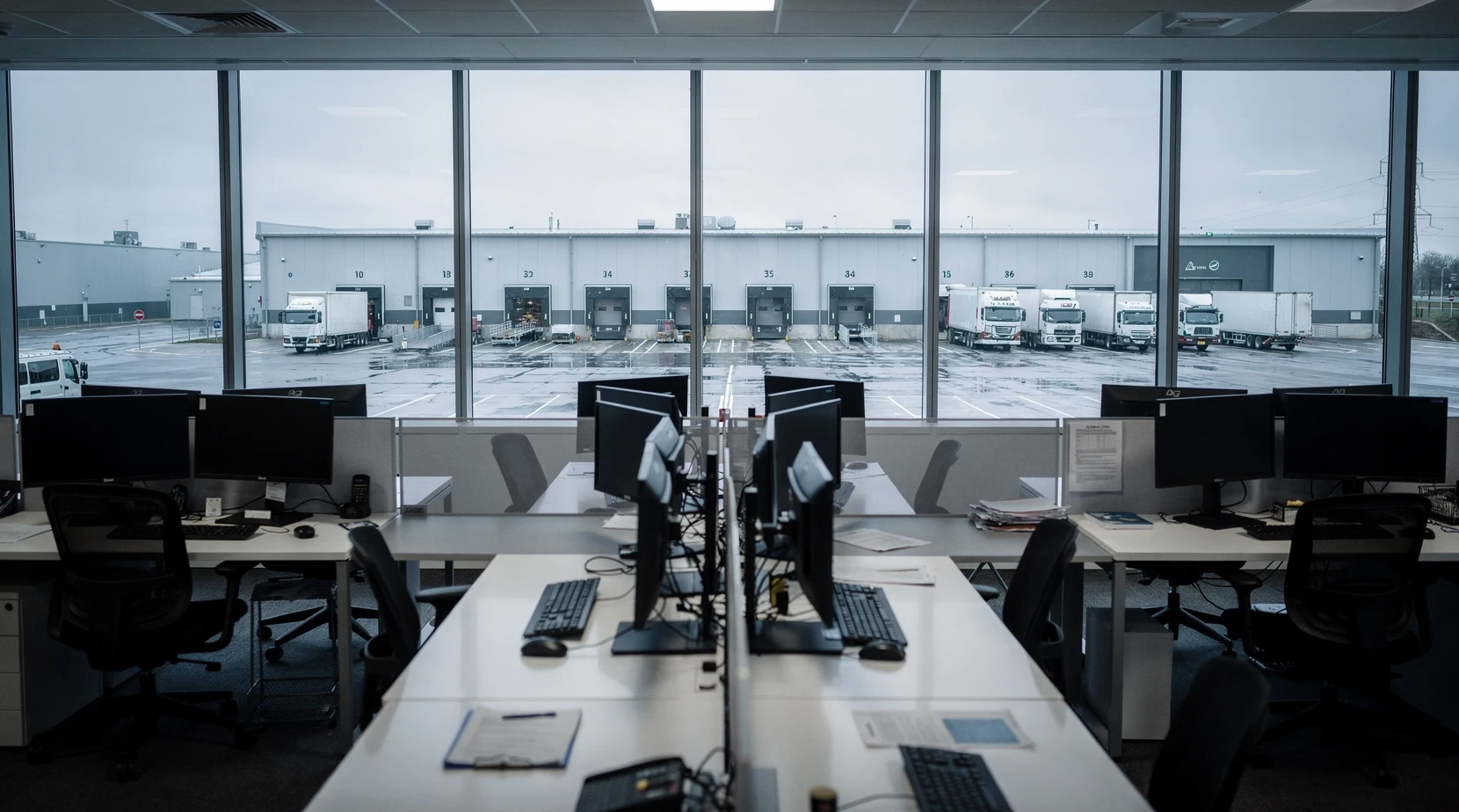
Aldi’s UK business is cutting hundreds of head office and logistics roles as part of a wider push by its German owner to trim costs and run more work centrally. The Guardian reported on Wednesday morning that the discounter is consulting its technology team on the loss of up to 150 roles, on top of 103 redundancies in finance and administration earlier this year and almost 20 among buying directors. Retail Week and Birmingham Live have since carried the story, and Aldi has confirmed in a statement that it is “making some adjustments to the way parts of our UK business are structured”.
Store jobs are not affected, the company says. But the cuts land at an awkward moment for Britain’s fourth-largest grocer: its sales growth has slowed to a crawl, rivals are matching its prices on key lines, and it has just committed a record £900m to new shops and distribution for 2027. This article sets out what is being cut, why, what the law requires of Aldi as an employer, and what it means for the people who shop there.
In short
- Up to 150 technology roles at Aldi UK are in consultation, according to the Guardian, after 103 finance and administration redundancies and almost 20 buying director exits earlier in 2026.
- Store staff are not affected, Aldi says, although it has slightly reduced the number of regional managers.
- Work is moving offshore and to the centre: finance, procurement and administration roles are being outsourced to India and other countries through a deal with Genpact, the Guardian reports, and payroll is next in line for consultation.
- Growth has stalled: Aldi’s UK sales rose just 0.4% in the 12 weeks to 1 November, per Worldpanel by Numerator, with market share at 10.4%, down 0.1 points on a year earlier.
- For shoppers, nothing changes at the till today. Aldi says the savings support its promise of “unbeatable prices”, and it was the only big grocer whose average unit price fell in the latest Worldpanel period.
What exactly is Aldi cutting in the UK?
The cuts are spread across several head office functions rather than one big announcement. Taken together, the Guardian’s figures add up to roughly 270 roles already gone or under formal consultation in 2026, before any payroll redundancies are counted. That is a material slice of a head office workforce based largely in Atherstone, Warwickshire, where Aldi UK has its headquarters.
The single largest block is in technology. Aldi is consulting with its tech team on the loss of up to 150 roles, the Guardian reports. That follows 103 redundancies in finance and administration earlier in the year and “almost 20” redundancies among buying directors, a senior group that negotiates with suppliers on everything from milk to the Specialbuys aisle.
| Function | Roles affected | Status | Reported by |
|---|---|---|---|
| Technology team | Up to 150 | In consultation (November 2026) | The Guardian; Retail Week; Birmingham Live |
| Finance and administration | 103 | Redundancies made earlier in 2026 | The Guardian |
| Buying directors | Almost 20 | Redundancies made earlier in 2026 | The Guardian |
| Regional managers | “A handful” | Number reduced slightly, per Aldi | The Guardian |
| Payroll | Not disclosed | Consultation expected “in the coming months”, per sources | The Guardian |
| Head office cleaning (agency) | Hours cut, not roles | Already reduced at Atherstone | The Guardian |
| Store colleagues | None | Not affected, per Aldi | The Guardian; Birmingham Live |
Aldi has not published its own breakdown, and it has not confirmed a total. The figures above are as reported, and the technology number is an upper limit under consultation rather than a final outcome. Consultation can reduce the number of compulsory redundancies through redeployment or voluntary departures.
One detail matters for store teams even though shop-floor jobs are safe. Aldi told the Guardian it had “reduced the number of regional managers slightly”, affecting a handful of high-paying roles. Regional managers oversee a cluster of stores and are often the link between head office and individual store managers, so fewer of them means each will look after more shops.
For shoppers, that is unlikely to be visible in the short term. For store managers, it may mean less frequent visits and more decisions taken locally or pushed up to the centre, depending on how Aldi redraws its patches.
Why is Aldi cutting head office jobs now?
Aldi’s own explanation is about cost and simplicity. “At Aldi, our promise to customers is that we will always offer great quality products at unbeatable prices,” a spokesperson said in the statement carried by the Guardian and Birmingham Live. “Across our international business, we continuously review all aspects of our operations to ensure we operate simply, efficiently and use our global scale to deliver on that promise.”
The spokesperson added: “We are therefore making some adjustments to the way parts of our UK business are structured. Any changes are being introduced gradually and following a consultation period. We recognise that this is difficult for those involved, so we are giving colleagues as much notice as possible, with full support available to everyone affected.”
A global centralisation programme
The UK cuts are part of something bigger. The Guardian reports that the German-owned group is reducing the number of people in local country operations as it centralises more work. Aldi UK and Ireland sits within the Aldi Süd group, which also runs Aldi in the United States, Australia and much of western and southern Europe.
In practice, centralisation means that functions once duplicated in every country (technology support, finance processing, some buying decisions) are handled once, by a group-level team or an outside provider, and shared across markets. That is the “global scale” Aldi’s statement refers to.
The timing also reflects trading. According to Worldpanel by Numerator’s latest grocery market share figures, Aldi’s UK sales rose only 0.4% in the 12 weeks to 1 November, while the overall market grew 1.7% over the same period. Its share slipped to 10.4% from 10.5% a year earlier. We covered the full Worldpanel release showing grocery inflation at 2.6% on Tuesday.
The Guardian notes that the traditional supermarkets have made life harder for the discounters by matching them on price for key items while offering a far wider range. When a discounter’s growth slows, its low-margin model leaves little room to absorb rising wage bills, so overheads become a natural target.
Where are the jobs going, and who is Genpact?
Not all of these roles are disappearing outright. According to the Guardian, Aldi is outsourcing finance, procurement and administration roles to India, among other countries, as part of a deal with Genpact, a company that helps businesses develop the use of AI technology. In other words, some of the work will still be done, just not by Aldi UK employees in Warwickshire.
Genpact is a professional services firm, listed in New York, with large operations in India. It runs back-office processes for big companies, such as accounts payable, procurement and reporting, and increasingly sells automation and AI tools alongside that work.
What the Genpact relationship looked like before
Genpact and Aldi Süd announced a multi-year partnership in July 2024. At the time, Genpact’s press release said the engagement would support the transformation of Aldi’s operations in the United States and Australia, applying “data, technology and AI solutions” to business services. Trade coverage of that deal said it would cover systems including SAP S/4HANA, Ariba, Blackline and ServiceNow, the enterprise software that sits behind finance, purchasing and IT support.
Wednesday’s reporting is the first clear sign that the same approach is now reaching the UK. Neither Aldi nor Genpact has published terms for a UK arrangement, and the Guardian does not say how many roles will be transferred abroad versus removed altogether. Until either company says more, those figures should be treated as unknown.
No. In February 2025, City AM, citing Grocery Gazette, reported that Aldi was consulting on up to 350 roles at its Atherstone headquarters, covering some buying positions including non-food, finance and back-office functions. Aldi said then that no customer-facing roles were affected and that no final decisions would be made until consultation was complete. The 2026 cuts look like a continuation of that restructuring rather than a sudden change of course.
How are Aldi’s UK sales and prices really doing?
On the headline numbers, Aldi UK is still a large and profitable business. Its most recent annual results, published in late September and covering the year to 31 December 2025, showed sales up about 5% to a record £19bn, according to trade press reports including Grocery Gazette and The Grocer. Operating profit was broadly flat at £432.9m, against £435.5m a year earlier, which several outlets put at an operating margin of around 2.3%.
At the same time, Aldi pledged a record £900m investment for 2027, including 40 new stores and work on its distribution network. It had 1,092 stores across the UK and Ireland at the time of the results and has a long-term target of 1,500. Our earlier piece on Aldi’s store-a-week opening push sets out how that expansion has been rolling out across the country.
The most recent Worldpanel data shows how much the discounters’ momentum has diverged. Lidl has been the fastest-growing bricks-and-mortar grocer, while Aldi has barely grown.
| Retailer | Share, 12 weeks to 1 Nov 2026 | Share a year earlier | Sales growth year on year |
|---|---|---|---|
| Tesco | 27.8% | 27.9% | +1.2% |
| Sainsbury’s | 15.5% | 15.6% | +0.8% |
| Asda | 11.3% | 11.6% | -0.5% |
| Aldi | 10.4% | 10.5% | +0.4% |
| Lidl | 8.6% | 8.2% | +6.6% |
| Morrisons | 8.3% | n/a | +2.0% |
| Co-op | 5.3% | n/a | +0.7% |
| Waitrose | 4.5% | 4.4% | +2.2% |
| Ocado | 2.3% | 2.1% | +12.3% |
Aldi’s growth of 0.4% sits well below the market’s 1.7%, and below grocery inflation of 2.6%. That gap implies Aldi’s volumes (the amount of goods shoppers bought) were lower than a year ago, although Worldpanel does not publish volume by retailer in its headline release.
There is a twist that matters for shoppers. The Guardian points out that the average unit price at Aldi fell by 0.1% over the period, making it the only retailer reducing overall prices. Aldi also told the Guardian it had invested £300m in lowering prices on 900 products in the UK this year.
Part of the weak sales figure, then, is a deliberate choice: Aldi is cutting prices while others are letting them rise with inflation. Lower prices mean lower revenue per item unless more customers come through the door, and the Worldpanel data suggests that has not happened yet. The head office cuts are one way to pay for that strategy.
What does this mean for Aldi shoppers?
In the short term, very little. Aldi says no store roles are affected, and nothing in Wednesday’s reporting points to fewer stores, smaller ranges or changes to the Specialbuys schedule. The new store programme for 2027 remains in place, according to the company’s September results.
The more interesting question is what the savings fund. Aldi frames the restructure explicitly as a way to protect “unbeatable prices”. If that holds, shoppers may see the benefit in continued price cuts on staples, especially as rivals’ prices drift up with inflation.
Will Aldi prices go up or down?
No retailer can promise prices. But the evidence so far points one way: Aldi’s average unit price has been falling while the market’s has been rising. A discounter that is losing share to Lidl and to Tesco’s and Sainsbury’s price-match schemes has every incentive to keep pressing on price, and the head office savings give it more room to do so.
Shoppers comparing baskets should keep watching shelf prices rather than headlines. Aldi has been the cheapest supermarket in Which?’s monthly basket comparison for much of the past few years, with Lidl usually close behind. Whether that continues will depend on how much of the saved overhead goes into the shelf price.
Cutting buying directors and outsourcing procurement can, in theory, affect what ends up on the shelves. Fewer UK buyers may mean more products sourced centrally for several countries, and less room for local or regional lines.
Aldi has built much of its British reputation on UK-sourced fresh meat, dairy and produce and on regional suppliers. There is no evidence in the current reporting that this is changing, and Aldi’s statement does not mention ranges. It is a point worth watching in future range reviews and in supplier comments over the next year.
Buying changes also matter to Aldi’s suppliers, many of them British farmers and food manufacturers. Since the CMA’s decision on 22 October, Aldi and Lidl are both designated as large grocery retailers, which brings them under the Groceries Supply Code of Practice and the Groceries Code Adjudicator. We explained what that designation does in our report on the CMA naming Aldi and Lidl as large grocers. Whoever ends up handling procurement, Aldi UK remains bound by the code in its dealings with suppliers.
How does this compare with job cuts at other UK supermarkets?
Aldi is not alone. British grocers have spent 2026 stripping cost out of head offices and back-end operations, with technology, logistics and support functions bearing the brunt. The Guardian lists several recent rounds.
| Retailer | When | Roles | Area affected |
|---|---|---|---|
| Sainsbury’s | February 2026 | 300 | Head office, restructuring technology and Argos delivery network |
| Ocado | February 2026 | 1,000 | Group-wide cost-saving drive of £150m |
| Morrisons | Spring 2026 | Hundreds | Head office |
| Tesco | 2026 | A similar number to Sainsbury’s | Changes to how it runs bakeries |
| Asda | Summer 2026 | Up to 1,000 at risk | Logistics, through more automation |
| Aldi | 2026, latest November | About 270 reported, plus payroll to come | Technology, finance, administration, buying |
The pattern is consistent. Supermarkets are protecting store labour, where cuts are visible to customers and hit sales, and cutting in areas where technology or outsourcing can replace people. Higher employer national insurance contributions and successive rises in the National Living Wage have added to the pressure, a theme we tracked in our analysis of UK retailers cutting 18,000 jobs after the tax rises.
There are three reasons. Store staffing is already lean at discounters, and cutting it further risks queues and empty shelves. Back-office work such as invoice processing, reporting and IT support is easier to standardise across countries. And AI and automation tools sold by firms like Genpact are aimed squarely at exactly those tasks.
The flip side is that head office roles tend to be better paid than store roles, so each cut saves more money. Aldi’s mention of “a handful of high-paying roles” among regional managers fits that logic.
What are the rights of Aldi staff facing redundancy?
For the people affected, the process matters as much as the headline. UK employment law sets out minimum steps that a large employer like Aldi must follow when proposing redundancies on this scale. The following is general information about the statutory framework, not legal advice on any individual case.
When an employer proposes to dismiss 20 or more employees at one establishment within 90 days, it must collectively consult with employee representatives. If between 20 and 99 are proposed, consultation must start at least 30 days before the first dismissal takes effect. If 100 or more are proposed, the minimum is 45 days. The employer must also notify the government using form HR1 within the same timeframes.
| Rule | What it requires | Relevance to Aldi |
|---|---|---|
| Collective consultation, 20 to 99 roles | At least 30 days before first dismissal | Applies to smaller rounds such as buying directors if in one establishment |
| Collective consultation, 100 or more roles | At least 45 days before first dismissal | Likely to apply to the up to 150 technology roles |
| HR1 notification | Notify the government before dismissals, on the same 30 or 45 day timetable | Required for proposals above the threshold |
| Protective award | Up to 180 days’ gross pay per employee if consultation rules are breached (doubled from 90 days for dismissals on or after 6 April 2026) | Applies to any 2026 dismissals |
| Statutory redundancy pay | Payable after two years’ continuous service, based on age, service and capped weekly pay | Minimum entitlement; Aldi may pay more under its own terms |
| Suitable alternative employment | Employer should consider redeployment | Possible moves into regional or store roles |
The 2026 change to protective awards
One change is new this year. Under the Employment Rights Act 2025, the maximum protective award for failing to collectively consult properly doubled from 90 to 180 days’ gross pay per affected employee, for dismissals taking effect on or after 6 April 2026, according to Acas and several law firms. That makes cutting corners on consultation far more expensive for employers than before.
There is nothing in the current reporting to suggest Aldi is failing to consult. Its statement stresses a consultation period and “as much notice as possible”. But staff in the technology team should expect a formal process, elected or union representatives, and a timetable of at least 45 days if more than 100 roles are proposed at one site.
Staff in scope can ask for the selection criteria in writing, check whether redeployment into other roles has been offered, and take advice from Acas or a union before signing any settlement agreement. Anyone with two or more years’ service is entitled to at least statutory redundancy pay, and anyone offered a settlement must receive independent legal advice for it to be binding.
How do Aldi’s store pay and head office cuts fit together?
The cuts sit alongside a very different story on the shop floor. Aldi has spent the past few years marketing itself as the best-paying supermarket for store staff. According to the Aldi UK press centre, store assistants have earned at least £13.50 an hour nationally and £14.88 inside the M25 since 1 April 2026, rising to £14.47 and £15.20 with length of service.
Those rates sit comfortably above the £12.71 National Living Wage that applied from April 2026, and Aldi says it employs more than 45,000 people in the UK. Store pay is also rising again across the sector: the National Living Wage will rise to £13.21 from April 2027, so pressure on store wage bills will continue.
This is the core of the discounter model. Aldi pays store staff well to keep stores running with fewer people, and it keeps the rest of the organisation as small as possible. When sales growth slows and wage costs rise, the simplest place to find savings is in the offices behind the stores.
One affected worker told the Guardian the cuts were “shortsighted” and showed that “upper management [are] woefully out of touch with the reality”. That view will not be universal, but it reflects a real risk: losing in-house knowledge of British suppliers, systems and shoppers when work moves offshore.
What happens next?
Several things are now in motion, and each will produce new information over the coming months.
- The technology consultation will run for at least 30 to 45 days, depending on the final number. Its outcome will show how many of the up to 150 roles actually go.
- Payroll consultation is expected to begin “in the coming months”, according to the Guardian’s sources. Aldi has not said how many roles that could affect.
- The Christmas trading update in January will show whether price cuts are winning back shoppers. Aldi usually reports festive sales in early January, alongside the other big grocers.
- The next Worldpanel release, due in early December, will show whether Aldi’s share has stabilised heading into the Christmas peak.
- Annual results for 2026, expected around September 2027, will show whether operating profit recovers once the restructuring costs are absorbed.
Shoppers should also watch the competition. Asda’s new chief executive, David Potts, arrived in early November promising to fix the struggling chain, as we reported when Asda appointed the former Morrisons boss. A more aggressive Asda on price would put more pressure on Aldi’s share and its costs.
What we do not yet know
There are gaps in the public record. Aldi has not said how many roles in total will go in 2026, how many will move to Genpact or other providers rather than disappear, which countries the work will go to apart from India, or what the restructuring will cost. It has also not confirmed whether any logistics roles beyond head office functions are affected, despite the Guardian’s headline reference to logistics.
Does this change the case for shopping at Aldi?
For most households, the answer is no. The things that drive a weekly shop decision (price, location, range and quality) are not directly affected by Wednesday’s news. Aldi’s prices were the only ones falling in the latest Worldpanel data, and its stores and opening plans are unchanged.
Where it may matter is over the longer run. If Aldi’s centralisation works, it should keep its cost base low enough to stay cheapest. If it goes badly, with systems problems or weaker supplier relationships, shoppers would notice through gaps on shelves or a narrower British range. For now there is no evidence of either.
Practical tips for Aldi shoppers this Christmas:
- Compare unit prices (per kilo or per litre) rather than pack prices when checking Aldi against a rival’s price-match offer.
- Check Specialbuys dates in advance, as popular Christmas lines sell out quickly and are not usually restocked.
- Keep receipts: Aldi’s returns policy for faulty goods sits on top of your statutory rights under the Consumer Rights Act 2015.
- Watch for festive vegetable price cuts in the final week before Christmas, a regular battleground between the discounters and the big four.
Frequently asked questions
How many jobs is Aldi cutting in the UK?
The Guardian reports that Aldi is consulting on up to 150 technology roles, after 103 finance and administration redundancies and almost 20 buying director redundancies earlier in 2026. That is roughly 270 roles in total, with payroll consultation expected in the coming months. Aldi has not confirmed a total.
Are Aldi store jobs at risk?
No. Aldi says jobs in stores are not affected. It has slightly reduced the number of regional managers, which affects a handful of senior roles that oversee groups of stores.
Why is Aldi cutting head office roles?
Aldi says it is restructuring to operate “simply, efficiently” and use its global scale to keep prices low. The German-owned group is centralising work across countries, and UK sales growth has slowed to 0.4% in the latest Worldpanel period.
Is Aldi moving jobs to India?
The Guardian reports that Aldi is outsourcing finance, procurement and administration roles to India and other countries through a deal with Genpact. Aldi has not published how many roles are involved or named the other countries.
Who is Genpact?
Genpact is a professional services company with large operations in India that runs back-office processes such as finance and procurement for big businesses, and sells AI and automation tools. It announced a multi-year partnership with Aldi Süd covering the US and Australia in July 2024.
Will Aldi prices go up because of the cuts?
There is no sign of that. Aldi says the changes support its promise of low prices, it says it invested £300m in cutting prices on 900 products this year, and it was the only major grocer whose average unit price fell in the 12 weeks to 1 November.
Is Aldi closing any UK stores?
No closures have been announced. Aldi plans to open 40 new stores in the UK and Ireland in 2027 as part of a £900m investment and has a long-term target of 1,500 stores.
What redundancy rights do Aldi head office staff have?
Where 100 or more redundancies are proposed at one establishment, consultation must start at least 45 days before the first dismissal. Staff with two years’ service get at least statutory redundancy pay. Since 6 April 2026, the maximum protective award for failing to consult properly is 180 days’ pay.
Where is Aldi’s UK head office?
Aldi UK’s headquarters is in Atherstone, Warwickshire. The Guardian reports the company has also recently reduced cleaning hours for agency workers there.