
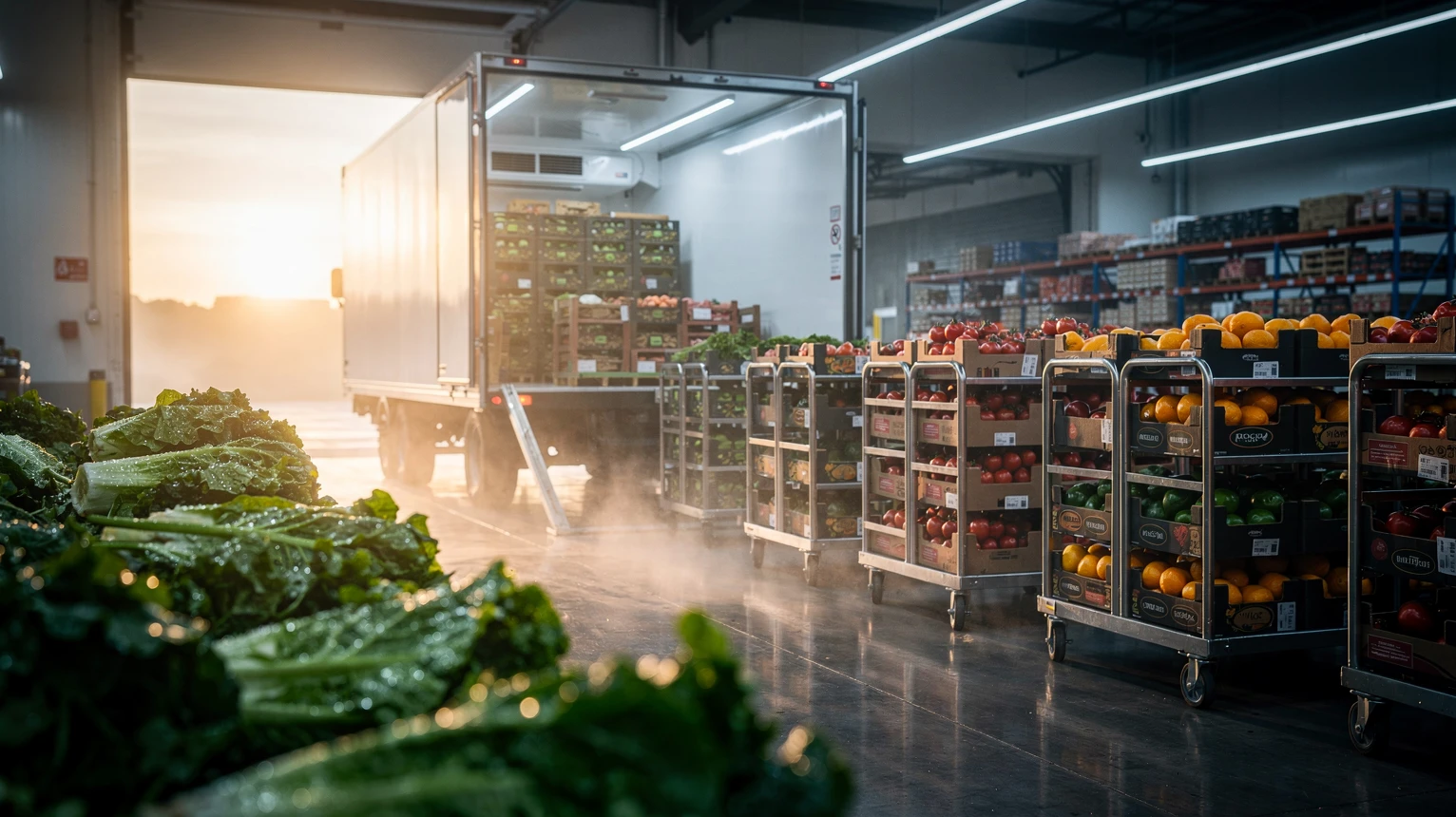
Fresh food is the part of a grocer’s catalog that customers actually use to judge the store. Produce, meat, dairy, bakery and prepared meals carry both the highest margins and the highest expectations on quality, freshness and consistency. That is why fresh food supply chains have become the strategic battleground for US supermarkets and the grocery arms of e-commerce platforms in 2026.
In short
- Fresh wins repeat visits. Customers may price-check center store online, but they decide loyalty in the produce, meat and bakery aisles.
- Cold chain is the bottleneck. Temperature breaks, dock dwell time and last-mile handoffs cause most fresh shrink, not pricing or assortment.
- Forecasting is the new merchandising. Daily, store-level demand models beat weekly category plans for perishable goods.
- Local sourcing is a real differentiator. Regional growers, smaller MOQs and faster lead times now compete head-to-head with national distributors.
- Vendor mix matters more than vendor count. A tight roster of growers, 3PLs and traceability partners outperforms a long list of interchangeable suppliers.
This guide walks through how grocers and digital-first retailers actually run fresh food supply chains in the United States, where they win and lose, and what a working playbook looks like. It sits inside the broader state of retail story we cover on ShopAppy, where fresh increasingly decides which formats grow and which formats shrink.
Why fresh supply chains decide grocery winners in 2026
Fresh categories make up roughly a third of US grocery sales but a much larger share of trips. According to the US Census Bureau monthly retail trade report, food and beverage stores remain one of the most resilient retail segments through 2025, even as discretionary categories slow. Within that pool, fresh is what pulls shoppers off the app and into the store, and what drags them back two or three times a week.
A few forces are reshaping the category in 2026:
- Persistent input cost pressure. Diesel, packaging, refrigerant and seasonal labor have not returned to 2019 levels. Margins on fresh remain thin and operationally sensitive.
- Same-day and next-hour delivery. Instacart, Walmart, Amazon Fresh, Kroger and regional players have normalized rapid delivery for fresh, which compresses the time window between pick, pack and consumption.
- Private label and meal kits. Store-brand prepared foods are growing faster than national brands in many fresh categories, which forces grocers to take more direct supply-chain responsibility.
- Regulatory traceability. The FDA’s Food Safety Modernization Act rule on traceability (Section 204) is shifting how grocers and suppliers record handoffs on a defined list of high-risk foods.
The grocers winning today are not the cheapest. They are the ones whose fresh assortment looks the same on a Tuesday morning, a Saturday evening and during a holiday peak. That consistency is a supply-chain output, not a merchandising one.
Key terms and definitions
Before going deeper, here is the working vocabulary used across procurement, logistics and store operations teams.
| Term | Plain definition | Why it matters in fresh |
|---|---|---|
| Cold chain | The unbroken sequence of refrigerated handling from grower to shelf. | A single temperature break can cut shelf life by days and trigger shrink at the store. |
| DC (distribution center) | Regional warehouse that consolidates inbound and routes outbound to stores. | Fresh DCs are multi-temperature and run on much tighter dwell times than ambient DCs. |
| Cross-dock | Inbound trucks unload directly into outbound trucks with little or no storage. | Reduces dwell time for produce and dairy, raising effective shelf life. |
| OTIF | On-time, in-full delivery rate from a supplier. | Low OTIF on perishables means out-of-stocks, not just late shipments. |
| Shrink | Loss of inventory from spoilage, damage, theft or markdowns. | In fresh, spoilage and markdowns dominate, not theft. |
| Trim | Edible product lost during in-store preparation (produce, meat, deli). | Tracked separately from shrink and often invisible to financial reporting. |
| Days on hand (DOH) | Average inventory expressed in days of forward demand. | Lower DOH on fresh means better freshness, but raises stockout risk. |
| Mock pick | Picking a customer order from store shelves to fulfill online demand. | Common in grocery delivery; quality of fresh picks drives app retention. |
These terms come up in almost every meeting where merchandising, operations and digital sit at the same table. Without them, conversations collapse into anecdotes.
How fresh food supply chains actually work in practice
A typical US grocer’s fresh supply chain has four moving parts: sourcing, inbound logistics, store handling and the customer-facing layer (shelf or pick). Each stage has its own clock, and the clocks rarely line up cleanly.
Sourcing and supplier mix
Most grocers run a hybrid model. National distributors (such as UNFI, KeHE or Sysco-owned banners) handle commodity volume. Regional growers and processors fill in seasonal, local and specialty assortments. Direct-store-delivery vendors (bread, soda, snacks, some dairy) bypass the DC entirely. The mix varies by chain, but the trend is toward more direct relationships in produce, protein and bakery, where freshness and provenance translate into shelf appeal.
Inbound logistics and the cold chain
Inbound fresh moves through temperature-controlled trailers, usually split into three zones: frozen, refrigerated and produce. Produce in particular needs ethylene-aware loading, since some commodities (apples, bananas, avocados) ripen others if combined incorrectly. Temperature loggers travel with the load, and most chains now reject loads that show out-of-range readings, not just visibly damaged product.
DC and store handoff
At the DC, cross-docking is common for high-velocity items: lettuce, berries, bagged salad, fluid milk. Slower-moving items see a short storage cycle. From the DC, store deliveries land overnight or pre-dawn so that produce, meat and bakery teams can stage the floor before opening. This is where freshness is either preserved or quietly destroyed by long dock dwell times and slow put-away.
Store handling and the digital layer
Inside the store, fresh teams cut, weigh, wrap, rotate and discount throughout the day. Markdown rules and dynamic pricing are increasingly automated, which raises sell-through and lowers spoilage. For online orders, pickers either pull from shelf (mock pick) or from a dedicated micro-fulfillment area. Fresh picks are the most quality-sensitive part of any e-grocery operation, since one bruised peach in a $200 basket is enough to lose a household.
The flow looks simple on a slide. In practice, every handoff is a place where temperature, time and judgment can drift.
Common mistakes and how to avoid them
Even mature grocers repeat the same set of operational mistakes in fresh. The pattern is consistent across formats, from regional supermarkets to digital-first players. Many of them surface in how industry analysts rank retail performance year over year, where freshness scores and basket consistency increasingly explain the gap between leaders and laggards.
- Treating fresh like center store. Weekly forecasts and case-pack thinking do not work for produce or bakery. Fresh needs daily, SKU and store-level forecasts with weather, promotion and event inputs.
- Optimizing transport at the cost of dwell time. Saving fuel by consolidating routes can extend dock dwell beyond the temperature tolerance of berries or leafy greens.
- Ignoring trim as a real KPI. Most chains track shrink but not trim. Without trim data, produce and deli teams cannot improve cutting yield or pricing.
- Letting OTIF slip on a few suppliers. A 95 percent OTIF average can hide a 70 percent OTIF supplier whose categories chronically stock out.
- Underinvesting in store-level training. A best-in-class cold chain still produces poor fresh if store associates do not rotate, cull and re-merchandise on schedule.
- Confusing local with regional. Sourcing from a regional broker is not the same as direct grower relationships, which is what customers actually respond to in signage and storytelling.
- Skipping traceability tooling. Manual lot tracking falls apart at the speed required by FSMA 204 and recall management. Digital traceability is now table stakes.
None of these mistakes are exotic. They are simply expensive to fix, which is why so many grocers carry them year after year.
Examples from US retail and e-commerce
Concrete examples make the playbook real. The grocers below illustrate different strategies for the same problem: making fresh feel consistently better than the competition, week after week.
Kroger and the data-first model
Kroger has built one of the most analytically driven grocery operations in the United States, with 84.51° (its in-house data subsidiary) feeding demand signals into both merchandising and the supply chain. Its fresh strategy leans on dense store-level forecasting and a tightly integrated set of regional DCs. For e-commerce, Kroger has invested in customer fulfillment centers run with Ocado robotics for ambient and chilled goods, while leaving most fresh picks at the store level for proximity and quality control.
Walmart and scale-led freshness
Walmart’s grocery business is the single largest in the country. Its fresh strategy uses scale to negotiate direct grower contracts, then layers on a private-trucking fleet that gives it more control over the cold chain than most peers. Walmart has also pushed earlier on traceability with growers, partly to comply with regulations and partly to defend its quality narrative as it grows online grocery share through Walmart+.
Wegmans and the assortment story
Wegmans is smaller than the national leaders but consistently rated among the top fresh grocers in the country. Its supply chain emphasizes a curated assortment, deep store-level prep (in-house bakeries, prepared meals, butcher counters) and longer-term supplier partnerships. The lesson is that fresh quality can win on assortment depth and execution, not only on price or scale.
Whole Foods inside Amazon
Whole Foods provides Amazon with a physical fresh network it could not build from scratch. The supply chain is still largely Whole Foods native, with regional DCs and grower programs, but increasingly serves both in-store shoppers and Amazon Fresh / Prime Now baskets. The integration is a useful case of how a digital giant treats fresh as a strategic asset rather than a feature.
Sprouts and the specialty grocer angle
Sprouts focuses on produce-forward, attribute-led assortments (organic, plant-based, regional). Its supply chain is smaller and more nimble than Kroger or Walmart, with a heavier dependence on specialty growers and a marketing story built around the produce department. For specialty and natural formats, this is the dominant playbook for fresh.
Digital-first players
Instacart, DoorDash, Uber Eats and Amazon Fresh do not own most of the fresh supply chain. They sit on top of grocer inventories. Their leverage is in the pick-and-pack experience: clear refund flows, photo-verified substitutions and tight time windows. For pure digital players, supply chain quality is mostly someone else’s problem until customer complaints make it theirs.
For a broader view of how supermarket strategy is changing across the United States, see our deeper read on how supermarket strategy is shifting in 2026, which sits next to this article in the Supermarkets and Grocers cluster.
Tools, partners and vendors worth knowing
The fresh supply chain ecosystem is broad. Below are the categories that matter most for any grocer, e-commerce platform or operator building a fresh program.
| Category | What it does | Representative names |
|---|---|---|
| Demand forecasting | SKU and store-level fresh demand models, often with weather and promotion inputs. | Relex Solutions, Blue Yonder, Symphony RetailAI, o9 Solutions |
| Traceability and food safety | Lot-level traceability, FSMA 204 compliance, recall management. | FoodLogiQ, Trustwell, Wholechain, IBM Food Trust |
| Cold chain visibility | Real-time temperature and location data across inbound shipments. | Tive, Roambee, Sensitech, Emerson |
| WMS and DC orchestration | Warehouse management tuned for multi-temperature, cross-dock operations. | Manhattan Associates, Körber, Blue Yonder WMS, Oracle WMS |
| Last-mile and delivery | Store-fulfilled or DC-fulfilled grocery delivery, including same-day windows. | Instacart, DoorDash, Uber Eats, Walmart GoLocal, regional 3PLs |
| Markdown and shrink reduction | Dynamic pricing for fresh based on remaining shelf life and demand. | Wasteless, Afresh, Shelf Engine, Invafresh |
| Direct sourcing and farm tech | Connecting grocers to growers, with traceable supply pools. | ProducePay, Silo, Farmstead, Square Roots |
A useful exercise for any operator is to map the current vendor stack against this list and identify gaps. Most chains will find at least one category where they are running on spreadsheets or legacy tools. For a more detailed breakdown of which platforms suit different store formats, our tools and vendors for supermarkets and grocers in 2026 guide covers selection criteria, integration patterns and pricing tiers.
What a working fresh supply chain playbook looks like
For a grocery operator or an e-commerce team building or rebuilding fresh, a usable playbook tends to include the following moves. None of them are theoretical; they show up in actual operating reviews.
- Set freshness KPIs at the customer level. Repeat purchase rate of fresh items, complaint rate per 1000 fresh units sold and basket NPS for orders containing fresh. Without these, internal KPIs (DOH, OTIF) optimize for the wrong thing.
- Build a store-day forecast. Daily SKU-store demand models, refreshed with weather and promotions. This is the single highest-impact investment for most chains.
- Tighten the cold chain measurement. Temperature loggers on every inbound load, dwell-time SLAs at every dock and a no-tolerance policy on out-of-range deliveries.
- Re-segment the supplier base. A short list of strategic growers and distributors, a medium list of seasonal partners and a tail of tactical suppliers. Manage each tier differently.
- Industrialize markdowns. Move from manager judgment to rule-based or model-driven markdown across produce, meat and bakery. Track lift, not only shrink reduction.
- Treat traceability as customer-facing. FSMA 204 compliance is the floor. The ceiling is using traceability data in signage, app product detail pages and recall response time.
- Wire digital and physical pricing. Fresh pricing on the app, in-store and in third-party marketplaces should align in near real time. Inconsistency erodes trust faster than slightly higher prices.
- Invest in store-team fresh skills. Produce, meat and bakery managers are the last mile of the supply chain. Their judgment determines whether a perfect cold chain looks fresh on the floor.
The playbook is not glamorous, and there are no silver bullets. The grocers who execute consistently across these eight moves tend to widen their freshness lead over time, even as competitors copy individual tactics.
How fresh fits into the wider US retail story
Fresh food is no longer a category that sits quietly inside a grocer’s P&L. It is one of the defining battlegrounds for US retail in 2026, alongside same-day delivery, marketplaces and store experiences. The grocers and digital platforms investing in fresh supply chains are also the ones reshaping consumer expectations of what a retailer should be. That is why fresh shows up so prominently in the broader state of retail conversation, and why both pure-play e-commerce companies and traditional supermarkets are quietly making fresh the center of their roadmaps.
For department-store and mass operators, fresh is increasingly used to drive trips that support discretionary baskets. For digital-first players, fresh is the wedge into household replenishment. For traditional supermarkets, fresh is the moat. None of these strategies work without an operationally serious supply chain underneath.
Format-by-format view of fresh supply chains
The same playbook does not apply equally to every kind of grocer. Format dictates assortment depth, supplier mix and how much of the cold chain a retailer actually controls.
| Format | Typical fresh assortment | Supply chain emphasis |
|---|---|---|
| National chain supermarket | Full produce, butcher, seafood, bakery, deli, prepared meals. | Owned DC network, balanced national and regional sourcing, in-house demand modeling. |
| Regional supermarket | Strong local assortment, mid-depth deli and bakery, growing prepared meals. | Smaller DC footprint, more regional grower contracts, often outsourced WMS. |
| Mass merchant with grocery | Edited produce, packaged meat, basic bakery, limited deli. | Leverages enterprise transport network, focuses on velocity and OTIF. |
| Warehouse club | Bulk produce and protein, limited assortment, high turn. | Few SKUs, very high velocity, minimal markdown infrastructure needed. |
| Hard discounter | Tight private-label assortment across all fresh departments. | Vertically integrated suppliers, simple SKU base, very low DOH. |
| Specialty natural grocer | Produce-led, attribute-rich, deep prepared and bakery. | Heavy use of specialty distributors and direct grower relationships. |
| Pure-play online grocer | Limited fresh assortment, frequently rotating. | Centralized fulfillment, third-party cold chain, strict pick SLAs. |
| Marketplace and delivery platform | Mirrors partner grocer assortment. | Owns last mile and substitution rules, does not own upstream cold chain. |
Reading this table the right way: a regional supermarket cannot copy Walmart’s scale playbook, and a digital-first marketplace cannot pretend it owns a cold chain it has actually outsourced. Format honesty is half of fresh strategy.
The next two years: where fresh supply chains are heading
Looking ahead from 2026 into 2027 and 2028, a few trends are likely to dominate fresh supply chain investment in US grocery and e-commerce.
- AI-driven forecasting becomes table stakes. Daily store-day SKU forecasts, refreshed with weather, promotion and event signals, will move from pilot to baseline. Vendors that cannot show measurable shrink reduction will lose deals.
- Traceability data leaves the warehouse. Information captured for FSMA 204 will start to appear on product detail pages, in-store signage and recall workflows, turning compliance into a brand asset.
- Micro-fulfillment for fresh expands cautiously. Automated fresh micro-fulfillment is still hard, but grocers will continue testing in dense urban markets where same-day fresh demand justifies the capital.
- Direct grower programs deepen. Expect more multi-year contracts, shared forecasting and joint investment in growing capacity, especially for produce and protein.
- Cold chain visibility becomes continuous. Single-load loggers will give way to always-on sensors at the trailer and dock level, with alerts wired into operations teams.
- Sustainability metrics merge with shrink metrics. Food waste reduction targets and shrink targets will increasingly be reported together, since most of the operational levers are shared.
None of these trends are speculative. Every one is already visible in the operating plans of the larger US grocers and in the roadmaps of the supply chain vendors that serve them. The pace of adoption will vary, but the direction will not.
FAQ
What counts as a fresh food supply chain?
It covers the sourcing, transport, storage, in-store handling and customer fulfillment of perishable categories such as produce, meat, seafood, dairy, bakery and prepared meals. The defining feature is short shelf life and tight temperature requirements, which separate it from ambient and frozen supply chains.
Why is fresh harder to manage than center store?
Center store items can sit on a pallet for weeks. Fresh items have shelf lives measured in days or hours. That changes forecasting cadence, replenishment frequency, transport temperature requirements, store handling and markdown strategy. Each step is more sensitive to delays, errors and variability.
Which KPIs matter most in fresh?
OTIF for suppliers, dwell time at docks, days on hand by SKU, shrink and trim by department, sell-through rate, markdown lift and customer-facing measures such as fresh complaint rate and repeat purchase rate. Most chains track too many metrics and act on too few.
How does e-commerce change the fresh supply chain?
It compresses the time between picking and consumption, raises the bar on visual quality, introduces substitution logic and shifts some shrink risk to the retailer (refunds, replacements). It also generates richer demand data that, used well, improves forecasting for both online and in-store.
Is local sourcing actually worth the complexity?
For specialty grocers and many regional chains, yes. Local sourcing supports the assortment story, shortens lead times for seasonal items and reduces dependence on long-haul transport. It does add operational complexity, so it works best as a deliberate segment of the supplier mix, not a replacement for national distribution.
How does FSMA 204 change things?
The FDA’s Food Traceability Rule under FSMA Section 204 requires lot-level traceability for a defined list of high-risk foods, with specific key data elements at each critical tracking event. Grocers and suppliers need digital traceability tooling to comply at scale, which also improves recall management and audit response.
What is the biggest source of fresh shrink in most stores?
Spoilage and markdowns, in that order, driven by overordering, weak markdown discipline and uneven store-level handling. Theft and damage are smaller contributors in fresh than in many other categories. Fixing forecasting and markdown rules usually delivers the biggest reduction.
How should a new grocer or e-commerce platform start?
Begin with a tight assortment, a small set of reliable suppliers, a strong cold chain measurement program and clear customer-facing freshness KPIs. Expand assortment and supplier count only after the basics are stable. Most fresh failures come from scaling too fast on a fragile operation, not from lack of ambition.