
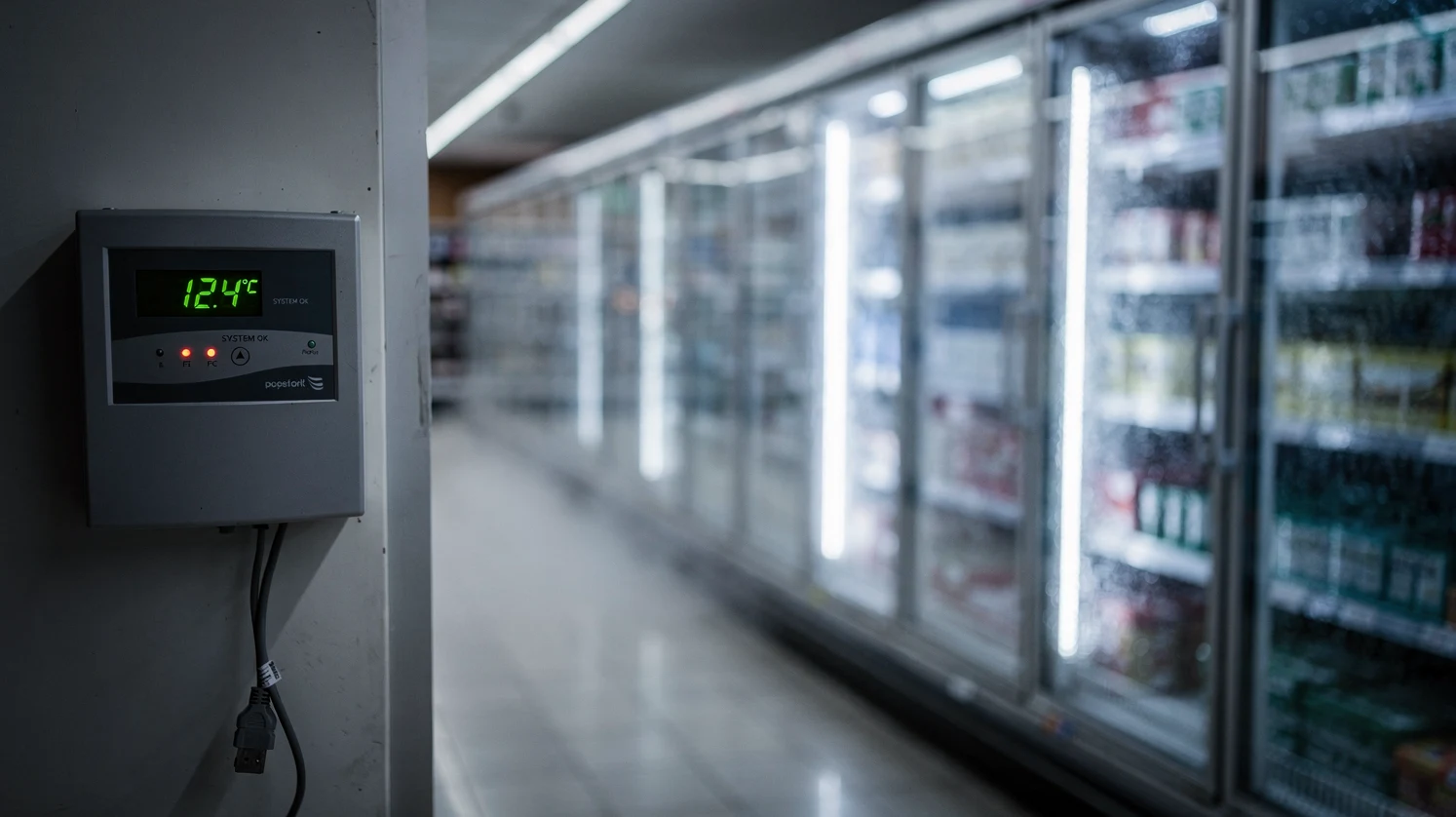
Tens of thousands of fridges and freezers in UK supermarkets, warehouses, restaurants, petrol stations and stadiums have been quietly secured against hackers in a nationwide operation that ran for most of November, the BBC revealed in the early hours of Friday 20 November 2026. The operation followed the discovery in late October of a security flaw in the refrigeration controllers most widely used in Britain, made by the British firm Resource Data Management (RDM).
The BBC said it held the story back until now to reduce the chance of hackers finding the weakness first. The Guardian, Retail Gazette, Cybernews and The Verge have since followed, and the security firm that validated the flaw, Pen Test Partners, has published its own account. This article sets out what was found, what supermarkets did about it, why smaller shops may still be exposed, and what it means for the chilled and frozen food in your basket in the weeks before Christmas.
In short
- The flaw: researchers at refrigeration consultancy Omega Solutions found a weakness in RDM refrigeration controllers, the most popular units in the UK, in late October. Pen Test Partners validated it and found further vulnerabilities.
- The response: the National Cyber Security Centre, Defra, the Food Standards Agency and the British Retail Consortium worked with retailers to take thousands of controllers off the open internet, in some cases by physically pulling cables.
- Scale: the BBC reports that thousands of devices controlling tens of thousands of fridges and freezers were taken offline; one worker at a large chain said hundreds of devices were disconnected every day for a week.
- Still at risk: Pen Test Partners says the issue is largely mitigated at big chains, but many thousands of controllers at small stores and smaller cold chain operators may still be exposed.
- For shoppers: no UK supermarket has reported spoiled food from this flaw, and RDM says it has no evidence it was exploited. Chilled food must be kept at 8°C or below in England, Wales and Northern Ireland, and unsafe food can be returned for a refund.
What happened to UK supermarket fridges?
According to the BBC, a behind the scenes cyber security operation has secured tens of thousands of fridges and freezers at major UK supermarkets and across the wider food and drink trade. The work began in late October, when security researchers discovered what the BBC described as a major flaw that, if found by hackers, could have led to even worse damage in Britain than the attacks seen on the continent.
Since then, researchers, retailer IT teams and the National Cyber Security Centre (NCSC) have been working round the clock to warn dozens of companies, the BBC reports. Thousands of devices that control tens of thousands of individual refrigeration units were taken off the open internet. Some were disconnected remotely; in other cases staff were ordered to remove internet cables by hand and check temperatures manually.
The broadcaster said most major supermarkets had to divert IT teams to the problem. A worker at one large chain, who asked not to be named, told the BBC that their team took hundreds of devices offline every day over the course of a week. “It did feel like a race against time as we were expecting another wave of these fridge hacks to come,” the person said.
The same worker described what was at stake for retailers: “Our warehouses have millions of pounds worth of food that could have been spoiled if any hackers found out about this method of attack.” No UK supermarket has said publicly that any stock was lost as a result of this particular weakness.
Pen Test Partners lists the organisations that took part in what it calls a mass effort to contact supermarkets and their supply chains: Omega Solutions, Pen Test Partners itself, the NCSC, RDM, the British Retail Consortium (BRC), the Department for Environment, Food and Rural Affairs (Defra) and the Food Standards Agency (FSA). The BBC says officials held industry conference calls and tasked teams to contact firms at risk.
A spokesperson for the NCSC told the Guardian that it “shared important insight and security advice to ensure that organisations understood potential risks to their networks, and were taking the appropriate measures to mitigate them”. The NCSC has not published a public advisory naming the affected product at the time of writing.
Why were UK stores exposed when the European attacks hit Danfoss?
The fridge attacks that have hit continental Europe this autumn targeted controllers made by the Danish manufacturer Danfoss. Pen Test Partners says that is why UK supermarkets were largely spared: Danfoss units are not particularly popular in the UK, and the most common controllers in the British market come from RDM instead. We covered the second European wave, and what it meant for UK shoppers at the time, in our report on hackers heating supermarket freezers in seven countries.
Those European attacks prompted Neil McCourt, an employee of Omega Solutions, a firm that specialises in fridge telemetry, to examine the security of RDM equipment while helping a UK retailer check its own exposure. He noticed a weakness and asked Pen Test Partners to help validate it. The firm’s hardware team, led by Andrew Tierney, confirmed the finding and, in Pen Test Partners’ words, “found a whole load more vulnerabilities in the device”.
Ken Munro, managing partner at Pen Test Partners, told the BBC that the RDM units “had a similar weak password problem to the Danfoss and other controllers that were attacked so successfully in previous hacks”. He added: “There is so much extra attention on these ubiquitous bits of kit now that it was likely a matter of days until criminals or nation state hackers figured it out.”
How the two weaknesses compare
Neither the researchers nor the authorities have published the technical method for the RDM flaw, and Pen Test Partners says it will not do so for now. The table below sets out only what has been made public.
| Point of comparison | Danfoss controllers (Europe) | RDM controllers (UK) |
|---|---|---|
| Where they are common | France and other continental markets | The most popular controllers in the UK market, per Pen Test Partners |
| Nature of the weakness (as reported) | Units exposed to the public internet, mostly on cellular modems, plus a back door account with a daily password seeded from the date | A related but not identical weakness; Ken Munro described a similar weak password problem |
| When it became known | Disclosed by Claroty in May 2025 (US CISA advisory ICSA-25-140-03); exploited as far back as 2022, per Pen Test Partners | Found by Omega Solutions in late October 2026; not publicly disclosed in technical detail |
| Exploited? | Yes: France in October and seven countries in early November 2026 | RDM says there is no evidence it was exploited |
| Fix | Patching and removing units from the internet | New RDM firmware plus taking controllers off the public internet |
| How hard to find | Relatively easy, per Pen Test Partners | Harder to find, which Pen Test Partners says “buys time, not protection” |
What does RDM say about the flaw?
RDM disputes how serious the weakness was. According to the BBC, the company argues that comparisons with the units attacked in mainland Europe are not fair, because exploiting its controllers would have required getting hold of a piece of RDM hardware first. The ethical hackers say that would have been achievable, as the hardware can be bought cheaply online on sites such as eBay.
Ged Evans, RDM’s chief executive, told the BBC: “This was a vulnerability identified in a test environment.” He said the testing “went beyond” what such exercises usually involve, because it “included dismantling our hardware”. He added: “In any event we have acted at pace to address this issue and have already deployed first patch releases and have been in proactive contact with our customers to flag any issues and recommend mitigatory steps.”
Retail Gazette reports that the company said there was no evidence hackers had exploited the vulnerability in its controllers. RDM did not respond to the Guardian’s request for comment.
A weak first advisory, then a fast fix
Pen Test Partners is critical of RDM’s first customer notice. It says an initial advisory, RDM-SA-2026-001, was issued on 2 November and revised on 3 November, but “was really quite weak”. According to the firm, it did not say what an attacker could do, did not offer independent validation that the new firmware fixed the problem, and gave no confirmation that users further down the supply chain had been told.
Once the researchers spoke directly to RDM’s chief executive and chief technology officer, the tone changed. Pen Test Partners says the company was “open and responsive”, worked around the clock on new firmware, and even tracked down controllers installed by third parties so it could send advisories to their operators. The BBC says RDM has been praised for its professional response, despite disputing the critical nature of the findings.
How did the secret operation actually work?
Pen Test Partners’ account gives the clearest picture of the sequence. Omega Solutions alerted the NCSC with a detailed vulnerability report. The security firm says the NCSC did not acknowledge receipt, but did issue an urgent alert to UK supermarkets through its existing channels. Omega then asked Pen Test Partners to get further involved.
By chance, Ken Munro was at a retail industry cyber event on the day the extra vulnerabilities were confirmed, the Guardian reports, so he was able to brief NCSC representatives in person that afternoon. That triggered a series of briefing calls between retailers and officials from the NCSC, Defra and the FSA, among others.
From supermarkets to cold stores
Pen Test Partners says it then rang every supermarket security contact it knew to check whether the alert had landed. Some chains found exposed systems and started fixing them at once; others already ran their RDM controllers on private networks or behind virtual private networks (VPNs), which significantly reduced the risk. The firm says retailer cyber teams worked evenings and weekends at very short notice.
The researchers also used Shodan, a search engine that indexes devices connected to the internet, to find exposed controllers. Some revealed location details that helped identify the operator, and the firm says it contacted many of the significant ones and had their controllers taken offline. After supermarkets, these were typically food manufacturers and large cold storage warehouses. The rest could not be identified without breaking into the controllers, which the firm says it was not prepared to do.
| Date | Step | Source |
|---|---|---|
| 11 to 12 October 2026 | Hundreds of supermarkets and food sites in France hit through Danfoss controllers | BBC |
| 14 October 2026 | Pen Test Partners publishes an analysis of the Danfoss issue | Pen Test Partners |
| Late October 2026 | Omega Solutions finds the RDM weakness; Pen Test Partners validates it and finds more | BBC, Pen Test Partners |
| 1 to 2 November 2026 | Second European wave hits dozens of supermarkets in seven countries | BBC |
| 2 and 3 November 2026 | RDM issues advisory RDM-SA-2026-001, then revises it | Pen Test Partners |
| November 2026 | NCSC alert, industry calls, controllers taken offline across supermarkets and the supply chain | BBC, Guardian |
| 20 November 2026 | Operation made public by the BBC; Pen Test Partners publishes its account | BBC, Pen Test Partners |
Which businesses could still be exposed?
The big chains appear to have closed the gap. The open question is everyone else. The BBC says the warnings went well beyond supermarkets, to convenience stores, petrol stations, restaurants and fast food chains, sports arenas, hotels, food processing plants and cold storage sites. Each RDM controller can remotely manage the temperature of dozens of fridges and freezers, so one exposed unit can put a whole shop’s chilled range at risk.
Ken Munro told the Guardian: “Some controllers were easy to identify and thus contact the owners, but many thousands at small stores are still exposed.” He added that the flaw is “not easy to find” but “once the method is known, it’s easy to recreate”, which is why the method has not been published. “There is still time for small operators to take their controllers off the public internet and/or apply the updated firmware,” he said.
Pen Test Partners’ own write up is more cautious about how far the alerts have travelled. “We have no idea how far down the supply chain those alerts have got to,” it says, noting that the NCSC and the BRC have been sharing intelligence but that the supply chain for chilled and frozen food “is complex and extensive”. That matters for independent grocers and convenience stores, which do not have the in-house security teams the big chains used to clear their estates. The pressure on small shops’ costs is already heavy, as the ACS Local Shop Report showing business rates bills doubling made clear earlier this autumn.
| Type of operator | Reported position on 20 November | Source |
|---|---|---|
| Major supermarket chains | Diverted IT teams; controllers taken offline or already on private networks | BBC, Pen Test Partners |
| Food manufacturers and large cold stores | Many significant operators found via Shodan and contacted directly | Pen Test Partners |
| Small stores and convenience shops | “Many thousands” of controllers still exposed, per Ken Munro | Guardian |
| Restaurants, hotels, stadiums, petrol stations | Warned to act; status not published | BBC |
| Smaller cold chain operators | “May still be exposed”; unidentifiable operators could not be contacted | Pen Test Partners |
Have any UK businesses already been hit by fridge hacks?
Yes, though not the major supermarkets and not, as far as has been reported, through the RDM flaw. During the early November wave, the NCSC confirmed it was working with affected UK firms. A few members of the Association of Independent Meat Suppliers saw their fridges heat up overnight, according to ITV News, though the units were empty at the time and no meat was lost. The association said its members used the same software as the European supermarkets that were attacked.
Retail Gazette reports that London fruit and vegetable wholesaler Langridge Organic said six of its 10 refrigeration units had been compromised. Pen Test Partners also notes that there have been “small incidents in small suppliers, but nothing widespread” in the UK.
The BBC counts three waves of attacks on refrigeration temperature controllers so far in 2026. In August, fridges at a small number of US military bases were affected. On 11 and 12 October, hundreds of supermarkets and food processing sites in France were hit through Danfoss systems. On 1 and 2 November, dozens of supermarkets across seven European countries were hit, with Belgium and Luxembourg worst affected, and a small number of blood bank sites in France were also caught up.
France has publicly blamed Iran’s Revolutionary Guards for the October wave, the Guardian has reported, a claim Tehran denies according to the BBC. No one has been formally identified as responsible for the November wave. In the United States, the FBI’s Cyber Division and the Cybersecurity and Infrastructure Security Agency (CISA) said in a joint release, as reported by Cybernews, that they were observing malicious activity targeting industrial refrigeration and cold chain monitoring systems around the world.
Is the food in UK supermarkets safe?
Nothing in the reporting suggests that food on UK supermarket shelves has been made unsafe by this flaw. RDM says it has seen no evidence of exploitation, and the operation was designed to close the gap before anyone could use it. In the European attacks, the visible effect was that stores pulled chilled and frozen products from sale once temperatures rose; some units reportedly reached 50°C, Retail Gazette says, which leaves food obviously unsellable rather than quietly unsafe.
The legal backstop for shoppers is clear. In England, Wales and Northern Ireland, food hygiene rules require food that needs chilling to be kept at 8°C or below, and the FSA recommends that fridges run at 5°C or below. In Scotland the law requires such food to be kept refrigerated, and Food Standards Scotland also advises 5°C or below. Frozen food is normally stored at around minus 18°C.
What to look for when you shop
- Check that chilled cabinets feel cold and that frozen goods are hard to the touch, with no soft or slushy packs.
- Be wary of heavy frost or ice crystals inside frozen packaging, which can be a sign of thawing and refreezing.
- Pick chilled and frozen items last, and get them home and into your own fridge or freezer quickly.
- If a whole section of fridges is closed off or empty, that is a sign the store is managing a problem, not hiding one.
What are your rights if chilled or frozen food is spoiled?
Under the Consumer Rights Act 2015, goods must be of satisfactory quality and fit for purpose. Food that has been stored at the wrong temperature and has spoiled, or is unsafe, does not meet that standard. You have a short term right to reject faulty goods within 30 days for a full refund, though with perishable food that window is effectively the shelf life of the product. Keep your receipt or banking record and take the item, or a photograph of it, back to the store.
Separately, the Food Safety Act 1990 makes it an offence to sell food that is not of the nature, substance or quality the buyer demands, and retailers must operate food safety management procedures based on hazard analysis (known as HACCP), which include temperature monitoring. If you think a shop is selling food that has been kept warm, you can report it to the food safety team at your local council.
| Situation | What you can do | Legal basis |
|---|---|---|
| Chilled food you bought is warm, sour or spoiled | Return it for a refund or replacement | Consumer Rights Act 2015, satisfactory quality |
| Food made you ill | Seek medical advice, keep packaging, report to your council | Food Safety Act 1990; council food safety teams |
| Online grocery order arrives warm | Reject the items at the door or contact the retailer for a refund | Consumer Rights Act 2015; goods at seller’s risk until delivered |
| Store has empty or taped off fridges | Ask staff; no action needed, the store is controlling the risk | Retailer’s HACCP obligations |
Why are UK retailers so sensitive to cyber threats right now?
British retailers have had a bruising period. The cyber attack on Marks and Spencer in 2025 stopped online orders for weeks and hit profits hard, and its recovery has been a theme of every set of results since, including the M&S half-year figures showing profit more than doubling to £403m. The Co-op suffered a serious attack in the same period, and online fashion retailers have dealt with their own breaches, including the cyber attack that dented ASOS’s UK trading.
Those incidents targeted IT systems: websites, payments, stock and customer data. The fridge attacks are different, because they reach into operational technology, the equipment that physically runs a shop. A hacked controller does not leak data; it can spoil stock, empty shelves and, in theory, put unsafe food in front of customers if nobody notices the temperature change. That is why the FSA and Defra, rather than only cyber specialists, were drawn into this operation.
The timing also matters. The fridge story lands a month after the government’s public resilience campaign prompted a run on supplies, a trend we covered when the Be Ready checklist sparked a wind-up radio sell-out. Official figures published on the same day as the BBC report showed that long-life food buying lifted retail sales in October. Shoppers are already alert to the idea that supply chains can be disrupted, and supermarkets will want to show that their chilled and frozen ranges are secure through the busiest weeks of the year.
What should independent shops and small grocers do now?
The advice from the researchers is short and practical. Pen Test Partners says anyone running RDM equipment, or any refrigeration controller, should first verify that it is not reachable from the public internet, and then apply the latest firmware from RDM. Cellular modems connected directly to the internet are a common problem; the firm recommends using a VPN or a private APN (a private mobile data network) instead.
- Ask your refrigeration engineer or maintenance contractor which controller brand runs your cabinets and cold rooms, and how it connects to the internet.
- Take it off the public internet if it is exposed. Remote monitoring can still work through a VPN or private network set up by your installer.
- Apply RDM’s latest firmware, or ask your installer to do so. RDM says it has already released first patches and contacted customers.
- Change default and shared passwords on any connected equipment, and remove access for former contractors.
- Keep manual temperature records as a backstop, as some supermarket staff were asked to do during the operation, and record what you do with any stock that goes out of range.
- Plan where stock would go if a cabinet fails, including a supplier or neighbouring business with spare cold storage.
The NCSC offers free guidance and tools for small organisations, including its Small Business Guide and the Cyber Essentials scheme, which covers basic controls such as secure configuration and patching. Food business owners can also check with their trade body: the BRC has been sharing intelligence with the NCSC, and the Association of Convenience Stores and the Federation of Independent Retailers are the natural routes for smaller shops.
Do not try to test your own controller for the flaw by searching for exploit guides online, and do not hire anyone offering to “check” your fridges without verifying who they are. The researchers deliberately have not published the method, and any guide claiming to show it should be treated with suspicion. Your installer and the manufacturer are the right first contacts.
What happens next?
Several things are worth watching. RDM has released first patch releases, and Pen Test Partners says it has reported additional vulnerabilities directly to the company, so further firmware updates are likely. The NCSC may publish a formal advisory now the operation is public, which would give smaller operators a single reference point. And the researchers have said they may eventually publish technical details once enough controllers are fixed.
There is also the question of who was behind the European waves and whether they will turn to UK targets. Pen Test Partners says it has had ongoing dialogue with the NCSC on “several related findings in other technologies”, which suggests refrigeration controllers are not the only connected equipment in food retail under scrutiny. For shoppers, the practical message is reassuring for now: the big chains acted, nothing on UK shelves has been reported spoiled by this flaw, and the law gives you a refund if chilled food is not right. For small shopkeepers, the message is more urgent: check your controller this week.
Frequently asked questions
Were UK supermarket fridges hacked?
No major UK supermarket has reported that its fridges were hacked through the RDM flaw. The BBC reports that a secret operation secured tens of thousands of fridges and freezers before the weakness could be used, and RDM says there is no evidence it was exploited. Some UK meat suppliers and a London wholesaler were affected by the separate European wave in early November.
What is RDM and why does it matter?
Resource Data Management (RDM) is a British firm whose refrigeration controllers are the most popular in the UK market, according to Pen Test Partners. Each controller can manage the temperature of dozens of fridges and freezers, so a weakness in one unit can affect an entire store’s chilled range.
Who found the fridge flaw?
Neil McCourt of refrigeration consultancy Omega Solutions found the weakness in late October 2026. Pen Test Partners, led on the hardware side by Andrew Tierney, validated it and found further vulnerabilities. The NCSC, Defra, the Food Standards Agency and the British Retail Consortium then helped alert retailers.
Is supermarket food safe to eat after the fridge hacks in Europe?
Nothing reported suggests food on UK shelves has been made unsafe by this flaw. Chilled food must be kept at 8°C or below in England, Wales and Northern Ireland, and stores that lose temperature control are expected to remove affected stock. If something you bought seems warm or spoiled, do not eat it and return it.
Can I get a refund if chilled food I bought has gone off?
Yes. Under the Consumer Rights Act 2015, food must be of satisfactory quality. Spoiled or unsafe food fails that test, and you can ask for a refund or replacement. Keep your receipt or a bank record and, if possible, the packaging.
Are small shops and convenience stores still at risk?
Possibly. Ken Munro of Pen Test Partners told the Guardian that “many thousands” of controllers at small stores are still exposed. The researchers say smaller operators should take controllers off the public internet and apply RDM’s latest firmware as soon as possible.
How do I know if my shop’s fridge controller is exposed?
Ask your refrigeration engineer or installer which controller you use and how it connects to the internet. If it is reachable from the public internet, for example through a cellular modem, they should move it onto a VPN or private network and install the latest firmware.
Who is behind the European fridge attacks?
France has publicly blamed Iran’s Revolutionary Guards for the October attacks on its supermarkets, the Guardian has reported, and Tehran denies involvement. No one has been formally named as responsible for the early November wave across seven countries.
Why was the operation kept secret?
The researchers and the BBC held back details so that criminals and hostile states would not learn about the weakness before it was fixed. Pen Test Partners still has not published the method, saying the difficulty of finding it “buys time, not protection”.