
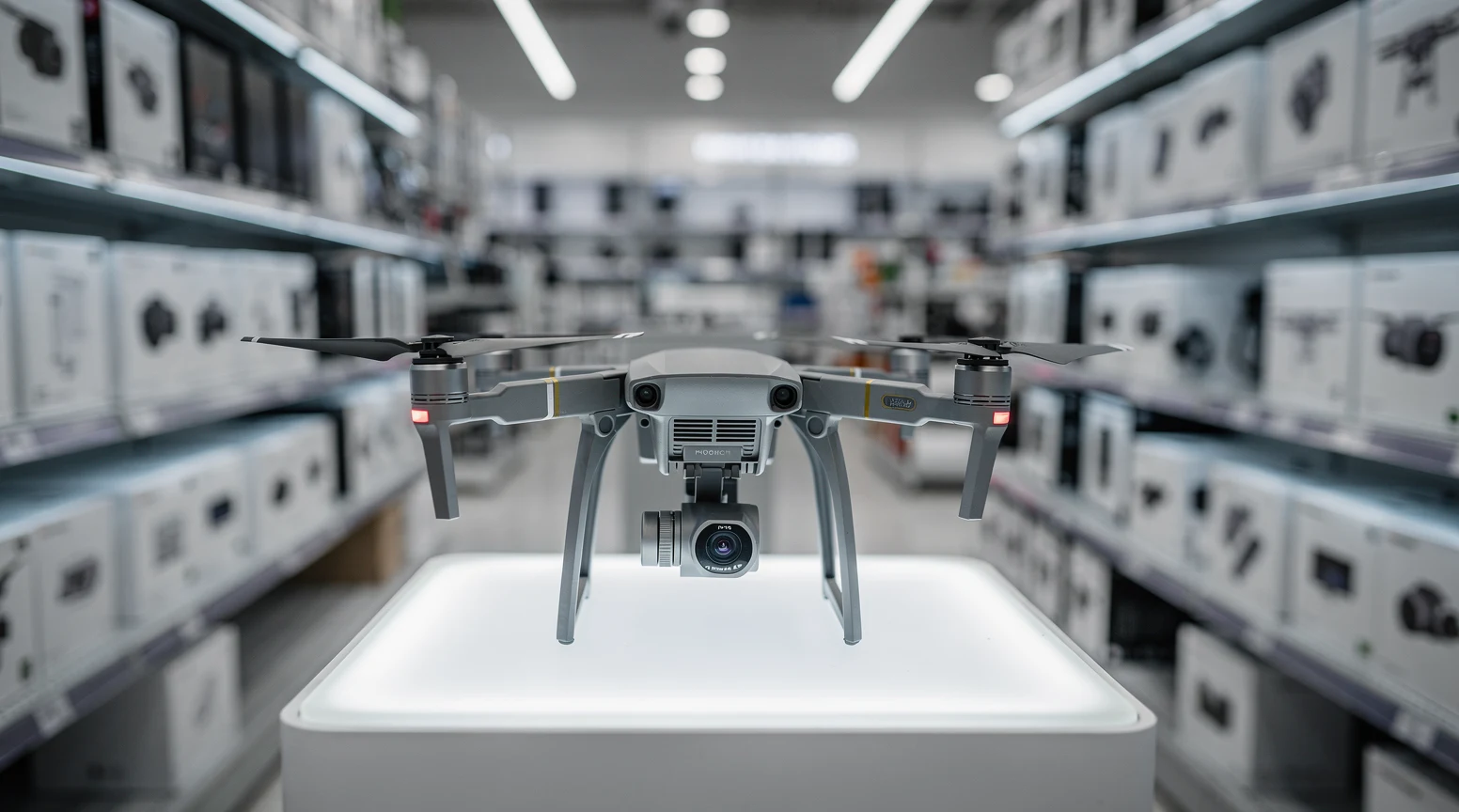
Imported drones become one of the most heavily tariffed consumer electronics categories in the United States on September 3, 2026. A proclamation signed on August 13 imposes Section 232 duties of 100 percent on heavier and thermal-imaging unmanned aircraft systems, and 25 percent on the smaller models that dominate consumer retail shelves.
The timing matters more than the rates. September 3 sits at the front edge of holiday inventory build, which means retailers are committing to fourth-quarter drone assortments while the landed cost of those assortments is still moving. A second wave of component duties follows on February 9, 2027.
In short
- Effective September 3, 2026: Section 232 duties of 100 percent on Annex I unmanned aircraft systems and 25 percent on Annex II models of 25 kilograms or less.
- Thermal imaging is the dividing line: any drone with thermal capability falls into the 100 percent tier regardless of weight, alongside docking stations and critical components.
- Components follow later: a further 25 percent on designated components in Annex III takes effect February 9, 2027, covering items such as motors, batteries and propellers.
- Allied caps exist but are conditional: rates are capped at 15 percent for the EU, Japan, South Korea, Taiwan, Switzerland and Liechtenstein, and 10 percent for the United Kingdom, subject to a strict content certification.
- Two escape routes: products on the Blue UAS or FCC conditional lists as of September 2 get a 180-day deferral, and an onshoring program offers duty-free imports for companies committing to US production before January 20, 2029.
What the proclamation actually does
The action rests on Section 232 of the Trade Expansion Act of 1962, the national security authority already used for steel, aluminum, copper and automobiles. According to the proclamation and the accompanying White House fact sheet, the Commerce Department found that United States reliance on foreign-produced drones and critical components creates supply chain, cybersecurity and national security vulnerabilities.
That framing is what gives the measure its shape. Section 232 actions are structured around reducing import dependence rather than raising revenue, which is why the proclamation pairs punitive rates with an onshoring incentive and a rolling expansion mechanism.
Three annexes carry the operative lists. Annex I holds the 100 percent tier, Annex II the 25 percent tier, and Annex III a delayed component tier that does not bite until February 2027.
Unlike the Section 338 action against Canada, which arrived with a 30-day fuse, this measure gives importers three weeks before the first tier lands and nearly six months before component duties follow. That gap is deliberate, and trade counsel have read it as an implicit invitation to relocate sourcing rather than simply absorb the cost.
The staging also reveals the policy sequence. Finished aircraft are hit first, components later, which pressures importers to move final assembly before it pressures them to move the component base. Whether that ordering is achievable in practice depends on how much of the value sits in the airframe versus the flight electronics.
Section 232 also carries a procedural history that matters for planning. It has proved more resilient to legal challenge than emergency-powers tariffs, and it comes with an established machinery of inclusions, exclusions and agency discretion that importers in steel and aluminum have spent years learning to navigate.
Which drones fall into which tier
The classification logic runs on two variables: maximum takeoff weight and thermal imaging capability. A drone above 25 kilograms goes into the 100 percent tier. A drone at or below 25 kilograms goes into the 25 percent tier, unless it carries thermal imaging, in which case it moves up to 100 percent regardless of weight.
Docking stations and the critical components named in Annex I also carry the full 100 percent rate. That detail matters for enterprise deployments, where the docking infrastructure can represent a meaningful share of system cost.
| Tier | Scope | Rate | Effective date |
|---|---|---|---|
| Annex I | UAS above 25kg maximum takeoff weight; any UAS with thermal imaging; docking stations; critical components | 100% | September 3, 2026 |
| Annex II | UAS at or below 25kg maximum takeoff weight, without thermal imaging | 25% | September 3, 2026 |
| Annex III | Designated additional components (reported to include motors, batteries and propellers) | 25% | February 9, 2027 |
For general merchandise and consumer electronics retailers, almost all shelf inventory sits in Annex II. Mainstream folding camera drones weigh well under two kilograms, which places them in the 25 percent tier as long as they lack thermal sensors.
The thermal trigger is the trap. Several prosumer models sold through specialty and online channels pair a standard camera with a thermal sensor, and those units jump four times the duty rate of an otherwise similar drone. Assortment reviews need to run at the SKU level rather than the product family level, which is the kind of classification work covered in our primer on classifying products to cut duty legally.
The weight threshold is less troublesome for retail but decisive for commercial buyers. Agricultural spray drones, heavy-lift platforms and survey aircraft routinely exceed 25 kilograms, which puts an entire professional category into the 100 percent tier without any thermal component involved.
Docking stations deserve separate attention because they are easy to overlook in a duty model. A drone-in-a-box deployment bundles aircraft, dock and software, and the dock is separately dutiable at the full rate. Buyers who model the tariff against the aircraft price alone will understate the cost of the system.
Product data quality becomes a compliance question in this context. Many retailers hold thermal capability as a marketing attribute rather than a structured field, and merchandising systems that cannot filter on it reliably will struggle to produce an accurate exposure list.
How the allied country caps work
The proclamation grants preferential treatment to a defined group of partners. Products of Japan, South Korea, Taiwan, Switzerland, Liechtenstein and European Union member states face a combined duty rate capped at 15 percent. Products of the United Kingdom are capped at 10 percent.
These caps are not automatic. Baker Botts noted that qualifying requires certification that substantially all critical components and technology are products of the United States or one or more of the specified partner countries.
That condition is demanding in a category where subassemblies, flight controllers, sensors and batteries frequently originate outside the partner group. A drone assembled in a capped country using components sourced elsewhere will not necessarily qualify.
The list of capped countries is also notable for who is absent from it. China does not appear, and neither do the other large low-cost manufacturing bases, which means the caps function as a redirection incentive rather than broad relief.
For buyers, the caps change the vendor conversation from price to provenance. A 15 percent ceiling against a 25 percent default is worth pursuing on volume lines, but only if the supplier can document component origin to the standard the certification requires.
Sourcing teams should expect that documentation to be slow. Component-level origin tracing is not a capability most consumer electronics vendors maintain on demand, and assembling it for a September deadline is unrealistic for anyone starting now.
The two exemption routes worth understanding
Blue UAS and FCC list deferral
Products from companies appearing on the Department of War Blue UAS Cleared List, the Blue UAS Framework, or the FCC Conditional Approval List as of September 2, 2026, receive a 180-day deferral. For those qualifying listed products and their covered components, the duties take effect 180 days after the proclamation rather than on September 3.
The snapshot date is what makes this urgent rather than strategic. Eligibility is determined by list status on September 2, so a company not already listed cannot join the deferral after the fact.
This route matters far more to enterprise, public safety and defense-adjacent channels than to consumer retail. The lists are oriented toward security-vetted platforms, and most mass-market consumer models do not appear on them.
The onshoring program
The Secretary of Commerce administers an incentive program for domestic facility development. Qualifying applicants must commit to constructing, refurbishing or expanding United States production facilities before January 20, 2029.
The benefit is substantial for those who qualify. Approved companies may import covered products and production equipment without paying the Section 232 duties while the United States facility is under construction, which converts the tariff from a cost into a financing mechanism for domestic capacity.
Drawback treatment is narrower. Manufacturing drawback is restricted to products containing a minimum 85 percent content from designated trade agreement partners, which excludes most current supply chains.
The January 2029 commitment deadline is generous relative to the tariff timeline, which suggests the program is aimed at genuine capacity building rather than at providing a quick administrative exit. Companies cannot use it to defer duties on a nominal plan.
For most general merchandise retailers, neither route is realistic. Retailers import finished goods rather than manufacture them, so the onshoring program is a supplier-side instrument, and the Blue UAS lists are oriented toward security-vetted platforms rather than mass-market inventory. The practical exposure for retail is the headline rate, not the exemptions.
What this does to retail pricing
The arithmetic is unusually direct in this category because drones are largely finished imported goods with limited domestic value added. A duty applied at customs value flows through to landed cost with little to absorb it, which is the mechanic we walk through in our guide to calculating landed cost for retail orders.
The critical point is that these duties stack rather than replace. Section 232 drone duties sit on top of tariffs already applied to Chinese-origin electronics, and trade press covering the category has reported cumulative rates well above the headline 25 percent for some Chinese-made models.
| Segment | Typical tier | Pass-through visibility | Near-term sourcing alternative |
|---|---|---|---|
| Consumer camera drones | 25% (Annex II) | High, sharp price points at shelf | Limited, category is concentrated |
| Prosumer thermal models | 100% (Annex I) | High, specialty channel | Very limited |
| Enterprise and industrial platforms | 100% (Annex I) | Medium, negotiated pricing | Blue UAS listed vendors |
| Docking stations and infrastructure | 100% (Annex I) | Low, bundled in system cost | Limited |
| Spare parts and accessories | 25% from Feb 2027 | Medium, attach-rate category | Time to plan exists |
Industry estimates commonly place a single Chinese manufacturer above 70 percent of the United States consumer drone market, though published figures vary widely and should be treated as approximate. Whatever the precise share, the concentration means the category has little pricing dispersion to hide behind.
Specialist drone retailers have reported enterprise platform prices rising substantially under existing duty stacks, with some industrial systems repricing by a multiple rather than a percentage. Those reports come from vendor and reseller commentary rather than audited disclosure, and should be read as directional.
Retail price effects rarely arrive on the effective date itself. Inventory imported before September 3 clears at the old rate, so the visible shelf increase typically trails the tariff by a full replenishment cycle, a lag we examine in our analysis of how tariff changes ripple through retail prices.
Margin structure determines who feels it first. Consumer electronics carries thinner gross margin than most retail categories, which leaves less cushion to absorb a duty before it reaches the shelf. Categories with 40 percent margins can defer a price move for a quarter; categories in the teens cannot.
Attach-rate economics complicate the picture further. Batteries, propellers and carry cases are high-margin accessories that currently subsidize thin hardware margins, and the February 2027 component duties land directly on that subsidy.
Who the measure is designed to benefit
Section 232 actions are structured to shift production rather than to raise revenue, so the intended beneficiaries are identifiable from the instrument’s design. Domestic manufacturers and vendors already on the Blue UAS lists gain the clearest advantage.
The 180-day deferral for listed products creates a six-month window in which listed vendors sell without the duty while unlisted competitors pay it. In a category where enterprise procurement cycles run in quarters, that window is long enough to convert accounts rather than merely to win a price comparison.
Allied manufacturers in the capped countries occupy the second tier of advantage. A European or Japanese producer that can satisfy the content certification competes at 15 percent against rivals paying 25 or 100 percent, which is a decisive gap in a price-sensitive category.
The losers are easier to identify than the winners. Importers of Chinese-origin consumer drones face the full stacked rate with no exemption route, and retailers whose drone assortment is concentrated in a single dominant supplier inherit that exposure without a substitution path.
Domestic assemblers occupy an ambiguous position. A United States manufacturer importing motors, batteries and flight controllers gains protection on finished goods from September but pays duties on its own inputs from February 2027, which compresses the benefit unless component sourcing shifts as well.
Why the September 3 date lands badly for holiday
Consumer electronics buyers finalize fourth-quarter assortments and pricing in late summer. A duty change on September 3 arrives after most holiday purchase orders are written but before much of the inventory has physically landed.
That sequencing creates a specific problem: promotional price points may already be committed to circulars, marketplace listings and co-op advertising plans built on pre-tariff cost assumptions. Renegotiating those commitments is harder than renegotiating the orders themselves.
Drones are also a gifting category with sharp psychological price points. A model built to hit $499 does not absorb a 25 percent duty without either crossing a threshold or losing specification, and neither outcome is neutral for sell-through.
The pull-forward incentive is therefore strong. Entries for consumption filed before September 3 pay current rates, which makes the next two and a half weeks the cheapest window to land holiday inventory.
Pull-forward carries its own risk, however. Buying ahead converts a tariff exposure into an inventory exposure, and a category facing a price increase into the holiday is also a category facing uncertain sell-through at the higher price.
Marketplace sellers face a sharper version of the same problem. Third-party sellers operating on thin margins with limited working capital cannot pre-buy at scale, which means the tariff will compress the independent seller base faster than it compresses large retailers.
Gift-guide placement is the quiet casualty. Editorial and retail gift guides lock in late summer, and a model that reprices in October may still be listed at a price it no longer holds, which drives cancellations and margin leakage through price-match commitments.
How this fits the wider 2026 tariff calendar
This is the third significant tariff action to hit retail supply chains inside a month. Section 301 duties across 60 economies took effect on July 24, Section 338 duties on a range of Canadian goods landed on August 19, and Section 232 drone duties follow on September 3.
Each runs on a different statute with different exemption logic, which is what makes compliance planning difficult. A sourcing team cannot apply one mitigation playbook across all three, since USMCA relief works against some measures and not others.
| Measure | Statute | Effective | Headline rate | Main relief route |
|---|---|---|---|---|
| Multi-country duties | Section 301 | July 24, 2026 | 10% to 12.5% | Origin shift |
| Canadian goods | Section 338 | August 19, 2026 | 50% | None via USMCA; entry timing only |
| Unmanned aircraft systems | Section 232 | September 3, 2026 | 25% and 100% | Allied caps, Blue UAS list, onshoring |
| UAS components | Section 232 | February 9, 2027 | 25% | Onshoring, limited drawback |
The drone measure is the most structurally generous of the four, which is easy to miss behind the 100 percent headline. It is also the only one of the group that offers a defined path to zero duty, through the onshoring program, rather than merely a lower rate.
Our coverage of the 50 percent tariffs on Canadian goods that took effect on August 19 sets out how that measure overrides preferential origin entirely, which is a different structure from the conditional country caps in the drone proclamation.
The parcel channel offers no relief either. Direct-to-consumer imports of drones from overseas sellers now clear under standard entry procedures following the court decision upholding the repeal of the $800 de minimis exemption, so the tariff applies whether a drone arrives in a container or a parcel.
What retailers and importers should do before September 3
The window for action is short and the highest-value steps are operational rather than strategic. Four workstreams matter.
Classify the assortment at SKU level
Every drone SKU needs a determination on two axes: maximum takeoff weight and thermal imaging capability. The second variable is the one most likely to be recorded inconsistently in product data, because thermal capability is often a variant-level attribute rather than a family-level one.
Accessories and spare parts need a separate pass against Annex III. Those duties do not land until February 2027, which means there is time to plan but also time to forget.
Confirm entry timing
Duties attach on entry for consumption, not on order date or arrival. Goods already in transit should have entry filings reviewed against the September 3 cutover, and bonded warehouse withdrawal schedules checked for the same reason.
Test whether allied caps are actually available
A supplier claiming production in a capped country is not sufficient. The certification requires that substantially all critical components and technology originate in the United States or the specified partner countries, so the question to put to vendors concerns component origin rather than assembly location.
Reprice deliberately, not reflexively
Pre-tariff inventory clears at old rates, so an immediate across-the-board increase is neither necessary nor defensible. Modeling the blended cost of existing stock against replenishment cost gives a more accurate picture than applying the duty rate to the current shelf price.
Pricing decisions should also distinguish between tiers. Applying a uniform increase across the drone category would overprice Annex II consumer models while underpricing thermal and heavy platforms, which distorts the assortment in both directions.
Contract review is the fourth workstream and the one most often deferred. Purchase orders written before August 13 are unlikely to allocate this cost explicitly, so change-in-law provisions and duty-paid terms determine whether the retailer or the vendor absorbs the increase on goods not yet landed.
What could still change
The Secretary of Commerce retains authority to incorporate additional UAS components into the tariff schedule if import volumes demonstrate a threat to national security, and such additions take effect immediately upon formal public notice. That is an unusual mechanism, since it removes the comment period that importers have come to expect from Section 232 inclusions processes.
The practical consequence is that component sourcing plans built around the current Annex III list carry residual risk. A component that is outside scope today can be inside scope on short notice.
Section 232 actions have historically proved more durable than emergency-authority tariffs, having survived legal challenge where other instruments have not. Importers hoping for judicial relief in the way that IEEPA measures have been contested should not assume the same path is available here.
The onshoring program is the variable most likely to reshape the category over a two-year horizon. If it draws meaningful commitments before the January 2029 deadline, the tariff will have functioned as intended; if it does not, the measure resolves into a straightforward cost increase carried by retailers and consumers.
Retaliation is a live but secondary consideration. Drones are a narrow category and an unlikely centerpiece for a counter-measure, though the affected exporting countries have broader trade relationships that could absorb a response elsewhere in the schedule.
The signal worth watching between now and September 3 is the Blue UAS list itself. Any additions before the September 2 snapshot date effectively hand a six-month duty holiday to the vendors added, and that is the single administrative decision with the most immediate commercial consequence for the category.
Frequently asked questions
When do the drone tariffs take effect?
September 3, 2026 for the 100 percent Annex I tier and the 25 percent Annex II tier. A further 25 percent on designated components in Annex III takes effect February 9, 2027.
What determines whether a drone faces 100 percent or 25 percent?
Maximum takeoff weight and thermal imaging capability. Drones above 25 kilograms face 100 percent, as does any drone with thermal imaging regardless of weight. Drones at or below 25 kilograms without thermal imaging face 25 percent.
Are consumer drones affected?
Yes. Most mainstream consumer camera drones weigh far less than 25 kilograms and fall into the 25 percent Annex II tier. Consumer models that include a thermal sensor move into the 100 percent tier.
Which countries get reduced rates?
Products of the European Union, Japan, South Korea, Taiwan, Switzerland and Liechtenstein are capped at 15 percent, and products of the United Kingdom at 10 percent. Qualifying requires certification that substantially all critical components and technology originate in the United States or the specified partner countries.
What is the Blue UAS deferral?
Products from companies on the Department of War Blue UAS Cleared List, the Blue UAS Framework, or the FCC Conditional Approval List as of September 2, 2026 have their duties deferred to 180 days after the proclamation rather than September 3. Eligibility is fixed by list status on that date.
Can importers avoid the duties by building in the United States?
Partly. Commerce administers an onshoring program under which companies committing to construct, refurbish or expand United States production facilities before January 20, 2029 may import covered products and production equipment without paying the Section 232 duties while the facility is under construction.
Do these duties stack with existing tariffs?
Yes. The Section 232 duties apply in addition to tariffs already in force on the relevant origin, which is why cumulative rates on some Chinese-made models are reported well above the headline figures.
Does buying direct from an overseas seller avoid the tariff?
No. Following the repeal of the $800 de minimis exemption, low-value parcel imports clear under standard entry procedures and pay the same duties as containerized freight.
Could the scope expand further?
Yes. The Secretary of Commerce may add UAS components to the tariff schedule if import volumes are found to threaten national security, and those additions take effect immediately upon formal public notice rather than after a comment period.