
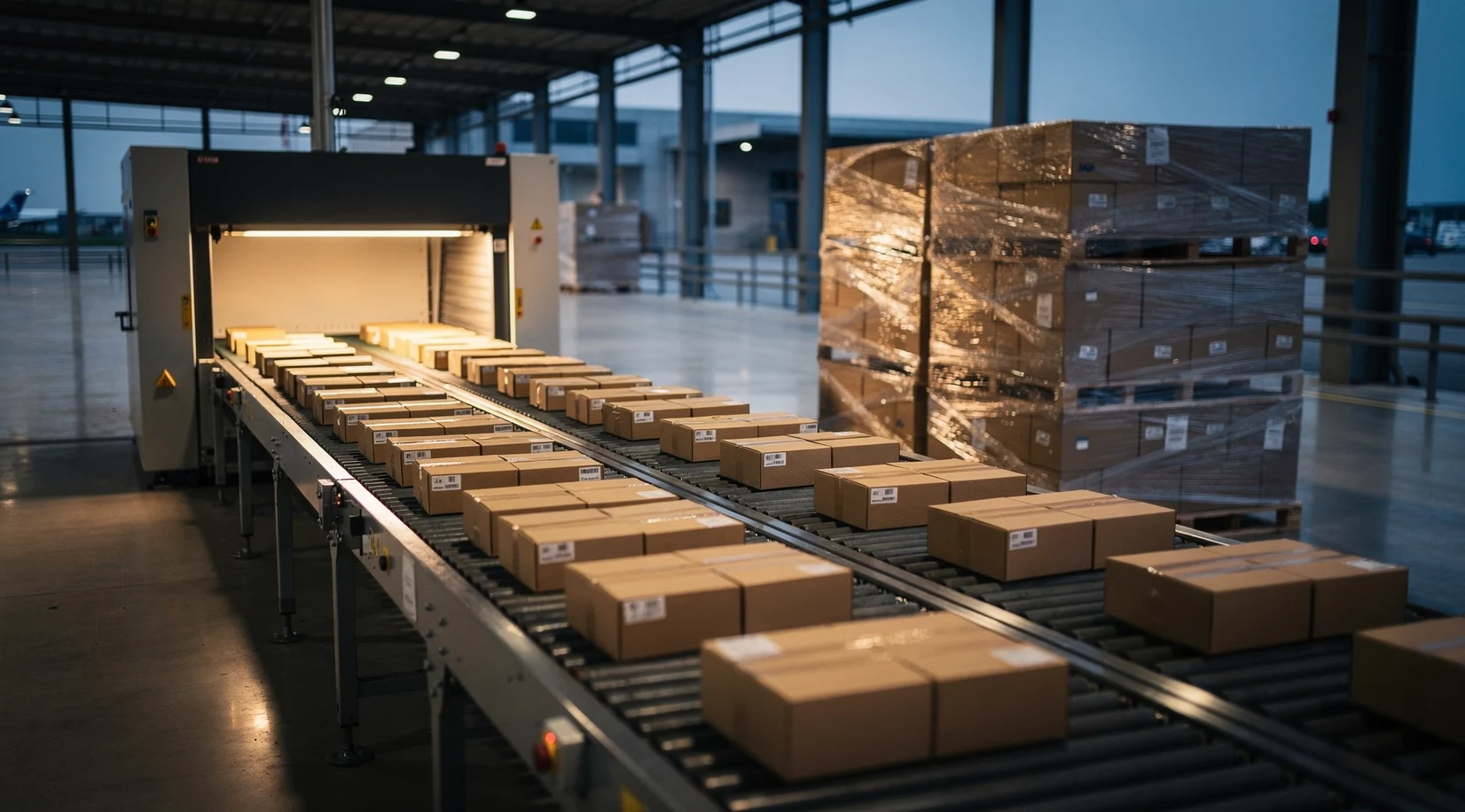
The number of low-value parcels entering the European Union has fallen by roughly half since the bloc began charging a flat EUR 3 (about USD 3.50 at current rates) customs duty on every consignment worth less than EUR 150 on July 1, 2026. Belgian customs recorded 53% fewer small-parcel declarations in July than a year earlier, and Dutch customs reported a 46% drop in e-commerce declarations across July and August, according to figures published by both agencies and compiled by Euronews on September 14. The decline is real, but the parcels have not vanished: the same customs offices report that the goods are increasingly arriving in bulk, clearing customs as ordinary freight, and being shipped to consumers from warehouses inside the EU.
That distinction matters for anyone trying to read the headline. The EUR 3 duty was pitched as a lever against the flood of direct-from-China shipments from Temu, Shein and AliExpress. Two and a half months in, the data suggest it is working as a routing tax rather than a demand tax: the cheap-parcel lane is shrinking fast, member states are collecting hundreds of millions of euros, and the platforms are doing exactly what they signaled they would do, which is move stock closer to the customer.
In short
- Belgium: 52.96 million low-value (H7) declarations in July 2026 versus 113.71 million in July 2025, a 53% fall, per Belgian finance ministry figures released through the business federation UNIZO.
- Netherlands: e-commerce declarations down 46% in July and August against the first-half 2026 average; monthly counts fell from 21.99 million in June to 12.54 million in July and 7.65 million in the first 25 days of August, per Douane Nederland.
- Revenue: Belgium collected EUR 223.7 million (about USD 259 million) between June 29 and August 16; the Netherlands booked roughly EUR 35 million (about USD 41 million) in July alone.
- The goods moved, not the demand: Belgian declarations for consignments above EUR 150 rose 102%, Dutch regular declarations rose 20%, and both agencies say non-EU webshops are shifting to bulk import and EU warehousing.
- What comes next: an EU-wide handling fee on all e-commerce parcels is due by November 1, 2026, the EUR 150 duty exemption is being abolished under the recast customs code, and a European Customs Authority in Lille is expected to be operational by 2028.
What did Belgian and Dutch customs actually report?
The two countries matter because they are the EU’s front door for Chinese e-commerce. Belgium’s Liège airport is a major hub for parcels from China, and the Netherlands handles a large share of postal and express traffic into the bloc. Euronews reports that the two nations together process roughly half of the EU’s low-value parcel imports, which is why their customs figures are being read as a proxy for the whole union.
Belgium’s numbers come from the federal finance ministry, FOD Financiën, and were released through UNIZO, the Flemish federation for small and medium-sized businesses, in early September. Customs registered 52.96 million H7 declarations, the simplified filing used for consignments under EUR 150, in July 2026. In July 2025 the count was 113.71 million. That is a 53% decline in a single month, measured year on year. Over the same period, the average declared value of a low-value consignment rose from EUR 5.73 to EUR 10.85 (about USD 6.65 to USD 12.60), which is consistent with shippers consolidating multiple cheap items into fewer, higher-value packages.
The Dutch figures are more granular. In a statement dated September 1, Douane Nederland said e-commerce declarations in July and August were 46% below the monthly average for January through June. The raw monthly counts show the slope: 21,995,636 e-commerce declarations in June, 12,541,096 in July, and 7,651,673 through August 25. Declaration lines, which count individual product entries within those filings, fell 70%. In the same window, regular customs declarations rose 20% and regular declaration lines rose 30%.
The quote that frames the whole story
Nannette van Schelven, director-general of Dutch Customs, said the figures “give an initial indication that fewer individual packages go direct to the consumer, making it easier for us to control product safety,” according to Dutch public broadcaster NOS. Her agency’s statement added that “more and more companies appear to be opting for bulk import and storage within the EU to resell their goods to consumers from there,” and that it would investigate the change in working methods further. Douane Nederland said it had observed the same pattern in France and Belgium.
Dirk Gotink, the Dutch member of the European Parliament who leads the customs reform file for the assembly, told Euronews that “the temporary EUR 3 import duty that has been in force since July 1 has already significantly reduced the flow of parcels, but we are not there yet.” Gotink pointed to the broader reform package, which includes a central data hub, a European Customs Authority in Lille, and more risk-based checks, as the next stage.
How does the EUR 3 duty work, and why does it bite harder than it looks?
Before July 1, goods worth less than EUR 150 entered the EU free of customs duty under the de minimis exemption, although import VAT had applied since the 2021 e-commerce VAT package. The Council of the EU agreed in spring 2026 to impose a temporary flat duty of EUR 3 per item on such consignments from July 1, 2026, pending the full abolition of the exemption under the recast Union Customs Code. The Belgian finance ministry describes the interim measure as running from July 1, 2026 to July 1, 2028, when the permanent framework is expected to take over.
The key design choice is that the duty is charged per item type, keyed to tariff classification, rather than per parcel. A single box containing a phone case, a T-shirt and a kitchen gadget can attract the duty three times. Daily News Hungary, citing PwC Hungary consultant Szabolcs Timár, notes that this is why shoppers have begun looking at the final checkout price rather than the advertised price of each item. For a typical Temu basket where individual items average a few euros, a EUR 3 charge per tariff line can add 30% to 100% to the landed cost.
Why a small flat fee reshapes the economics
The economics of direct-from-China e-commerce rest on very low average order values. The Belgian data show the pre-duty average declared value at EUR 5.73. A flat EUR 3 duty on a EUR 5.73 consignment is an effective rate above 50%, far higher than the ad valorem tariffs most goods would face if declared as ordinary imports. That asymmetry is the point: the fee is small in absolute terms but punitive relative to the cheapest parcels, and neutral to irrelevant for higher-value consignments.
The rational response for a platform is to stop shipping EUR 5 parcels one at a time and instead ship pallets. A container of goods clears customs as a single commercial import, pays the regular tariff rate on the declared wholesale value, and is then split into consumer orders inside the EU with no further customs event. That is precisely what the Belgian H1 filings (up 102%) and Dutch regular declarations (up 20%) are recording.
Where did the parcels go?
Both customs agencies are careful to say that the drop in declarations does not mean Europeans are buying less from Chinese platforms. Belgian regional outlet Noordernieuws, summarizing the finance ministry data, wrote that goods “are more often imported in larger quantities collectively, stored in a warehouse within the European Union and only then sent to individual customers,” and noted that Temu and AliExpress already had European warehouse arrangements in place before the duty took effect.
This is the “local pivot” that shopappy has tracked since the spring. In June, before the duty took effect, this site argued that the EU de minimis fee was unlikely to slow Temu and Shein in 2026 because adaptation would come through local fulfillment rather than retreat. The customs data now confirm the mechanism, even if the scale of the parcel-count collapse is larger than most forecasts assumed.
Three routing patterns customs is now seeing
The statements from Douane Nederland and FOD Financiën, read together, describe three distinct adaptations. First, consolidation: multiple consumer orders bundled into one consignment that still clears under H7 but at a higher declared value, which explains the jump in average value from EUR 5.73 to EUR 10.85. Second, bulk pre-positioning: platforms import inventory as commercial freight into bonded or fulfilled warehouses in the Netherlands, Belgium, Poland or Germany and ship domestically. Third, semi-managed models: Chinese sellers list on the platforms but hold stock in third-party EU fulfillment centers, which is the model Temu has been expanding under its “local-to-local” program.
The second and third patterns are why Amazon’s European logistics footprint is also part of this story. As this site reported last week, Amazon is expanding mandatory Pan-EU FBA storage requirements for third-party sellers, which has the effect of pulling more Chinese seller inventory into EU warehouses ahead of customs clearance. The EUR 3 duty and the Amazon program push in the same direction: goods clear customs in bulk, and the cross-border event moves from the consumer’s doorstep to the warehouse gate.
How much money have member states collected?
The revenue figures are large enough to matter for national budgets. Belgium’s finance minister, Jan Jambon, announced that the country collected EUR 223.7 million in the first seven weeks after implementation, covering June 29 to August 16, according to newsmonkey.be and Business AM. That works out to almost EUR 32 million per week on average. KMO Partners, a Belgian advisory firm summarizing the UNIZO release, projected roughly EUR 831 million for the June-to-December period, of which about EUR 208 million (about USD 241 million) would flow to the Belgian treasury after the EU’s share is deducted.
Jambon said the government plans to allocate the 2026–2029 proceeds to “improving border security by hiring more customs personnel and acquiring advanced screening technology,” per newsmonkey.be. The Netherlands reported approximately EUR 35 million (about USD 41 million) in July revenue for the Dutch state, per Douane Nederland.
Why the revenue and the volume drop can both be true
A 53% drop in Belgian declarations still leaves 52.96 million H7 filings in July. At EUR 3 per tariff line, and with some consignments carrying more than one line, the arithmetic reconciles with roughly EUR 150 million to EUR 160 million of Belgian collections in July alone. The revenue is a function of the residual flow, not the flow that disappeared. If the bulk-import shift continues, H7 revenue will decline over time even as the same goods pay regular tariffs on a wholesale value at the container stage.
| Metric | Belgium | Netherlands |
|---|---|---|
| Low-value declarations, latest month | 52.96 million (July 2026) | 12.54 million (July 2026); 7.65 million (Aug 1–25) |
| Comparison base | 113.71 million (July 2025) | Monthly average January to June 2026 (June: 21.99 million) |
| Decline | 53% year on year | 46% vs H1 average; declaration lines down 70% |
| Offsetting rise | H1 (above EUR 150) declarations up 102% | Regular declarations up 20%, lines up 30% |
| Average declared value | EUR 5.73 to EUR 10.85 | Not disclosed |
| Revenue collected | EUR 223.7 million (June 29 to Aug 16) | About EUR 35 million (July) |
| Data source | FOD Financiën via UNIZO; Finance Minister Jan Jambon | Douane Nederland statement, Sept 1 |
Who is winning and who is losing?
The platforms most exposed are the three that built their European businesses on the direct-parcel model. Temu, the marketplace owned by PDD Holdings, told investors in August that the EU parcel duty would weigh on its international business in the second half, and its parent reported a 12% fall in net income for the second quarter. Shein, which listed in Hong Kong on September 1 at a valuation roughly 73% below its 2022 peak, cited de minimis changes in the US and EU among the drivers of that compressed IPO valuation. AliExpress, part of Alibaba, has the longest-standing European warehouse network of the three and may be the best positioned to absorb the shift.
Business AM reported in late August that Temu and AliExpress had seen the largest revenue declines in Belgium under the new regime, with imports from China down 30% to 40% at that point. That figure preceded the fuller July data, which showed a steeper fall in declarations, though not necessarily in sales.
The Hungarian case: parcels down, intra-EU orders up
Hungary offers the clearest evidence so far that demand is shifting rather than disappearing. Daily News Hungary, citing PwC Hungary, reports that Temu processed more than 13 million orders in Hungary in 2025 worth about HUF 195 billion (about USD 620 million at current rates), in a total Hungarian online goods market of roughly HUF 2.1 trillion (about USD 6.7 billion). In the first quarter of 2026, Temu’s Hungarian orders reached about 5 million, up 92% year on year, reaching 1.8 million consumers.
Between the first and second quarters of 2026, the number of parcels arriving in Hungary from outside the EU fell by around 750,000, while orders from within the bloc rose by more than 1.25 million. PwC’s Timár identified Poland’s Allegro as the strongest regional beneficiary, with Romania’s eMAG and Czech-based Alza also well positioned to capture spending that migrates from Chinese platforms. “So when we ask whether it was necessary to restrict Chinese platforms and level the playing field, the answer is definitely yes,” Timár said, per Daily News Hungary.
| Player | Pre-duty European model | Observed or stated response | Exposure to the EUR 3 duty |
|---|---|---|---|
| Temu (PDD Holdings) | Direct-from-China parcels, average item value in low single-digit euros | Expanding local-to-local warehousing; flagged EU duty as an H2 headwind in Q2 results | High; largest single source of low-value parcels |
| Shein | Direct-from-China apparel parcels, some EU distribution | Cited de minimis changes in IPO risk factors; shares at post-IPO low on Sept 14 | High; low average item value, apparel focus |
| AliExpress (Alibaba) | Mix of direct parcels and Cainiao EU warehouse fulfillment | Pre-existing EU warehouse deals per Belgian reporting | Medium; longer warehouse history |
| Allegro (Poland) | Domestic and intra-EU marketplace | Named by PwC Hungary as strongest regional beneficiary | Beneficiary |
| Alza (Czech Rep.), eMAG (Romania) | Intra-EU e-commerce retailers | Positioned to absorb migrating CEE demand | Beneficiary |
| Amazon EU marketplaces | Third-party Chinese sellers with FBA stock in EU | Mandatory Pan-EU FBA store expansion pulls inventory inside the bloc | Low; goods already clear in bulk |
What is the safety argument behind the duty?
EU officials have consistently framed the parcel measures as a product-safety tool as much as a revenue or competition instrument. Van Schelven’s statement stresses that fewer loose packages going directly to consumers makes safety control easier, because customs can inspect containerized freight far more efficiently than millions of individual envelopes.
Euronews cites a 2025 peer-reviewed laboratory study published in Contact Dermatitis that analyzed 111 clothing items sold across Italy and the EU and found that 63% contained carcinogenic, endocrine-disrupting or sensitizing chemicals. The Commission’s own 2024 figures, referenced in the same report, put the pre-duty inflow at about 4.6 billion low-value consignments a year, or roughly 12 million parcels per day, up from 2.3 billion in 2023 and 1.4 billion in 2022. The Commission has previously said that about 91% of those shipments originated in China.
Why bulk import changes the enforcement picture
From a regulator’s perspective, the shift to bulk import is a feature rather than a bug. A pallet declared as a commercial import carries a named EU importer, a commercial invoice and a tariff classification that can be risk-scored against safety databases. A EUR 5 parcel addressed to a consumer carries none of that in practice. Whether the same goods are safer once they sit in a Dutch warehouse is a separate question, but the paper trail is undeniably better, and market surveillance authorities gain a physical location to inspect.
What happens next: the November handling fee and the 2028 customs authority
The EUR 3 duty is explicitly temporary. Three further steps are already scheduled. First, an EU-wide handling fee on e-commerce imports from outside the bloc is expected to apply from November 1, 2026. Unlike the EUR 3 duty, it will apply to consignments both above and below EUR 150, and the amount has not yet been set. Douane Nederland’s September 1 statement flagged the fee but gave no figure, and Noordernieuws reports that the Commission is still determining the level. This site’s earlier analysis of how the handling fee would push Temu and Shein local before November 1 now looks conservative: the pivot is already visible in July data, four months ahead of the fee.
Second, the recast Union Customs Code, which the Council of the EU gave final approval on September 3, makes non-EU platforms the deemed importer of the goods they sell into the bloc and abolishes the EUR 150 duty exemption altogether. As shopappy reported when the Council adopted the customs overhaul, the reform also creates an EU Customs Data Hub and a Trust and Check trader category, with penalties for non-compliant platforms reportedly running up to 6% of the annual value of imported goods. The European Parliament is expected to approve the final text this month, with full application 12 months after publication in the Official Journal.
Third, the European Customs Authority, to be based in Lille, France, is expected to be operational by 2028, according to Euronews. Belgian reporting notes that normal ad valorem tariffs on low-value goods will apply once the new data hub is running, which is when the EUR 3 flat charge is due to lapse.
| Date | Measure | Status |
|---|---|---|
| July 1, 2026 | EUR 3 per-item flat duty on consignments under EUR 150 | In force; temporary to July 1, 2028 per Belgian finance ministry |
| September 3, 2026 | Council final approval of recast Union Customs Code (deemed importer, end of EUR 150 exemption) | Adopted; Parliament vote expected September |
| November 1, 2026 | EU-wide handling fee on e-commerce parcels above and below EUR 150 | Scheduled; amount not yet published |
| Late 2027 (indicative) | Full application of recast customs code, 12 months after Official Journal publication | Dependent on publication date |
| 2028 | European Customs Authority (Lille) and Data Hub operational; normal tariffs replace flat duty | Planned |
What does this mean for US retailers and cross-border sellers?
American readers will recognize the pattern. The US ended its own USD 800 de minimis exemption in 2025 under emergency tariff authority, and the Court of International Trade upheld that rescission in August. The response in the US was the same as the one now visible in Belgium and the Netherlands: Temu and Shein shifted toward US-warehoused inventory and semi-managed seller models, direct parcel volumes fell, and domestic fulfillment capacity absorbed the flow. The EU is running the same experiment with a smaller price signal and a longer legislative runway.
For US brands selling into Europe, the practical implication is that the cheap direct-parcel lane is closing from both ends. A US direct-to-consumer brand shipping EUR 40 orders into the Netherlands now pays the EUR 3 duty per tariff line today and will owe the handling fee from November. The more consequential change is the deemed importer rule under the recast code, which will make marketplaces rather than consumers responsible for duty and VAT at checkout. Sellers who rely on Amazon, Zalando or bol for European distribution should expect those platforms to pass through the compliance cost, either as fees or as tighter inventory placement requirements.
The landed-cost math for a typical order
Consider a EUR 60 order with three product types shipped from outside the EU. Before July 1, the consignment paid import VAT (around 21% in the Netherlands, roughly EUR 12.60) and no customs duty. Since July 1, it pays the same VAT plus EUR 9 in flat duty (three tariff lines at EUR 3 each), lifting the tax and duty burden from about 21% to about 36% of the goods value. From November 1 it will also pay the handling fee. If the same three items are pre-positioned in an EU warehouse, they pay a regular tariff on the wholesale value at the container stage, typically a much smaller absolute sum, and no per-parcel customs charges thereafter.
| Scenario (EUR 60 order, 3 tariff lines, NL delivery) | Customs duty | Import VAT (21%) | Handling fee | Total on top of goods |
|---|---|---|---|---|
| Before July 1, 2026 (de minimis) | EUR 0 | EUR 12.60 | None | EUR 12.60 (21%) |
| July 1 to October 31, 2026 | EUR 9 | EUR 12.60 | None | EUR 21.60 (36%) |
| From November 1, 2026 | EUR 9 | EUR 12.60 | Amount not yet set | Above EUR 21.60 |
| Bulk-imported, shipped from EU warehouse | Ad valorem tariff on wholesale value, paid once per container | Domestic VAT at sale | None per parcel | Typically lowest per order |
Illustrative calculation based on the published duty structure and the standard Dutch VAT rate; actual amounts depend on tariff classification and the handling fee level once set.
What the data does not yet tell us
Several caveats apply before treating “halved” as a settled verdict. The Belgian and Dutch figures count customs declarations, not consumer orders, and consolidation alone can cut declaration counts sharply without any change in the number of items sold. The Belgian comparison is year on year for a single month, while the Dutch comparison is against a first-half 2026 average, so the two 46% and 53% figures are not strictly like for like. Summer is also a seasonally soft period for some e-commerce categories, which may flatter the decline.
Neither agency has published data on what happened to the value of goods entering the EU from China once bulk freight is included. Douane Nederland said explicitly that it would investigate the change in working methods further. Until a value-based series is published, the most defensible reading is that the flat duty has moved the customs event upstream, from the parcel to the container, while the effect on final European demand for Chinese platform goods remains unmeasured.
Two figures worth watching in the next reporting cycle
The first is the September and October declaration counts in the Netherlands, which will show whether the July-to-August slide continues into the run-up to peak season or stabilizes at a new floor. The second is the handling fee level. If the Commission sets it at a nominal amount, the November step will be a formality. If it is set high enough to matter on a EUR 10 consolidated parcel, the residual direct lane could shrink again, and the revenue that Belgium is currently banking at almost EUR 32 million a week would fall with it.
Frequently asked questions
What is the EU EUR 3 parcel duty?
Since July 1, 2026, every consignment worth less than EUR 150 entering the EU from a non-EU country pays a temporary flat customs duty of EUR 3 per item type, based on tariff classification. It replaces the previous de minimis duty exemption and is intended to run until the permanent customs reform takes effect, which the Belgian finance ministry indicates is July 1, 2028.
How much have parcel volumes fallen?
Belgian customs recorded 52.96 million low-value declarations in July 2026 against 113.71 million in July 2025, a 53% decline. Dutch customs reported e-commerce declarations down 46% in July and August compared with the first-half 2026 monthly average, with monthly counts falling from about 22 million in June to 12.5 million in July.
Does the drop mean Europeans are buying less from Temu and Shein?
Not necessarily. Both customs agencies say the goods are increasingly imported in bulk and shipped from warehouses inside the EU. Belgian declarations for consignments above EUR 150 rose 102% and Dutch regular declarations rose 20% over the same period. Hungarian data cited by PwC show intra-EU orders rising by more than 1.25 million while non-EU parcels fell by about 750,000.
How much revenue has the duty raised?
Belgium collected EUR 223.7 million (about USD 259 million) between June 29 and August 16, according to Finance Minister Jan Jambon. The Netherlands reported roughly EUR 35 million (about USD 41 million) for July. Belgian projections cited by KMO Partners put June-to-December collections at around EUR 831 million, of which about EUR 208 million would stay in Belgium.
What is the November 1 handling fee?
It is a separate EU-wide charge on e-commerce imports from outside the bloc, expected to apply from November 1, 2026 to consignments both above and below EUR 150. The European Commission has not yet published the amount. It is intended to cover the cost of customs processing rather than act as a tariff.
What does the recast Union Customs Code change?
The Council gave final approval on September 3, 2026. The reform makes non-EU e-commerce platforms the deemed importer of the goods they sell into the EU, responsible for customs formalities and duty at the point of sale, abolishes the EUR 150 duty exemption, creates an EU Customs Data Hub, and establishes a European Customs Authority in Lille, expected to be operational by 2028.
Why is the duty charged per item rather than per parcel?
The EUR 3 duty applies per tariff classification within a consignment. A parcel containing three different product types can attract the duty three times. This design targets the very cheap multi-item baskets typical of Temu and AliExpress, where a per-parcel fee would have been easy to dilute.
Which European retailers benefit?
PwC Hungary, cited by Daily News Hungary, names Poland’s Allegro as the strongest regional beneficiary so far, with Romania’s eMAG and Czech-based Alza also positioned to capture spending that shifts away from Chinese platforms. Amazon’s EU marketplaces, where Chinese sellers already hold FBA stock inside the bloc, are largely insulated.
How does the EU measure compare with the US de minimis repeal?
The US ended its USD 800 duty-free threshold in 2025, and the Court of International Trade upheld the rescission in August 2026. The EU’s EUR 3 flat duty is a smaller price signal, but the observed response is the same: direct-from-China parcels fall and platforms move inventory into local warehouses. The EU’s deemed importer rule, once in force, goes further than current US practice by placing legal responsibility for duty on the platform.