
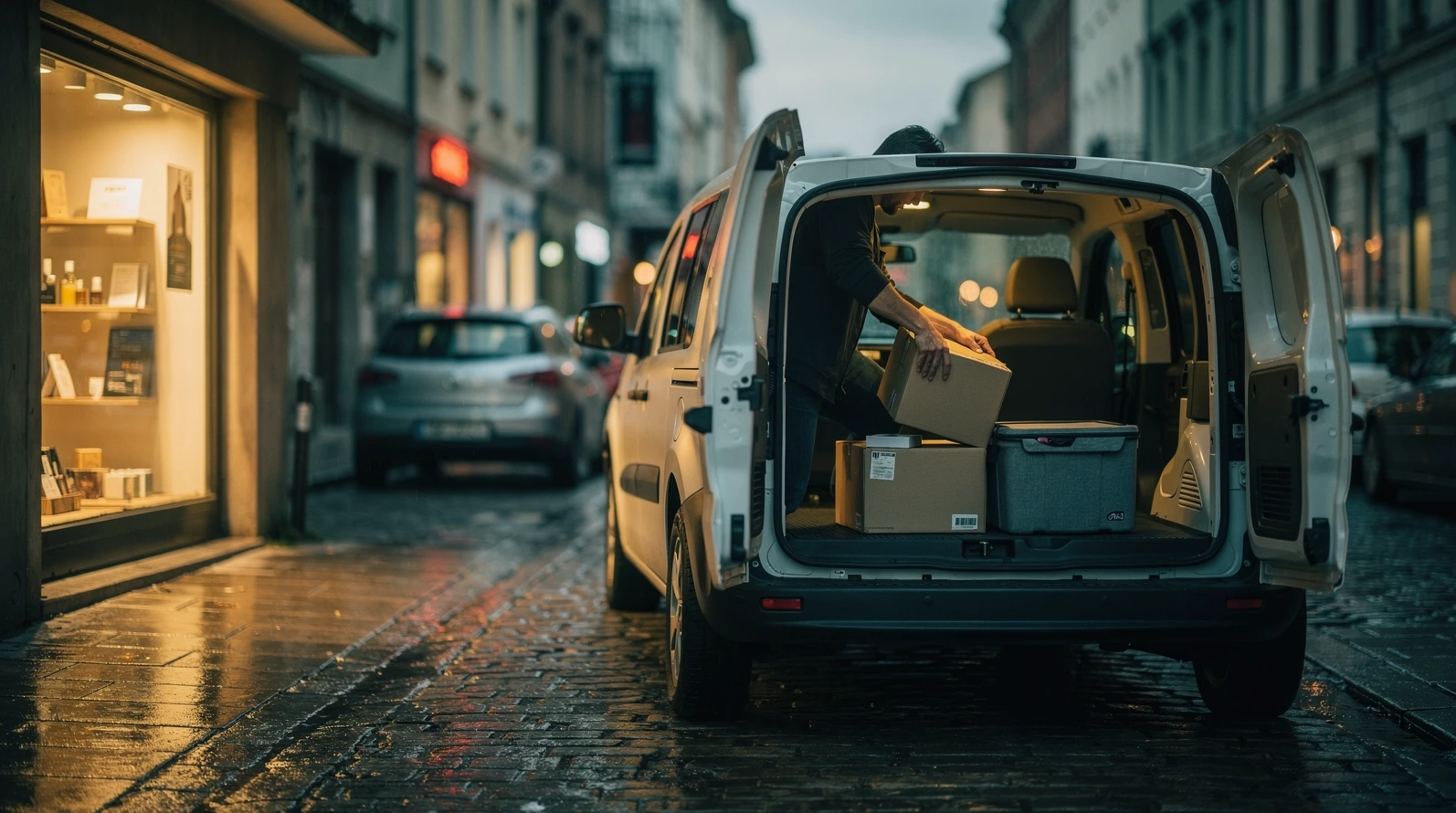
Local delivery has quietly become a default expectation rather than a premium service. Shoppers who order groceries in twenty minutes and household goods the same afternoon carry that expectation into every purchase, including the one they make at an independent shop three streets away. The awkward part for small retailers is that the expectation arrived without the economics to support it, and the options on the table (hiring a driver, plugging into a courier app, joining a shared city scheme) each move money out of a gross margin that was never designed to absorb a delivery cost.
In short
- Local delivery is now an expectation, not an upsell, and independent shops are being measured against same-day standards set by national retailers and grocery platforms.
- An own driver typically costs more per drop than owners assume, because the honest number includes wage, payroll burden, vehicle running cost, insurance and, critically, the idle time between drops.
- Courier app quotes are rarely the full price: commission structures, service fees, promotion co-funding and refund liability sit outside the headline delivery fee and often decide whether the order was profitable.
- Shared city and chamber-run schemes cut the cost per drop by pooling volume across shops, but they trade away control over timing, branding and the customer relationship.
- Zone design, minimum basket rules and fee tiers do more for delivery margin than negotiating a slightly better courier rate, because they change the mix of orders you accept in the first place.
Why customers now expect local delivery from small shops
The expectation did not come from independent retail. It came from the top of the market and worked downward. Once national chains normalised same-day fulfilment on ordinary items, the perceived difficulty of getting a product from a shop to a home collapsed in the customer’s mind. Distance stopped being the variable people thought about, and speed became the only one.
That shift matters more for small retailers than for large ones, because the independent shop’s structural advantage is proximity. A shop two miles from a customer is genuinely better placed to deliver in ninety minutes than a warehouse two states away. The problem is that the advantage is only real if the shop can turn it into an operating routine rather than an occasional favour done by whoever is not serving a customer.
There is also a demand-side reason worth taking seriously. The share of retail sales moving through digital channels has kept climbing across the last decade, a trend documented in the quarterly e-commerce figures published by the US Census Bureau. When a customer is already buying online out of habit, the deciding factor between a national platform and a local shop is often nothing more than whether the local shop offers a delivery option at all. Silence on delivery reads as a no.
What “local delivery” actually means to a customer
Retailers and customers frequently use the same words for different things. A shop owner hears “delivery” and thinks of the logistics: vehicle, route, driver, proof of receipt. A customer hears it and thinks about certainty: will it arrive today, will someone tell me when, and what happens if it does not.
Those three questions map to three operational commitments, and they are the ones customers judge. Arrival window, proactive notification and a clear failure path matter more to repeat purchase than whether the box arrived in ninety minutes or three hours. Shops that promise a window and hit it consistently outperform shops that promise speed and miss occasionally.
Where delivery fits alongside pickup
Click and collect remains the cheaper sibling and it is frequently the better first move. It removes the transport cost entirely, brings the customer into the store where basket-building happens, and requires no vehicle decision. Many independents find their healthiest mix is pickup as the default with delivery offered as a paid, clearly bounded alternative rather than a free universal promise. This is the same structural argument that runs through the future of local retail and main street commerce, where proximity only converts into advantage when it is packaged as a service the customer can actually select at checkout.
Own driver: the true hourly cost per drop
The in-house driver is the option owners tend to price optimistically, usually by dividing a wage by a hoped-for number of drops. The honest calculation has more lines in it, and the missing lines are where the margin goes.
Start with the loaded labour cost rather than the hourly wage. Payroll taxes, paid time off, and any benefits add a meaningful multiple on top of the base rate. The exact burden varies by state and by how the role is structured, but treating loaded cost as materially above the sticker wage is the safer planning assumption.
Then add the vehicle. If the shop owns or leases a van, the relevant figure is total running cost: fuel, maintenance, tyres, depreciation, commercial insurance and any parking or permit costs in the delivery area. If a personal vehicle is used and reimbursed per mile, the IRS publishes a standard business mileage rate that is revised annually and is widely used as a reimbursement benchmark; the current figure and the rules around it are on the IRS standard mileage rates page and should be checked there rather than assumed from a previous year.
The variable almost nobody models: idle time
Cost per drop is not wage divided by drops. It is total hourly cost divided by drops actually completed in that hour. A driver paid for a four-hour shift who completes six drops carries a very different unit cost to one who completes fourteen, and the difference is almost entirely route density.
Route density is the single largest lever on in-house delivery economics. Six orders spread across a fifteen-mile radius will consume the same shift as fourteen orders inside a three-mile radius. This is why zone design, covered further down, is not an administrative detail but the core cost control.
A worked cost-per-drop illustration
The table below is an illustrative model, not a benchmark. It uses a round loaded cost of $28 per hour for driver plus vehicle to show how sharply the unit cost moves with density. Substitute your own loaded figure before drawing conclusions.
| Drops completed per hour | Illustrative cost per drop | Typical route profile | Realistic for |
|---|---|---|---|
| 1.5 | $18.67 | Wide radius, unscheduled, one-by-one dispatch | Furniture, appliances, bulky single items |
| 3 | $9.33 | Batched by afternoon, moderate radius | Homeware, gifts, general retail |
| 5 | $5.60 | Tight zone, planned route, fixed window | Grocery, pharmacy, dense urban shops |
| 8 | $3.50 | Very dense, apartment-heavy, repeat addresses | City-centre food and convenience |
Two conclusions follow. First, an own driver is rarely the cheapest option at low volume, because the fixed shift cost is spread across too few orders. Second, it becomes the cheapest option surprisingly quickly once density arrives, which is why shops that grow into it tend to stay with it.
When the in-house driver is clearly right
There are three situations where owning the delivery is worth the cost even before the density argument works. High-value or fragile goods where a courier handoff creates real breakage or loss risk. Products requiring installation, assembly or a returns collection on the same visit. And any category where the delivery itself is part of the brand experience, which is common in specialist food, florists and premium homeware.
There is a staffing consideration too, and it is easy to underestimate. A driver is a shop employee out of the shop, which means the rota needs to survive their absence. The scheduling discipline described in the retail store operations playbook is a prerequisite rather than a nice-to-have once someone is regularly off the floor for three hours at a time.
Courier apps and the commission that hides in the quote
Third-party courier platforms solve the volume problem elegantly: you pay only when there is an order, and there is no shift to fill. The trade-off is that the price quoted is usually not the price paid, and the gap is structural rather than sneaky.
The first distinction to get straight is between marketplace and white-label delivery. In a marketplace arrangement, the platform lists your products, owns the customer, handles the transaction and takes a commission on the order value. In a white-label or “drive” arrangement, the customer orders through your own website or phone line, and you buy the courier leg only, usually at a flat or distance-based fee.
The line items that sit outside the headline fee
Merchants regularly compare a marketplace commission to a white-label delivery fee and conclude the fee is expensive. That comparison is not like-for-like. The full cost of a marketplace order typically includes several components beyond the commission percentage: payment processing, any promotion or discount the platform runs and expects the merchant to co-fund, refund liability when a customer disputes an order, and in some structures a customer-facing fee that suppresses conversion even though the merchant never sees it.
Commission structures also change. Platforms revise merchant terms, run tiered plans and adjust rates by market and category, so any specific percentage quoted in an article ages quickly. Treat published ranges as orientation and read the current merchant agreement for your market before modelling anything.
Comparing the delivery models side by side
| Model | Cost shape | Who owns the customer | Control over timing | Best fit |
|---|---|---|---|---|
| Own driver | Fixed shift cost, falls per drop with density | The shop | Full | Steady daily volume in a tight radius |
| Courier app, white label | Variable per delivery, distance-banded | The shop | Partial, subject to courier supply | Irregular or seasonal volume |
| Courier app, marketplace | Percentage of order value plus fees | The platform | Low | Customer acquisition, not margin |
| Shared city scheme | Subsidised or pooled per-drop rate | Shared, scheme-branded | Low, fixed schedule | Low-volume shops in a participating district |
| Standard parcel carrier | Per-parcel rate by weight and zone | The shop | Next-day at best | Non-urgent, shippable goods |
Reading a courier quote properly
Before signing, four questions decide whether the arrangement works. What is the fee at the longest distance you intend to serve, not the shortest. Who absorbs the cost of a failed delivery where the customer is absent. What is the refund policy when an item arrives damaged, and does the merchant carry that liability. And is there a minimum monthly commitment or a rate that changes above or below a volume threshold.
The last one catches small shops most often. A rate card built for a merchant doing four hundred deliveries a month may look attractive and then reprice unfavourably at forty. Ask for the rate at your actual expected volume.
Shared city and chamber-run delivery schemes
A growing number of business improvement districts, chambers of commerce and municipal economic development offices operate or subsidise shared delivery for local independents. The structure varies widely, but the logic is always the same: no single small shop generates enough orders to make a route dense, while thirty shops in one district collectively do.
These schemes typically run on a fixed collection schedule. A vehicle circuits the participating shops at set times, collects outbound orders, and runs a consolidated route. The per-drop cost can be dramatically lower than any individual shop could achieve, and in subsidised schemes it can be lower than the true cost of the service.
What you give up
Control over timing is the first casualty. If collection is at 2pm and 5pm, an order placed at 2.15pm is not going out until the evening run, regardless of how urgent the customer considers it. That is workable for planned purchases and poor for impulse or replacement buying.
Branding is the second. The van, the bag and often the notification carry the scheme’s identity rather than the shop’s. For retailers where the delivery moment is part of the product experience, that is a real cost. For most general retail it is an acceptable trade.
The third is durability. Subsidised schemes depend on funding cycles, and a scheme that is free this year may be priced at cost next year or discontinued. Building a delivery promise on top of one without a fallback plan is a risk worth naming out loud.
How to evaluate a scheme before joining
Ask what the collection windows are and whether they can flex in peak weeks. Ask how many shops currently participate, because density is the entire value proposition and a scheme with six members has none. Ask what happens to a failed delivery, and who the customer contacts. And ask what the pricing looks like if the subsidy ends.
Shops already coordinating with neighbours through a district association or a joint online storefront usually find the scheme easier to join and easier to influence. That coordination overlap is one reason the collective structures discussed in local marketplaces and how they compete with national platforms and the shared-logistics arrangements used by farmers market vendors selling online tend to appear in the same districts.
Delivery zones, minimum baskets and fee design
If there is one section to act on, it is this one. Zone and fee design determine which orders you receive, and the mix of orders determines whether delivery makes money. Most independents who lose money on delivery do so because they accepted orders they should have priced out or declined, not because their courier rate was poor.
Draw zones by drive time, not by radius
A circle on a map is the wrong shape. Real driving cost follows road networks, one-way systems, bridges, traffic patterns and parking availability. An address a mile away across a river can cost triple an address two miles away on a straight road.
The practical method is to define zones by realistic drive time in your actual delivery window, then price each zone differently. Zone one at ten minutes, zone two at twenty, zone three at thirty with a higher fee and possibly a longer promised window. Anything beyond that is either declined or quoted individually.
Set the minimum basket from contribution, not revenue
A minimum order value should be derived from gross margin, not from the order total. If your blended gross margin is 40 percent and your cost per drop is $6, an order needs roughly $15 of gross margin before delivery to break even on the transport alone, which implies a basket around $37.50 before you have covered any packing labour. Setting the minimum at $25 because it sounds reasonable guarantees losses on every order that lands near it.
Fee tiers that steer behaviour
A single flat delivery fee is the least effective design because it does nothing to influence order size. Tiered fees do. The table below shows a structure that recovers cost at the bottom and rewards larger baskets at the top.
| Basket value | Delivery fee | What it is doing |
|---|---|---|
| Below minimum | Not offered, pickup only | Removes structurally unprofitable orders |
| Minimum to 1.5x minimum | Full cost recovery fee | Delivery pays for itself, no subsidy |
| 1.5x to 2.5x minimum | Reduced fee | Creates a visible reason to add items |
| Above 2.5x minimum | Free | Margin covers transport comfortably |
| Outer zone, any value | Cost recovery fee always | Long routes never become free |
The free-delivery threshold in the top row is the most powerful number in the whole structure, and it is worth revisiting seasonally rather than setting once. National retailers move theirs deliberately ahead of peak trading, a pattern examined in the analysis of free-shipping thresholds and Black Friday, and the same logic applies at neighbourhood scale.
Make the offer visible where customers actually look
A delivery service nobody knows about generates no orders. The two highest-yield placements are the checkout page and the shop’s local search listing. Delivery attributes, service areas and hours are structured fields in a business profile rather than free text, and the fields that carry weight are covered in the walkthrough of Google Business Profile fields that matter for retailers.
Packaging, temperature and the categories that complicate it
Transport cost is only half the delivery expense. Packaging, handling and the risk of damage vary enormously by category, and some categories carry requirements that change the vehicle decision entirely.
Chilled and frozen goods are the clearest example. Maintaining safe temperature across a multi-drop route requires either insulated packaging with coolant sufficient for the full route duration, or a refrigerated vehicle. Businesses handling food should work from the food safety guidance published by their state or local health authority, since temperature control requirements for transport are enforced locally and vary by jurisdiction and by product type.
Category difficulty at a glance
| Category | Main complication | Practical implication |
|---|---|---|
| Chilled and frozen food | Temperature control across the route | Insulated packaging or refrigerated vehicle, shorter routes |
| Fresh flowers and plants | Water, stability and heat sensitivity | Upright securing, limited route length in summer |
| Glassware and ceramics | Breakage in transit and at the door | Higher packaging spend, own driver often preferred |
| Furniture and bulky goods | Vehicle size and two-person handling | Scheduled slots, separate fee structure |
| Alcohol | Age verification at handover | Courier must support ID check, licence conditions apply |
| Pharmacy and supplements | Handover rules and record keeping | Category-specific compliance, check with the regulator |
| Apparel and general goods | Returns rate | Reverse logistics plan needed from day one |
Returns are the forgotten half of the cost
Any category with a meaningful return rate needs a collection plan before delivery launches, not after. The choices are collection on the next delivery run, return to store by the customer, or a prepaid carrier label. Return to store is cheapest and has the useful side effect of bringing the customer back through the door, which is often where the replacement sale happens.
Packaging cost is a per-order line, so treat it like one
Insulated liners, coolant packs, protective wrap and tamper seals are consumables with a per-order cost that belongs in the delivery model alongside transport. Shops that track packaging separately from transport frequently discover that a chilled order costs more in packaging than in driving, which changes the minimum basket calculation for that category specifically.
Measuring whether delivery is adding profit or volume only
The most common failure in independent retail delivery is not operational. It is measurement. Delivery orders get counted in the revenue line and their cost gets absorbed into general wages and vehicle expenses, so the channel looks like growth while quietly running at a loss.
The four numbers that settle the question
Contribution per delivered order, calculated as gross margin on the order minus the delivery fee revenue offset, minus transport cost, minus packaging cost, minus the packing labour. If this is negative on your median order, the fee structure is wrong.
Incrementality, meaning what share of delivery orders would have happened anyway as a store visit or a pickup. A delivery order that cannibalises a walk-in adds cost and no revenue. Asking new delivery customers whether they have shopped in store before is a crude but workable proxy.
Repeat rate among delivery customers compared to the store baseline. Delivery justifies a thinner per-order contribution if it produces a materially higher purchase frequency, and that is a measurable claim rather than an assumption.
Route density trend, tracked weekly as drops per driver hour or drops per route. This is the leading indicator. Density rising means unit cost is falling and the model is heading toward viability; density flat while order count rises means the delivery area is spreading and cost per drop will not improve.
Review on a seasonal cycle, not a monthly one
Delivery economics move with the trading calendar. A route that is comfortably dense in December can be uneconomic in February, and a summer heat wave changes packaging cost overnight for anything chilled. Reviewing the zone map, the minimum basket and the fee tiers at each season change keeps the structure aligned with actual demand. The seasonal planning discipline in the account of a garden center that built a year-round revenue calendar transfers directly, because the same demand peaks that justify staffing also justify a temporarily wider delivery zone.
When to stop
Discontinuing delivery is a legitimate outcome and not a failure. If contribution per order is negative after two full seasonal cycles of fee and zone adjustment, if density has not improved, and if the repeat rate among delivery customers matches the store baseline, the channel is a cost with no strategic return. Converting it into a strong pickup proposition with a reliable ready-in-one-hour promise usually recovers most of the convenience benefit at a fraction of the cost.
Compliance, insurance and the paperwork behind a delivery service
Running deliveries introduces obligations that shop-floor retail does not have, and they differ substantially by state, by city and by product category. The purpose of this section is to name the areas worth checking rather than to give an answer for any particular business.
Insurance is the most frequently missed. A personal auto policy generally does not cover commercial use, and a business that has a staff member driving their own car for deliveries typically needs to look at non-owned auto liability coverage. This is a question for an insurance broker before the first delivery, not after an incident.
Worker classification is the second. Whether a delivery driver is an employee or an independent contractor is determined by legal tests that have been revised repeatedly, and the applicable standard depends on federal rules and on state law, which in some states is stricter than the federal position. The US Department of Labor Wage and Hour Division publishes the current federal guidance, and state labour departments publish their own. Both need checking, because the state test can apply where the federal one would not.
Category rules form the third group. Alcohol delivery is licensed and age-verified with conditions set by the state alcohol authority. Pharmacy and certain supplements carry handover and record-keeping requirements. Food transport is subject to health department rules on temperature and handling. Vehicle weight thresholds can bring commercial motor vehicle requirements into play, which the Federal Motor Carrier Safety Administration defines for interstate operation while states set their own intrastate rules.
To be explicit about what this article is: it is general information for retailers thinking through the operating economics of local delivery, and it is not legal, tax, insurance or regulatory advice. Rules and rates change, sometimes mid-year, and they vary by jurisdiction and by product category. Before launching a delivery service, the sensible step is to confirm your specific position with a licensed insurance broker, an employment attorney or advisor familiar with your state’s rules, and your accountant, and to verify any figure in this article against the official source that publishes it.
None of this is a reason to avoid delivery. It is a reason to spend an hour on the paperwork before spending months on the operation, and it is the same due diligence any new service line deserves. Shops that treat delivery as a proper channel rather than an informal favour tend to get both the compliance and the economics right, and that discipline is a recurring theme in how local retail and main street commerce businesses are adapting to a same-day world.
FAQ on local delivery
Should a small shop start with its own driver or a courier app?
In most cases a courier app or a shared scheme is the better starting point, because it converts a fixed cost into a variable one while order volume is still unproven. The own-driver model becomes competitive once route density is reliably above roughly three to four drops per hour, and the honest way to find that out is to run the variable option first and measure the pattern of orders.
What is a realistic delivery radius for an independent retailer?
Define it by drive time rather than distance. A ten to fifteen minute drive from the shop is a workable core zone in most towns, extending to twenty or twenty-five minutes as a second, higher-priced tier. Dense urban areas support tighter zones with more orders inside them, while rural shops usually need a wider radius and a higher fee to match.
Should delivery be free above a certain order value?
A free-delivery threshold is a useful tool, provided the threshold is set from gross margin rather than revenue. The order needs to carry enough margin to absorb transport, packaging and packing labour with something left over. Setting the threshold too low is the most common way independents turn a growing delivery channel into a shrinking profit line.
How do I work out my real cost per delivery?
Take the total cost of running the delivery for a period (driver loaded wage, vehicle running cost, insurance, packaging consumables, packing labour) and divide by the number of orders actually delivered in that period. Do not use a per-order estimate built from wage alone, because it omits idle time, which is usually the largest single component at low volume.
Is a marketplace courier app worth it if the commission is high?
It depends on what you are buying. If you are buying customer acquisition and you can measure how many of those customers return through your own channels, a high commission on a first order can be defensible. If you are buying fulfilment for customers who already know you, a white-label delivery arrangement where you keep the customer relationship is usually the better structure.
Can I offer same-day delivery without hiring anyone?
Yes, and this is the main reason on-demand courier platforms exist. The trade-offs are cost per drop, which is higher than a dense own-driver route, and courier availability at peak times, which you do not control. A common hybrid is a scheduled own-driver run for planned orders with an on-demand courier used as overflow for urgent ones.
What should I do when a delivery fails because the customer is not home?
Decide the policy in advance and publish it. The usual options are a safe-place drop with photo proof, a neighbour handover, a return to store for collection, or a second attempt at a stated fee. Whichever you pick, the important part is that the customer knows it before ordering, because failed deliveries generate disputes mainly when the outcome was unexpected.
How does local delivery affect my search visibility?
Delivery service areas, hours and attributes are structured fields in local business listings rather than something search engines infer from your website copy. Filling them accurately makes the shop eligible to appear for delivery-qualified local queries. It is a configuration task rather than a content one, and it is usually the fastest available improvement.
Do I need special insurance to deliver from my shop?
Very likely yes, and it should be confirmed before the first delivery. Personal auto policies generally exclude commercial use, and businesses whose staff drive their own vehicles for work often need non-owned auto liability cover. Requirements vary by state and by what you carry, so this is a conversation for a licensed insurance broker rather than a decision to make from a checklist.